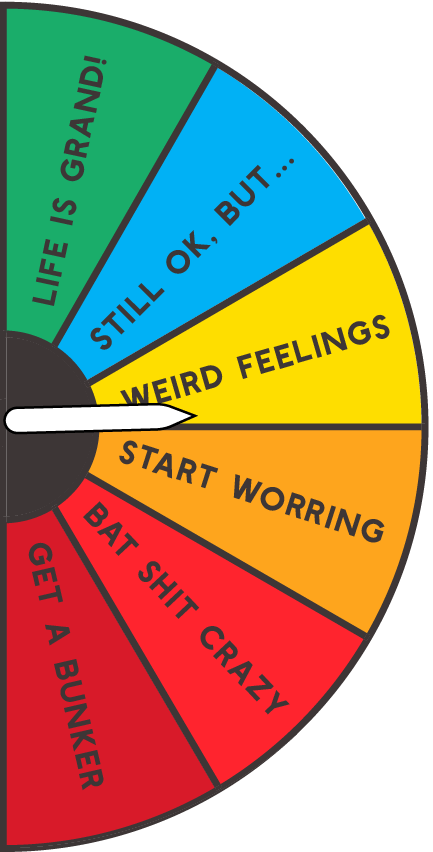
Volcanoes are erupting in The Philippines, but on-fire Australia received some welcome rain. The Iran war cries have been called off and The Donald’s military powers are about to be hamstrung by the Senate. Meanwhile, his impeachment trial is starting, and we’re all on Twitter for a front-row seat.

AI Was Supposed to Destroy Jobs. Here’s What Actually Happened.
Featuring Emma Varvaloucas
There’s been a lot of doom and gloom around artificial intelligence taking our jobs. Even founders of AI companies like Sam Altman have said that many jobs will go poof and disappear. But is the AI job apocalypse all hype, or are we just in the calm before the storm? We dive in. We also discuss adorable dogs gene-edited to be hypoallergenic, and two women in New Zealand who paved the way for women’s rights.


Prefer to read? Check out the Audio Transcript
Although the transcription is largely accurate, in some cases it may be incomplete or inaccurate due to inaudible passages or transcription software errors.
Emma Varvaloucas: Is the AI job apocalypse all hype, or are we just in the calm before the storm? That’s our main story on today’s episode of the What Could Go Right? Progress Report. And stick around, because we’re also talking about gene-edited dogs and two women in New Zealand who paved the way for women’s rights. If you’re new here, hey, I’m Emma Varvaloucas, and I’m the executive director of The Progress Network.
Let’s get into it. We’re going to imagine the future. Close your eyes and visualize your neighborhood in 30 years. Are you giggling in a flying Jetsons car as you land on your driveway? Is an AI robot butler that looks like Ryan Gosling opening your front door and bringing you nutritionally enhanced lemonade?
Or maybe your vision of the future is darker. Maybe all the public anxiety around AI is even giving you flashes of a dystopian, jobless, Mad Max landscape for the common man while the 1% control the AI that makes the world run. Okay, maybe less Mad Max, more Jodie Foster in Elysium. Great villain, incredible pantsuit.
Well, stop daydreaming and snap out of it. I have some good news. Jodie Foster isn’t coming to your HR office, and AI isn’t taking our jobs, for the most part, and at least not yet. Hear me out. It’s true there’s been a lot of doom and gloom around AI and jobs, even from some of the founders of AI companies.
About three years ago, Sam Altman, the founder of OpenAI, they make ChatGPT, said that an AI revolution could Thanos-disappear half of our jobs. He said it was a good thing and called it, quote, “the way of progress.” He’s charming, like a root canal. Then last year, Dario Amodei, the CEO of a different AI company called Anthropic, said that AI could send the unemployment rate up between 10 and 20% by 2030.
But it doesn’t look like any of that is happening anytime soon. Even sweet-talking Sam walked it back a little bit. He said last month that the AI transformation he predicted was happening slower than expected. The good news is he’s right. This time. Unemployment is not skyrocketing us into the end of times.
One thing to know about me is that I love a government report. To me, a government report reads like Fifty Shades of Grey, just with better vocabulary. And if you also love some jargon with a statistical summary, you’ve probably heard by now that the latest report from the Labor Department had some surprisingly good stuff in it.
Not the dungeon-y kind. In August, the US added 162,000 jobs, way above expectations, and the unemployment rate, at 4.1%, was lower than 90% of the months in the past 50 years. So why doesn’t AI have us struggling and naked in the street yet? Actually, I don’t know why we’re naked. I think I’m just stuck on the Fifty Shades of Grey reference.
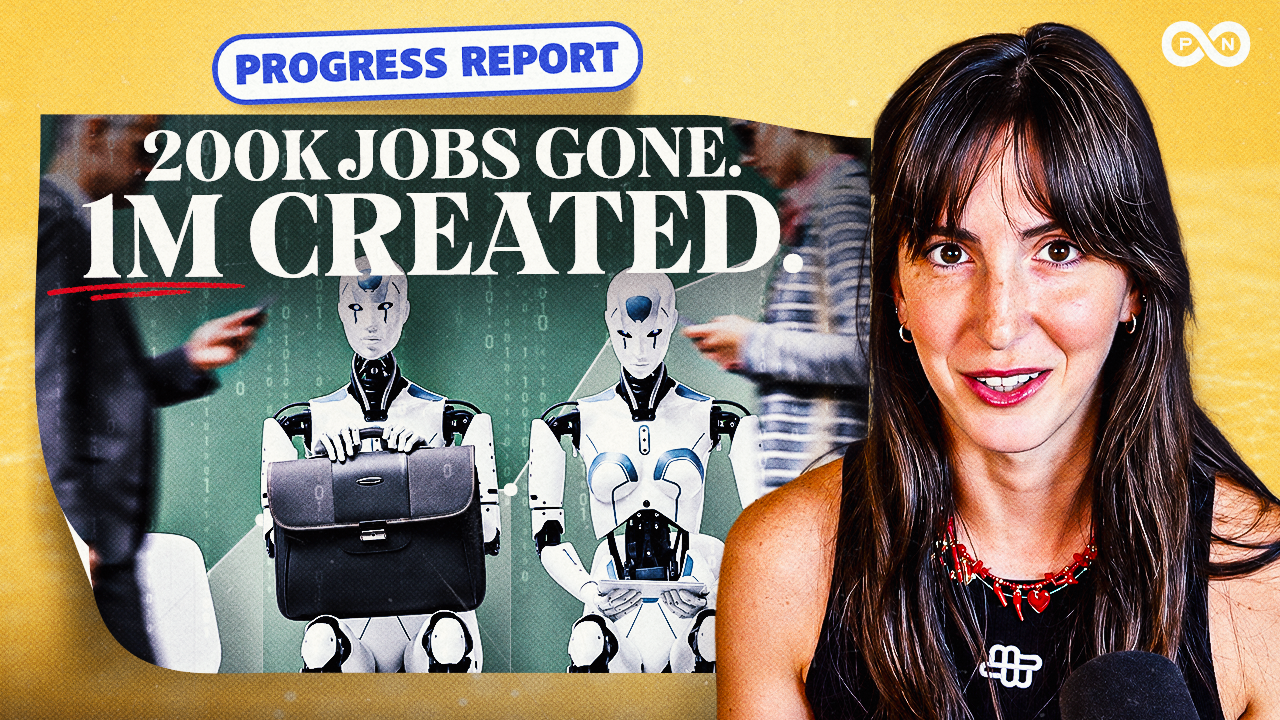
There are a few reasons, and it depends what industry you’re in. Although The Economist estimates that AI has caused 200,000 layoffs since mid-2023, it’s also responsible for the creation of one million new jobs. That’s probably surprising to a lot of people, but what kind of jobs is AI offering? Some of them are the obvious office jobs you’d expect.
A friend here in Greece, for instance, is the chief financial officer at an AI-based startup. Another went to his bosses and pitched a completely new role for himself as head of AI, and got it. Both companies are based in Europe, but the wider trend applies in the US as well. It’s possible that AI is even continuing to fuel an American startup boom that began during the pandemic.
More than three million new business applications were filed in the first six months of 2026, the most for a January to June period since data started being collected in 2005. It’s time to dust off that idea you had about typing classes for cats. It’s genius. Don’t let your mom tell you otherwise. And AI’s not just creating desk jobs.
Data center construction is going at an annual rate of $75 billion, almost 60% higher than last year. That construction needs all kinds of tradespeople, like HVAC technicians, electricians, grid workers, and installers. Your uncle who loves to discuss the intricacies of central air conditioning at Thanksgiving could be pulling in some serious cash right now.
These centers are one of the reasons why young Americans without college degrees are currently seeing one of their lowest unemployment rates in decades. However, it’s also important to mention that Americans do not want data centers in their neighborhoods. Who said Americans can’t agree on anything? In a poll released last week, 69% said that they oppose a data center being built in their local area.
Although supporters are down for the jobs, critics are worried about the data center’s need for resources like electricity, water, and land. The ongoing debate is making data centers a hot political issue for the upcoming local and national elections, so we will see if the job creation related to the data centers continues.
Stay tuned. Anyway, another reason why we’ve avoided an AI job takeover hellscape is that economists were wrong about the jobs that were supposed to go extinct by now. 10 years ago, experts were saying that radiologists would become obsolete because of AI. Not only was that wrong, radiologists are making it rain out of their bigger-than-ever paychecks right now.
Translators were all supposed to have their jobs taken too, but their numbers are actually stable. How could that be? Well, there’s essentially no ceiling on their work. Think about all the things that can be translated into all different languages, and human translators still need to check AI translations for accuracy.
My aunt happens to be a translator, and she is overwhelmed with work. She can also complain about her lazy coworker, Carol, in four different languages. So If there’s all this positive employment news, why does it feel like looking for a job is a soul-crushing experience for many people right now? It seems like everyone has at least one friend who’s applied to, like, 100 different jobs this year and has nothing to show for it.
Well, the job news isn’t great for everyone in every group. Young people with a degree are having a tragically hard time right now. The unemployment rates for workers age 22 through 34 have only been worse in the pandemic and the brutal 2008 financial crisis. And an analysis of US workers through the first half of the year by Erik Brynjolfsson, a member of the Progress Network, yes, the same people who bring you this podcast every week, show that employment for recent college graduates in occupations where AI is automating tasks was down 19% compared to people their age in occupations less exposed to AI.
Plus, in certain fields like tech, customer service, and office administration, there’s been a bloodbath. Cuts have caused candidate pools to become flooded with thousands of workers in the same fields. By the way, the bloodbath has been especially bloody at tech companies like Amazon and Meta, who have been responsible for thousands of layoffs while going full throttle on the AI transition.
So that’s why the job search still feels weird and terrible for some people, even though overall things are pretty solid and the AI robots haven’t taken over your office chair yet. Pro tip if you are on the search, fields like healthcare and green energy are growing fast. So are we just delaying the AI jobs apocalypse, or are we in the clear?
It’s hard to say, but it could be helpful to look to the past for some hope. More than six million Americans have computer-related jobs that didn’t exist a few decades ago. We don’t know what new jobs could arise out of the AI age, so let’s hold out hope for a future with a Ryan Gosling butler and the flying cars.
Next, here are some numbers that’ll make you smile. Two, the seconds needed for a new AI tool to spot heart disease. It works by extracting more information from an ECG than a human eye can see. 33%, the share of Delhi Metro system’s power usage that is met by solar. And 198.5, the percentage increase in the global health workforce since 1990.
And now, here’s some extremely adorable good news that may make you ask some big philosophical questions. Okay, so you’re a dog person. I don’t actually care if you prefer cats. For the sake of my example today, you’re a dog person. You love them so much, you wanna get a cute new best friend, but- There’s just one problem.
You’re allergic to dogs. Like super allergic. It’s bad. You will sneeze all day every day if their fur is near you. However, there’s a new state-of-the-art pet store down the street that will breed a brand new puppy for you that won’t make you sniffle. All you have to do is agree to let them genetically engineer your new puppy before it’s even born.
You’ll be rolling around with your new pooch getting licks in the face in no time. This hypothetical scenario is fast approaching reality. Last month, biotech startup Kindred Companion Sciences announced that it created the first gene-edited hypoallergenic dogs who happen to be two incredibly cute beagles.
How did they do it? They used a gene editing technique called CRISPR. It’s short for Clustered Regularly Interspaced Short Palindromic Repeats. Super catchy name. It’s a technology that can change the DNA of living organisms. It was developed from naturally occurring genome editing systems in bacteria, and it’s behind a lot of very cool medical advances today from curing rare diseases to gene-inherited blindness and deafness.
But today we’re talking man’s best friend. So the beagles were edited with CRISPR so that they’re unable to produce a protein that triggers allergies in some people. Basically, they edited the dog genome, dropped it into two embryos, and implanted those into a surrogate beagle mom. She gave birth to Alfie and Bailey who are now nearly two years old.
The company says it has not detected any allergens in either dog so far. But will Alfie and Bailey be okay? Critics worry there could be long-term effects to the dogs’ health and wonder if it’s ethical to engineer designer dogs when there are so many dogs who need rescuing from shelters. That being said, it’s worth asking if someone who’s deeply allergic to dogs would be able to adopt one from a shelter anyway.
So far, the startup reports that the dogs are perfectly healthy. And now a positive look back at the past. For this week in history, we bring you a marvel of measurement, a paramount piece of paper, a doozy of a document. It’s the story of the history-making monster of a petition that changed rights for women in New Zealand forever.
On September 19th, 1893, women in New Zealand won the right to vote, which made New Zealand the first self-governing country in the world to give all adult women the right to vote in national elections. But that’s not where the story starts. Decades before the Electoral Act was signed, two important figures in New Zealand’s suffrage’s history said, “Enough.”
is enough. English immigrants Mary Ann Mueller and Kate Sheppard decided separately that they were done with being second-class citizens, and it was time to do something about it. Let’s start with Mary. She was kind of like Whistledown on Bridgerton if Whistledown were writing about women’s rights instead of the ton’s latest scandals.
She did start with a scandal of her own, however. After leaving her first husband in England, who, by the way, might have been suspiciously found dead, although that’s unconfirmed, Mary came to New Zealand and found another man to marry. This one was still alive, but he was also a, quote, “prejudiced politician,” her words, who didn’t think women should get involved with politics.
So Mary secretly picked up her pen and got to writing about women’s rights. She used a pseudonym, Femina, and wrote a pamphlet called An Appeal to the Men of New Zealand that came out in 1869. She actually kept her pen name a secret for decades until after her husband died, and that’s all I’m gonna say about that.
Sexist husband aside, her appeal was foundational to the women’s rights movement in the country. It was the first pamphlet about women’s voting rights to be published in New Zealand, and it had some choice lines in there. Mary wrote, quote, “Why, when the broad road of progress is cleared for so many human beings, is the Juggernaut car of prejudice still to be driven on, crushing the crowds of helpless women beneath its wheels?”
Mary had bars, and her words helped stir up support for women’s rights and increased momentum. Around the same time that Mary was anonymously writing, Kate Sheppard was loudly promoting three things: women bicyclists, her belief that women should be involved in politics, and her desire to abolish corsets.
If you’ve ever tried to squeeze into shapewear for a night out, you get it. She started organizing with other women. In 1891, Sheppard and her team of suffragists were leading petition campaigns asking for women to have the right to vote, and by 1893, an election year They decided it was time to apply pressure to the haters like never before.
They collected more than 30,000 signatures and created the petition to end all petitions. This thing was 270 meters long. That’s two and a half American football fields. The 30,000 signatures were nearly one-third of the country’s entire population of women over 21 years old at the time. They wrapped that petition around a broom handle.
It was presented to Parliament, and the council duked it out. A turning point came when the anti-suffragist Premier Richard Seddon got super annoying and pushy. He did not want these ladies to get the right to vote, and he was being so overbearing and manipulative about it that two council members who had always opposed women’s suffrage couldn’t take it anymore and changed sides just to teach him a lesson.
One more thing I won’t say anything more about. On September 19th, the ladies and their allies got that baby passed. Over the next 10 weeks, Shepherd and her team worked tirelessly to get women registered to vote, and about 65% of eligible women in New Zealand voted in the 1893 election. It’s worth noting that American women didn’t get the right to vote until the 19th Amendment was ratified in 1920, and even then, non-white women were often blocked from voting.
New Zealand’s Electoral Act gave all women in New Zealand the right to vote, including Maori women, influencing suffrage campaigns around the globe. I hope these stories remind you that there’s so much good in the world, so it’s important to shift our focus away sometimes from all of the bad. Send this episode to your friend who is so bummed that they have to wait a whole month for that nuts Elizabeth Holmes documentary to come out.
Make sure to subscribe to our YouTube channel. We release 60-second good news stories every day. See you next week.
.
LOAD MORE
Meet the Hosts

Emma Varvaloucas