
Volcanoes are erupting in The Philippines, but on-fire Australia received some welcome rain. The Iran war cries have been called off and The Donald’s military powers are about to be hamstrung by the Senate. Meanwhile, his impeachment trial is starting, and we’re all on Twitter for a front-row seat.

What Could Go Right? The Underpopulation Bomb
Underpopulation requires levelheaded thinking, just as overpopulation once did.

Emma Varvaloucas
This is our weekly newsletter, What Could Go Right? Sign up here to receive it in your inbox every Thursday at 5am ET. You can read past issues here.
The Underpopulation Bomb

With the passing of academic Paul Ehrlich on March 13 has come what might be called obituaries of the “good riddance” genre, not in regards to the man himself but to his doomsaying.
Ehrlich, who wrote the 1968 bestseller The Population Bomb, is most famous for his prediction that the world would break under the weight of its growing number of inhabitants. Perhaps his most well-known prophecy of catastrophe was that hundreds of millions would starve to death in the ’70s and ’80s, but some of his others were no less extreme: He thought, for instance, that social and environmental turmoil would lead to the dissolution of England by 2000.
For many in the progress movement, his work is a kind of exemplum of what happens when you bet against humanity’s capacity to solve problems. Rather than mass famine, agricultural advancements during the Green Revolution led to super-high-yield harvests. Today, famines are predominantly considered man-made, in that they have less to do with food production and more to do with conditions created by war and conflict.
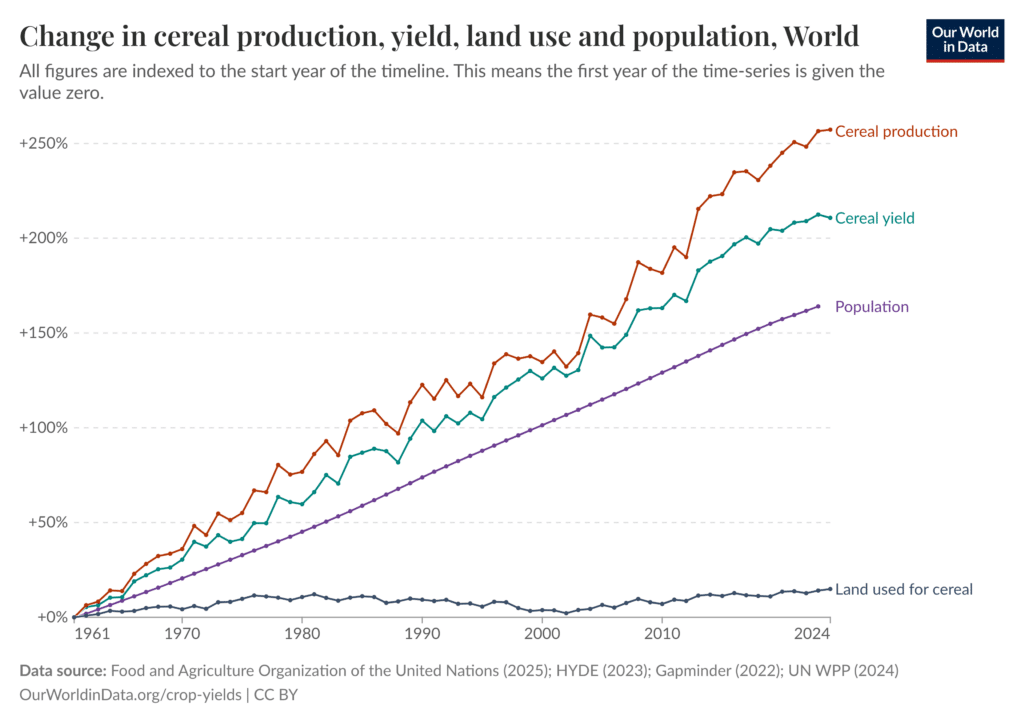
Ehrlich’s work laid the foundation for the environmental movement, so it makes sense that, on the left, overpopulation fears have lived on to this day as climate change concerns, albeit tempered somewhat from 10 years ago, when warming figures seemed apocalyptic.
On the right, they’ve been, as Progress Network member Gregg Easterbrook wrote recently, “transmuted” into worries about underpopulation. Elon Musk, baby daddy of 14 children, speaks about population collapse resulting from declining fertility rates as a civilizational threat. Meanwhile, pronatalism is growing as a movement, including within progress circles, which are saturated by economists. (The central concern is that after the global population peaks sometime this century, fewer people will equal less economic growth, historically the key lever behind all sorts of global quality-of-life upgrades, from literacy to sanitation.)
The Trump administration has taken up the pronatalism banner, soliciting a variety of ideas—from a “motherhood medal” awarded to moms with more than six children to a $5,000 baby bonus—with the hopes of producing another boom. Making it easier to have a family also appeals to many on the left, who see space under the pronatalism umbrella for big-government ideas to thrive.
The Parable of Ehrlich is usually told as a cautionary tale against dire predictions driving policy, especially when governments enter the treacherous business of personal decision-making. The Population Bomb did contribute to a worldwide obsession with curbing population growth. Some of Ehrlich’s proposals were broadly fine, like increasing access to contraceptives. But others were inhumane. He infamously described sending emergency food aid to India during a famine in the late 1960s as “hopeless,” and many connect his work to mass forced sterilization campaigns instituted by governments from China to Mexico.
Now that underpopulation rules the day, we would do well not to mimic these mistakes and policies, which are at best wasteful—other countries’ experiences show that cash bonuses, for instance, do little in the long-term, as much as I’m sure parents would love one—and at worst evoke The Handmaid’s Tale. We should be particularly cautious when the project of having more babies is married to a 1950s-nostalgia of women barefoot and pregnant in the home.
There is a second layer to the Ehrlich story, however. As Stephen Heins writes, “The Green Revolution did not appear out of nowhere. Its roots lay in decades of agricultural research, especially in the United States,” a hefty portion of it government-led and funded. Governments can do a lot of good when the right levers are pulled. So when it comes to pronatalism, what’s a well-meaning one to do? It’s not just the Americans asking.
For one, we should at least consider the possibility, as Easterbrook points out, that people simply don’t want a lot of kids anymore. Minds could change in the future, but we may need to start accepting that fewer kids will remain the norm, bonus checks be damned.
Such a future need not be catastrophic. There are upsides to a world that has arrived naturally at a smaller population—lower energy demand, for one, which will make climate change easier to handle. We’ll “age out” of crime, as I wrote about a few weeks ago. The portion of the world’s women who are formally employed, currently less than half, might rise substantially, cushioning families in the developing world against poverty. Who knows, in a few decades, journalists may be writing articles about how the “grandparent boom” is easing the childcare burden.
Other concerns could be mitigated, too. A shrinking workforce in the developed world could be filled in the mid-term with immigration and the long-term with AI and robotics, something we’re scared of today that may turn out to be a lifeline later on. Medical advances will likely mean that our lifetimes, and the number of healthy years in them, will be extended; we’ll work longer, but with more flexibility. Scientific breakthroughs in the fertility field could be impactful as well.
For now, we can at least focus on the practical over the hyperbolic. An interesting new paper out of Arizona State University suggests that one thing the Trump administration could do to encourage young people to have kids is dial down the volatility. Its authors find that across 140+ countries, those confident about their nation’s future are more likely to procreate, regardless of whether or not on-the-ground economic conditions have actually improved. In other words, if families feel that they can bet on the future, they will. To boost this sense of security, the authors suggest governments go back to basics: job security programs, social insurance, and affordable housing.
—Emma Varvaloucas
By the Numbers
2.3M: Barrels of oil per day that weren’t used last year, as a result of global EV adoption
93%: Youth literacy rate in South Asia in 2023, up from 53% in 1985
75%: Decline in cats killed in US shelters from a decade ago
64%: Year-over-year rise in Mexico’s monarch butterfly population
Go Figure
Founded in 1843, The Economist has long been known for a clear-eyed take on pretty much everything. But it was still somewhat jarring—albeit greatly encouraging—when we came across this well-reasoned call for more research into sex. The arguments for better carnal data are many, but not least is the reality that if governments have any hope of creating effective fertility policy they ought to know as much as possible about the underlying operating system.
Quick Hits
🏠 The national leader in affordable starter home construction? Potentially Portland, Oregon, where redone zoning codes have led to a building boom.
🌎 Chile is creating the world’s third-largest fully protected marine area with the addition of 360,000 square km of water surrounding a chain of remote islands. Half of the country’s exclusive economic zone is now protected.
🛩️ A Scottish airline is the first commercial airline to fly an all-electric aircraft on one of its routes, a short hop from Glasgow to Dundee.
🌲 Brazil has unveiled a climate plan that pledges to reach zero deforestation by 2030 and cut emissions 59%–67% compared to 2005 levels. Half of Brazil’s greenhouse gases come from tree clearing.
🧠 China has approved the world’s first brain implant outside of clinical trials, a chip that allows paralyzed people to control a robotic hand.
📉 The adult cigarette-smoking rate has fallen to single digits for the first time in the US, a sign that the practice could be considered “rare” in the country.
🤮 Scientists have found a clue to what causes hyperemesis gravidarum: a hormone produced by the fetus that some women are hyper-sensitive to.The condition causes severe vomiting that can lead to hospitalization and life-threatening complications.
🐷 The first lab-grown esophagi have been successfully implanted in pigs. Because the method uses stem cells from the animals themselves, immunosuppressants aren’t needed, making it a potential alternative for babies born without a working throat and cancer patients.
💊 A new drug for sleeping sickness may finally wipe out the disease. Unlike previous treatments, it’s single-dose and has no serious side effects.
🚫 The EU has reached an agreement to ban animal testing for detergents and other everyday cleaning products, effective mid-2029.
☀️ The rapid transition to renewables has cushioned some countries against the energy shocks caused by the war in Iran. China, Nepal, and Pakistan are among those benefiting from the energy-independence lesson Europe learned after the invasion of Ukraine.
🦦 Otters, once scarce, have returned across the Great Lakes basin. Threats remain, but the recovery has been remarkable.
👀 What we’re watching: In Ukraine, the Supreme Court has ruled that same-sex couples should be considered a de facto family, putting pressure on legislators to update the civil code. The service of LGBT soldiers in the armed forces has “reshaped public debate” there.
TPN Member Originals
(Who are our Members? Get to know them.)
- AI faces a fertility test | Faster, Please! | James Pethokoukis
- Face it. You’re addicted to politics. | TFP ($) | Arthur Brooks
- Engineered ignorance, hubris, and the US entry into war | Lucid | Ruth Ben-Ghiat
- From an ally to the Great Satan | Middle East Uncovered | Faisal Saeed Al Mutar
- Making the US more resilient to oil price shocks | FP | Jason Bordoff
- It’s cruel to take away people’s HIV medication | NYT ($) | Maia Szalavitz
- How to make the Loyal Opposition real | The Renovator | Danielle Allen
- One man a hero. One man a monster. | Breaking the News | James Fallows
- Why Silicon Valley hasn’t done more for most Americans | Slow Boring | Matthew Yglesias
- What would an abundance foreign policy look like? | FP | Suzanne Nossel
Studies have shown that the United States could achieve a replacement birth rate if everyone who wanted another child was able to have one. While some of those people have fertility issues, the majority felt they could not afford another child. So, the best government program to raise the birth rate is a booming economy.