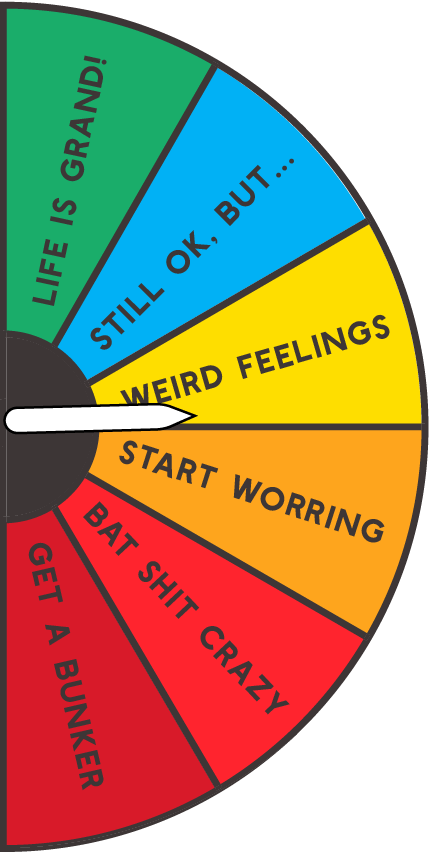
Volcanoes are erupting in The Philippines, but on-fire Australia received some welcome rain. The Iran war cries have been called off and The Donald’s military powers are about to be hamstrung by the Senate. Meanwhile, his impeachment trial is starting, and we’re all on Twitter for a front-row seat.

What Could Go Right? The Baby Who Got His Own Cure
One infant’s experimental rescue inspired a new framework to fast-track gene editing therapies.

Emma Varvaloucas
This is our weekly newsletter, What Could Go Right? Sign up here to receive it in your inbox every Thursday at 5am ET. You can read past issues here.
The Baby Who Got His Own Cure
It was 2024, and a baby named KJ had just been born. He had his mother’s bright blue eyes, just like his three older siblings. Within days, however, it was clear something was seriously wrong. Little KJ was diagnosed with CPS1 deficiency, a rare liver condition in which ammonia builds up in the blood and eventually causes organ damage.
CPS1 is often treated with a liver transplant, but KJ was too small and medically unstable to receive one. Instead, doctors came to his parents with an idea. What if a gene editing therapy—which, by altering a small section of his DNA, would correct a malfunctioning enzyme in KJ’s liver—could be built just for him?
Six months later, KJ received his first dose of the therapy. Four months after that, in June 2025, he was released from the hospital where he’d spent his entire life. The treatment had stabilized his condition, with no serious side effects. It was the first time a CRISPR-based therapy had been custom-built for one patient.

CRISPR has made gene editing therapies for common genetic conditions, such as sickle cell disease, a reality. Theoretically, similar therapies are also possible for the more than 7,000 rarer ones, like KJ’s. But most people with rare diseases are out of luck; it’s not worth it for biotechnology companies to try to develop a cure given the small number of future customers. KJ’s story raised the exciting possibility that bespoke gene editing therapies could become viable workarounds.
Until last week, one barrier to that future was the Food and Drug Administration (FDA). Though KJ’s therapy was built just for him, it could be tweaked to treat others with related liver disorders. But traditional FDA regulations required that each tweak be treated as a totally new drug, subjected to its own lengthy review and large-scale clinical trials. Those, of course, are impossible to conduct for most rare diseases.
Now, however, regulations have been updated so that researchers can “bundle” data from distinct but related rare-disease treatments. This new clearance pathway was developed specifically to fast-track gene editing solutions, especially those that could help children. But it may eventually apply to a broader range of conditions and therapy types—good news for both patients and innovation.
We Won an Award!

We are so honored to have won an Anthem award for our podcast episode with climate journalist Emily Atkins! What Could Go Right? won bronze in the climate awareness category. Competition was fierce: the awards fielded 2,000 entries from over 42 countries this year. | Listen to the episode
By the Numbers
31%: Argentina’s inflation rate, down from 193% in October 2024
27: Countries that have eliminated trachoma—Egypt is the latest
73%: Share of women in low- and middle-income countries with a financial account, up from 50% in 2014
Quick Hits
🐟 More than 50 US fish stocks have rebounded from collapse or are on track to—and commercial fishing jobs are up nearly 40%—after environmental activists and fishermen found a win-win solution that netted fewer fish but earned more for fishermen.
📉 Since the 1990s, youth crime has declined significantly across the developed world. Less alcohol consumption and more helicopter parenting have resulted in lower rates of violent and nonviolent crime.
💶 Salaries climbed and subjective poverty fell across Europe in 2024. On average, the former rose 5% and the latter—how individuals perceive their own financial situation—dropped 1.7 percentage points.
🦠 Efforts since 2023 to bring the HPV vaccine to lower-income countries have saved an estimated 1.4 million lives. The vaccine is nearly 100% effective at preventing cervical cancer. (Related: a nasal vaccine to treat—rather than prevent—cervical cancer has shown promise in animal trials.)
☀️ Solar is the fastest-growing source of electricity the world has ever seen. When the Paris Agreement was signed in 2015, it made up just 1% of global electricity generation. Today, it’s nearly 9%—and emerging economies are taking the lead.
🫁 Tuberculosis cases fell in 2024 for the first time since the pandemic. Furthermore, between 2015 and 2024, deaths from tuberculosis declined by 29%, although that progress is far from the targets set by the World Health Organization.
🐖 Scientists have figured out how to stop the body from rejecting a donor pig kidney, a controversial medical breakthrough that could potentially ease the shortage of donor organs.
💉 All the women who received an experimental breast cancer vaccine two decades ago are still cancer-free. The vaccine teaches their body to recognize and attack cancer cells long term.
🧑🎓 The US is still a magnet for international PhD students, with numbers essentially flat year over year despite new immigration restrictions. The anticipated crash hasn’t come, at least not yet.
👀 What we’re watching: The world’s first ban on social media for kids under the age of 18 will go live on December 10 in Australia. Tech companies are complying.
💡 Editor’s pick: What happened to global carbon emissions in 2025?
TPN Member Originals
(Who are our Members? Get to know them.)
- An evening ritual to realize a happier life | The Atlantic ($) | Arthur C. Brooks
- Why you should talk about your goals | Flourishing Friday | Clay Routledge
- Shocked by Trump’s profiteering? Here’s some perspective. | WaPo ($) | Zachary Karabell
- Are things falling apart? | NonZero | Robert Wright
- How to replace Christian nationalism | NYT ($) | David Brooks
- Russia is collapsing | Diane Francis | Diane Francis
- Ukraine’s stain | Diane Francis | Diane Francis
- “Diplomacy” as cover for shakedowns and self-dealing | Lucid | Ruth Ben-Ghiat
 Epstein and Trump with Nina Burleigh, author of Trump’s Women | Lucid | Ruth Ben-Ghiat
- The Epstein emails | Tangle | Isaac Saul
- National service | No Mercy/No Malice | Scott Galloway
- One horror of slavery that until recently could not be told | NYT ($) | John McWhorter
- The candidates who deserve your money | Slow Boring | Matthew Yglesias
- Will “AI euphoria” crash the markets? | GZERO | Ian Bremmer
- Is AI a bubble? Not so fast. | TFP ($) | Tyler Cowen