Volcanoes are erupting in The Philippines, but on-fire Australia received some welcome rain. The Iran war cries have been called off and The Donald’s military powers are about to be hamstrung by the Senate. Meanwhile, his impeachment trial is starting, and we’re all on Twitter for a front-row seat.

What Could Go Right? The American Good List
Do Americans truly deserve their poor opinion of one another?

Emma Varvaloucas
This is our weekly newsletter, What Could Go Right? Sign up here to receive it in your inbox every Thursday at 5am ET. You can read past issues here.
The American Good List
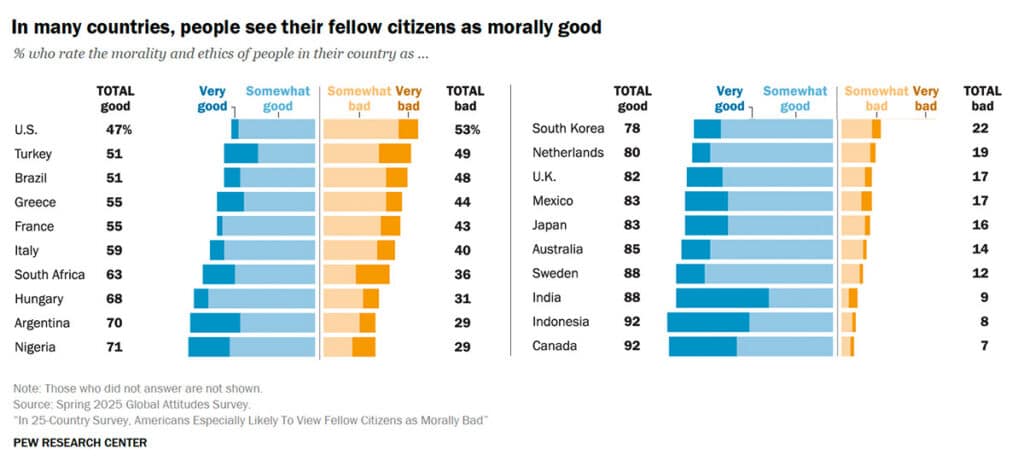
Earlier this month, Pew Research Center published a depressing but unsurprising survey: Among 25 countries, Americans are most likely to view their fellow citizens as morally bad. We actually beat Turkey and Brazil for the top spot, two countries where the percentage of people who rate their compatriots negatively sits in the high 40s. In fact, Americans have the ignominious distinction of being the one country surveyed where a majority of adults—53%—describe their compatriots’ ethics as bad.
Yikes.
The survey authors wondered if Americans are particularly moralistic, until they found that we are actually middle of the pack when it comes to judging certain moral issues, such as abortions, and among the most accepting when it comes to others, like smoking marijuana or gambling. (One exception: cheating on your spouse. Nine in 10 Americans say an extramarital affair is morally wrong.)
Instead, the authors seem to suspect that Americans’ low rating of Americans may be a stand-in for a disapproval with the governing party. Although partisans from both sides are likelier than ever to view those in the opposing party as immoral, in the survey it was Democrats and Democrat-leaning independents who were more likely than Republicans to deem fellow Americans as morally and ethically bad, 60% vs. 46%. The pattern holds in half of the countries surveyed, with those under the thumb of a leadership they don’t like more inclined to view fellow citizens as morally suspect.
To which I can imagine the retort: Well, it was our fellow Americans who voted for that guy in the White House, was it not?
Putting aside the question of whether everyone who voted for Trump voted for this exact reality—stories of regretful voters suggest otherwise—it does go to show how poisonous a character like Trump can be to the national fabric. I find much about the Trump administration abhorrent; I suspect that’s why I also find it abhorrent to let him and his cronies define how I feel about Americans as a whole. I’ve lived outside of the States since 2020, and I miss the American spirit terribly. Goodness knows we have our faults. But we’re also a cheerful, outgoing bunch, deeply caring, actively generous—and, I daresay, good on net, despite our politicians.
For one, we lift one another up when the chips are down. I still remember the mutual-aid support systems that sprung up during the pandemic, when it became the norm to send absolute strangers a buck or two, and the nightly chorus of pots and pans from our balconies and stoops to let essential workers know we were behind them.
The backdrop has changed, but the neighborliness continues. Progress Network member Thomas Friedman, a Minnesotan, just wrote an incredibly touching article about the local reaction to the ICE surge there earlier this year. I hadn’t heard many of the stories he tells about the pluck and verve of the Twin Cities: the million dollars raised to aid immigrant families and the restaurants that housed employees afraid to be on the streets. A mom who brought breast milk to a baby whose own mom had just been taken by ICE—and then began a breast milk donation network. Neighbors who brought cookies to the Somali family next door. Really, it’s enough to bring a tear to Diogenes.
The New York Times recently launched a newsletter called The Good List, “a weekly collection of ideas, recommendations, rituals and inspirations to add joy and perspective to everyday life.” Its proprietor, Melissa Kirsch, writes in its inaugural issue:
I keep a good list because I know how much easier it is to complain or despair over what’s bad, what’s missing, what we wish were different. And let’s be clear: There’s plenty to be sad or cross or dissatisfied about. We shouldn’t stop wrestling with those things or trying to change them when we can. But there’s got to be more.
It occurs to me that maybe what we need in this moment is an American Good List—big and little things across the country that inspire us, that keep us going. On mine would be Friedman’s Minnesotans; my sister, who runs a nonprofit for low-wage workers; our love for an underdog story; $1 Arizona iced tea. This WWII veteran, who at the age of 100 became the world’s oldest known organ donor. The Sandlot. Andor. Hip-hop. Our national parks system.
There is so much more to my fellow Americans—and America—than Trump and red baseball caps. I imagine we’d find the good in all or at least most of us again if we just began to look for it. What would be on your list? Let me know in the comments.
—Emma Varvaloucas
By the Numbers
1.5M: People lifted out of poverty in Uzbekistan in 2025
49%: Decrease in Malawi’s maternal mortality rate between 2016 and 2024
19: Cities across nine countries that have cut air pollution by at least 20% since 2010
6.2M: Drop in the number of people experiencing hunger in Latin America and the Caribbean since 2020
~30%: Drop in fentanyl overdose deaths in the US between 2023 and 2024
Quick Hits
🇺🇸 More for the American Good List: Virginia has passed legislation to guarantee nearly all workers paid family and medical leave and is the second state to allow balcony solar; North Carolina’s new Medicaid plan for foster care children has cut home placement time dramatically; pregnant women can now get divorced without a judge’s sign-off in Missouri; and the first offshore wind project completed during Trump’s tenure is now sending power to New England’s grid.
🏳️🌈 India elected its first openly queer member of Parliament, an Oxford- and Harvard-educated constitutional lawyer who was part of a broader strategy to insert public intellectuals into politics to “sharpen opposition arguments at the national level.”
📈 The share of female lawmakers in Africa has nearly tripled since 2000, rising in many countries from near zerosince the introduction of a gender quota system.
💉 Could acne be prevented with a vaccine? Big Pharma thinks so: One candidate from French company Sanofi just entered early-stage trials, and others are in development.
🪘 France has returned a sacred talking drum looted from Cote d’Ivoire more than 100 years ago, the latest instance in the trend of former colonial powers returning artwork and objects.
⚖️ Sexual violence cases can no longer be settled through mediation in Mali, Liberia has closed its “bush schools” where female genital mutilation was practiced, and there are other examples of women’s rights advancing in Africa, too.
⛰️ Conservation efforts have returned bearded vultures to the Alps after they had been declared extinct there. The birds have a wingspan the height of a door and are known for smashing carcass bones from great heights in order to break them into smaller, edible pieces.
☀️ A massive project in Abu Dhabi that aims to prove that 24/7 solar power is possible is due to become operational next year. The falling cost of batteries has been key to its development.
🦁 Two lion-killing poachers were successfully prosecuted in the first CSI-style wildlife case. Forensic specialists were able to trace the identity of the feline victim, and eventually its hunters, by analyzing DNA taken from its trafficked teeth and flesh.
📈 Poland not only broke out of the poverty trap but also entered the world’s top 20 economies, a “historic leap from the post-Communist ruins of 1989-90 to European growth champion.”
🏥 More Black patients with severe kidney disease are receiving transplants, and faster, after a clinical algorithm that artificially inflated kidney function on a racial basis was phased out in 2022.
👀 What we’re watching: Artificial intelligence has set off one of the fastest evolutions in mathematics, ever.
💡 Editor’s pick: In the pluriverse—a radical idea that resolves many quantum paradoxes—we create reality together.
TPN Member Originals
(Who are our Members? Get to know them.)
- I live with my grandchildren. You should too. | TFP ($) | Arthur Brooks
- How Trump’s Iran gamble backfired | GZERO | Ian Bremmer
- The arrogance of ignorance | Breaking the News ($) | James Fallows
- Iran: Markets, midterms, North Korea | Diane Francis | Diane Francis
- What did I miss? | The Edgy Optimist | Zachary Karabell
- Trump and partisanship killed an American tradition | WaPo ($) | Theodore R. Johnson
- Virginia shows how it’s done | Of Boys and Men | Richard Reeves
- Wall Street’s AI panic is real. The predictions probably won’t be. | WSJ ($) | Zachary Karabell
- How to lose the AI arms race | TFP ($) | Tyler Cowen
- I traveled to Ukraine to teach sociology. It left me amazed. | WaPo ($) | Nicholas A. Christakis
- The Democratic brand is toxic in too many states | NYT ($) | Matthew Yglesias