Volcanoes are erupting in The Philippines, but on-fire Australia received some welcome rain. The Iran war cries have been called off and The Donald’s military powers are about to be hamstrung by the Senate. Meanwhile, his impeachment trial is starting, and we’re all on Twitter for a front-row seat.

What Could Go Right? Global Terrorism Has Been Shrinking for a Decade
2025 was a remarkably good year, but it’s too early to take the trend for granted.

Emma Varvaloucas
This is our weekly newsletter, What Could Go Right? Sign up here to receive it in your inbox every Thursday at 5am ET. You can read past issues here.
Global Terrorism Has Been Shrinking for a Decade

Here’s a sentence that surprises me even as I write it: 2025 was a remarkably good year for terrorism. By that I mean, incidents, deaths, and injuries all fell significantly from the year prior, according to the most recent Global Terrorism Index report, and no large-scale attacks—with victims in the hundreds or thousands—occurred anywhere in the world.
In fact, deaths from terrorism were at a 10-year low, nearly half the high of 10,882 in 2015.
It’s not just deaths: Over the past decade, terrorism’s footprint has been shrinking overall. Incidents occur in fewer countries—57 in 2015 vs. 36 in 2025—and have become less impactful in every region except sub-Saharan Africa. Even there, it has concentrated in the north-central strip called the Sahel.
To be fair, last year was not a particularly safe one for the West, which experienced a surge in attacks. The shooting on Australia’s Bondi Beach in December killed 15, for example, and the January truck attack in New Orleans, 14. Still, as much media coverage as these incidents attracted and as awful as they were, even a “surge” equates to extremely low death counts. About the same number of people died in the United States last year in terrorist attacks as they do every year from taking selfies.
Surge or no surge, the proportion of deaths from terrorism that occur in the West is so small that it’s barely visible on a graph:
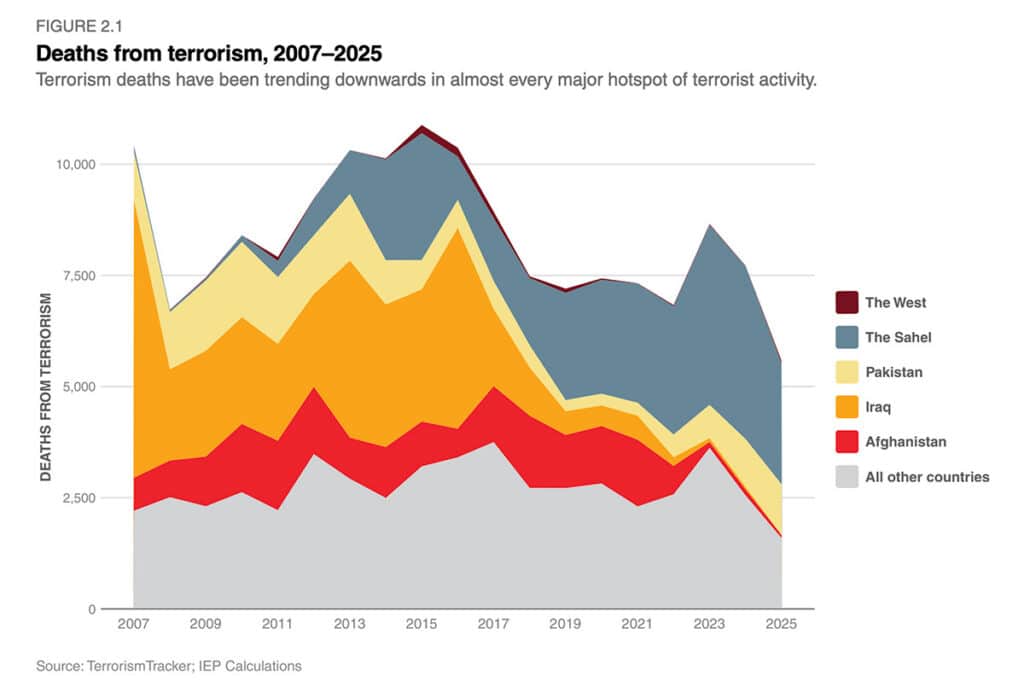
As the most compelling graphs do, however, this one tells more than one story. As you can see, terrorism rose in Iraq and Afghanistan—and spilled over into Pakistan—during American interventions in those countries, then fell once the US left. As the report notes, where conflict goes, terrorism follows. Sowing the seeds for proxy-led terrorist attacks in the Middle East and the West is just one more thing the American and Israeli governments are risking in their current war against Iran. The cards are still being dealt, but it would be a shame to reverse a 10-year positive roll.
—Emma Varvaloucas
By the Numbers
46%: Decrease in opioid overdose deaths in the US since 2023
99%: Decline in battery costs over the past three decades
319K: Number of Filipino children removed from child labor over the past three years
60%: Drop in child mortality worldwide since 1990
Go Figure
For those who fret that AI will inevitably lead to student brain rot comes news that educators are starting to use in-class oral exams to ensure that critical thinking is not prompted out of existence. One prof is even using AI to administer chatbot-led virtual oral exams. (He calls it “fighting fire with fire.”) Somewhere, an avatar of Socrates is smiling.
Quick Hits
🧑🚀 We have liftoff! NASA astronauts are on their way to the moon for the first time in more than 50 years. The mission is the first stage of a recently announced plan to build a moon base.
☀️ India’s solar power is expected to quadruple over the next decade and its wind power to triple, reducing its coal reliance from more than 70% to under half. Already, the country’s growth of CO2 emissions is slowing.
🏠 Developers in England now must install solar panels and heat pumps in all new homes, according to recently instituted government guidelines. And, plug-in solar panels, currently unavailable in the UK because of existing safety regulations, will come onto the market in a few months.
📱 A village in Ireland agreed to grant its children a smartphone-free youth, after 70% of parents opted in to the idea. Other towns are now interested in copying the model.
🫦 The full network of clitoral nerves has been mapped for the first time, 30 years after the same was done for the penis. Apart from revealing more about the fun stuff, the map will help to guide a variety of surgeries, such as the reconstruction done after female genital mutilation.
🦇 In Australia, an unlikely hero is to thank for the creation of 91 million trees and hundreds of millions of dollars in annual revenue: the grey-headed flying fox, one of the world’s largest bats—and, more importantly, a super pollinator.
🌞 A 10-year project in California will turn fallowed land into the world’s largest solar farm, producing enough energy to power the equivalent of nine million homes.
⛪ For the first time in history, a woman has been installed as the archbishop of Canterbury, the de facto leader of the Church of England. Women have been allowed to become priests since 1994 and bishops only since 2014.
⚖️ Luxembourg has enshrined abortion rights in its constitution, the second country, after France, to do so.
🚫 Virginia has passed 25 gun reform laws, including a ban on assault weapons and much more. The one that makes it a crime to leave a visible gun in an unattended vehicle might have prevented the March 12 shooting at Old Dominion University.
👀 What we’re watching: Gen Z is at it again: Will political resistance led by young people be able to lift Hungary out of autocratic rule?
💡 Editor’s pick: Old people are keeping the economy steady, at least at the moment. Meanwhile, a push for paid leave for caregiving is forming.
TPN Member Originals
(Who are our Members? Get to know them.)
- Operation Epic Fury: A civilizational fail | The Renovator | Danielle Allen
- Why public anger doesn’t bring down regimes | Middle East Uncovered | Faisal Saeed Al Mutar
- The Iran War: Forecasting incompetence, degrading diplomacy | Lucid | Ruth Ben-Ghiat
- Why we keep stumbling into stupid wars | NonZero | Robert Wright
- Trump’s Iran climbdown wasn’t an offramp | GZERO | Ian Bremmer
- Workers are leaving the Trump coalition | Jacobin | Joan C. Williams
- The case for hope in an exhausted America | The Preamble | Sharon McMahon
- Marc Andreessen’s mistake | The Atlantic ($) | David Brooks
- Why is OpenAI dropping video? To focus on what really matters | TFP ($) | Tyler Cowen
- Antienshittification | Yancey Strickler | Yancey Strickler
- Emigration for growth | CGD | Charles Kenny