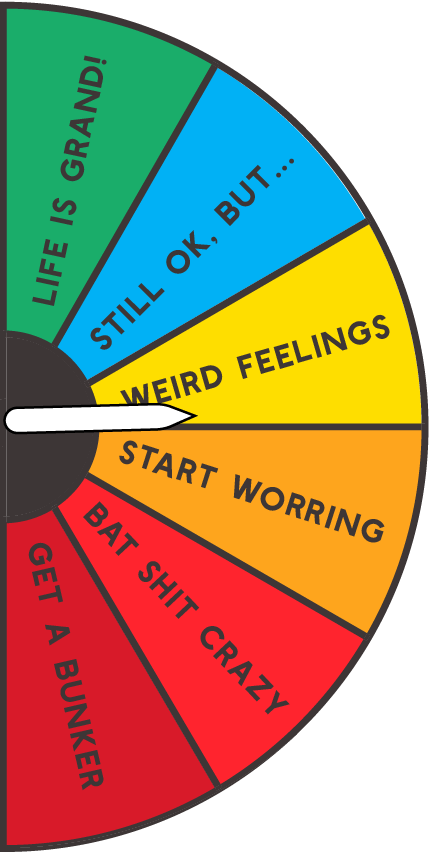
Volcanoes are erupting in The Philippines, but on-fire Australia received some welcome rain. The Iran war cries have been called off and The Donald’s military powers are about to be hamstrung by the Senate. Meanwhile, his impeachment trial is starting, and we’re all on Twitter for a front-row seat.

What Could Go Right? Architects of Our Own Meaning
How rich societies can reverse their unhappiness spiral

Emma Varvaloucas
This is our weekly newsletter, What Could Go Right? Sign up here to receive it in your inbox every Thursday at 5am ET. You can read past issues here.
Architects of Our Own Meaning
The opening sentence of the research group Gallup’s latest Life Evaluation Index is cheering: “Worldwide, people in more countries are living better lives and expressing more hope for the future than they have in years.”
By Gallup’s metric, a third of the world is thriving, and fewer are suffering:

Good news overall, but let’s dig in. The Index’s measuring stick is the Cantril Self-Anchoring Striving Scale. People rate their present and future lives from 0 (worst) to 10 (best); they are considered to be thriving if they rate their current life at 7 or higher and their expectation of their life five years forward at 8 or higher. A 4 or below is considered “suffering.” Everyone in between is “struggling.”
What basis one uses to choose a number is fuzzy. The Scale is meant to measure well-being, which might suggest things like purpose, joy, and relationship quality. But studies have shown that respondents tend to answer based on where they see themselves in a socioeconomic hierarchy—how much money they make, for instance, compared to those around them.
This would explain why respondents in growing economies—where rising tides are lifting all boats—report better well-being over time. Well-being has improved so much in places like Latin America, Eastern Europe, and Southeast Asia that it has driven the global picture upward even while those in advanced economies repeatedly post declines. In 2007, 67% of people were thriving in North America; now, it’s 49%. Similarly, Western Europe has seen a drop from 52 to 42%.
It’s not that everyone in rich societies is so unhappy these days, though. Rather, Gallup’s data says it’s specifically young people.
There are many explanations for the younger generations’ deep malaise. There is the tangible: Gen Z economic commentator Kyla Scanlon, for instance, has written about the demoralizing effects of things like prohibitively expensive education and housing, not to mention AI-driven workforce changes.
And then there is the intangible. With basic needs met, those of us in affluent societies have become victims of our own success. Rather than fill our historically unprecedented amounts of leisure time with worthy endeavors, we have become dopamine junkies, glued to social media and addicted to online shopping and porn.
We have also lost touch with the projects—family, religion, community—that have traditionally given our lives meaning. Religiousness is waning, marriage and childbirth rates have plummeted, and we no longer trust our institutions or fellow Americans. Loneliness has become a public health concern, especially for Gen Z, members of which are more reliant on social media to forge connections.
To reverse well-being trends in rich societies, we would need to address both the tangible and the intangible. The first is a complicated project that requires the kind of good governance Americans have been yearning for. The second, however, may have an answer that is within our personal control.
Recently, I spoke with existential psychologist Clay Routledge for a book I’m writing. Routledge does a lot of things, but, generally, he’s trying to figure out how people can live a life of meaning. That its time-honored pillars are withering used to worry him. Lately, however, he has become optimistic that we, and younger generations especially, can become “architects of our own meaning.”
That we must rely on ourselves to create that meaning is a weighty challenge. But there are upsides. Rather than contort ourselves to fit into traditional boxes, we are free to carve a path of existential significance that hews to our own identities, interests, and passions.
It’s totally possible. Ordinary people who have become architects of their own meaning are all around us. There is no perfect recipe for how to do it, but there are a few essential ingredients, says Routledge. One, it must contain patterns of predictability. Two, it must include the pursuit of a specific set of goals. And three, it must embed us in something larger than ourselves.
A recent guest on our podcast, for example, was SolarSPELL co-founder Laura Hosman. She spoke to us about the organization’s endeavor to develop and distribute solar-powered digital libraries to communities without Internet, giving them access to life-changing information (ingredient three). What was just as important to her as the impact, however, was coming into work every day (ingredient one) to collaborate with the other people on her team to keep expanding SolarSPELL’s reach (ingredient two).
Find a way to introduce these three components into your life, and you’ll be well on your way to introducing meaning as well.
Does this idea resonate with you? If so, comment below.
What Could Go Right? S7 E21: Does the Deficit Even Matter? with Stephanie Kelton
Is everything you know about government spending upside down? Zachary and Emma welcome trailblazing economist and author Stephanie Kelton, champion of Modern Monetary Theory (MMT), to challenge the way we think about deficits, inflation, and what really matters for America’s financial future. Stephanie warns about the real dangers behind rising wealth inequality, explores the impact of Trump’s One Big Beautiful Bill, and highlights countries that have rewritten their economic playbooks. | Listen now
By the Numbers
26%: Formula One’s drop in carbon emissions since 2018.
340K: Number of kids under five who die from diarrheal diseases every year, down from 1.1 million in 2000. (A donation to UNICEF is a good option for keeping the progress going.)
90%: New energy capacity built in the US in 2024 that was renewable.
Quick Hits
☀️ “The sun is rising on a clean energy age.” UN Secretary General António Guterres has updated his tone on climate change from alarmist to upbeat now that renewables consistently beat fossil fuels on cost.
💊 A hormone-free birth control pill for men has passed a safety trial for the first time. Several other contraceptive options for men are being developed or tested; furthest along is a gel that just finished a Phase 2 clinical trial.
📉 Maryland is building a real-time gun violence database that will operate independently from federal sources, which are slower and dependent on unreliable funding. The state has recently fallen out of the top 10 of states with the highest firearm homicide rates.
🪦 AI trained on fragmentary texts from the Roman Empire can predict its missing characters, helping historians reconstruct the texts in full. The tool can also predict where and when an inscription came from, within 13 years.
⚠️ Ghana has launched an AMBER Alert system for missing children that works over Facebook, Facebook Messenger, and Instagram. It’s the 36th country to join the program. Ghana’s police formed a Missing Persons Unit only four years ago.
🌲 A Liberian activist is piloting a simple scheme to pay communities the same rate to conserve trees that loggers would to cut them down. Liberia is home to almost half of West Africa’s tropical forests.
🦟 Timor-Leste has eliminated malaria within its borders, becoming the 47th country to do so. It’s a stunning achievement for a country whose 23-year-old malaria program began with only two full-time workers.
👀 What we’re watching: Japan is looking into a plan to build its first nuclear reactor since the Fukushima disaster, now that public opinion has rebounded and the rise of AI is increasing electricity demand.
💡 Editor’s pick: The world’s aging population may have unexpected upsides, including fewer wars.
TPN Member Originals
(Who are our Members? Get to know them.)
 My cancer and my AI | NonZero | Robert Wright
- The blessing and curse of ambition | NYT ($) | David Brooks
- The psychological secret to longevity | The Atlantic ($) | Arthur C. Brooks
- Last laugh | No Mercy/No Malice | Scott Galloway
- Foreign aid rescissions and the ongoing crisis of delivery | CGD | Charles Kenny
- California, Panama, and the future of our countries | Our Towns | Deborah and James Fallows
- There’s plenty of water for data centers | Slow Boring | Matthew Yglesias
- The US economy at midyear, with economic analyst Joey Politano | Faster, Please! | James Pethokoukis
- As China disappears people and histories, an artist fights back | Lucid | Ruth Ben-Ghiat
My pleasure, Catherine! I agree, it’s wonderful phrasing.
Thank you for the three keys that Clay Routledge names for us to become “architects of our own meaning”. That phrase grabbed and held me. It has the power of poetry.