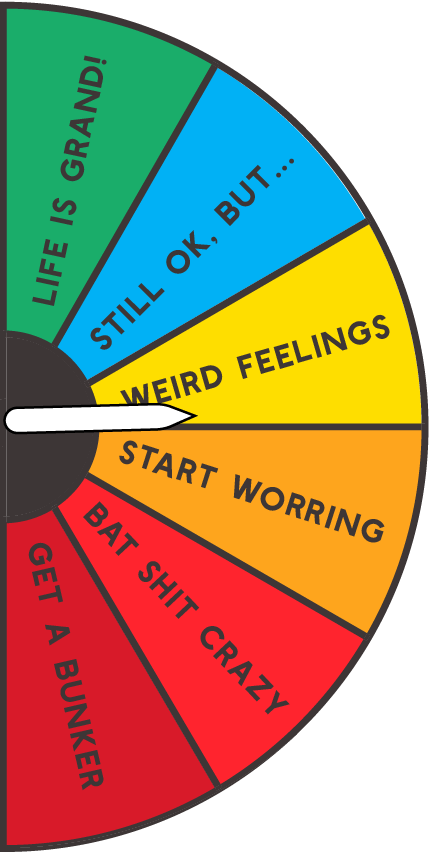
Volcanoes are erupting in The Philippines, but on-fire Australia received some welcome rain. The Iran war cries have been called off and The Donald’s military powers are about to be hamstrung by the Senate. Meanwhile, his impeachment trial is starting, and we’re all on Twitter for a front-row seat.


Is the US Still a Rule of Law Country?
Featuring Joyce Vance
It’s time to right the ship of democracy! Zachary and Emma sit down with powerhouse legal expert Joyce Vance, former U.S. Attorney and author of the popular Civil Discourse Substack and upcoming book Giving Up Is Unforgivable: A Manual for Keeping a Democracy. Pulling on her 25 years of experience at the DOJ, Joyce pulls back the curtain on how federal courts have confronted Donald Trump’s unprecedented use of power, the evolving responsibilities of the Supreme Court, and why the right to vote is democracy’s lifeline.


Prefer to read? Check out the Audio Transcript
Although the transcription is largely accurate, in some cases it may be incomplete or inaccurate due to inaudible passages or transcription software errors.
Joyce Vance: I view voting as the right that unlocks all of the other rights. If you have your full rights as a citizen and you can vote, and you can shape the course of the future of our democracy, then you’re able to participate. It’s really important as a society that we protect the right to vote.
Zachary Karabell: What Could Go Right? I’m Zachary Karabell, the founder of The Progress Network, joined as always by Emma Varvaloucas, the executive director of The Progress Network. And this is What Could Go Right? which is our weekly podcast. For those of you who have been listening weekly, you already know that. And for those of you who are not, we hope that you do.
And we try in this podcast to take a more constructive view of often destructive news, or to put it differently, we try to look at the upside when everyone else is looking at the downside. But of course, there’s a lot of downsides. So we do indeed look at the downside. We just try to do so with an eye toward what can we do to make things better? Are we getting the current story wrong in the haze of malaise? And how can we construct the future of our dreams and not the future that we think we’re constructing, which given polling both in the United States and throughout the world, seems to suggest that most people think that that future is bleak, dark, and unremittingly grim.
We have during this season talked quite a bit about the role of the courts in American society and about the outsized role the courts are now playing, given the contestation about the powers of the executive branch that the second season of the Trump show has raised in spades.
And we’re gonna do so again today and kind of continue the conversation in light of the continued contestation and the many and manifold and myriad court battles that are going on all around us all the time, many of which are focusing on whether or not the actions of the executive branch are or are not constitutional or should be allowed to continue. Obviously, one of these is this theory of the unitary executive, which the Trump administration has been pursuing zealously and often quite effectively, but which remains a question mark as to whether or not that is in fact the constitutional balance that either the framers are intended or that contemporary Americans want.
So we are going to continue the judicial branch conversation and the role of the courts ad nauseum because it is the nauseam that we think is amongst the more important nauseum that we should be focusing upon.
So Emma, who are we going to talk to today?
Emma Varvaloucas: Today we are talking to Joyce Vance. She is a former US attorney for the Northern District of Alabama, an office that she held during the Obama administration, and then she actually resigned on the eve of Donald Trump’s first inauguration, and that ended a 25 year career as a federal prosecutor. She’s also a legal analyst now for NBC and MSNBC, and she writes the very popular Civil Discourse substack. She is also on two podcasts. What is she not doing is really the question now.
And we’re also gonna be talking to her a little bit about her book, which is called Giving Up is Unforgivable: A Manual for Keeping a Democracy, which is coming out in the fall, I believe. So we’re a little bit ahead of the, the game on that.
Zachary Karabell: Indeed.
Emma Varvaloucas: You ready for a conversation with Joyce?
Zachary Karabell: God, I hope so.
Emma Varvaloucas: I hope the US is ready too.
Zachary Karabell: Joyce Vance. It is such a pleasure to have you on What Could Go Right? We’ve been touching more on legal issues and the courts this season. We did a podcast with Stephen Vladeck. We did one with Jeffrey Rosen at the Constitution Center, and I think it’s probably indicative of the degree to which one of the, I guess, unintended offshoots of the Trump administration, or what I like to call the second season of the Trump show, has been the prominence of the courts in our political debates. I don’t know, maybe since the 1960s when the courts have had such a central role in collective debates about how we should be governing ourselves and what’s right and what’s wrong.
I mean, it’s always been part of the mix, but certainly in 2025 it has become, I think one could argue, I don’t know how you’d measure, it used to be that you kind of paid attention to the presidency and then the Congress and then the courts. And I would say in 2025, we’re paying about as much attention to the courts as we are to the presidency and much less attention to Congress.
So I’m wondering what you make of that in terms of I guess the broader constitutional picture and you’ve kind of been in the doing of this and now the past year since you left being a US attorney have been in the thinking about it. I think that’s a fair, I mean, the line between doing and thinking is fuzzy at best, but you know what I mean.
I mean, is this an okay thing for the courts to be as prominent or were they supposed to be kind of in the order that I said before, which is the less noisy branch of government? I’m just wondering what you make of this historically. It’s easy to lose sight of how unusual this is.
Joyce Vance: Well, first off, thanks for having me with y’all this morning. I’m delighted to be in such good company. Steve and Jeff are two of my favorite people, so it’s nice to be able to share some thoughts with your audience too. I think you ask such an interesting question, right? We all get that there are three co-equal branches of government, but in reality, the structure that the founding fathers created was one which deemphasized the courts and gave them less power than the other two branches of government.
But that’s not to say that their power is insignificant, and something that you see against the long scale of American history is moments where one branch or maybe two branches step up to ensure progress to ensure the success of democracy when perhaps another branch is lagging behind. We are living in one of those moments right now where the courts, or at least the lower federal courts, are trying to do more than their fair share to carry the weight of democracy in a moment where Congress, you know, is just supine.
They’re off taking a nap in large part, and the president is doing everything he can to accumulate power, to exercise power in unprecedented ways, and to grow the prominence of the Article Two branch of government.
Emma Varvaloucas: So Joyce, you referenced something kind of interesting there, which is you specifically said the lower federal courts, right? And one thing that you do really well on your Substack, Civil Discourse, is that you give people a really thorough rundown of what’s going on with the rule of law and the Trump administration and the intersection of that.
But you also point at some places where people are pushing back and kind of holding the line. So I’m wondering if you could talk a little bit about the lower federal courts, but also maybe about some of the other stories that people aren’t as familiar with. Like, I saw some things about federal grand juries that are pushing back on indictments or, you know, deciding not to indict people.
And also anything that comes to mind about how people are holding the line in ways that maybe are not making it up into the mainstream media.
Joyce Vance: You know, one of Trump’s myths, one of the myths he sort of spreads across the country is that he’s successful and that his overall success is inevitable. Right? Trump in many ways, without saying it quite this way, tries to convey the sense that democracy is already broken, that he has already reshaped and reformed this country in his own image. That’s just not the case.
The Supreme Court is maybe a topic that we’ll take up. They have not always done the job, frankly, that we would hope that they would do, for instance, and most notably giving Donald Trump a free pass for now and forever from criminal prosecution, for just about anything he does while in office.
It’s a huge disappointment and legal scholars debate, and the side of the debate that I’m on is that decision was wrongheaded. But as for the lower federal courts, we are seeing judges regardless of which President appointed them standing up for Democratic principles, they did it following the 2020 election when the Trump folks tried to challenge election outcomes. We’re seeing them do it now, and sometimes it comes in, you know, a non substantive form. Sometimes it’s just an early procedural step to press pause and to enter an injunction that ensures that the status quo remains unchanged while the courts try to sort out whether the Trump administration is exceeding its constitutional authority or not. Of course there too, the Supreme Court has made it a little bit more difficult saying that nationwide injunctions can’t be used.
But what we’re seeing happen, and Emma, this is to the point of your question, what don’t we know about? We’re already seeing the lawyers fight back. My friend Mary McCord at Georgetown just had the first nationwide class certified in one of the birthright citizenship cases so that the lower courts can continue to do their job. And I think we all expect that even in. In this moment, when Trump’s efforts to write birthright citizenship out of the Constitution, you know, there’s a process for doing that. It requires states to engage and lots of hoops have to be jumped through. It’s not as easy as the president saying, I’m gonna cross that off with my Sharpie pen. So we all expect when it gets to the Supreme Court that they will actually rule against the Trump administration on this one. It’s the lawyers that are quietly doing their jobs that we don’t always know about.
And you asked about grand juries, and I think the important thing for people to realize. Is that Trump has not broken the rule of law. There is still a lot of play left in the joints. Pam Bondi can’t just by fiat say, I’m gonna engage in all of these revenge prosecutions. She has to convince a grand jury to indict. They have to be persuaded that there’s probable cause to proceed in some of these cases that just look kooky and like they’re way out of time and there’s nothing to ’em. And even if she gets an indictment, that’s a very modest sort of a barrier. Prosecutors have to establish that there’s probable cause to proceed against a defendant. You’re still talking about judge and jury in the courtroom. Nobody can force them to convict if they’re not persuaded beyond a reasonable doubt that a defendant is guilty. Judges can find legal flaws in indictments or limit the sorts of evidence or argument that the governments can make, which is all to say the end of democracy is not a foregone conclusion here.
Zachary Karabell: Let’s be wonky for a minute ’cause I wanna get into this lower court.
Joyce Vance: I like being wonky.
Zachary Karabell: I know it’s like, it’s kind of your stock and trade.
So I was on a panel at the end of June in Aspen with one of your colleagues, Preet Bharara, and it was right as the Supreme Court decision about national injunctions came down. It was portrayed in the media as a Supreme Court decision about birthright citizenship, which is also how the Trump administration presented it. But as you know, it wasn’t a decision about that. It was a decision about the procedural ability of district court judges to do nationwide injunctions. And there was a lot of hand wringing at the time, and the feeling that this was gonna vastly make it more complicated to challenge some of these sort of fiat decisions from the Trump administration before they could get worked through the courts.
What ended up happening is that there are now more injunctions, including a bunch of class actions. You referenced one, but there are a whole series of others that have now been granted. There are now more injunctions about the birthright citizenship measure than there were before the end of June when the Supreme Court made its decision.
So I’m wondering from your perspective, is this like, and again, no one talks about this stuff or nobody used to talk about this stuff except if you were really in the profession. Are you gonna start to see a bunch of district courts sort of push back against the right of the Supreme Court to dictate what it is and what it is they can’t do? I mean, is there kind of a brewing, I don’t know what you’d call it, like intra judicial fissure opening up here?
Joyce Vance: I think not so much. I think it’s more nuanced than that. The Supreme Court in what was, you know, sort of billed on the marquee as the birthright citizenship case, but actually very cleverly maneuvered by the Solicitor General, so that the only issue that the court heard was whether district judges could impose these nationwide injunctions. What the court said was not that courts couldn’t impose injunctions, just that they, for the most part, couldn’t be nationwide.
And so lawyers understood the message. That meant that in every one of the 94 federal district courts across the country, if you had impacted plaintiffs, you had to go to court in your district to get an injunction. And so that’s what lawyers did. They brought new and additional lawsuits, and so they acted in compliance with the Supreme Court’s dictates.
I think it’s a little bit ironic because you imagine how this could play out, you know, take a case in birthright. Citizenship is not a bad example where you’ve got potential plaintiffs who are negatively impacted in all of those 94 districts. You end up with just all these cases clogging up the courts. Judges are gonna rule differently or maybe rule for different reasons, and then it just rebounds on the Supreme Court and they have to decide it at the end like they should have in the first place. So maybe there’s a little edge of snark in the way some of these district courts and even the courts of appeals are handling their relationship with the Supreme Court.
But at least for now, you know, this is a top down judiciary and the lower courts, whether or not they like the Supreme Court’s decisions, like all of us lawyers and citizens in this country, we all follow ’em because we’re a rule of law country.
Zachary Karabell: There was an interpretation of that June decision, particularly I think in some of Brett Kavanaugh’s reasoning that what was going on and what has been going on is more and more sort of centralization of determining power in the Supreme Court in that it, it’s almost arrogating to itself more of these like all major decisions as opposed to, let’s say, what had been true for the past 50 or 60 years, where it was more selective and the cases it took, it often would kind of make a decision by not making a decision, meaning someone would appeal to the court and they just, they wouldn’t take the case, in which case the appeals court ruling would stand.
Do you see that as happening in its own way of like the Supreme Court sort of centralizing its role as the ultimate arbiter?
Joyce Vance: So the court is taking fewer cases than it has taken in prior years. It does seem to take every case that involves Donald Trump or this administration’s policies where it could let the rulings and the courts of appeals stand. My sense has been that they’re taking those cases because they present important issues of first impression that the court should be deciding whether I like the outcomes or not. I think that’s the job of the Supreme Court, to decide cases and provide the lower courts with guidance. And so the one thing I feel compelled to say is to the extent that the court is deciding these issues in cases that have been fully briefed and argued in front of it, well, that’s how things should work.
What I am less a fan of are decisions that come off of the shadow docket. You know, that’s what we popularly call the court’s Emergency docket. Every court needs an emergency docket. It’s what you use, for instance, for emergency appeals, from death penalty cases, and other matters that have to be addressed speedily, but increasingly, issues are going to the Supreme Court at a very early procedural stage, right? The case is opened, somebody asks for a preliminary injunction or even a temporary injunction. Bam. The court rules. It’s really just the preliminary injunctions that can go up on appeal. But the Trump administration has been making this sort of argument that even the early temporary injunctions are appealable in some cases.
So it’s going up and the court is in essence deciding these cases on the shadow docket. That means there hasn’t been any factual development of a record. That means cases and legal issues haven’t been fully briefed, and when the Supreme Court rules, in the guise of whether or not the injunction was properly granted and now we’re really wonky, right, because one of the issues that comes up when a lower court is deciding whether to grant an injunction is whether they believe the party requesting the injunction will end up prevailing on the merits of the case.
So it’s this early predictive decision being made without full development of the record or the legal arguments, and then the Supreme Court rules. Often it doesn’t issue an opinion. It might just be one paragraph saying, this is our decision. Occasionally you will get a lengthy, somewhat scalding defense from Justice Sotomayor or Justice Jackson or Justice Kagan when they find themselves in the minority.
But the real problem here, right, is the court is supposed to be giving guidance to the lower courts. Sometimes they even get pissy about it. They’ll admonish district courts or courts of appeals for not following their decision when they’re not providing any guidance or any reasoning. And look, the reality is this is the highest court in our country when they’re deciding these sorts of important issues. They have an obligation not just to lower courts, not just to lawyers, but to the public to show their work. I, I think it’s unfortunate that they’re not doing that, and perhaps that’s part of what’s reflected in the lowest esteem that the public holds the Supreme Court in recent polls.
Emma Varvaloucas: I’m gonna move us away from the courts and onto the DOJ. You were at the Justice Department for over 20 years. How long were you there? 25 years. And we mentioned before, some of these, I think we’re all aware of how much the DOJ has changed in the past six months, let’s say, in some of the kooky investigations that have been launched.
I am curious to hear what you have to say regarding the DOJ and elections. Particularly some of the reports coming out of the DOJ has been asking for voter information. I feel like one of the big comforts for me is this sort of surety that the 2026 elections are going to happen, the 2028 elections are going to happen.
They’re run by the states. But I’m curious how it looks like to you from somebody that has been inside the DOJ for a long time.
Joyce Vance: So I think you’re right when you say that the question is not whether elections will be held in 2026 and 2028, it’s whether those elections will be free and fair. Historically, DOJ has been part of that guarantee of free and fair elections. Every one of the 94 US attorney’s offices nationwide has a DEO, a day of election officer who coordinates if there are any concerns and helps in real time. DOJ’s job isn’t to litigate the outcome of the election. It’s to make sure as best it can, if there’s a precinct where something’s happening and people can’t get into vote, trying to help state and local folks resolve those issues. It’s a very minimalist, non-interventionist role and much of DOJ’s work goes on in advance of the election coordinating with secretaries of states and local officials to make sure that concerns don’t arise on the day of the election itself.
DOJ’s role should not be an aggressive role of trying to intervene to impact the outcome, whether that’s by obtaining these voter information files, y’all, I was amused. I had an opportunity to speak with Shenna Bellows, who’s the Secretary of State in Maine, and when she was asked for her state’s voter files, she told DOJ and the president that they could go jump in the Gulf of Maine. Which I think is an entirely appropriate response, right? I mean, tell me why you need this stuff, but if you’re just trying to mess with our voters, absolutely not. You’re not entitled to it.
So I’m disturbed by the role that DOJ appears to be attempting to play. Pam Bondi, no big fan of the rule of law herself, seems to be a Trump loyalist who would do anything she’s asked to do, and I think that’s dangerous, particularly in this environment where the Supreme Court. I’m sorry, Emma, I know you were trying to get away, but we have to go back, where the Supreme Court, since its decision in Shelby County versus Holder, a case that came out of my district during the Bush administration and that the Supreme Court used to gut one of the key provisions of the Voting Rights Act, section 5, which was sort of the way to think about voting rights as section 5 kept discriminatory policies from going into effect. So state of Alabama passes a law. State of Alabama has a history of racial discrimination in voting practices. It has to submit its new law to either the Justice Department or the court in the District of Columbia for what was called pre-clearance before it can bring it into effect, and only if it passes constitutional muster can it go into effect. Supreme Court guts that in 2013. And so what’s left of the voting rights is essentially section 2. There are other parts, I’m painting with a broad brush, but section 2, which lets the. Individuals withstanding challenge racially and other sorts of discriminatory measures that impact voting. And now the Supreme Court is on the war path against section 2, they’ve recently held over a Louisiana gerrymandering case, re-upping it for this. Coming term and asking the parties to address the question of how section 2 should work, giving the court perhaps an opportunity to gut section two as well. One might hope perhaps they would take the opportunity to reinforce it, but we will see. All of that, though, means that with DOJ, absent from voter protection and the court making it more difficult to bring these cases successful, and there’s even a move afoot to limit who can bring them. There’s some cases that are designed to say that the civil rights groups that have historically litigated under section 2 can’t bring those cases anymore, only the Justice Department can. And of course if that view prevails, well, I don’t think Pam Bondi is gonna do a whole lot to protect voter rights from racial discrimination.
So we will see.
Emma Varvaloucas: I mean, is that likely to occur that they would prevail? That seems extreme.
Joyce Vance: I think that there’s a strong trend that direction that I’m not able to discount at this point.
Zachary Karabell: And there’s also clearly the gerrymandering cases where the court has essentially said, this is a international issue, or, you know, we’re gonna defer to state rules around district drawing and more of an inclination, I think, as some of the gerrymandering comes up to allow those aspects of the Voting Rights Act that would’ve precluded that to not be enforced or to be unenforceable.
Joyce Vance: Right. That’s the section 2 challenge, the Louisiana case. There’s a similar case in Alabama that recently enabled Alabamans to elect out of a second black opportunity district, the second black member of Congress from Alabama. You know, these cases have real impacts, right? If you look at the number of voters and see, gerrymandering is sort of based on what we call cracking and packing, either cracking, splitting up black and other minority votes so that they have no opportunity to elect candidates of their choice, or packing all of the black voters into just one district in a state where they really should be spread out to have the opportunity to elect than just more than just one member of Congress. That’s sort of the, I think, basics of gerrymandering, and the courts used to be more willing to prohibit that.
Now, in Alabama, the Supreme Court disallowed the maps that were drawn by the state legislature. I mean, they were just. If you looked at the map, you just went, there’s no other reason for this other than racial discrimination. It was very much a packed district, but maybe less likely. Brett Kavanaugh was in the majority in the Alabama case. He said when he voted that way, that he might not be there for all time. And of course, John Roberts in Shelby County versus Holder, the Section 5 case, sort of scoffed at the idea that there was still racial discrimination and talked about how much progress we’d made. And I think in the descent, Ruth Bader Ginsburg said that his view was like shutting your umbrella in the middle of a rainstorm because you hadn’t gotten wet yet. And I think what’s happened since Shelby County was decided, has shown that she was absolutely correct.
Zachary Karabell: So let me follow that with a couple of pushback ones. ’cause there is the, you know, you mentioned the packing. There is a criticism of democratic legislatures since the mid 1960s very much gerrymandering districts in the packing sense and creating, as it were, racially homogenous districts often because of a desire to have, you know, primarily African Americans represented, but that this is the, this is kind of the blowback against that in the first place that these districts, that that was a, an errant path that was taken after the Voting Rights Act.
So that’s one thing that’s raised, and now you’re kind of seeing the iterations of that going forward. And it’s certainly true that there’s a lot more gerrymandering to be done if Texas manages to redraw its maps as the Texas legislature is now doing. California then threatens to do the same thing, and New York state could do the same thing. I mean, you could end up having even less competitive districts.
And I guess the other question is you do hear a lot about, certainly on the left, where the rhetoric around the gutting of the Voting Rights Act is usually phrased in terms of the gutting of democracy or the evisceration of voting rights. But it, to me, that raises the question of we certainly, both historically and in the way we talk about the past, you know, we talk about flawed democracy in the United States, and we talk about the incompleteness of democracy in the United States before the 1960s. But we don’t say the United States wasn’t a democracy in 1930 or 1890, even at the heights of, you know, Jim Crow and discrimination and refusing a lot, lots of American born citizens, the right to vote, particularly on racial grounds. So I’m just, I’m wondering about that rhetoric, meaning does the administration of the Voting Rights Act really constitute the gutting of democracy, or does it just constitute a huge step backward towards the kind of democracy that America had for much of its history until the 1960s?
Joyce Vance: Yeah, it’s funny that you would ask the question because I’ve just finished writing a book that takes on that question.
Look, I think here’s the way that I would answer it. I view voting as the right that unlocks all of the other rights. If you have your full rights as a citizen and you can vote, and you can shape the course of the future of our democracy, then you’re able to participate. It’s really important as a society that we protect the right to vote and that we understand that there’s sort of two dimensions here. Who you vote for, that’s a political choice. And if I’m a politician, I really want you to vote for me. But your ability to vote if you’re an eligible citizen, that’s something that we should all support, right? We should all have a right to vote. It’s the political process that persuades you to vote for a candidate, but you have that right, and politicians should not be able to choose their voters. It’s voters who should be able to choose their politicians, in my view. That’s what all of this is about.
Yes, our country, you know, at its birth, right, was scarred by slavery. No, we haven’t always guaranteed women or black people the right to vote, but the story of democracy is the story of aspiring to do better and to guarantee the rights and the promise of the constitution for all people. So I think it’s a mistake to give up on democracy just because it’s imperfect. And what we should do is constantly be trying to make it better.
You know, we’ve seen so much progress in our lifetimes. The idea that we would be willing to settle for going backwards seems to me to be a terrible tragedy. Something that we can all as Americans agree upon. I may not love policies that my Republican friends espouse, but I really wanna hear them out. I really wanna have the opportunity to vote for candidates after being well-informed, and I want everybody else to have that same opportunity.
So I think that’s my view of the way this system is intended to work and how it should work. I’m not sure if that’s a full answer to your questions, but that’s what I’ve got.
Emma Varvaloucas: So, Joyce, you mentioned your book that’s coming out in a few months and it’s called Giving Up is Unforgivable. I wanted to ask what giving up means to you in this context in terms of who you’re talking to? Like when I look out on the American public right now, there are two things that worry me.
One is people that are like on the left, particularly people with a lot of resources that seem really freaked out and yet also seem like they’re doing absolutely nothing in response to this administration.
And then the other group is people where like, I’m not even sure you could call them giving up at all, because they never really started. Right? Like it’s just a bunch of people that don’t vote. Very cynical about all politicians. I think that they’re all basically the same corrupt bullshit.
I’m curious what you mean in that book title about giving up. Like who are you talking to?
Joyce Vance: I have exactly the concerns that you have and address those groups of people directly. But I think the lesson that we can all take, and we’re sort of seeing it in action, right? I mean, it’s become popular or it became popular in certain circles after Kamala Harris lost in the last election to say, I’ve done everything I can do, I can’t do anything else. I give up. Somebody else can take it from here. It’s a dangerous attitude.
Or as you point out, well-resourced people on the left who’ve made a decision that they can ride this one out in their own little bubble and they’re not gonna engage. I mean, I don’t mean to display hostility because some of my good friends are in included in those groups or the groups of people who don’t believe that politics matter to them, don’t believe that the rule of law has any impact on their lives. But I think something we’ve lost in this country, and we’re a big country, much bigger than we were at the founding, and we’ve lost this sense of shared responsibility for democracy, which doesn’t always mean our politicians doing their jobs in Washington, although I wish they would, and I think we should all demand that they do. It also means us in our communities and in our trusted circles of friends having conversations about what democracy should look like and how we insist that it look more like that.
And so I really encourage people to recognize that we have a lot of power in our voices, right? For your trusted circle of friends, you may be the most influential person out there when it comes to convincing people to register, when it comes to convincing people to vote, when it comes to encouraging people to get engaged.
One of the examples that I use in my book is talking about the rule of law, which is an academic concept that I teach to my law students, but also if you are doing business in this country, if you’re investing, the reason that you can do that, or at least have been able to do that with some level of confidence is because the rule of law establishes your rights vis-a-vis the people that you’re in business with, so that you know that you will be treated fairly. Maybe at a more basic level, the rule of law says that if you pay rent, your landlord can’t unfairly evict you. You are protected and cloaked in this rule of law in very real ways. Impact our daily life. And so we should all be alarmed by political leadership that wants to make it less stable and do away with it. And we should all talk to the folks around us about how that should work.
And, you know, Emma, an example that we’re seeing today that I think is really instructive in this notion of individuals taking responsibility for democracy is happening with Trump’s recent effort to take over control of law enforcement in the District of Columbia where he sees control of the Metropolitan Police and indicated he would deploy the National Guard for about 30 days. And the basis for all of that is this fake claim that crime is rampant in the District of Columbia. In fact, there were numbers up on the Justice Department’s website at the time he made that announcement that directly contradicted him showing decreases in the amount of crime. You know, you can’t fake the number of murders, right? I mean, there are dead bodies that back those numbers up. So even claims that those numbers were flawed, just don’t stand up to scrutiny. Crime in DC is decreasing while Trump is claiming American carnage out on the streets. That is information that we should all be sharing with those around us, because I hear a lot of folks saying crime is a terrible problem. Thank goodness there are more resources being deployed. And the reality is that if the present President will lie to you about something that’s so readily disproven, what else might he be lying to you about? And those are conversations we should all be having with our friends as we consider the future of democracy.
Zachary Karabell: You know the issues of crime, and you know this better than anyone having served as US attorney. American beliefs about what crime statistics are have been profoundly wrong for at least 50 years, meaning most people believe there’s higher crime rates than there are, even when crime rates have been higher.
They believe they’re even higher than they are, and to some degree, that’s a political phenomenon. It’s a news phenomenon, meaning stories of violent crime are news, stories of safety are not news because they just, they don’t scan that way. We talk about this a lot in The Progress Network about how we’re predisposed, right to pay attention to crises or problems, were not predisposed to pay attention solutions in the same way.
I guess I wanna ask you a little bit, given your background, there’s that old phrase of the crime is what’s legal. And to me a lot of what is going on in both Trump One and Trump Two is raising an awareness, or at least it should be raising an awareness that a whole lot of what, certainly in the first part of 2025 that the Trump administration is trying to do, falls within the purview of law.
Now, I don’t wanna get into the conversation about the things that might not, or not. There’s a real viable question about overuse of tariff authority. There’s also, there’s a whole series of other things and those can be pursued. But I’m not talking about that part. I’m talking about the awareness that people, I think, ought to be having of the degree of power that Congress has ceded to the executive branch kind of year by year by year, often very sloppily and national emergency power being one of them. There’s all these emergency powers that the president can kind of invoke where Congress didn’t even bother to define what could constitute an emergency. It’s just kinda like left it up to the executive to go, well, I think it’s an emergency. Trump is not the first president to use emergency powers. There were like 12, I don’t know how many were, there were several dozen ongoing emergencies since 2000 in particular. He’s certainly using it way more aggressively in ways that I don’t think anyone ever thought possible.
But I just, I wonder how you think about that, both as a legal scholars and a practitioner in that there’s been this kind of envelope of expanding powers that have been granted to the executive branch that most executives have used intermittently or sloppily or occasionally that the Trump administration’s ba basically taking in bazooka and trying to use all of them, but that we ought to be focusing on the legal aspect of this, meaning not, oh my God, he’s doing all these things, but oh my God, what have we done in creating an executive branch?
Joyce Vance: I think Congress has always operated under the assumption that a president would act in good faith. And so very often, and particularly in laws that have been around for a long time, like the Insurrection Act is a good example, assessments are left up to a president to give him a certain ability to act in a nimble fashion in a crisis. The Home Rule law in DC that permits a president to take over the Metropolitan Police Force is a good example. The president has to articulate the emergency conditions that require him to do that, but it’s not really something that can be challenged in a court because we don’t wanna unnecessarily hem a good faith actor president in, and now we have Donald Trump. And that creates the problems you’re talking about, a president who uses power in unprecedented fashion, a president who is unafraid to test those limits and sort of let God, or maybe the courts, sort it out. A president who pushes in ways that many people find to be unconscionable, closing federal agencies and cutting people off from much needed aid and assistance costing people their jobs, and waiting for a court to tell him that he can’t do it, right? That’s the new world that we live in.
Some of this though, is of longstanding, at least since the Nixon era, there’s been sort of a movement towards what’s called a unitary presidency. That means an Article Two President who claims the full extent of the powers that folks who push this theory believe the Constitution offers. They believe that the President should have total control of the executive branch. So for instance, he can hire and fire at will, or he can tell the Justice Department who to indict. You know, he can tell climate experts in executive agencies that he’s gonna override their expert decisions with his political ones.
There’s this whole tug of war that’s been going on, and one would’ve thought that conservative Republicans had they existed any longer, would’ve been delighted with the Supreme Court’s decision two terms ago in Loper Bright, which in large measure took decisions away from executive branch agencies, what that group of Republicans often referred to as the nanny state and let courts override them. But now what we’re actually seeing is a president who’s claiming all of that power for himself. Congress is of course not doing much of anything, and it remains to be seen if the Supreme Court will stand up.
But look, there are at least three justices on the Supreme Court who are all in fans of the unitary executive theory that was in part the basis for the criminal immunity decision. It’s been the basis for other decisions. I think the reality is that we are living in a world where a willing president can exercise far more power than the sort of restraint that our chief executives have historically shown. And I have to say the irony to all of that, right, is that the Supreme Court relied on Joe Biden’s good faith and leadership when they issued that criminal immunity decision that protected Donald Trump, because Joe Biden could have done at that point anything that he chose to do to remain in power without any sort of criminal exposure. But they knew that was not who Joe Biden was. They knew he would not do that. They knew he would abide by the results of the election and permit a smooth transition of power like he did.
And now we live in a world where a president has supersized powers, and that may not be the case in the future.
Emma Varvaloucas: Joyce, I’m wondering if you talk a little bit about this odd dichotomy that you feel where, on the one hand we’re talking about all these changes that are going on in US politics that are scary and that have impact. Right? But in some senses they remain abstract for a lot of people and I had this experience when I came back to the US. I live outside of the US and I came back for the first time since the Trump inauguration in the spring. And I was sort of expecting like, I don’t know, like some kind of death march to be playing when it got off the plane or like some kind of doom, gloomy lighting. And it was just normal. Like I got off the plane. JFK was normal. Everything was normal. Like you couldn’t really. Tell the difference. And on the one hand, on the one hand, it’s a good thing, right? That people’s lives haven’t been affected on a mass scale by this.
On the other hand, it’s not good because you kind of want people to be kind of poked a little bit, you know, to kind of wake up. So I’m wondering what, if anything, you’ve thought about that. I mean that weird sort of balancing line between you want some damage so that people react versus there’s enough damage being done already that people aren’t reacting to.
Joyce Vance: Yeah. Who thought that the world could look so normal when you were living through a constitutional crisis, right? I remember reflecting on that in February, and I write about this in the book too, about being out for drinks with girlfriends and everything looked normal, right? I mean, people were walking their dogs, people were having dinner, getting ready to go on vacations, go to their kids’ graduations, and for a large majority of the country, they were not feeling the impact.
And then as time went on, I think for some people I assessed the turning point as the denial of due process to people being deported who were not American citizens, and the growing understanding in a small but significant part of the country that if those people could be denied due process, then we were all vulnerable. Right? I mean, if I get rounded up in an immigration sweep and if I don’t get due process before I’m deported to South Sudan or something like that. I’m not being treated any differently than that person who’s not an American.
I think what we need and what is slow to develop is a more general awakening. I’ve been watching developments in Israel, of course, where there are all sorts of political issues and it feels in some ways, like there’re about five years ahead of us, where people have been out on the streets in massive numbers where there has recently been a general strike that sort of broad political awakening has not yet happened in this country, but it may have to happen. It may take something like a general strike to get the attention of politicians who right now feel comfortable in the middle of what’s going on and as though they too are untouched by it. And I think you identify a real issue.
Zachary Karabell: So as we wrap up, Joyce, and obviously we could keep going to great effect and interest, but time being finite, unfortunately. I’ll ask the kind of open-ended, are you feeling like in having done your book about the unacceptableness of giving up the work you’ve done, the arc you’ve seen, are you feeling optimistic about the future of America, even in a time where you are not in favor of a lot of what’s going on, or do you feel we’re at some sort of dark inflection point?
Joyce Vance: I feel optimistic about the ability of Americans to wake up to recognize how much power they have to right the ship of democracy and to guarantee that we have a better future. I don’t think that’s, you know, 100% what’s going to happen. I think a lot of that depends on people like us and people around us deciding that democracy is important to them, that they want to live in a democracy, that they want their kids to grow up in one. It’s a very real moment. You know, we’re not fighting the fight for democracy on battlefields in Europe in our generation. We’re gonna fight it in polling places and at neighborhood meetings and at family picnics, and I think part of the issue is it’s a little bit difficult to take yourself seriously in a moment like this. I had people after the last election accuse me of being a drama queen, which I most assuredly am not. I think it’s important for us to be willing to be in community with people to sort of take up that space and insist that people listen and pay attention. It’s a very different kind of battle for democracy. I do believe that if we stay the course, we can make it through this one and out the other side.
Zachary Karabell: I want to thank you for your time. Everyone should go out and pre-order Joyce fan’s book on whatever local bookstore platform. However, just pre-order, just do it. Just go out and get the book. Giving up is unforgivable. It’s unforgivable if you don’t pre-order the book.
I’m sure we will digest these thoughts. This is gonna be, as it were, a continually, probably unpredictable bunch of years. All years are unpredictable, but this feels the delta between what we can know and what we don’t feels ever more extreme. I guess that’s simultaneously terrifying and exciting. I’m gonna go with exciting, but we’ll see if that proves to be blinkered. And I wanna thank you for your work, your time in government, your time teaching the future, we hope leaders of the country. And maybe we’ll have you back on and see how it all goes in a year.
Joyce Vance: Thanks y’all so much for having me. I’d love that.
Emma Varvaloucas: Thank you Joyce.
Zachary Karabell: All right, well, she was cool and has led a kind of fascinating life and has, I think, you know, a unique perspective. She clearly knows what her views are and what, what partisan side she falls on. And clearly judging from our audience, demographics probably in sync with what many of our listeners feel. But it is important to recognize that she, you know, she has a very particular take on the Trump administration that obviously many Americans including, I mean, we probably should have gotten into this more many Americans in her literal neck of the woods. She’s from Alabama, lives in Alabama. I’m sure many people down there disagree with her vehemently and vociferously, so that’s worth keeping in mind. You know, there’s many people who view a lot of what’s going on in Trumplandia, as I think a lot of people who support Trump often. you hear it say things like, yeah, well I don’t really like what he says and I don’t like the way he says it. I wish he would be more dot dot dot about his language. But you know, we like directionally many of the things that this administration is doing.
Emma Varvaloucas: Yeah, it’s funny, I just had a conversation with somebody from Alabama who is a Trump supporter, and he is very happy with Trump right now. So that might not be what people wanna hear, but they’re certainly cognizant of the country that are, they’re very happy. They think that also that the ends are worth the means, right?
No, the means are worth the end. Yeah there we go.
Zachary Karabell: One of those two.
Emma Varvaloucas: We’re one of those two.
Zachary Karabell: Ends, means, it’s so hard to keep track of which one you’re focusing on at any given time.
Categories that seem more fluid than they ought to be, right?
Emma Varvaloucas: The ends are worth the means. I like that.
Zachary Karabell: Yeah, absolutely.
Emma Varvaloucas: What does that mean? Anyway, also, I wanna say too, I’m happy to have someone on the podcast who says, y’all, I think it might have been the first time, so clearly we’re not talking to enough people from the south.
Zachary Karabell: It absolutely might have been. And there is a clear north-south divide here that feels more visceral than it did 20 years ago, but probably isn’t any more visceral than it was in the fifties and sixties when Jim Crow was still woven into the fabric of the south. I mean, let alone everything from 1894. So I’m just, I’m using the fifties and sixties as the most recent reference point that many people might have had within at least their own familial lived lives.
And that, you know, is something that I don’t know that we grapple well with. Funnily enough, I’m in Birmingham as we’re recording this conversation with Joyce ’cause I was giving a speech and went to the Civil Rights Museum. I mean, it definitely feels as if we ought to be having more conversations about the regional divides in the United States, which are maybe not at the heart of a lot of what’s going on. There’s clearly a lot of people who voted on both sides of whatever political spectrum throughout the Northeast and California. But in terms of predominant culture, there are some real divides in the United States that shape perspectives. And obviously talking to someone like Joyce Vance also reminds us that these, even within that, these aren’t homogenous blocks, right? But they are strong tendencies that are seemingly more at odds than they have been.
Emma Varvaloucas: It’s funny to, to me, because North and south almost sounds like a antiquated divide, and I think you’re right in that it’s not. I mean, it still exists, but I feel like people don’t talk about that anymore. They really talk about red versus blue, and of course there’s a bit of north versus south in that. But I feel like that is the larger kind of interface that we put on when we talk about political divides and or like a big city versus rural. Right?
But maybe we should be talking a little bit more how the North South divide lives on.
Zachary Karabell: It makes me think that that red, blue, urban, rural kind of fuzzes over a certain degree of strong regional divisions that are cultural and it’s certainly true that the west, the libertarian west, right, Idaho, North, South Dakota, Wyoming, Montana, parts of Colorado, the western parts of Washington state and Oregon are their own thing as well. They just aren’t as demographically. I mean, the south is, is demographically substantial. Certainly if you include Texas and Florida, you know, Texas is its own particular thing and is proud of it. But if you include that, it’s actually the largest region in the United States demographically, and maybe we should be talking about that more.
Emma Varvaloucas: So there’s a great book, if people haven’t heard of it before, called American Nations. It’s by Colin Woodard, and it talks about exactly this, the 11 nations and their cultures that exist within the United States, and he traces back there. Values and their behavior and their ideologies back to the colonial era.
So highly recommend if someone finds this conversation intriguing who wants to jump off a little bit more from that.
Zachary Karabell: All right. Well, that’s it for us this week. Thank you so much for joining us. We will be back next week as always.
We value your time, your energy, your focus. Send us your thoughts, your comments, your tired and your hungry. To theprogressnetwork.org website, there’s a Hello tab that you can click on when you wanna give us some feedback, positive feedback, negative feedback, any feedback to remind us as always that we are not shouting into the void. And try in these summer weeks to look out for stories and news that lift you up not that pull you down, and we’ll be back with you next week.
LOAD MORE
Meet the Hosts

Zachary Karabell

Emma Varvaloucas