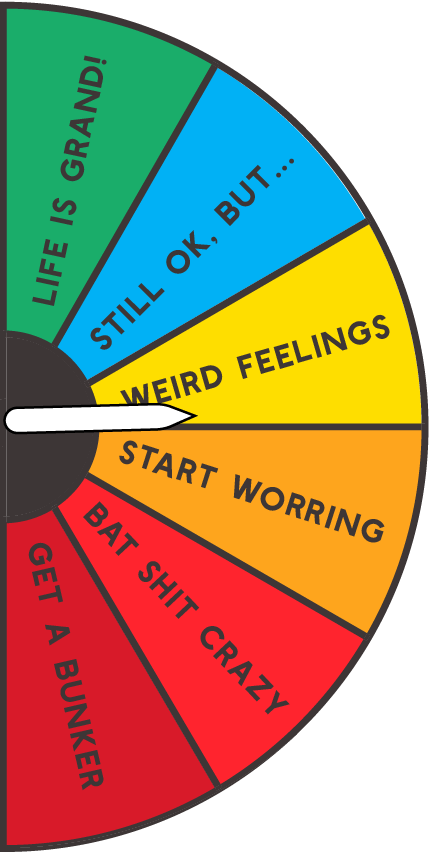
Volcanoes are erupting in The Philippines, but on-fire Australia received some welcome rain. The Iran war cries have been called off and The Donald’s military powers are about to be hamstrung by the Senate. Meanwhile, his impeachment trial is starting, and we’re all on Twitter for a front-row seat.


The Progress Report: Crime Is Down, Fear Is Up!
Featuring Zachary Karabell and Emma Varvaloucas
On this week’s episode, Zachary and Emma dig into three surprising pieces of underreported good news. Illinois becomes the first state to ban AI from acting as a therapist, which is sparking a debate about ethics, tech limits, and vulnerable users. Global deaths from extreme weather have hit record lows in 2025, and in the U.S., the FBI’s final 2024 crime stats show a dramatic drop in murder, violent crime, and property crime, even as public fear remains sky-high. As always, Zachary and Emma cut through the noise to uncover the facts and provide your weekly reminder that progress is happening.


Prefer to read? Check out the Audio Transcript
Although the transcription is largely accurate, in some cases it may be incomplete or inaccurate due to inaudible passages or transcription software errors.
Zachary: What Could Go Right? I’m Zachary Karabell, the founder of The Progress Network, and this is our Progress Report version of our What Could Go Right? Podcast, our weekly short, quick, and dirty look at some of the good news that you. Likely have missed this week, and in fact have missed every week, and which we would miss every week unless we were making a concerted effort to find it.
Because news is almost, by definition, not good. There is no quote unquote good news. ’cause good news doesn’t tend to draw attention nearly as much as bad news. Heat and passion drive clicks and eyeballs and ears far more than. Cool, good news. And that is a problem because it shapes an impression of the world as one of constant crisis, constant chaos and constant bad things happening everywhere all the time.
And while it is certainly true that bad things are indeed happening everywhere, all the time. That is not the entire story or even the predominant story of human beings and how they live their lives daily on this vast, complicated, and wondrous planet of ours. And so at The Progress Network, Emma Var Lucas and her team spend their days combing through the archives of the interweb to find.
Stories of uplift and change for the better, or stories at least, of people who are daily engaged in solving those myriad problems and dealing with the chaos and the crisis by trying to figure out what do we do about it to shape a future that is better and not to send into the maelstrom of the present.
That auger is a future that is worse. So that’s why we do this, and that’s why we try to highlight this every week and bring you a couple of nuggets, which you can also find in the What Could Go Right? newsletter, which Emma writes and which is free, and which you can sign up for on our website, The Progress Network dot org.
So Emma, what have you for us this week.
Emma: Yeah, so I’m curious to hear about your reaction to this one. Zachary, Illinois has become the first state to ban AI in therapy.
Zachary: Wow. And how are they gonna do that?
Emma: I don’t know. I mean, I do know they’re gonna give fines in the case that they find out that it’s happening now. The question about how they find out if it’s happening is, I don’t know if somebody brings a lawsuit, if somebody writes into the office of the state, I don’t totally –
Zachary: Meaning that you can’t like ask chat GPT therapy questions or it just means you can’t be an office that’s setting itself up as like online? That actually turns out to be an LLM.
Emma: You can ask whatever questions you want, but
the law applies to the companies where. LLM, any kind of AI company isn’t allowed to have the AI act as a solitary therapist or like give therapeutic advice. So it’s basically like if somebody goes to the AI and that happens and then they report it.
Find can be levied on the company again, like it, how that’s actually gonna be in practice I think is interesting. I don’t know if this thing really has a whole lot of teeth, but as a symbolic measure, it’s interesting ’cause it certainly is one of the first instances that we’ve seen of a state pushing back a little bit on what AI can do, what are its challenges, and some of the horror stories around people using it for therapy.
Zachary: I would say that this is one of these things. That is somewhat tilting against windmills in that it’s one thing to say that a licensed mental health professional cannot crib chat GT’s answers to the question like, what do I do about my depression? Which is in many ways, like just banning therapeutic plagiarism, right?
Emma: I don’t think it’s that they’re talking about that. They’re talking about like they’re not allowing AI companies to have their technology behave as standalone therapists.
Zachary: I think the way the law was written is it prohibits mental health professionals from being human, fronts for ai. It restricts the use of AI in mental health therapy, prevents licensed mental health professionals from using AI for treatment decisions or direct communications with clients.
Emma: Well, treatment decisions make sense.
Zachary: No, I would agree,
Emma: I mean.
Zachary: How much Lexapro should I prescribe to Jane?
Emma: It says only licensed professionals are allowed to offer counseling services in the state and forbids AI chatbots or tools from acting as a standalone therapist. It also specifies that licensed therapists cannot use AI to make therapeutic decisions or perform any therapeutic communication. So
Zachary: Yeah. And it prevents like chat GPT from saying that this is therapy. It doesn’t prevent you and I from asking therapy questions in the LLM,
Emma: I don’t think you could prevent that, but if, I think the idea right, is like if you go to the chat GPT for therapy questions and chat, GPT is acting as a therapist and providing therapeutic responses and in, in theory, you’d be able to report that and the company could again, in theory get fined.
Zachary: Yeah. Which I actually hope isn’t the implication of it. ’cause it seems to me just like you can. Type almost any search into Google, although that search canon will be used against you if it turns out you commit a crime. I mean, if, if you type into Google, how do I build a bomb? And you then plant a bomb, that search history will be used against you subsequently as proof of intent.
So I mean, I, but in general, I would hope that no, nobody will try to prevent the use of speech in LLMs. It’s just not the presentation of licensed therapy.
Emma: Yeah, I don’t think it’s about the limitations of speech. I think the LLMs work in a different way than a Google search does. Right? Like LLMs, you can. They do make changes to how the LLM responds as a personality. Basically, I think it was the last release of, I don’t remember if it was Claude or Gemini or chat JBT.
It was Lily’s release of one kind of ai. Well, it was so sycophantic as a technology to the people that it was speaking that they actually dialed that down and the next version it was people were complaining about it. So there are tweaks that are going on to like how the AI functions and its personality that go beyond just like, Hey, I’m asking Google to send me to a webpage.
Zachary: And what do we think about this? We think this is the right thing, so that people don’t think that they’re interacting with a human or a licensed human when in fact they’re just interacting with a chat bot.
Emma: I don’t think it’s that people are confused that they’re interacting with a human. I think, for instance, I’m sure that this is not on your TikTok algorithm, but it’s on my TikTok algorithm. There’s this woman who fell in love with her psychiatrist. She clearly has a severe mental illness, and she went to chat GPT or a clot or whoever it was.
Whatever it was, to ask it. Like, this is what I’m seeing in my psychiatrist. Do you think that he’s also in love with me? And the chat, GPT was like, yes, for sure. Oh no. Like you’re definitely on
Zachary: onto something here.
Emma: Yeah. And it turned into a whole thing because she went massively viral on TikTok. The psychiatrist ended up getting docs and then like this woman was getting like the full rage of thousands and thousands of people coming at her, and she’s obviously mentally ill.
So you have these kind of horror stories where, okay, isn’t the government’s. Job to step in between individuals and technology that can be harmful to somebody who’s vulnerable like that. I don’t know. Can they really even step in a way that’s actually gonna do anything? Also, not sure. I am intrigued by the fact that Illinois did take this first step.
Zachary: We’ll take that one under consideration. What do you
Emma: It was under consideration for sure. That’s why I brought it to you. ’cause I thought maybe you’d be a
Zachary: No, it’s, it is an important debate about what are the limits of, or what limits should be placed on the simulacrum of intelligence that AI provides.
Emma: Yeah, let’s talk about one of these interesting stats where I’m always worried about sounding like a climate change denier, but. It is a real fact that the first half of 2025, and of course we still have six months to go, but so far in the first half of 2025, it is the record setter for the fewest number of people globally to die from extreme weather.
Since basically they started keeping records for it, which is very at odds, I think, with people’s narrative about how much extreme weather is affecting our lives today. And that’s not to say that it’s not affecting it. And it’s not to say that they’re not occurring, it’s just that fewer people are dying from it.
Zachary: Look, and this is the challenge of the legit challenge of climate change and the warnings of what effects that will have on the human race, right? Which is our ability to adapt. Control for, respond to and protect ourselves against. A lot of things that we do that are bad for us tends to be underemphasized when we extend our concerns into the future, and that includes things like hunger.
Soil depletion, unlivable of places. I mean, air conditioning is in and of itself, right, a human invention to allow humans to live in climates that they otherwise wouldn’t thrive in easily in, in large numbers, I mean, obviously human beings have been living equatorial forever, but. Not always doing things that we can now do because of air conditioning work longer.
Maybe that’s a bad thing, but it allows us to do so and mitigating the effects of climate change by building buildings that are H more hurricane resilient or earthquake resilient. All the things that natural disasters do, right? They tend to destroy human structures and aero the land on which human beings are living.
There are things we can do technologically that mitigate the effects of that. It doesn’t mean that those effects aren’t more extreme and a more negative. In the sense of they’re more extreme and they require more adaptation and mitigation. It just means the assumption that we won’t be able to mitigate it or adapt to it is often incorrect.
It’s not incorrect if like, if seas actually rise eight feet. I mean, there will definitely be coastal areas that just will cease to be coastal areas. There’ll be ocean or there’ll be underwater. But even in a place like Miami, we know our ability to mitigate against that is pretty extreme. Or Venice or Amsterdam, where you’ve been spending time in the Netherlands.
Even there, right? Human beings can actually mitigate weirdly problematic environmental issues. And I don’t think these things need to be intentioned, but it should give pause to the expectation that we know the negative outcomes of something that is currently negative.
Emma: Yeah, I agree with that wholeheartedly. And we’re not giving enough credit to the technological advances that a lot of rich countries have done and also how much they are now actually. After the millennium. I mean this is relatively recently getting passed on to poor countries and countries working in partnership to get people out of harm’s way when it comes to a cyclone or tsunami or things like that.
So you won’t hear about that in the news, but it is true and it is helping. So, alright. I thought this would be a good one to talk about given the Trump and DC News, and we have definitely talked about crime perceptions versus crime rates before, but just to have a final stamp on the data for 2024, because the FBI just released its crime report for the full year of 2024 with all their data, we have had a nearly 15% decline in murder, a four and a half percent decline in violent crime rates.
Other than murder and about an 8% decline in property crimes. So not just murder and violent crimes, but also property crime.
Zachary: And yet we still have talk of American carnage and vermin that are infecting our cities, or at least that is what we are told. Look, crime always sells meaning. Stories of crime have been a staple of news for a long time, and I don’t think there’s been a period of time in the United States where people’s perception of crime rates has been way, way higher than actual crime rates.
Even when crime was very bad, people thought it was even worse. And when crime went down, people thought it was worse. And then when crime went up in like 21, 22 or kind of COVID, that COVID crime spike, there was a degree of like, yeah, we knew that. Like we knew crime was bad. Even though it was anomalously bad and now that it’s coming back down again, people still think it’s anomalously bad.
So there are a lot of people who feel that police departments in most metropolitan areas are chronically underreporting crime in their own statistics like that. Well, yeah, the statistic are showing the crime’s going down. But come on, we know the fact that they’re being told to under report. I mean like it’s kind of hard to underreport murders and violent crime.
Presumably you could underreport, larcenies, but then that’s a whole other issue. Do you like really believe there’s a conspiracy amongst every measure? Metropolitan police force from blue cities to red cities? I mean, most cities are more blue than red, but there are certainly cities that are in red areas, and I don’t particularly believe that theory, that crime rates are much higher than officials crime statistics, because all these police departments are trying to make themselves look better or all these.
Municipal governments are trying to make themselves look better. The reality is we live in a safer time than most people think, which doesn’t mean that there isn’t crime that is dangerous and disruptive. And then two, when you look at crime statistics in most major metropolitan areas in the United States, most violent crime is confined to very specific areas of those cities.
So the anomalies are like when someone in an area where there isn’t a lot of crime is subject to violent crime. Which then tends to make the news because it’s somewhat anomalous. So like, I live in Manhattan. Someone getting murdered on the upper East side of Manhattan is unusual. It’s certainly not unprecedented.
It definitely happens. Someone getting shot in one of the projects in Manhattan is not as unusual, unfortunately, and is much less likely to be the news. But then it creates this impression of crime being everywhere.
Emma: Well also what’s interesting about, by the way, the theory that police departments across the nation are underreporting their figures. Is that like, did they just start that recently or have they been doing that the whole time? ’cause if they’ve been doing that the whole time, the trend line is still valid. Right.
Zachary: Right, right.
Emma: The other theory I’ve seen that’s like new that I hadn’t seen before. Is that, yes, crime physics are down, but perception of it is up because there’s a perception of public disorder because there are more petty crimes like shoplifting and things like that are on your personal radar in your life. I don’t know what I make of that.
Zachary: So the question of if you go into a CVS and all, everything is behind plexiglass barriers where you need someone to unlock the barrier in order to pick out a product, does that make you think, oh my god. God, there must be a lot of crime here because if there weren’t, we wouldn’t have to, get this stuff off the shelves and then you go to your local pharmacy like five stores down and everything’s open on the shelves because either crime is not significant enough for them to do that, or they just can’t be bothered with setting up plexiglass barriers.
I don’t know. Right. That’s another conundrum of all this. So this perception of reality is definitely a problem. And like everything else, like the question of. When did you stop beating your wife? Like the question, it is incriminating trying to say that crime isn’t as high as my opponents or my adversaries are saying is often just a losing argument, right?
Because then people can say, yeah, well, but there’s still unacceptably high levels of crime, even if it’s lower. And it’s very hard to counter that argument. Like what’s the counter to it in a political context is the counter. Some people are gonna commit crimes and there’s only so much we can do. Like that’s not satisfying to
Emma: Yeah, of course not. Of course not. It’s definitely not a winning political strategy.
Zachary: Which may be why the mayor of DC has recently, in light of the Trump administration’s takeover of the police force in the district, has gone from speaking against it to saying, absolutely bring us more resources. Right? Because the mayor can’t go, it’s okay, crime’s low. We want it to get lower. It’s lower than it was.
Emma: We’re not, yeah, we’re not worried about it. Yeah. Yeah. Not a winning political message. Luckily for us, we’re not politics, so we don’t need to worry about that.
Zachary: We don’t have to deal with it anyway. The reality is this, the statistics are clear whether or not they are reassuring and they should be paid attention to because reality matters. Or at least we think it does. And on that note, we wanna thank you for your. But does it. Thank you for your time. Please send us your news stories, your ideas at hello at The Progress Network dot org.
Thank you for Emma and her team at The Progress Network for coming up with the news you can use for the week, and we will be back with you next week.
Emma: Coming up as in finding, not making ’em, just to be clear.
LOAD MORE
Meet the Hosts

Zachary Karabell

Emma Varvaloucas