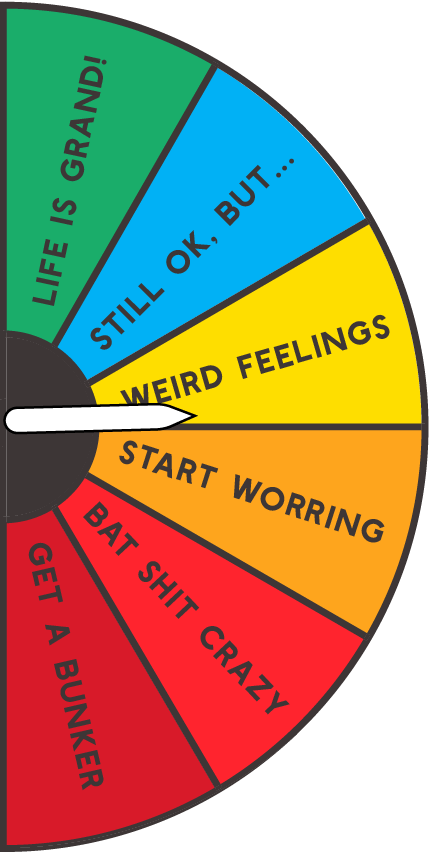
Volcanoes are erupting in The Philippines, but on-fire Australia received some welcome rain. The Iran war cries have been called off and The Donald’s military powers are about to be hamstrung by the Senate. Meanwhile, his impeachment trial is starting, and we’re all on Twitter for a front-row seat.


Turning Down the Headline Noise
Featuring Zachary Karabell and Emma Varvaloucas
Let’s close out Season 7! Zachary and Emma look back on seven months of thought-provoking positive conversations, from global politics to the depths of sci-fi, exploring how to stay hopeful in a world hooked on negative news. They dive into protecting your mental health by controlling your news intake while also celebrating how social media platforms empower 8 billion voices to be heard!


Prefer to read? Check out the Audio Transcript
Although the transcription is largely accurate, in some cases it may be incomplete or inaccurate due to inaudible passages or transcription software errors.
Zachary Karabell: This kind of roiling discontent that is evident everywhere is not a sign of the breakdown of something in a negative way, but I think is the chrysalis of something. And that is never have more people felt like they have the right to have a voice and they have a right to have their needs met and they have a right to express their discontent and the belief that that should be heard.
What Could Go Right? I’m Zachary Karabell, the founder of The Progress Network, joined by Emma Varvaloucas, the Executive Director of The Progress Network, and this is our last episode of this particular season, and we are going to do a little bit of a roundup and a little discussion between us as we ruminate on what we have learned over the past lo, these six or seven months. Feels like longer than that. Somehow there seems to be a lot going on in the world, and what we have tried to do over this season is to toggle between the constant cacophony of the headlines, most of which are negative or crisis-oriented about American politics and their many and manifold divisions or about global politics and their many and manifold divisions or about what’s going on with climate and global democracy, or the lack thereof, or the receding ness thereof.
We have tried to both address some of these issues and with an eye toward not sugarcoating the challenges and the difficulties, but toward what’s the perspective we can bring to this that is not purely of the moment and not purely of what is often, frankly, the hysteria of the moment.
Very difficult for any of us to not give in to the intensity of our social media feeds, the intensity of whatever headlines of whatever news, quote unquote we read, if we do, in fact, digest any news, and if we don’t, and we’re getting our news from social media and clips on Insta and clips on TikTok and Facebook, yes, some of us do in fact watch Facebook reels,- maybe not many of us, but some of us, if that’s our primary source, even on LinkedIn, which is a little more sober, but still not immune from the being buffeted by the same trends and same wins as the other venues.
It’s hard to maintain any degree of equanimity in a world that seems to be losing its equanimity by the moment, so we try to give a different perspective or a different look, which we also do with the Progress Report, which is our adjunct to the longer form podcast of What Could Go Right? where we look at some news of the week that is more positive. Some stories that we all probably missed in the fray because they don’t leap out at us. There aren’t like good news headlines as a general thing that’s just not part of the mix. And Emma and her team at The Progress Network goes through every week and tries to find some of these nuggets, some of these things that are going on in throughout the world, whether it’s American states and New Mexico offering a wider suite of education or places in Africa dealing with disease or places in Asia dealing with more rights and more freedoms. I mean it’s, you know, it depends on the mix, but there’s always things going on and that we don’t tend to look at because there’s no such thing as a headline that says, Things are Great. Check in Tomorrow. That doesn’t grab the attention.
So maybe let’s start for a minute, ’cause Emma is writing a book about news and how one consumes it and how one reads it and how one deals with it. You do not succumb to the, oh my God, despair or the, oh my God, anger and agitation. That tends to come with a news diet in a world where that’s what galvanizes attention. That’s what grabs us viscerally, liminally, right?
The hot emotions grab us, the cool emotions not so much, even though we all recognize that in a balanced life, we need a mix of both, and we need the perspective that coolness offers in a hotheaded time. So maybe Emma, why don’t you take two or three minutes and tell us how to deal?
Emma Varvaloucas: The more research I do for this book, the more intense I get about telling people that however you decide to intake your news, the absolute worst way to do it is through social media, and especially if you’re on a social media algorithm, that’s not things that you’ve decided to follow, but it’s like a for you algorithm the way that TikTok has it, for instance. Absolutely worst way to get your news. Social media is not just a platform. I think when we think about social media, we think about it’s a neutral platform. It’s just a way of disseminating information. Social media is actually an actively radicalizing platform, and if you are not taking control over what kind of information you’re seeing on social media, it’s kind of letting, it’s like someone coming into your house, filling your refrigerator with a bunch of junk food and like ultra processed foods and candy and Snickers and Coca-Cola, and then saying here, like, I have figured out your diet for you. We would never accept that, right, when it comes to eating. We would never let people with questionable intentions at best come into our house and decide what we’re going to put into our bodies. Why would we let that happen in terms of what we decide to put into our minds and our consciousnesses and what we’re paying attention to?
So I really try to convince people like it’s gonna make a huge difference to your mental health, to take all of your news and all of your politics related content off of social media. You can either train, if you’re a TikTok person, you can train your algorithm to not serve you. That stuff like I, it almost never serves me political news content because it knows that I will actively skip by it. But even if you’re not on a for you algorithm, I recommend to people like choose one or two news organizations that if you’re like, you really, really, really wanna look at your social media for them, fine. I’m not gonna argue about it. Try not to follow them, just like start your social media time by like going on, checking their page, seeing their their most recent posts or their stories and then moving off, and you’re gonna have a lot more control over your news intake that way, both in terms of like, are you in the right mind space to handle this right now, and in terms of the quality of information.
Zachary Karabell: The short take is like train your algorithm, right? These are tools that if left to their own devices will, will feed you the, the most agitating news ’cause that tends to be on a global population scale, the stuff that gets the most attention. So if you kinda leave it be. Maybe not just the most agitating, it’ll probably feed you sex, it’ll probably feed you, you know, gossip. It’ll probably feed you a few things that they think you wanna buy. So if you’ve looked at a cat video, it’ll probably feed you cure something to buy for your cat. So it’s not all just hysterical news, but in, in general, it’s the algorithm is designed to keep you attending to keep you attentive and you have to train it to keep you attentive to what you want to attend to and not what a greater population of humans tends to attend to.
And, you know, we’re, we are all part of a greater population of humans, as you’ve pointed out, like none of us are immune from the, the willow wisp of the siren call of some of that media, right? Just like we’re not immune from enjoying junk food or, or having a kind of a visceral response to sugar, fat, salt.
And the same is true as you’ve looked at, like in our social media, but it doesn’t mean that these algorithms per se are like, have a mind, right? They are, they’re just like designed.
Emma Varvaloucas: No, they, they, they do have a mind and the mind is us, and that’s what’s radicalizing about them. And in a way that I think I didn’t properly appreciate before I started researching this book. You are a hundred percent correct that the most attention grabbing stuff floats to the top. And also in particular with politics and news, because they co tend to come from the, like massive accounts. They’re also gonna come to the top of your, your algorithm, but also there’s an effect on social media where unless you’re somebody who really cares about journalistic standards, so unless you’re following somebody that you know has a journalistic background and they are privileging, know, facts and context above all else, they’re saying if they publish an error, they’re quoting their sources, and so on and so forth, you’re actually following people that are becoming steadily radicalized by their user base is also radicalizing their user base. It’s like a radicalization circle here because people stop following them that are more moderate, ’cause they start to get steadily more extreme because they see that the extreme stuff is juicing engagement. And then they, as their audience becomes more extreme too, they wanna serve them the stuff that they know is going to excite their audience. So again, if you’re not following people that are putting journalistic principles above all else, you are both participating in the radicalization of that influencer and letting that influencer radicalize you. So I would really be careful about who you follow on social media. And as you say, be careful about training your algorithm rather than letting the algorithm train you.
Zachary Karabell: Yeah, I mean, that’s a fascinating point about the kind of constant feedback loop. At some point you don’t know where the chicken and the egg is. You don’t know where the head and the tail is.
Emma Varvaloucas: Exactly.
Zachary Karabell: They are simply becoming one spinning top that’s just spinning faster and faster. ’cause you’re all engaged in the process of spinning it, and like that’s something to be really mindful of.
I mean, the question look, we have, and you and I have talked about now for a couple of years is like, can that top spin with more positive, uplifting, you know. And when we say positive, uplifting, it’s, it’s from the principle of there are actually positive, uplifting stories. I mean, we live in a time where I say the words positive, uplifting, and there’s a little part of my own voice that goes, Oh my God, that’s just ridiculous. I mean, there’s like, that’s, that’s beside the point, or silly or naive or like it sounds somehow hollow. And yet a lot of what we do is predicated on a belief that there is a positive aspect of the human condition that is constantly in evidence in action in the world, and we don’t pay attention to it because it just doesn’t constitute whatever the hell it is we’ve decided is news and entertainment in the way that these other things are.
I mean, clearly not all of it’s about politics. I mean, there’s plenty of stuff about Love Island or whatever the hell, the, you know, whatever show is currently the show. I mean, I’m not, I’m not as hip to these things as I probably should be, should be from the perspective of being aware of what’s going on. But I know this stuff is going on, so not everything is that right. Not everything is Donald Trump and Xi Jinping and the, the, the cacophony of politics or Gaza and Hamas, and many people tune out from that completely, right? Their algorithms don’t feed them that either ’cause it’s too busy them feeding them, you know, cats and Kardashians.
But there is this reality that we believe that there’s also like good news, good news, meaning there’s human beings doing good things, even in a difficult time. There’s human beings trying to solve things, recognizing the problems we have, but thinking, okay, what? What can I do to make the future a future of our dreams and not a future of our fears?
Maybe we’re also assuming a a negative future. We’re kind of over-indexing for armageddon and under indexing for utopia, and yet is there a way in this kind of world where that becomes if not dominant, but like is there a way, if you’re saying these algorithms are us, is there a way for that to rise to the top or is it just doomed to be overwhelmed by all that unless you make a really concerted conscious effort otherwise.
Emma Varvaloucas: From the baseline of how the algorithms work, right? They’re maximized for short term engagement. There is a way to harness that in a positive way. Like the people that help us with our social media, they do a lot of deep dives into which social medias of ours hit and which don’t. Right? And what we’ve discovered, and it’s interesting that it’s the case for us personally as, as The Progress Network, and so as an organization, and this is also what the research says, is that any emotion can be harnessed on the algorithm. So it doesn’t necessarily need to be a negative emotion like anger or rage or controversy, although again, like those things do naturally tend to grab our attention, you can also harness the algorithm through a positive emotion like awe or wonder or intrigue or curiosity, and you can build your social media around getting people to respond to that emotion, like first out, so like it is possible. However, that being said, I still think that you’re, aside from the, the infrastructure problem and the backdrop, there’s a lot of money floating around social media, and particularly with politics and political lobbying that is not disclosed. You don’t know who’s getting paid by whom at all. No influencer, no brand, no platform has ever had any penalties about not disclosing political lobbying, even though it’s everywhere.
A lot of people don’t know, for instance, that RFK was getting paid out money by big anti-vaccine misinformation accounts that have made tens of million dollars off of their products. So there’s also just a lot of, like in affiliate marketing going on, on social media where people are being paid to change your opinion and to do things in a political manner that we have no idea. We’re also living in a system right now where politicians are winning elections off the back of their social media and off the back of grabbing attention. So, you know, those incentives are all screwed up too.
So when I put all those things together, I’m not exactly positive. That’s why I feel like the best thing to do. I think it’s like, I love social media. I’m on TikTok a lot, and it’s a completely different experience when you clear out news and politics. So I think that we, we need to make a push from the social media side, although I’m not really bullish on them making serious changes nor our political class making serious changes, so I’m hoping that people will at least heed our advice here on this podcast.
Zachary Karabell: Yeah, I mean that’s, it’s a challenge. I do think, as you’ve pointed out, and I think as some of us have experienced, you can shape what you take in and it’s probably a good idea to take in a bit of everything, or at least that’s my perspective, right? I find it useful and important to be aware of what’s out there, which means not over filtering to the point where you create a total filter bubble, right?
Because that’s also the danger. One of the advantages of news as it used to be, was while it was heavily curated, right? You got the New York Times as a paper and it, it was a much more finite thing than, for instance, even the New York Times is today, where you can find a lot more variety of stuff on their site because they just have more content. You still were exposed to, yeah, whatever the editors thought their readers should be exposed to. But it tended to be a somewhat wider range. Now you can, you can curate to the point where you don’t get any information other than information you’ve decided you want.
And that of course applies to politics, but it applies to extreme skiing videos or cooking videos or for a little while I was obsessed with Korean cleaning videos ’cause they have all these like amazing gadgets that you’re just didn’t even know existed and probably don’t in the United States. So you can do that, right?
You can fill your feed with only that which what you wanna see that the danger of that of course, is there things we should all probably be exposed to that. We don’t want to be exposed to contrary viewpoints, different perspectives in the world, different cultures. That’s always been a challenge. That’s hardly a new thing. But our ability in a very noisy world to modulate the noise and determine which noise we wanna hear is also greater. So more information coming at us, more ability to shut out information we don’t like. Maybe not more ability than if you’re in a Burgundian village in 1502, you know, but then your individual ability to either get information or resist, it was limited to just by virtue of circumstance. All that by way of saying I might do it differently than you, and that I would make sure that there was some something to penetrate the filter bubble. Now it, that may not need to be TikTok in your case, right? You, ’cause you can then read the Economist, or you can read whatever the hell you read.
Emma Varvaloucas: I’m in total agreement with you. I read across the political spectrum in terms of like my news intake. So like that’s a separate thing from social media and I am totally with you that we should all be trying to read across the spectrum or, or use some of the tools that are out there like all sides or ground news or you know, the founder of Tangle, Isaac Saul, has been on this podcast. They’re all a bunch of great tools out there for you to do that.
One little interesting tidbit from the research, which is fascinating, is that that is a great system for depolarizing if you’re not already highly polarized. But if you are already highly polarized, being exposed to contrary viewpoints actually makes the situation worse.
So if you are on, if you’re listening to this podcast, you’re, you’re probably not like a super highly polarized person, but if you’re interested, you can just Google like polarization test online and, and see where you’re at because the, the fixes are different depending on intense you feel. Mm-hmm.
Zachary Karabell: So what, what is the fix if you’re intensely polarized, like what if you’re intensely on the left and you just think that everything that that isn’t of that is, is dangerous and destructive and bad.
Emma Varvaloucas: Yeah. I haven’t found a good answer for it. Like people aren’t really sure. So I mean, what I can offer just personally is like.
Zachary Karabell: Please hold.
Emma Varvaloucas: At least, at least stop purity testing the people that are like one step to the right to you. And I don’t even mean like on the right, I just mean like one step to the right, like try to stop purity testing the people around you in your own tribe. That’s the best I can offer at the moment.
Zachary Karabell: Okay, so no, no Mensheviks versus the Bolsheviks. Okay, obscure 1917 Russian Revolution reference. But the point being is definitely true that in highly contested moments and particularly politically contested moments, you’re totally right that people go after those who are slightly elsewhere on a similar part of the spectrum than they are with even more intensity than they go after people who are clearly way over there, where wherever over there is, right?
So there is that weird, particularly for those who loosely identify with the left. If you read about left politics over the past 150 years or so, the most intense animosity is often like that person who’s slightly to the right of you or who you perceive to be slightly to the right of you, not for the like the person way to the right of you.
And again, it’s hard to know now, right? Because there’s also huge animosity just, or at least people feel the huge animosity in a polarized system. And that’s true everywhere in the world, right? This is not an American phenomenon. Anything that we talk about that’s an American phenomenon today tends to be a global phenomenon in various ways. The rise of nationalist groups, the rise of anti-immigration sentiment, middle class people feeling the system has failed ’em, that there is something amiss with the political class and or the political system. A fear and or belief or conviction that the future is gonna be worse, that their kids aren’t gonna do better, that the world is a chaotic place like these are, these are themes you will find in almost every country in the world. Not every single country, Saudi Arabia, the UAE, tend to be a little more hopeful about the future than most other societies. And then there are a few societies that you either can’t tell or really, really are apathetically grim about the future.
And you know, a lot of the world is roiling in the middle. So this is not just an American thing. And even though our show tends to focus on American issues, ’cause you know, we are, although as listeners know, Emma also has the perspective of living in Greece, an American abroad kind of thing, which we’ve, you know, I think has enlivened and, and expanded our sense of what is, what the perspectives are.
So let’s talk for a moment about the season that we’ve had. You know, I, I, I’m, I’m struck when I look over the interviews that we’ve done this year, you know, we’ve had a lot of really intense discussions about the political issues that are grabbing most people. We had a really good discussion, I thought, with David Frum who is Canadian and American, has been deeply involved in American politics as a speech writer was a sort of establishment Republican and has since really started to question the nature of the contemporary Republican party and also is acutely still aware of, of the Canadian perspective on all things Americans. So kind of a fascinating discussion, although very, in many ways, partisan one, I mean Frum is no fan of Donald Trump, and made that very clear in our interview and certainly believes the pathway the United States is on economically with tariffs and if we’d had an a continuing conversation, those who followed David Frum’s columns at the Atlantic and his podcast also produced by The Atlantic, know that he is adamantly concerned about the nature of American politics and the direction of the Trump administration.
But you know, again, that was, I think a really good conversation at the time, right after the April announcement of tariffs. And it wasn’t clear exactly how extensive those tariffs were gonna be. Turns out they remain extensive in rhetoric and far less extensive in fact, meaning the announcement of tariffs and the collection of them are not the same thing. Way more announcements than actual tariffs being collected. Doesn’t mean that hasn’t disrupted things hugely just by the announcements thereof, but we also had a bunch of shows where it was, I thought important and fruitful, and for me at least a relief to not talk about all things Trump and all things Gaza and all things left and all things politics, and to talk to people like Sue Dominus about siblings and how our sibling lives and raising kids, raising siblings, shapes our own future, our own sense of what’s possible.
And we talked a lot to Emily Oster about parenting and kids and economics and how that all plays in. You know, these conversations that really are not about what’s going on, but if you think about new families, like a lot of your bandwidth is consumed with your kids more than it’s consumed with the sandbox in Washington, DC. It’s consumed with your own local sandbox.
That’s very important to remember, right? It’s important to focus on the degree to which most people are not focusing 24 7 obsessively on what’s happening in Washington or what’s happening in Paris if you’re French, you know the whole, your own local realities, familial realities have profound effects on your lives that are palpable and tangible that matter greatly, that again, just don’t constitute the news.
Emma Varvaloucas: I think that that question around balance is such an interesting one right now because I definitely agree with you that those episodes that we’re not talking about politics and Trump, and the Supreme Court, and Canada.
And by the way, that, my main takeaway from that episode with David from was the audience response. I mean, people won’t know this from listening to the podcast, but that went like small town viral on Canadian YouTube, and the Canadians are pissed. I think that Americans are maybe not properly understanding how upset they are with the United States. But anyway, moving beyond that, it really was such a relief to have those episodes, and I think that that relief is important right now.
Like you, you can’t just be worried about what’s going on at the level of politics if you don’t have other things in your life that are filling your cup, and there are plenty of things going on that we can continue to fill our cup with, that doesn’t mean that we tune out completely like you were talking about before. Like I also think that that’s an unhelpful response that people are just like, well, like the world kind of sucks, but my life is basically fine, so I’m just gonna kind of like ride this out. I don’t think that’s a, the proper response either, but finding some kind of balance between the two, I think is a, a huge question of, of now, and I wonder how people are doing with it.
Zachary Karabell: That episode, I think with, with Frum on YouTube got close to 100,000 views, many of which were very favorable about, about David, not a, not as favorable about us. There was a lot of comments that were, you know, sort of, we were the Amer, we were the ugly Americans in that conversation, no matter what we were saying, right? It was, it was a fascinating eye of the beholder kind of conversation that we kind of expect on a left right perspective that this was a new one at a nationalist perspective.
We’ve done some episodes about China. We don’t even know if A, if anyone listens or watches in China, and B, we wouldn’t know what the commentary was because most of it wouldn’t be visible to us. So it could be that same, the same dynamic would occur in any hotly contested national rivalry slash tense relations. But it was fascinating to have like Canada, US become this heated thing, and you know, for someone like me growing up, the last thing you would’ve expected was having a heated conversation about Canada and the US, nor would you ever have expected anything about Canada and the US to go viral. Right? It would’ve been kind of antiviral.
It would’ve been, it would’ve been, it would’ve put people to sleep like the, if you had sort of proposed that as a conversation, Hey, let’s do, in our limited season an episode focusing on Canada and the US. Had we had producers who were really totally heavy handed at any other time in human history, that would’ve gone No, no. That is, that is not a good way to get viewer engagement. That is a really good way to get the opposite of viewer engagement because it’ll turn into just about any and tune into just about anything else other than Canada, like that was a snooze story and now it’s like, whoa, the story du jour, which is its own sort of fascinating how things turn. I mean, in this case, not a very good fascinating, but fascinating nonetheless.
Emma Varvaloucas: Yeah. And also very interesting to me about like the differences between what I feel like on the day to day in Greece and also I’m, I’m often in the Netherlands. You know, traveling around Europe, I have a family member that constantly asks me like, How is it as an American in Europe right now? Do they hate you?
And I’m like, No. I’m like, No, no. I don’t feel that on a, a daily level. Nobody really cares, you know.
It’s fascinating to me to compare that to the virulent response on Canadian YouTube because, I don’t know, I’m just thinking a lot about like, you know, how far is the damage going? How much of this is reversible? And some things, it’s good to remind yourself, like that stuff sticks around in people’s minds a lot more than they’re sticking around in ours, like judging part of that comment section, the, the Canadians are gonna be not gonna be recovering from this anytime soon. So.
Zachary Karabell: Yeah. I mean, look you that, that point you make about not everyone is obsessively taking in what the United States is doing. So Canada has a very particular close relationship that was really shook by Trump and the feeling that Trump had just like walked in and slapped a friend in the face. You get a little bit of that in Europe, but I’m definitely struck by, and I, I recently did a piece on this about, for a lot of the world, what’s going on in the United States is incredibly entertaining, it’s like popcorn movie entertaining, and so there’s a lot of people glued to what Trump is saying and what’s going on between the Democrats and Republicans and what policy is, and what’s going on in the States, but they’re glued to it in a, you know, frankly, more of a Kardashian way than a, like, this is really important way now it.
Emma Varvaloucas: Oh yeah.
Zachary Karabell: It obviously is a legacy of just how central the United States has been and remains a powerful dominant in the sense of wealth, military power, global reach way. But my sense traveling around the world is much more. There is a obsessive attention to what’s going on in the US because it’s incredibly entertaining. But there’s also both a degree of schadenfreude, and a degree of, there’s an almost an inverse relationship between the entertainment value of the Trump administration for a lot of people globally, and how much they care in the sense of this matters to the shape of their own future.
Emma Varvaloucas: A hundred percent. I’ve actually had the exact verbatim conversation with friends here who are European. They’re like, no offense, I know you’re American, but like we’re all like mimy. You know? They start mimy eating popcorn and I’m like, I honestly, if I were an American, I guess I would be too. Like that’s just how it is. So.
Zachary Karabell: I was at a conference last week and there’s a woman there who’s, some of her relatives are in Nigeria, and she’s constantly getting texts from them, like, did you see the latest thing Trump did? And she is not paying nearly as much attention to kind of the vagaries of what’s going on, partly for her own kind of mental health, but also just for them.
It’s more, it’s, again, it’s, it’s the card, it’s the reality TV, it’s the telenovela, like the United States has become a telenovela.
Emma Varvaloucas: Ironically enough, given the sentiment in States right now.
Zachary Karabell: Yeah, but that’s why I thought, look, we did a lot of episodes this year. We did one with Austen Ivereigh about the Vatican and about the new Pope, and we did one, well, we did one with Sam Tanenhaus that a little bit was how did we get here, the history of the 20th century, how the Right rise, or through the eyes of the story of William Buckley, who’s kind of the progenitor of a lot of things, although he would probably be, oh, who the hell knows what he would be speculating about, what dead people would think about, what they would think about our president, and if they were magically resurrected and asked to opine is something we do all the time. It’s kind of absurd. Like we don’t really know what they think. Some of them would think like, wow, this is really cool. Or maybe they think it’s awful. Or some combination of the two, which is kinda what we think.
Anyway, we did a really interesting episode with Mike Grunwald about, much less about climate change than about just food and what is the future of food and how do we deal with that and what’s the best way to think about that in a world of not as many people in the future as we thought, but still more people who want more things.
And, and then we did a really interesting episode with Johan Norberg about what makes societies thrive historically, right? What, what constitutes a golden age? Were we in one? Are we no longer in one? How would we know if we were no longer in one?
And he had some really sort of interesting criteria to assess, are you in a golden age? Are you in the dying embers of a golden age? How does one know these things? And so we, I think we tried a lot to broaden the perspective of what’s possible. We had a really interesting episode with Ed Finn of Arizona State about science fiction, talk about broadening the perspective of what’s possible, right? That’s the ultimate dreaming of the impossible or the improbable and this weird dialectic that exists between 20th century and now, 21st century science fiction and a lot of the kids who read it, who then become adults who kind of wanna make it true.
And there’s this kind of strange meme-ish like feedback loop that seems to inexplicably sow the seeds for future innovations and inventions.
Emma Varvaloucas: I need somebody to do this research, or maybe I’ll do it when I have time. I need to know what sci-fi is being put out right now that like the, you know, Gen Alpha future tech people or science people are going to try to make reality. What are the cool new things? Like I don’t, I don’t see it. I need someone to tell me.
Zachary Karabell: I don’t know.
Did any episodes stick out for you that you were like, wow, that was cool? They all did, right? I’m asking, we shouldn’t pick amongst our children. They were all cool and amazing and, but anything you wish to reflect on right now?
Emma Varvaloucas: I really enjoyed our conversation with Rutger Bregman about moral ambition. His whole reflection about moving from Europe to the United States. I keep on saying Europe. I feel like Europeans are gonna get annoyed. Moving from the Netherlands to the United States, to be specific, and kind of encouraging people to do more with their lives and kind of like sit around in a job that doesn’t contribute much to society.
And that kind of spirit, especially right now in the United States, and especially him doing a very unexpected move to the United States when so many people are currently moving out of the United States, I thought was just really refreshing and just a reminder that again, like we, we, we keep saying in this episode, we’re in a rough political moment. Who knows how long that moment will last, but there are things that are, have been problems in this world for 200 plus years and will probably be problems 200 plus years in the future. And we can turn our attention to those as well and probably have a whole lot more meaning in our lives because of that.
So yeah, I would encourage people to listen to that episode as well.
Zachary Karabell: It’s funny, there was some pushback on that episode that I heard of Rutger and you, you should look up Moral Ambition and the, the school that Rutger has created in New York and some of the, the goals that he has for that.
But there were some who felt like he was unnecessarily denigrating. Those traditional jobs and kind of banking, finance, consulting, and law. Because while it may be true that there’s people who go into those, because it’s the path of least resistance, if you’ve had an elite education and also maybe not feel fulfilled in it, but then there’s also a lot of people who do feel fulfilled in it, and also a defense of those industries and professions as being at least in part, necessary to the, the free flow of capitalism and of society. So.
Emma Varvaloucas: Wait, hold on. I gotta ask where you on, did this come from people that are currently in banking, finance and big blah, blah, blah, blah? Is this like crows protest anti crow propaganda?
Zachary Karabell: No, but it got, it came from some of my kids’ friends, some from, from that 20 something set who are thinking about careers in that.
Emma Varvaloucas: Oh, interesting.
Zachary Karabell: And yeah, I mean, one or two people I know, yes, who are in those professions who feel like, Hey, you want smart people involved in banking, meaning we all need banks. We all have bank accounts. There is a free flow of capital that is a vital aspect of society. I was in asset management for a while. I worked at a financial services company. You know, a lot of people involved in those industries are very service oriented. Yes, there are a few in, in aspects of all of those that are focused entirely on money and you know, that does have questionable outcomes.
There’s also a whole lot of other people, particularly in, you know, finance world, especially tech world, partly consulting even, who are really focused on helping people solve problems or helping the free flow of capital and doing it with integrity. I’m just saying that there was a pushback. Rutger had a kind of a broad brush, just like you correct it by saying, there’s no such thing as a European, right? We should be more subtle about how we talk about these professions rather than just encompassing them all in one bell, negative swoop.
Emma Varvaloucas: Fair enough. I do think that when you’re talking in broad strokes, I think also part of media literacy, right, is like understanding when something’s directed at you and when it’s not. So like if you’re part of these careers or considering these careers and you are like filled with meaning and joy and like they really play your strengths and you’re really interested in them and like certainly like. Everything across those sectors is not created equally in terms of like what you’re contributing to society. But I, I do think that Rutger’s point remains about like the proportion of people coming out of like a high, you know, like Ivy League institutions and really highly ranked colleges and institutions. The proportion that end up going into those professions, I feel like it’s probably lopsided.
Zachary Karabell: The thing you are trained for at elite institutions are how to excel at rules-based systems, so like engineers, lawyers, consultants, programmers. These, you know, these are things where, yeah, there’s immense creativity at a higher level, but they’re also rule-based systems that you have to master. And a lot of people who are selected into elite schools have already proven that that’s something they excel at. They take tests very well. They perform well in a classroom setting where the parameters are. You learn a curriculum, you take a test, you perform well on how well you have learned that particular set of parameters. That’s something I certainly excelled at, but it doesn’t necessarily lead to creativity.
It doesn’t necessarily lead to entrepreneurship. It doesn’t lead to service, right. Those are not, those are not the things that you are either rewarded for or got you to the place of getting into an elite institution of higher education. And we’ve talked about this over the years on the, on the show too, like what’s the nature of education? What’s the nature of higher education?
Emma Varvaloucas: And also, I mean, as you’re pointing out too, like services in the eye of the beholder, like what counts as service? Like I have always said that I’ve looked at my journalistic careers, like I would like to be of use to people, but I spent many years at a, a Buddhist publication and some people would find that very useful and other people would be like, what a waste of time. So yeah.
Zachary Karabell: You went to NYU to end up at a Buddhist publication, really? Was that? Did you need a four year degree for that? I mean that, I’m saying that would be the pushback of people.
You should have spent two years in a monastery.
Emma Varvaloucas: I did go to a monastic school for six months.
Zachary Karabell: There you go.
Emma Varvaloucas: Part of a study abroad program. Does that count?
Zachary Karabell: Okay. See if you, you, you partly did it anyway.
So again, we tried throughout the season to really broaden the topics that we looked at and not get completely immersed in the politics of the present. Partly because we believe. I think with good reason that there’s a lot of other people who are immersed in the politics of the present and are commenting on it daily or weekly or regularly in a way that is often very illuminating and important and that we have less to add to that, even with a different lens and even with a different sensibility, that we have something to add to that of like, Hey. Is that the full story or is there a history here that would help us place the present in a different context?
My bias has always been one of the things that makes me less pessimistic about the present of the United States and its future is that I’m probably more negative about the American past, meaning I think the American past has been uglier and full of authoritarian fascistic, mean sexist, racist tendencies and violence that is coursing through our history that we tend to sweep under the rug, or we tend to kind of conveniently forget in a more uplifting story that we tell about ourselves.
But here we are. And I do think there has been immense progress and I do think a lot of what was in the past has been ameliorated somewhat, but it does make me less, less despairing about the present, ’cause I don’t think we started from this enlightened place and we have now descended into a more dark place.
I think that’s the false narrative. I’ve tried, and I think you and I have gone back and forth in this, but I’ve tried often in these discussions to say one of the things that I think is most dangerous about how we talk about the present is that it is often if you peel back the assumptions full of a conviction that the past was better. The right often romanticizes the 1950s or the Reagan era, the left often romanticizes, the civil rights era and great society and the creation of safety nets and to some degree the 1990s end of the Cold War, the beginning of the internet revolution. Everybody tends to romanticize some moment in the past, and this is actually more American than it is of some other countries.
Although if you look at the rise of the Reform Party and Brexit in Great Britain, a lot of that was predicated on look how great we were. Look at all the values and virtues of Great Britain that were then undermined by being part of the European Union. Most societies have some degree of rose tinted glasses about the past.
And, and when that informs the present, I think that’s the source of a lot of anger and often destructive behavior because it, it doesn’t just say, Hey, we have problems that we need to solve. It says, we messed up along the way. Like things were okay, things were going well, and then a bunch of people made really bad decisions, everything effed up, and here we are trying to pick up the wreckage. And, and the problem with that viewpoint and that lens is that it, its presupposes that there was a formula that worked and now it’s broken and part of the way forward is to reclaim the past. And I think that is in almost every situation, false, false nostalgia and, and destructive because it leads to formulas and readings of the past that are wrong, borrowings from the past that were wrong, and not really seeing that, you know, often there’s been a lot of forward momentum that is positive, but imperfect and that the best way to often deal with our problems in the present is to just deal with our problems in the present.
Emma Varvaloucas: Here. Here. Yeah. And I think everything you’re saying is harsh but true. And reminds me of kind of a similar. Her point that. Has really changed my perspective since I moved to Greece, which is that there’s also this expectation, again, related to some of this historical inaccuracies, and I think also related to the bubbles that people put themselves in. an expectation that the world should be, at least from a liberal side in a certain era of progressiveness, right? Like that, you hear people say a lot like, oh my God, someone thinks like that in 2025. Like, how could they not realizing that like the rest of the world is much worse than, than most people in liberal bubbles can imagine.
And there’s a way that that’s discouraging and and depressing, but there’s also a way, and it’s like you, you need to. You need to form your opinions and perspectives of the country and the world around you from an accurate base of reality, like what you’re saying and from the historical sense. And also currently, if you don’t understand like where most of the people are right now, like you’re going to be profoundly disappointed all the time and not understand how to actually move people forward.
Zachary Karabell: I guess the final thing to leave with as this season is sort of urging everyone to really be careful about language. Now, I’ve said many times that words do not equal actions, and I believe that, and I think you should judge words differently than you judge actions, you know, saying, I want to kill you and killing you are not the same thing. There’s a lot more hateful words than there are hateful actions in the world. Thank God. Particularly in a social media sense, like if you extrapolated the viciousness in social media to action, then we really would live in a horrifically chaotic blinkered world. If all those words were kind of made manifest on a daily basis by a lot of people, because it is the unfettered, dark id of humanity and a lot of individuals who are much safer expressing whatever spleen they wanna vent in their underwear, and you know, at 2:00 AM than they would do in person and, and thank God for that.
That being said, our public language, if we’re all using it collectively and hyperbolically does have an effect in that it, it makes it increasingly difficult to have any perspective. So the leap to calling something fascist or the leap to believing we’re on the verge of X, Y, and Z, that’s awful. Or that the planet will be destroyed by climate change. All of these sort of hyperbolic language, which is meant to grab attention and claim the urgency of the moment if used for more and more things become less and less meaningful. So it’s sort of like if everything is evil and awful, it becomes hard to identify what in particular is at all.
And I’m hardly the only one to make this point. And it’s not just about the degradation of language, it’s about the hyperbole of language, the hyperbole that we bring toward almost everything. And again, that’s why the historical perspective is important. You know, I’ve tried again and again to say there’s a lot of bad things that have happened in American history where the word like fascist authoritarianism and death of democracy did not become the automatic response, even for those who were vehemently opposed to what was going on, you know, what went on in the fifties with McCarthyism and silencing of speech and, and, and stripping people who were in any way thought to be fellow travelers of communists of their livelihoods, their status, their friends, often their freedoms, like all that was awful.
It didn’t necessarily mean that American democracy was on the verge of like, you know, Kristallnacht and Nazi Germany, and people didn’t talk about it that way. So there’s a way of opposing something as being awful without leaping to the most extreme language. And the problem of leaping to the most extreme language really quickly is you start to lose any perspective about like, okay, where are we on the spectrum?
Emma Varvaloucas: I think part of that too is our language needs an update. Like for instance, what you’re talking about now in terms of people maybe throwing around comments like fascist or neo-Nazi and like there are literal neo-Nazis out there. Right. But there are a lot of people that are not neo-Nazis that end up getting called neo-Nazis or like radical leftists or communists. Right.
If you wanna go the other direction anyway, I don’t think the language exists yet for the type of like illiberal democracies and trends that we’re seeing right now that the US is like doing this weird dance with right now. You know, hungry people don’t know what to call it. I think that’s why we end up throwing around these terms because it’s there.
It’s our last historical reference point for the kind of thing that, as you say, we would like to point out is scary. We wouldn’t like, but we don’t have the right words to describe it yet. So I think that’s that’s part of the project of right now as well.
Zachary Karabell: So as we wrap up, let’s put each other on the spot and do like a, things we think are really like positive signs in the world.
Emma Varvaloucas: I think that despite all the fears around like an anarchic world order where there’s no, you know. good guy in charge. There are a lot of signs that international cooperation is getting better than ever. I think you saw that in the High Seas Treaty that was ratified recently. You see that in countries collaborating across climate change risks and responses to extreme weather.
There’s a whole lot more response, data sharing. Famines are even considered like manmade now because there’s so much global relief from various places. So I would say that, and I think also science is another huge portion of, of what’s going right at the moment. There are really big breakthroughs that are occurring with gene editing. It was relatively recently, not relatively recently. It was very recently that the first technique that uses CRISPR to treat a, a, a disease was approved, we’ve got the breakthrough HIV shot Lenacapavir, testing for maternal vaccines that we’ve never had before. I think there’s a whole bevy of things going on in the science world that is very positive. What about you?
Zachary Karabell: Mine would be, I take a lot of the roiling discontent that is evident globally. You know, people angry. There’s a lot of anger around the world at, again, we’ve talked about this and I mentioned it earlier in the episode, that their sys, political systems aren’t delivering what we’re promised or even delivering what anyone should expect in terms of basic security material or dignity, that this kind of roiling discontent that is evident everywhere, is not a sign of the breakdown of something in a negative way, but I think is the chrysalis of something. And that is never have more people felt like they have the right to have a voice and they have a right to have their needs met, and they have a right to express their discontent and the belief that that should be heard.
Now the problem is not everyone’s individual voice can be heard because it’s just too noisy. But if you think about the arc of human history, most people either lack the consciousness or lacked legitimately the belief that they could meaningfully do anything about their circumstances. You know, for most of history, you were born where you were born, you were born into the gender you were born, and the place you were born, and the society and the frameworks.
And there was very little you could do to change that. And if you tried to change that, you, you were punished in one form or another, and most people didn’t try. Right? You lived in the framework you lived in and you dealt with the hand that you were dealt. I think this belief now that human beings are believing more and more everywhere that they are, in fact agents of their own lives, is a kind of a growth of consciousness, a growth of human expectation of life and dignity.
Or if you wanna borrow the beginning of the Declaration of Independence, life, liberty, and the pursuit of happiness, as a kind of a global individual belief. And it’s 8 billion people who are noisier and have the ability to be noisier because all these social media tools give them a microphone. And that can be confusing, and it can be loud and noisy and it can be dangerous, and it can verge on chaos and it can can verge on, you don’t know when that particular genie is out of the bottle and those energies are unleashed. You don’t know where they’re gonna go, and some fear about that is legit. But I take the eff fluorescence of that noise and the demand of, Hey, I’m a person with dignity and deserve and need. Those needs to be honored and respected.
I think that is powerful in a good way and we’re kind of in the early stages of figuring that out. And it is, as I just said, with a lot of risks. But I also take that as the beginning of something pretty magnificent.
Emma Varvaloucas: Nice. That was done.
Zachary Karabell: So we wanna thank you for listening this season. We’ll be back with you in 2026. I wanna thank the Podglomerate for their incredible job producing the show. I wanna thank Emma for co-hosting and leading The Progress Network. I wanna thank the people at The Progress Network.
Emma Varvaloucas: I wanna thank specifically Molly, who runs all of our social media, Brian, who, if you’ve listened to any of the Progress Reports or read any of our newsletter, he’s the guy behind all of that research and collecting of articles and also our other social guy, Shubu. Those people are really what make The Progress Network run, doing all the things in the background that you don’t get to see.
Zachary Karabell: I also thank New America for being our fiscal sponsor, and of course, thank all of you for listening, and we hope you have a fruitful end of the year, and we will be back with you in 2026.
LOAD MORE
Meet the Hosts
Zachary Karabell

Emma Varvaloucas