
Volcanoes are erupting in The Philippines, but on-fire Australia received some welcome rain. The Iran war cries have been called off and The Donald’s military powers are about to be hamstrung by the Senate. Meanwhile, his impeachment trial is starting, and we’re all on Twitter for a front-row seat.

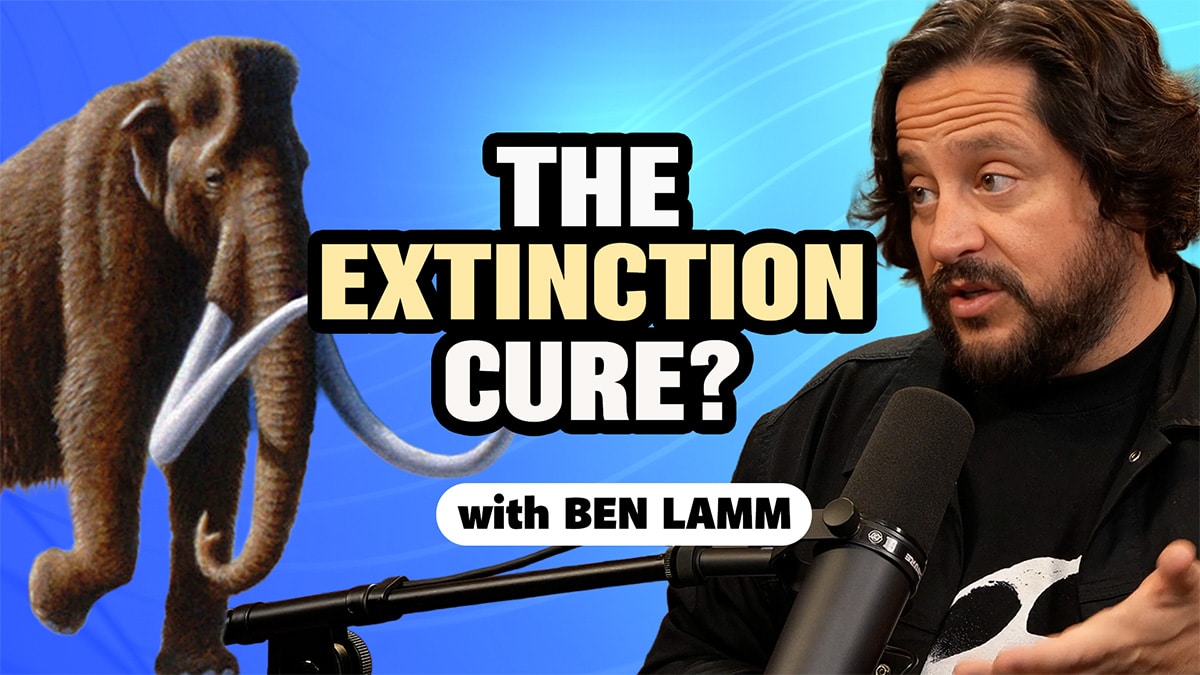
The Case for Rewriting Nature’s Code
Featuring Ben Lamm
Words like “de-extinction” and “cloning” are often associated with dystopian science fiction stories, but reality tells a more hopeful tale. Ben Lamm, CEO and co-founder of Colossal Biosciences, joins host Zachary Karabell to argue that de-extinction, genetic engineering, and biotechnology can fix the harms humans have caused to our environment and prevent us from passing down genetic diseases.


Prefer to read? Check out the Audio Transcript
Although the transcription is largely accurate, in some cases it may be incomplete or inaccurate due to inaudible passages or transcription software errors.
[00:00:00] Zachary Karabell: If you could bring any species back to life, would you? If you could select for what genes you wanna pass down, would you? I’m Zachary Karabell, the host of What Could Go Right? And this is my podcast. And today we are going to speak with someone who is at the forefront of these questions, Ben Lamm, who is the co-founder of Colossal Biosciences, a company that started with the proposition of bringing the wooly mammoth back to life, which they call de-extinction, and other people call Frankenstein’s monster with fur.
So These are the questions. Should we be regulating this within an inch of its life? Should we even be allowing companies to do this? If we, in this case the United States, didn’t allow it, wouldn’t other countries just do it anyway? Is this a genie that is un-put-back-able into whatever bottle it came out of?
Ben and I had a wide-ranging conversation where we touched on everything from the role of government to private [00:01:00] companies versus academic research to his own life and how this applied to his own questions about his own genes, and frankly, all of ours. So I hope you enjoy this as much as I did. Uh, so Ben Lamm, it’s great to have you on What Could Go Right?
This is kind of a perfect wheelhouse subject. Yeah,
[00:01:18] Ben Lamm: it’s a, it’s a great… It really is kind of the best podcast title for what we’re doing .
[00:01:23] Zachary Karabell: And it is, in fact, what you’re doing. Are you trying to con- correct for what nature failed to do, or are you trying to correct for what human beings did?
[00:01:34] Ben Lamm: So I think we’re trying to do two things.
I think we’re, one, trying to undo the sins of, of the past that humans did, right? And learn from those so that then we can apply those lessons learned to everything from human healthcare to conservation to even, like, directing the evolutionary direction of life.
[00:01:51] Zachary Karabell: So you’ve got the, the primary problem, which is you want to recreate a woolly mammoth.
[00:01:55] Ben Lamm: We wanna de-extinct extinct species back into the wild, while also [00:02:00] open-sourcing and subsidizing all those technologies for conservation and preserving species. We think de-extinction is just another form of conservation. We don’t think it’s an controversial- What’s wrong
[00:02:06] Zachary Karabell: with extinction?
[00:02:07] Ben Lamm: Well, it depends. I mean, if it’s a human-caused extinction of a keystone species that leads to a degradation of a ecosystem, then I think there’s a lot that’s wrong with that.
[00:02:17] Zachary Karabell: And I’m not doing this just for the sake of being argumentative. So much of what we live in now is, is a human-altered ecosystem- Yeah … over, over thousands of years- Yeah … not just hundreds. So why does trying to restore some past ecosystem that is no longer relevant matter?
[00:02:34] Ben Lamm: I think taking the perspective that something is, because it’s gone, is no longer relevant, I, I don’t think that’s the right
[00:02:42] Zachary Karabell: way- Look, I’m, I’m, I’m-
to look at it … all I’m saying is- I mean, because
[00:02:45] Ben Lamm: if someone-
[00:02:45] Zachary Karabell: Someone who, someone who is not in this deeply but has looked at this enough, it’s always worth asking. All right, everyone says that there is great virtue- … and strength in biodiversity.
[00:02:56] Ben Lamm: Mm-hmm.
[00:02:57] Zachary Karabell: You know, the question is, why?
[00:02:58] Ben Lamm: Yeah. Well, if you look at [00:03:00] every ecosystem, and I’m not a, a ecologist, I don’t even come from conservation, right?
I’m more of a system design technology guy. But if you look at every single ecosystem, everyone in conservation who doesn’t
It’s better at carbon sequestration, which is a real thing regardless of how you feel about climate change. You don’t have to like it for it to exist, right? So it is one of those things that, that a more biodiverse ecosystem is a healthier ecosystem. There are certain keystone species or specific species that play a bigger role in ecosystems than others.
I’m not saying that natural selection and natural extinction doesn’t occur, but we are in the sixth mass extinction that is accelerated by humans. Yeah. And, you know, a void-less ocean, void of life, will have a cascading effect where we will not be able to breathe. So if you like air, you should like [00:04:00] fish and reefs and sharks and all that goes with that, right?
Because if all of that dies, and you do not have proper like large megafauna that are constantly churning up all of that for the phytoplankton, which takes, which is like a large percentage of our oxygen creation, it’s not just that, you know, it’s not like the 1990s, like if we burn down the Amazon, we’re screwed.
That’s bad, too, but it’s like the ocean’s matter, right? These things really matter. I don’t think that we understand the rebound rate of nature, and I don’t think that while we have early warning systems for like missile defense and tsunamis and earthquakes, we don’t seem to have that for nature. And I think there are enough predictive models that, that especially with the advent a- and launch of Methos and then whatever comes next, that we will be able to build a nature-based digital twin system so that we can truly understand that.
And until we do, I’d much rather have a de-extinction system and not need it eventually than need a de-extinction system and not have it. I’m not trying to get all Star Trek on you, but- No, no … did you [00:05:00] see, did you see Star Trek, like was it Star Trek IV, the, like the ultimate ones? The
[00:05:02] Zachary Karabell: whales. Right. They come back to the whales.
It was. Yeah,
[00:05:03] Ben Lamm: yeah, yeah. They come
[00:05:04] Zachary Karabell: back to San Francisco to the whales. I
[00:05:04] Ben Lamm: don’t, I mean, now there’s UAPs, so I don’t know. Like maybe they are looking for whales- Yeah … and we have them, so they aren’t gonna destroy us, right? So I do think that having BioVaults and the ability to bring back species as well as engineer and apply evolutionary direction on an accelerated basis are pretty valuable technology sets as it relates to our way of life and our embracing of humans and nature living together.
Separately, because all this has to be subsidized because we are a private company and not just this academic think tank, Field of Roses conservation organization, we do have to subsidize it with, with work, right? And, and these technologies are very applicable to industry, to healthcare, to a lot of different, uh, use cases in some that have ag tech in, in, in, in other things.
So we’ve tried to build a model where we can work with the government, be the good guys on transparency, inspire the next generation, build technologies which are incredibly valuable, [00:06:00] and then subsidize the technology side ‘cause Colossal is not going to solve the global extinction problem. We are one strand in a giant tapestry that needs to be created to stop the bleeding of biodiversity loss.
[00:06:13] Zachary Karabell: I mean, that’s, uh, hard to argue with any of that. I’m not even gonna try, and not that I would even want to. What about the … Like, this shouldn’t be private companies at the end. Like, you’re … This should be a public good. Everything you’re saying should be a public good.
[00:06:25] Ben Lamm: I mean, it, it is. Yes, but it’s not. Like, that, that doesn’t exist, right?
It just doesn’t exist. Right. Right. So if the government wants to, to build the Department of, of Species Preservation and De-Extinction, and said, “Hey, we’re going to nationalize this coun- company,” like, that’s not necessarily a bad thing, ‘cause I think this shouldn’t be $635 million in, in funding. I think it should be $635 billion in funding.
[00:06:46] Zachary Karabell: What’s gonna happen for your company if you don’t- I mean, there’s gotta be some major revenue point, right? How long is it lo- when does that have to be?
[00:06:55] Ben Lamm: Yeah, so we, we’ve been pretty thoughtful about bringing on investors and investment [00:07:00] partners that understand the impact of what we’re making, value the inspiration for the next generation and making science important and the halo effect of what we’re doing, but also care about the value, ‘cause they are exch- there is an exchange of dollars for stock, right?
So there is a desire and hope of economic return. So for us, you know, we’ve got enough cash to last years. I think it’s highly likely we will raise capital again, being a technology company, and that will continue to fu- fuel the innovations. And we’ve started to build go-to-market models that look very promising.
So our investor base and our board are very excited. Uh, every round with capital we’ve raised has been, uh, 2X or more oversubscribed, so maybe we’re bad at pricing stock and
[00:07:42] Zachary Karabell: maybe we’re too cheap. No, well, I mean, you’re, I mean, you’re, you’re good at spinning a constructive vision, which is part of the, you know, part of the mix of what we’re doing.
I
[00:07:47] Ben Lamm: think we’re also good on, on delivering- Actual
[00:07:49] Zachary Karabell: science …
[00:07:49] Ben Lamm: actual science. Yeah. Right? The people that think that we’re good at con- building a constructive vision, which I agree with, you can be good at marketing and science, right?
[00:07:58] Zachary Karabell: Yeah, so you can
[00:07:58] Ben Lamm: do both. Yeah. You can actually do both. [00:08:00] But
[00:08:00] Zachary Karabell: you don’t buy into, or at least the way you talk about it doesn’t buy into what may be an unfair caricature of some Silicon Valley views, which is whatever harms human beings do to the lived environment, technology will solve.
[00:08:13] Ben Lamm: No, I don’t buy into that. I, like, people ask us, they, they … Some people miscategorize our work, and they think that we think that de-extinction is a replacement for conservation. We do not believe that. We think the Endangered Species Act is important. We have said that, regardless of what the left or the right
I think unfortunately for nature and unfortunately for biodiversity, the left and the right have both weaponized the Endangered Species Act. Sure. That’s not what it was created for. Right. Uh, it was just created to save species, right? So for us, I think that we believe that modern conservation does work, it’s just it is not working at the speed at which we are eradicating species and changing the environments.
So we look at this as just a new technology set. So our thesis around this was if we can bring new ideas, new money, [00:09:00] new innovations, subsidize it through our, our, our for-profit business, even new attention, right, to these problems, that that is a good thing, right? I, I would argue that more people know that there’s an, a virus that kill, a elephant herpes virus that kills 20% of elephants more because Colossal existed than it didn’t.
More research and more funding has gone into elephant conservation than before we started the company. That’s just a fact. There are nonprofits, you can go look at their E9 or E90 or whatever and see, and look at their, their donations. They have gone up. Right.
[00:09:31] Zachary Karabell: Why begin with a woolly mammoth? Was it just because, like, was that good marketing?
[00:09:34] Ben Lamm: No, no. I mean, look, it is great marketing. There’s not, like, Facebook hate groups out there that are like, “Oh, we hate the woolly mammoth.” So I, I don’t know if it’s, like, Ice Age or, you know, Ray Romano. Like, I don’t, I don’t know why people just love the mammoth. They love
[00:09:46] Zachary Karabell: it. You are, in fact- Yeah … restoring Ray Romano to his-
[00:09:49] Ben Lamm: To his glory days
rightful
[00:09:50] Zachary Karabell: place in- Yes … in human evolution.
[00:09:51] Ben Lamm: Yes, glory days. Yeah. George Church, my co-founder, who’s arguably the father of synthetic biology, led a lot of the work in human, uh, use of CRISPR and human r- [00:10:00] uh, use of genome engineering tools and re- reading and writing kind of, like, the, the next level of, of genomes.
He had been working on the mammoth for eight years, right? His view was, if we can bring back this, uh, species, we can inspire the next generation, we can open source the technologies for conservation, we can build a sustainable population of cold-adapted elephants, you know, back in the Arctic that can help the ecosystem, and there’s a lot of technologies that we have to solve and build along the way that then can apply to humans or other use cases.
So, you know, a- as an entrepreneur that’s built a handful of companies over the years, it was highly appealing. Without a background in biology, I couldn’t be more or less qualified depending on the day to run this company. But it was, it was a very compelling idea, and I felt like, you know, why not? We should go work on it.
[00:10:44] Zachary Karabell: Are you more or less qualified now?
[00:10:46] Ben Lamm: I think I’m more or less qualified now. You know, I, I’m very… I, I don’t have a lot of hobbies, so I get very passionate about what I’m working on. So I’m very passionate now about biology, and don’t understand it all still, but like, you know, I don’t have a background and PhD in it, but, you know, I really try [00:11:00] to focus on, on trying to help solve problems with the, with the teams.
But I do think that the childlike wonder coupled with not having, you know, a deep background on it allows me to ask sometimes really dumb and then occasionally insightful questions.
[00:11:14] Zachary Karabell: Okay, so what’s an example of, like, an occa- a dumb but occasionally insightful question?
[00:11:17] Ben Lamm: Yeah, well, like sometimes we’ll be looking at the editing modalities, and we were looking at different ways that we’re, like, actually editing the cells, right?
We’re saying, oh, people are doing editing like this, people are doing editing like this, people are, are, are trying to, uh, actually engineer big constructs. And a lot of times people historically in, in the scientific and academic fields are doing all these edits one at a time. And I was like, “Well, isn’t there a better way with the size of these that couldn’t we just, like-” cluster them, and this became kind of like my, my big contribution to the company, is like, “Couldn’t we cluster them and package them and deliver all of them?”
And they’re like, “Well, most people kind of cluster them in the same editing.” Huh. I was like, “Well, why couldn’t you cluster them with different editing?” And they’re like, “Maybe you can.” And, and, and our team has. That’s one of the novel technologies that we developed [00:12:00] is how we package and deliver different sets of edits that, that typically people would do linearly and sequentially.
When you’re trying to make so many edits, it, it, it, it goes quite well. And a year ago we were doing, uh, 20 edits. We’re now doing 300 edits pretty consistently. W- we have not done this yet, but we are working on 1,000 edits, and we have an idea of how that can be delivered.
[00:12:19] Zachary Karabell: So which, what are you editing?
What are you starting with?
[00:12:22] Ben Lamm: So we’re starting with a genetic donor. So we’d spent a lot of time trying to understand computationally what is the closest living relative, because if you just assume that the phylogenetic tree is correct, which we’re, uh, we’re continuing to find that it’s not, that if it is correct, then the closest living relative should have the closest DNA.
So-
[00:12:42] Zachary Karabell: So what is, what is the closest li- living relative to a woolly mammoth?
[00:12:45] Ben Lamm: Asian elephant.
[00:12:46] Zachary Karabell: Asian elephant.
[00:12:46] Ben Lamm: 99.6%.
[00:12:48] Zachary Karabell: And there, are there any Asian el- elephants in the wild, or are they all
[00:12:50] Ben Lamm: Oh, yeah, yeah, yeah … 100% extinct? Tons.
[00:12:52] Zachary Karabell: Okay. Tons.
[00:12:52] Ben Lamm: Yeah, yeah. I mean, they’re endangered, but there’s tons.
[00:12:54] Zachary Karabell: And then, so you- Tons of tons
so you get some DNA, you get some cells from an Asian
[00:12:57] Ben Lamm: elephant. Yeah. Which by the way, you just kind of yada, yada, [00:13:00] yadda’d over the hardest part. Like, you know, coming from software, I thought, “Well, we’ll just plug into the GCP of like DNA, like 23andMe exists,” right? Sure. Like, wouldn’t you think that like you could just, like someone somewhere, if people are spending like $39 to sequence their genome, some smart people have probably done this for all species, right?
At least like the big ones, right? You would think that. Completely wrong. So then even getting elephant cells to sequence it for free and provide it for free to conservation, you have to go through permitting processes, and then you have to go work with all of the different groups in Africa and Asia. And, and so just to be able to take the cells, sequence the cells, right, and give that data to humanity- is a tremendous amount of work.
All right, I’ll, I’ll- And most, most people don’t even realize how much work we do outside the lab. They just focus on the lab work.
[00:13:48] Zachary Karabell: So I’ll bite. What government agency in African country X is responsible for the permitting of elephant DNA?
[00:13:56] Ben Lamm: It, it depends on the individual government, right? So you have these global [00:14:00] permits that are, are import/export.
Some countries, there’s actually this thing called the Nagoya Protocol, where basically you can’t export any biological material because if you do, then you could be, some country- In, in, right, evasive or, or … Some, some s- well, well it’s not even just evasive, but some country or organization could be monetizing data that really belongs to maybe a First Nations group.
Not e- every country treats First Nation groups equally, right? So there’s, there’s layers to this. Even if you take domestic samples, like of a Asian elephant from a zoo, and you have a zoo partner or a conservation partner that owns them, there’s individuals that own elephants actually in America too, you have to look and say, “Do they own those?
Are there material transfer agreements that they own with someone else, or does someone really own the provenance of that elephant?” So it, it, it’s quite crazy.
[00:14:46] Zachary Karabell: Wow.
[00:14:46] Ben Lamm: Here’s a weird one for you. China-
[00:14:48] Zachary Karabell: Mm-hmm …
[00:14:48] Ben Lamm: owns all of the pandas worldwide. So- You can’t even work with pandas except if you have permission from China.
Except there is one population, very small, a population of [00:15:00] pandas in the world that they were gifted generations ago without any strings attached. But like when you see a panda at the zoo or whatnot- Yeah, it’s always from the Chinese government … there’s strings attached. It’s on a, it’s on a- You notice it, right?
Yeah … yeah. And they u- they actually use, this is kinda weird, they actually use pandas as a way of biodiversity diplomacy.
[00:15:15] Zachary Karabell: You know, human beings have had the prospect and the dream of, uh, being able to replicate species- Mm-hmm … for a long time. And starting around 15, 20 years ago where you had, particularly in China, cr- uh, parts of Asia, some experiments with cloning.
[00:15:29] Ben Lamm: Mm-hmm.
[00:15:30] Zachary Karabell: And we do some cloning in the United States. We have Dolly. We have for pets. We have Dolly the sheep. We have, we have pets. There’s the, the- I,
[00:15:35] Ben Lamm: I bought the cloning company in the US that did pets.
[00:15:37] Zachary Karabell: Yeah. So why do people react to some cloning with, “Oh my God, this is a dystopian world where we’re gonna start entering some Matrix universe,” and then other cloning, where it’s your pet or it’s Dolly, we’re like, “Oh, that’s really sweet and cool.”
Like, what-
[00:15:54] Ben Lamm: Well, I think if you clo- you, you … So first of all, so a couple things to unpack here. Cloning is a part of our [00:16:00] pipeline, but we are not, you cannot clone from a cell that isn’t living.
[00:16:03] Zachary Karabell: Right.
[00:16:03] Ben Lamm: But answering, to hypothetically answer your question, if you could clone a megalodon, because there’s living cells, there’s not, but if there were- I think that would be less well-received than cloning, like, you know, a sheepadoodle.
So I do think that, that the relevance to your cuteness factor and fear factor plays into that kinda three-dimensional model in, in, in individual’s brains. When we bought Viagen, which is the number one pet cloning company, to your point, they clone dogs, horses, and cats. Their efficiencies are 78% versus, uh, 2%.
That company, while people were excited about it, when people found out that Tom Brady cloned his dog with us, it, it, like broke the internet. Like, Tom was texting me. He’s like, “Like, I keep getting texts and calls about cloning my dog. I’ve never had this many texts and calls about anything.” And so because I think people love their dogs, right?
And they love their pets, and so they have this affinity of like, you know, dogs and cats and lives are too short compared to our companionship with them, and we want [00:17:00] them, we selfishly want them, them to go on that journey with us like a lot of people do at least. And so I think that’s why some people are more excited about it.
You say, “Oh, we can clone a Neanderthal.” We can’t, because there’s no Neanderthal cells. If you get a living cell that you could clone from, well then I think people would be really freaked out about that, right? And so, so I do think it’s, it isn’t the cloning process that freaks people out. I think it’s more, like, what is that resulting animal?
And, and, and how do I feel about that animal?
[00:17:25] Zachary Karabell: So you had the Jurassic Park example, right? If you- I’ve
[00:17:28] Ben Lamm: heard that before,
[00:17:28] Zachary Karabell: yeah. Yeah, I’m sure. You’ve probably never heard that one- No … before, but-
[00:17:31] Ben Lamm: Did you see Jurassic Park?
[00:17:32] Zachary Karabell: I did. I saw one- Did you like- I loved it. I loved it … did, was it- I loved it.
[00:17:35] Ben Lamm: Everyone
[00:17:35] Zachary Karabell: loved it, right?
I even liked the T-rex. Yeah. Just come on. I mean- Yeah, yeah. I mean, yeah, yeah … you could see an actual T-rex, just as long as it wasn’t gonna eat you.
[00:17:40] Ben Lamm: Yeah, yeah.
[00:17:40] Zachary Karabell: But you know, there was an element of that. So that was an interesting movie. Mm-hmm. I mean, the spinoffs are cheesy. But it was- Would
[00:17:46] Ben Lamm: you like the new one, though, by Gareth Edwards?
[00:17:48] Zachary Karabell: There’s a difference, isn’t there? The, the new…
[00:17:49] Ben Lamm: Yeah. It’s good, yeah. And it’s good, yeah. Did you see it?
[00:17:50] Zachary Karabell: Yeah. It was good, yeah. Yeah, yeah. Yeah. I mean, she was good. There was a element of wonder in it. Mm-hmm. Right? And, and the movies did, in very Spielbergian way, evoke that wonder of if you [00:18:00] could see these creatures.
[00:18:01] Ben Lamm: It’s close enough, though, too. It’s not like faster than light travel, right?
[00:18:04] Zachary Karabell: Right.
[00:18:04] Ben Lamm: It’s like it’s close enough. Like, you like, the technologies when, in the ‘90s, when it came out, it was like DNA was a thing. It wasn’t just some made up thing. DNA editing was a thing. They didn’t know really how to do it well.
But it was like gene therapies were a concept. Right.
[00:18:17] Zachary Karabell: We could, we could be, we were, Human Genome Project- You could, you could- … was starting. You could taste it … you could, you could
[00:18:21] Ben Lamm: almost touch
[00:18:21] Zachary Karabell: it. Yeah. You could taste it. But the other element of the movie was sort of the classic Frankenstein- Yeah … you know, human beings cannot be trusted with the power of their own technology.
[00:18:29] Ben Lamm: Yes.
[00:18:30] Zachary Karabell: And that has certainly been a motif that has some real legit echoes. Yeah. So you have, you know, Nobel creates dynamite, then a Peace Prize, because oops, maybe that was a problem. Yeah. You have the people who create the Haber-Bosch process for fertilization. That also becomes a source of chemical weapons.
Yep. You have splitting the atom. Oh my God, we’ve unleashed- Nuclear weapons … the power of the atom, nuclear weapons. And you know, the same questions arise, how do you encapsulate in your own mind when you do this work the [00:19:00] awareness of- The, the, the unfortunate yin and yang of human beings with these tools.
[00:19:06] Ben Lamm: I, I think that, that CRISPR and genome engineering and now access like at home to technologies even as powerful as just like the Opus model and, and, and b- even before we get into Fable and, and Mythos on, on Claude, right? I think that there’s now a biohacking movement. There’s all of these things. I don’t think you’re gonna put the genie back in the bottle, right?
‘Cause it’s not like, at least with like nuclear weapons, you have to get like enriched uranium or enriched plutonium, right? Uh, depending if you’re doing nuclear or thermonuclear. So you have to like really think. It like, like access to that technology is one thing. You can go online and find like how to build a bomb, but at the same time, the substance that you need for that particular bomb is highly guarded, highly monitored, highly regulated.
So it i- it is a little bit different. I truly do believe that genome engineering and directed evolution at the scale that gets [00:20:00] accelerated through models like Mythos and eventually onboarding of technologies like Quantum is more powerful than nuclear weapons, and it’s also more cost-effective and it’s more accessible.
But, but I think that’s not something that if Colossal didn’t exist, those threats would still exist.
[00:20:15] Zachary Karabell: No, look, I totally agree, and I think the, the idea of if human beings can do it, they likely will-
[00:20:21] Ben Lamm: Yeah …
[00:20:21] Zachary Karabell: is simply part of the mix. And m- you know, my take, it’s not very libertarian, but it is- You should design a regulatory framework around the assumption that if human beings can do it, they will.
Yep. Not around trying to prevent human- It- … beings from doing something that they’re gonna do.
[00:20:34] Ben Lamm: And the regulatory framework on this is terrible, at best. I’m, I’m telling you, it is terrible at best. ‘Cause you have certain countries in, in organizations and groups like the EU that’s like, “GMOs are just
[00:20:43] Zachary Karabell: bad.”
Right.
[00:20:43] Ben Lamm: W- we, we’ve been making genetic modifications to organisms for quite some time. Like, look at the pug as an example. Yeah,
[00:20:49] Zachary Karabell: and
[00:20:49] Ben Lamm: I
[00:20:49] Zachary Karabell: just- Uh, look, look- … I just, I just wrote this book about corn and basically arguing- Yeah,
[00:20:52] Ben Lamm: look at wheat. Yeah, exact- …
[00:20:52] Zachary Karabell: that we started doing this 9,000 years ago.
[00:20:54] Ben Lamm: We’ve just been shitty at it.
[00:20:55] Zachary Karabell: Right.
[00:20:55] Ben Lamm: And it is like, it’s like D&D random roll of like, oh, we think this is gonna come out, and then, then you get a [00:21:00] pug, right? Right. But it, it is one of those things that’s we can now do it with such fidelity and such intentionality, and that’s only, that fidelity and that intentionality is only gonna accelerate.
And so we are spending a lot of time with the administration educating them on that, right? Like, who should regulate these technologies? How should they be regulated? Because the FDA should regulate it on some level if it’s going into your human body, but what happens if you make something that isn’t going into the human body?
Well, that should probably, if it’s gonna be for consumption, it probably needs to sit within USDA. If it’s gonna go back and affect the environment, it needs to fit within the EPA. There needs to be a regulatory framework around all this, and this administration, regardless how people feel about, you know, political affiliations, has been open to understanding the technology.
This administration, for its ups and downs, likes technology. Yeah. So they, they will at least have a conversation about it ‘cause they like the technology. So we’ve leveraged that, and we’ve actually seen tremendous success. We just announced this partnership around BioVaults, right? Of backing up endangered species.
While some people say this administration doesn’t love endangered species, they’re supporting our efforts in backing up the [00:22:00] endangered species because it’s no cost to the taxpayer, right? They like to make money and save money in this administration. They like big wins, right? It’s a fluffy, big win because they’re providing a value to the future.
Oh, and by the way, it’s using innovative technologies in cryopreservation and DNA store that then we open source for the world, right? So, so there’s only benefits to it. And so our view is whether we’re talking to someone in Europe or someone in Australia or the, or this administration, we have to think through about what are the areas that we can help influence and educate and, and try to help get them excited about the applications of the use cases.
But also understanding, to your point, some of the concerns with the applications to a bad nation state or someone, uh, leveraging these technologies. So we, we, we actually do, and we’ve been very transparent about this, In-Q-Tel is an investor in us, and we do briefings with the IC and DOW on these, on these d- and not about Mammos, but on the technology sets and the capability sets around these technologies.
‘Cause it is important that we understand them.
[00:22:57] Zachary Karabell: Tell, tell people what In-Q-Tel is just in
[00:22:59] Ben Lamm: case they- Uh, In-Q-Tel [00:23:00] is a government-funded, public-funded investment vehicle that originally came from the IC.
[00:23:06] Zachary Karabell: Right. Intelligence community … intelligence community. Just, just-
[00:23:09] Ben Lamm: Jinx.
[00:23:09] Zachary Karabell: Yeah.
[00:23:09] Ben Lamm: Yeah.
[00:23:10] Zachary Karabell: So I wanna push on this, ‘cause I pushed myself on this when I’m thinking through it.
The European Union has loosely this idea of the precautionary principle. Yes. So their, their approach to GMOs, to CRISPR, to any new technology is- Yeah … is risk mitigation or risk avoidance- Yeah … is probably more accurate, not risk mitigation. And- I
[00:23:28] Ben Lamm: think it’s totally a great
[00:23:29] Zachary Karabell: way
[00:23:29] Ben Lamm: to look
[00:23:29] Zachary Karabell: at it … um, and, and their argument would be, look, introducing variables that you don’t know their effect in an environment where there’s all these other variables, uh, is just too risky.
[00:23:41] Ben Lamm: You’re, I think, correctly categorizing their belief in their framework, but their framework’s broken We, like, if you look at, like, global GDP, 55% of it comes from nature and is impacted by nature. So if we are forecasted to lose half of biodiversity in the next 25 years, kind of giving clue, it’s not a g- it’s not a good [00:24:00] thing, right?
That will have a negative effect on GDP. And so when you have an invasive species and your, and your idea is GMOs are bad so we’re not gonna release a gene drive ‘cause I’m scared of it, that sounds like new technology. Instead, I’m just gonna poison the landscape. That also has cascading effects. Right.
Not just killing that, but getting into water streams. We have no idea what those, what those forever chemicals look like, how they affect, like, drinking water for our kids. They want to regulate, and they do not want to innovate, and that’s not what is good for the world or, or good for the … Because other countries will be innovating on these technologies, and a lot of them will be innovating in ways that they can use them in nefarious ways.
Like that, that will … Uh, unfortunately to your human comment, that is the world, the complicated geopolitical world that we live in, and we have allies and we have adversaries. And Europe’s only getting in its own way, and they’re own- they’re getting lost in their own messaging on this because they’re already making choices.
Like, you go cut down a forest, you have made a decision. Right. You overfish, you know, the ocean, you pollute something, you spray forever chemicals to get rid of an invasive species so it [00:25:00] doesn’t affect your cattle industry. Guess what? Those are decisions that you are making. So I would say spend a lot of time in getting educated on these technologies, and then show that these aren’t things like gain-of-function research where you can actually make very targeted edits in something like the screw worm in Texas.
You can release it. You can save the taxpayers billions of dollars and make sure that the cattle industry prices don’t go up and that cows don’t have to get inoculated or die a horrible death due to the screw worm.
[00:25:28] Zachary Karabell: The Europeans would come back, and I’m … Obviously, that’s a huge generalization. There’s no such thing as the Europeans.
Yes. But we will use that as a proxy for a straw man- Yeah … that is partly a real-
[00:25:37] Ben Lamm: Yeah …
[00:25:37] Zachary Karabell: regulatory bo- Yeah … set of bodies.
[00:25:39] Ben Lamm: Yeah. They’ll tell you everything’s great and we should have tea.
[00:25:41] Zachary Karabell: And but no, they would also say, “Yes, that’s fine. You’ve, you’ve spun the constructive case for technology.” Yes. You’ve avoided the destructive one- Yep
which is the unintended consequences of, of interrupting a balanced ecosystem. Yes. Now, like, where I push back is- Which we’re already doing … there is no balanced ecosystem to disrupt. I,
[00:25:57] Ben Lamm: that, that, that’s, that … We, we have already [00:26:00] changed the balance of nature.
[00:26:01] Zachary Karabell: Right.
[00:26:01] Ben Lamm: Right? And so we have to look at ways that we can out innovate the take that we take from nature.
[00:26:06] Zachary Karabell: So what about the other country dynamic? I mean, there was a talk, you probably know way more about this now, of, of Putin at one point also kinda wanting to resurrect some, I don’t know if it was the mammoth or somebody else that- Uh,
[00:26:16] Ben Lamm: yeah, I heard that. I heard they
[00:26:17] Zachary Karabell: wanted to resurrect- The Siberian, you know, something, maybe- No, no.
[00:26:19] Ben Lamm: I think, I think he wanted to resurrect the mammoth, the Siberian mammoth. Oh,
[00:26:21] Zachary Karabell: right. ‘Cause it was a Siberian-
[00:26:23] Ben Lamm: Yeah …
[00:26:23] Zachary Karabell: like, Mother Russia. And a lot of our
[00:26:24] Ben Lamm: samples are … Yeah, yeah.
[00:26:25] Zachary Karabell: And Chinese government has what appears to be a ambivalent relationship toward these technologies ‘cause on the one hand, they are sponsoring them.
On the other hand, they have routinely punished, uh, some scientists and research institutes that have, I guess, touched some third rail of Don’t do that
[00:26:42] Ben Lamm: I think it’s highly unlikely that someone that breaks and does germline editing in human that’s like, “You’re in trouble and don’t do it again,” is highly unlikely.
[00:26:50] Zachary Karabell: So this is the other question of like-
[00:26:52] Ben Lamm: Well, BJ, b- b- basically- How
[00:26:53] Zachary Karabell: open will you be about your technologies?
[00:26:55] Ben Lamm: So say about, we’re, we’re pretty open about it, right? And so we don’t like to say … We’re so [00:27:00] open about it that we get yelled at sometimes by, uh, subs, even though people often forget that we’ve got Nobel laureates and 95 scientific advisors, 80 postdocs I fund in, in academic labs, 17 academic partnerships around the world, and 260 PhD scientists.
So sometimes people forget that fact about our business, and there’s a subset of the academic community that’s like, to your point about openness, is like, “Oh, we just achieved X”, and, and we’ll even have people that push back to us saying that we’re too open But that, which I think is insane, where they, you’re too open.
You, this hadn’t gone through peer review. I was like, “Oh, I’m not saying you accept it, I’m just telling you that we did it, right? We briefed the government on it and everything else.” But if you look at countries that aren’t gonna be as, as, uh, uh, forthcoming, like the Beijing Genomics Institute, BGI is sequencing everything, right?
They use C- they were geniuses in the COVID model, right? ‘Cause they said, “Oh, we’ll just sequence all the CO- we’ll do all your sequencing for free.” And the world bought it. They were the Huawei of genetics, right? And so everyone bought into that model, everyone gave them that data, and [00:28:00] then fast-forward a few years, you know, the, the president of BGI is like, “Oh yeah, we’re looking for the genes that will enhance our people.”
Like that intelligence, cognition. I mean, these are not like conceptual, no, we’re not gonna work on germline editing. Like, and so if you ask me d- did I think people in China were in the know on the CRISPR babies, yes.
[00:28:21] Zachary Karabell: All right, so pushing back on a few of these things. So for me at least, the, the spirit of that is you’ve gotta ask the hard questions of yourself.
Yeah. Like if, if you’re gonna, if you’re gonna tout a vision of a constructive future- Mm-hmm … and believe in the human capacity to create- Yeah … more than you fear the human capacity to destroy- Right … I do think it’s incumbent on all of us to interrogate that, to go, “Hey, wait a minute, am I just being too starry-eyed here?”
[00:28:46] Ben Lamm: No, I don’t think you’re wrong at all. I, I think your questions are spot on because fundamentally, it’s not our job, even with the federal governments and agencies domestically and, and abroad, to persuade them. You know, I hope that some of our education persuades them of [00:29:00] their own accord, but fundamentally our job is to be transparent and educate them.
As I mentioned, sometimes we get yelled at because people want to … or something goes through pe- peer review to be transparent. It’s like, you do understand that we will victory lap that innovation 20 times over before we get through peer review- Right … because that process is broken and, and, uh, and, and, and, and just a click.
So and so, so for us, I, I think you are asking the right questions and it’s something that we have to think about. And I think the way that we try to make decisions at Colossal, which I do think is moderately unique, is, uh, our board’s on board with this, our investors are on board with this, everyone that we bring in, the company’s on board with this, is that, that value creation for our shareholders cannot be at the expense of impact for the world that’s positive and inspiration.
So we put, y- this is going back to your Jurassic Park comment, the, like people have asked me if, if you make game-changing technologies that, you know, end up being worth $10 trillion, right? But you never deliver on a Dodo. Yeah, you got a mammoth, you got a … But, but you didn’t have a Dodo, [00:30:00] right? Do, do you think this company’s successful?
And, and my answer is no Hmm … because I truly think that if we have some, like, kid and their parents that are excited about science again because we’ve talked about dodos and made a promise that we’re gonna deliver that dodo to the Mauritian people, to the Mauritian Wildlife Foundation, to the global, you know, kids and parents and teachers around the world, and then we don’t deliver on that but we made a trillion dollars, our shareholders are happy, then I think we failed.
And so, so, so we take the responsibility of balancing all of the negative consequences and all of this, not just on the financial returns or the impact, but also on how people and kids will feel about us. Like, that, like, we literally make every major decision around value creation, impact, and inspiration.
[00:30:45] Zachary Karabell: Okay, two things. I’m, first of all, I’m gonna be that pedantic, really annoying guy and say- And I love that.
[00:30:49] Ben Lamm: Yeah …
[00:30:50] Zachary Karabell: you can’t say moderately unique. You’re either unique or you’re not unique. I
[00:30:54] Ben Lamm: disagree with you.
[00:30:55] Zachary Karabell: Well, I’m… Grammatically. You can say whatever the hell you want. Hey, no, no, I- You’ve got plenty of money
I’m in. Yeah, yeah … and, and you can [00:31:00] do what you want. I’m just saying in, in that pedantic grammar sense. No,
[00:31:03] Ben Lamm: it’s fine. Yeah, yeah, yeah.
[00:31:04] Zachary Karabell: Um, I’m that guy. I’m sorry. So let’s go to two things. One is you start the company Colossal Biosciences in 2021.
[00:31:11] Ben Lamm: Correct.
[00:31:11] Zachary Karabell: There is still machine learning, and there are early versions of what we now are, everybody’s calling AI.
Yep. But you didn’t have quite the robust number of models, so-
[00:31:21] Ben Lamm: Yeah, ear- early versions of OpenAI and Claude did not build, like, ancestral state reconstructions
[00:31:27] Zachary Karabell: of genomes. Right Now, however, I am presuming you can do a huge amount of modeling purely theoretically.
[00:31:33] Ben Lamm: A lot of the early work we did, we just had to go build this.
We had to build a whole software and machine learning team, right? We actually had a company that spun out of Colossal around specifically this use case ‘cause it just didn’t exist. The, the frontier models didn’t do any of that work in the early days, right? Some of the models today, if you look at Claude and you specifically look at Fable and Mythos, some of their power is quite interesting in terms of, like, predictive modeling.
Unfortunately, you can’t use any of it for biology without special permission [00:32:00] because i- i- it could be quite dangerous. Oh,
[00:32:02] Zachary Karabell: right. Yes. Yeah. You do not want the wrong people messing around with the-
[00:32:05] Ben Lamm: Yeah. So, so- … the genome … so this, you, you, you saw this in the US, right? Like, you saw, like, they rolled out Fable and Mythos, and they’re like, “No, no, just kidding.”
Government came in, shut it down. That wasn’t a DOW-DARIO fight. The, the models were quite powerful, and so I’ve been in classified briefings where I’ve seen some of the models, and they’re quite powerful for what they do. And so I understand why there’s certain segments, uh, and information that they wanna kick you back down to Opus versus keeping you at Fable or whatnot, so.
[00:32:33] Zachary Karabell: Does this change your timeline? I mean, at one point you thought this was gonna be decades, but now that you could model quadrillions of, or permutations, it’s probably more than quadrillions, right? Does that change the timing?
[00:32:43] Ben Lamm: So we’ve been pretty accurate on the timing of this. I think that what’s, what’s interesting is where we’re using some of these, you know, foundational e- frontier models is around two things, integrating with our existing systems in lab systems and lab notebooks so that we can [00:33:00] extrapolate data and share experiments and failure rates across organization.
Like, so I’ll give you a, an efficiency example. If someone’s experiments are all correct and all and everything works perfect, then they’re either an unintentional liar or an intentional liar, right? Because they, th- th- there’s just no way. If all of it, or they’re not taking any risk And this is a company that you need to take risks to solve challenges that have not been solved.
If you have experiments where everything fails, then they’re probably bad scientists. And so sometimes surfacing that data up is hard, especially when you have 260 scientists, multiple labs aro- around the world, 17 academic partners. One of the things that’s interesting about some of these models is applying them even at a
Before you get into, like, protein modeling and, and some of the prediction models that you’re, you’re, um, referring to, just integrating them around kind of, like, enterprise systems into being able to surface that data to us is helping us make decisions. So I think it’s more [00:34:00] accurate to say less things will slip further in the future than we’ll bring things back in.
Because coming from software and some space hardware in the past, my hardest challenge with this business is it, there’s biology, and you have to wait for things to grow, right? Like, elephants take 22 months to gestate. Great thing about wolves, they take 60, so dire wolves are easier, right, in that, in that regard.
So different species take different levels of time in terms of gestation. So you could, we could theoretically be pregnant with certain species that we haven’t even announced yet that won’t see the light of day for over a year.
[00:34:32] Zachary Karabell: So what about the, uh, this should be in the realm of academic nonprofit science, this should be a public commons good, that the advantage of universities doing this kind of work is- There’s
[00:34:44] Ben Lamm: no advantage to universities, though.
That’s the problem.
[00:34:46] Zachary Karabell: Okay. Yeah, so- So explain, explain why. So- I mean, I, I could use the critique of for the past 50 years, universities have taken percentages of the patents that their research faculty- Yeah … have done anyway. Mm-hmm. The nonprofit- Yeah … for-profit
[00:34:57] Ben Lamm: matrix. Yeah, trust me. Trust me, Harvard, we do have a great [00:35:00] relationship with Har- Harvard and Mi- and MIT.
And, you know, when this administration cut their funding, you know, even with their $50 billion endowment, they were calling us asking us for more money. Right. So I get it, right? But, you know, fundamentally, you know, I don’t know when it happened. I don’t know if it was COVID, I don’t know if it was pre-COVID.
We all saw what happened last year when the heads of these universities went and had conversations on Capitol Hill and what that terrible train wreck television looked like. But there has been a day where, you know, the Bill Nye make a volcano with food coloring and, and, and whatnot and, and make science accessible and fun, those days, I don’t know what happened But somehow, some way, I don’t know if it was over time and a shift or just, you know, happened overnight, but somehow certain amounts of science has become politicized.
I don’t know if it was climate change. I don’t know what it was, right? And, and I’ve said this before, which made people mad. I was like, you want people on certain sides of the political spectrum to support you in your efforts around climate change. Most people I have found don’t hate science. [00:36:00] They hate scientists.
[00:36:01] Zachary Karabell: Hmm.
[00:36:01] Ben Lamm: And so that has become a thing where people want to argue semantics. The peer review club, it, it’s not a club full of people that ever got invited to parties, but it is a club. And, and I see this with our, I, I see this with, you know, our scientists. Some of our scientists are the top of their field, and they can’t get a paper through because someone’s like, “Yeah, but I don’t like that you joined this company,” right?
Right. And so, so my view is, you know, I’m all about open source. I’m all about doing this. And to your point about academia, this was in academia. This was an academic project that, that raised $100,000. I don’t wanna break hearts and minds here, but building an end-to-end computational biology, genome engineering, and developmental biology company that can take a 73,000-year-old skull and make puppies costs more than $100,000.
And there’s a lot of times there’s a lot of, there’s responsibility in academia, uh, without accountability. And so when you have responsibility without accountability, and you have nothing that, that really motivates you to actually deliver, [00:37:00] you start to look at things and fall into the system of point solutions.
There’s the whole concept of publish or perish, right? It’s like, I need a point solution to get a paper. So I’ll out this person ‘cause it’s fun. The, the science, Journal of Science literally told me that they are concerned that 40% Not two, not one. 40% of the papers that are published in scientific journals, they do not think are reproducible.
That’s insane.
[00:37:26] Zachary Karabell: Yeah.
[00:37:27] Ben Lamm: Yeah. If I told, if I was a, if I was like a mathematician and I’m like, “Just so you know, this equation works 40% of the time,” or, “Oh, by the way, I’m a Boeing engineer and we’re pretty sure the plane’s gonna work 40% of the time,” you wouldn’t get on the fucking plane.
[00:37:40] Zachary Karabell: Yeah. So the, but the, the, the pushback is also the open versus closed.
[00:37:45] Ben Lamm: Is it open?
[00:37:46] Zachary Karabell: Yeah. I don’t know. I mean, that’s- I
[00:37:47] Ben Lamm: mean, I’m sharing da- d- well, you asked this earlier, is it open? Because I’m sitting here saying, “Hey, we made this big breakthrough. This is cool and, and, you know, as we get a little bit further, we’re gonna take all this testing and put it in peer review papers.”
If it was [00:38:00] open, then sharing that data on day one would be glorified, but it’s not glorified ‘cause they want it to be closed ‘cause they want you to go through a peer review process where two out of the three journals charge you for it, so that you go through this process of your peers/click so that you can get to this other side of it and, and then it come out.
But that’s a, that’s a three-year period of d- of a dark window, so that’s, that’s not an open model.
[00:38:23] Zachary Karabell: What about the pushback that people mostly in academic science say, which is there’s a lot of non-commercial scientific research- Totally agree … that ultimately ends up having some commercial application. 100%.
People use, I don’t know, it’s like research on starfish leading to-
[00:38:39] Ben Lamm: Yeah …
[00:38:39] Zachary Karabell: you know, drug thin medicine. True. And that companies are in the business of applied research because they want some connection between the money they’re spending-
[00:38:47] Ben Lamm: There’s more true discovery That happens in academia than in most commercial applications, at least in my experience.
But it’s not rewarded, [00:39:00] it’s not modeled correctly. There’s not an in… I mean, if you look at humans, right? We like, you know, it, it’s like sales comp models, right? It’s like you want to build a comp plan that in, that creates in, that behavior, right? If you have a comp plan for a salesperson to not sell things, they’re not gonna sell anything.
If you have a comp plan where it requires them to hit certain targets or they’re going to get fired or they make a bunch of money and it’s a pretty binary outcome, they’re gonna sell stuff or you’re gonna weed them out, right? And so that model in academia currently is broken. And so you have incredible researchers, right?
But a lot of times in our, our experience, we’ll go in and start talking to these researchers, and I’m talking about like Nobel laureates, I’m talking about tops their fields, like people that like Silicon Valley loves to have on panels, and they will tell you, “Yeah, I had to because of a grant or because of internal politics, go work on this when my f- as, as a component of my field of, uh, field when I really wanted to work on this level of the system,” and they don’t have that.
And I think that’s why we’ve been successful at recruiting so many [00:40:00] top scientists because they look at this as kind of this cross-functional project, right? Where someone that works on, you know, cancers in dogs but would love the idea to think about how impacting, you know, genetically modified wolves could be on the ecosystem, they find that intellectually interesting, and it could be leveraging their capability set, right?
But, but that’s not rewarded. That cross-functionality and domain expertise is not rewarded in academia. Talk about- Which remember, by the way, this is someone that funds 80 post-docs and funds 17 sponsored research agreements in global academic labs.
[00:40:29] Zachary Karabell: And do you do those … Are some of those what you would call tertiary, meaning they’re not direct They don’t directly lead into you figuring out the code.
[00:40:39] Ben Lamm: I think that if we’re lucky, 20% of it will work.
[00:40:43] Zachary Karabell: So you are funding not purely-
[00:40:46] Ben Lamm: Yeah, we’re not, we’re not looking at these, at our academic partners as contract research organizations. Okay. We’re not saying, “Hey, we…” They’re not manufacturing robots for us, right? Like, we’re saying, “Hey, think about this category.”
‘Cause I do think that freedom of thought, and I do [00:41:00] think that this idea of responsibility without any accountability sometimes leads to these, like, Reed College-esque breakthroughs.
[00:41:07] Zachary Karabell: For all those of you who went to Reed College, we’re just using that, you know-
[00:41:10] Ben Lamm: I’m pro-Reed College … de-
[00:41:11] Zachary Karabell: descriptively.
[00:41:12] Ben Lamm: I think it’s great.
I think it, that’s an, I think it’s a great school. I, I, I used it, it w- like, I, we don’t fund anything there.
[00:41:17] Zachary Karabell: The amount of research, let’s say the NIH, the NSF, and then you add in some of the defense research budget. You know, let’s say the federal government spends 100, $120 billion a year on research.
[00:41:29] Ben Lamm: Yeah.
[00:41:29] Zachary Karabell: Some of that, again, it’s hard to know ‘cause it’s, some of it’s in the- Mm … the, the defense budget and the intelligence community. Yeah. You know, that’s what, what, whatever, one of the, Microsoft’s gonna spend this year on, or- Yeah … they’ll, they’ll spend $60 billion. Yeah. Nvidia will spend $60 billion. Yeah. You’ll spend, you know- A
lot … l- so will that be enough to build the f- kind of research science frontier that we need?
[00:41:49] Ben Lamm: I think that you have to find better models for public-private partnerships, and f- and the government should fund those Like I, I do think that the federal government ha- I just [00:42:00] told you in our 17 academic partnerships, if 20% of them yield anything of value, I will consider that a win.
[00:42:07] Zachary Karabell: And do you think the, like the Microsofts and the Nvidias are doing the same thing?
[00:42:10] Ben Lamm: I don’t know. I, I don’t know to what level. I mean, they, they have different sponsored research agreements, some of which are sponsor- I, a lot of the work that we’re doing is currently … We see sponsored research come from biotech and pharm and healthcare.
So I don’t know to what depths some of the other organizations… DARPA funds a lot of stuff, to your point on, on, on the government side. And I think the federal government increasing its budget on scientific discovery is a good thing. I think that coming… And it shouldn’t go, in my opinion, to incremental updates.
Like, part of the issues I have with the National Science Foundation is a lot of the same people get the same grants, right? And that, that’s not… And, and unless you are hitting true milestones and having breakthroughs, iterative research I think is helpful in some ways, but we’re seeing even in cancer research, if you look at peptide research, if you look at all of these things, right?
Like, everyone like likes to say, “Oh, we hate peptides,” but [00:43:00] GLP-1s are peptides, right? And I mean, it is going to have a trillion dollars of economic impact on the global GDP because people aren’t gonna have some of these ancillary BMI-related, uh, health re- uh, issues.
[00:43:12] Zachary Karabell: What are the ancillary parts of what you’re doing, or that you could have envisioned?
And what about the human applications? ‘Cause that’s where people also get wigged out, which is… So I said earlier, I tend to believe that if human beings can do something, they will. Mm. It is clear that what we blithely and somewhat cynically refer to as designer babies is just simply going to be a thing at some point.
I do. I, I- In the next decades, it’s likely to be a thing for the wealthy and not the rest. It’s likely to be a thing where people start trying to, quote-unquote, “optimize their own progeny”- Yep … just like they’re trying to optimize their own bodies. There will be attempts at guardrails. Other countries will say, “Hey, you don’t like the guardrails in your country-” Come to our country
“come to our country and we’ll do it.” Yeah, yeah. And I
[00:43:52] Ben Lamm: think it’s already happening. Like, I, I don’t want to scare anyone, but it’s like I think it’s already happening. I think that there’s countries, as we saw with the CRISPR babies, that have a [00:44:00] different ethical standard than the United States. And I think regardless of whether you’re on the left or on the right, there is this balance of there i- there are core ethical standards that I think we all generally agree to, or we wouldn’t be in this country, right?
And so I think there’s varying views of what those can be at da- uh, on certain days more than others. But
[00:44:16] Zachary Karabell: I say I find those core ethical standards end up being rather fuzzy wh- when it’s applied to your own life. So many people will say- I don’t know. I don’t
[00:44:23] Ben Lamm: think you’re, I don’t think you’re wrong …
[00:44:24] Zachary Karabell: many people will say, like, “I am opposed to pre-selecting for certain traits.”
Uh, but if it’s your kid and your embryo or your potential- But I did that. So,
[00:44:32] Ben Lamm: so just so you know, I did that. I went through the IVF process. I have, uh… During COVID I got super sick. Uh, I got… I was, like, literally almost on my deathbed. Uh, and I found that I have a genetic mutation that causes a truncated mutation that I didn’t wanna pass on to my kids.
[00:44:47] Zachary Karabell: Right.
[00:44:47] Ben Lamm: Right? And so I, I, I’m much better now, thank, I guess,
[00:44:50] Zachary Karabell: you caring. No, it’s, I, I… Sorry. It’s okay. Let me, let, let, let’s rewind this. Oh my God, that’s terrible. Or how are you feeling today?
[00:44:56] Ben Lamm: No, I’m much better. I’ve actually- Okay, that’s great. That’s so, so- … uh, changed lifestyle. That’s good to know. Okay … gave up alcohol.
That’s great. Made [00:45:00] so many life changes based on this, you know, probably would’ve just kept building dumb software companies versus doing this. So this was a moment of introspection and inflection in my life. And so, uh, I truly, truly appreciate it. The thing though is, like, when you do IVF, right, they give you a morphological grade on, on the embryo.
You can do some baseline testing. I use this service called Orchid. Full disclosure, I like them so much, I then invested in them. They screen for specific mutations that you’re concerned about, and then they also give you this polygenic risk score, which to your point earlier on stuff, is a little fuzzy, right?
It is like, you know, not eye color and that level of eugenics even. It’s like could they have a predisposition to diabetes? Could they have certain genes? Now, we as humanity are still learning all of that, right? So there are parts of even the report that are a little fuzzy, right? And so, so you then go through this process of you have these embryos, you have different viability levels, and then you start looking at it.
Well, I didn’t wanna pass on the, the, the, the, the gene that I know has a limitation, so I did select for that. And so I think that [00:46:00] hopefully most countries will go down a path that looks at genetic screening. I think everyone should do services like Orchid, right? Not to only promote Orchid. And so I think that if we did that, I think there’s certain diseases over time that we as an entire race would eradicate, which I think is great.
Like, things like sickle cell anemia. Yeah. Things like, things like Wolf-Parkinson-White, things like this truncation that, that, that I had on, on, on, on my titan gene. So I, I do think that, that there is a benefit to this knowledge that can be transferred to wisdom.
[00:46:33] Zachary Karabell: Sure. But there, but-
[00:46:34] Ben Lamm: And not just vanity …
[00:46:34] Zachary Karabell: but part of the slippery slope is, okay, pe- Myopia, I mean, if you, it, we’ve learned how to correct physically for myopia with eyeglasses or surgeries to some degree.
But, you know, without that, that was a source of early mortality. Yep. It’s linked to a lot of other issues. Certain types of lactose intolerance. Maybe we’ll find a little more gluten issues, and, you know, if you’re a parent in that [00:47:00] situation and you have the means, it’s not only tempting, but it, it’s hard to figure out why that ethical line is an ethical line if you’re saying, “All I’m trying to do is give this nascent life-”
[00:47:09] Ben Lamm: But you try to do that for your child, right?
Right. Throw out genetics, right? You want your kid to hopefully have a better life than you did, right? So you want them to get in the best schools you can, you know, provide them with the resources you can. Like, you want them to do that, right? Or at least I, I say that’s the general concept that most people think.
I, I’m new to this whole kid thing. So I want my kids to grow up more like ‘80s and ‘90s like small s- small town where they can like ride their bike to their neighbor’s and not be afraid, right? So I, I, I kinda may have the, a slightly different view of how I want my kids to be raised than what most people want is this like iterative update.
But look, if you remove a s- if it … Look, getting into the vanity things like eye color and other things, I think that’s one conversation. I do think that that is here now. I think that is something that’s gonna happen, and we need to have the conversation about it. But making choices, if you can afford, and I think over time hopefully
You know, at one time, [00:48:00] the Human Genome Project was billions of dollars. Right now it’s- Now it’s $39, right? Right. So, so, so I do think these technologies come, and I think early adopters that pay those fees, governments, large family, like again, help subsidize the, the technology adoption over time. So I do think to your point it’d be price prohibitive, like orchids price prohibitive today, right?
It’s the cost of IVF. Yeah. So IVF’s already expensive. Then you’re doubling it with that, right? Hopefully at some point, at scale, that’s where it’s just an add-on and you’re like, “Oh, of course I’d spend $1,500 to, to be able to, to make these selections.” So I think that early adopters and the people that will pay for that help subsidize the technology set and the business cases for, uh, for the masses.
But I also think as it relates to ger- edits that could be passed on to future generations, it’s also an investment in the future of humanity. If my kids go out and have kids, they will not pass on this mutation.
[00:48:47] Zachary Karabell: Yeah.
[00:48:47] Ben Lamm: So 10, 100 generations down the line, that investment that I made has a po- net positive effect on humanity.
[00:48:54] Zachary Karabell: No, and I, I’m just saying it’s fascinating- And, and I think it was- … how human beings have these debates- Yeah … because, [00:49:00] uh, altering the genetic code Where you become resistant to something that until now you had to ingest a medicine- Yeah … or you had to, to create a different social order.
[00:49:11] Ben Lamm: Yeah.
[00:49:11] Zachary Karabell: That, that is the problem- PC-
these ethical questions.
[00:49:13] Ben Lamm: PCKS9 is another great example of that, right? It, it was … A study was done on a population of people that found that they had a non-functioning or semi-functioning copy of, of a gene PCKS9 that when inactive it produces lower LDL, the bad cholesterol, right? Bad lipid buildup is bad, right?
And so you can, you can offset it with high, with, uh, HDL, high d- high, high density lipid part, or you can do it with, uh, triglycerides, and there’s ways around it. People took statins and whatnot which have pretty other negative effects on the body. This seems to have a zero side effects besides a little acid reflux, what I’ve experienced in my case, where you take a shot twice a month.
It inhibits that gene and your LDLs cut by like [00:50:00] 40,
[00:50:00] Zachary Karabell: 50%. Right. Right now, of course, most insurance companies won’t pay for it. It’s several thousand dollars a shot.
[00:50:03] Ben Lamm: Yeah, yeah. So- Not cheap, right? But the side effects are so minimal compared to what you’ve seen in statins for a long time, which at one point statins were that same, same thing.
I think that, that PCKS9 inhibitors will become more ubiquitous, you know, over time, whether it goes to the generic and the patents are out. So does it take a generation to get there? Unclear, right? Right. To your, to your cost model. And
[00:50:23] Zachary Karabell: if you could figure out exactly which gene to switch on or off or what CRISPR to apply to that, why wouldn’t you do that?
A lot of the ethical concerns are simply we’ve never done this before, but it is a perception of something called natural that is static.
[00:50:37] Ben Lamm: Yeah.
[00:50:38] Zachary Karabell: And I think a lot of what you- Like, I hate
[00:50:40] Ben Lamm: the word- The work- I hate the word s- to your point, I think you just nailed it. We … Colossal, if you take away the extinction species reservation, we’re the number one synthetic biology company.
[00:50:48] Zachary Karabell: Hmm.
[00:50:48] Ben Lamm: I actually hate the phrase synthetic biology, ‘cause it applies exact- implies exactly what you said of what we’re doing isn’t natural.
[00:50:55] Zachary Karabell: Right.
[00:50:55] Ben Lamm: But to your point on corn is magic, corn is magic, corn, whatever the … Like, like we have been [00:51:00] selecting over time. We’ve just not done it very well.
[00:51:03] Zachary Karabell: Yeah.
[00:51:04] Ben Lamm: And now we have the tools to do it well.
[00:51:06] Zachary Karabell: So then I think about like if you and I were trying to figure out what the, what guardrails should exist, how would we do that? What would the right ones
[00:51:15] Ben Lamm: be? Man, I think it’s hard. I, I, I like … I, I just wanna make it clear is like there, I don’t think there’s a magic answer, and I think that you’ve gotta have a framework that doesn’t allow for like law creation to take forever, where you pack 50 million things in it and you filibuster.
I think in certain cases like this, we as a so- society are gonna have to suggest things and then roll them back Saying that we shouldn’t do germline editing, I, I disagree with that. Like, like there are certain things that I think we should do, right? If we could prevent all future generations to have a lower propensity to have, to get cancer or certain types of cancer, we should do that.
If we could remove sickle cell anemia, we should do that, right? So I think there’s certain things that we should do. You know, you also don’t wanna live in a government healthcare regulated police state, right? So it’s a hard one. [00:52:00] I, I don’t have the solutions for this, right? I, I, I don’t. But I do think and I do believe in kind of the, the benefit of
I, I believe in the other side of coin, of the coin, where I really do believe that like humans, that good conquers evil, and that human ingenuity works for good in the long run, run. I do believe that. Like I fundamentally … I’m a fundamental optimist. Like I don’t think you can be an entrepreneur and not be an optimist or there y- or you just have like some weird like sadist part of you.
Um, so, so I, I do believe in that, but I, I do think that looking at diseases that are 100% detrimental, that are genetic in nature that we could prevent the next generation and then the subsequent generations from inheriting is something … It’s, it’s a good place to start.
[00:52:41] Zachary Karabell: Well, on that, it’s also a good place to end.
So I wanna thank you, Ben, for your time, and, uh, check out Colossal and check out Ben Lamm’s work.
[00:52:50] Ben Lamm: Awesome. Thanks for having me.
[00:52:51] Zachary Karabell: Thanks. So I don’t know. Does that conversation make us go, “Oh my God, we are unleashing forces beyond our control and this is gonna end badly,” or does it make [00:53:00] you embrace Ben Lamm’s vision and the sensibility that I try to bring to this podcast and to life, which is that human beings will make a lot of mistakes on the way to doing the right thing?
I think it is abundantly clear that no matter what you think about all of this, it’s happening. No matter whether you are scared or hopeful, we’re going to recreate extinct species, we are going to designer our children, we are going to manipulate the genome of the lived environment far more than we do now, and we do it quite a bit now.
So the question more is what is gonna become of it, because there is no way we are going to prevent it, but we should absolutely be mindful of the consequences and think really seriously and hard and long about what those consequences might be. I wanna thank, as usual, Kaleidoscope for producing What Could Go Right.
I wanna thank my team at the Progress Network for their daily work combing through the desert [00:54:00] dorada of good news that is everywhere abundant and not always attended to. And I wanna thank all of you for your time today, for listening, for watching, for attending. Please send us your thoughts, your ideas, your criticisms at theprogressnetwork.org.
Sign up for the weekly newsletter, What Could Go Right, on Substack, and for my weekly Edgy Optimist, also on Substack. And we’ll be back with you next week.
LOAD MORE
Meet the Hosts
Zachary Karabell