Volcanoes are erupting in The Philippines, but on-fire Australia received some welcome rain. The Iran war cries have been called off and The Donald’s military powers are about to be hamstrung by the Senate. Meanwhile, his impeachment trial is starting, and we’re all on Twitter for a front-row seat.

What Could Go Right? The Post-Affirmative Action Puzzle
Almost nothing has happened as expected since the Supreme Court struck down race-based affirmative action.

Emma Varvaloucas
This is our weekly newsletter, What Could Go Right? Sign up here to receive it in your inbox every Thursday at 5am ET. You can read past issues here.
The Post-Affirmative Action Puzzle

Many braced themselves for the fallout of the Supreme Court’s 2023 decision that banned the consideration of race in the college admissions process, not least the court’s three liberal justices, who warned of a “devastating impact” on minority enrollment in their dissent. A systemic collapse—at least in elite institutions—seemed imminent. And then the issue fell nearly completely out of the news cycle.
So what has happened since? The data is both complex and limited, but there is enough at this point to suggest some preliminary—sometimes counterintuitive—contours.
Let’s start with the not so good. James S. Murphy, a senior fellow at the grassroots network Class Action, has compiled the most comprehensive analysis of enrollment trends I could find. According to his data from 3,000+ institutions, in 2024’s freshman class, Black and Hispanic enrollment declined significantly at the nation’s 50 most selective colleges—think the Ivy League, Carnegie Mellon, New York University, and so on. In the 100 most selective, Black enrollment still suffered somewhat, but Hispanic representation actually improved.
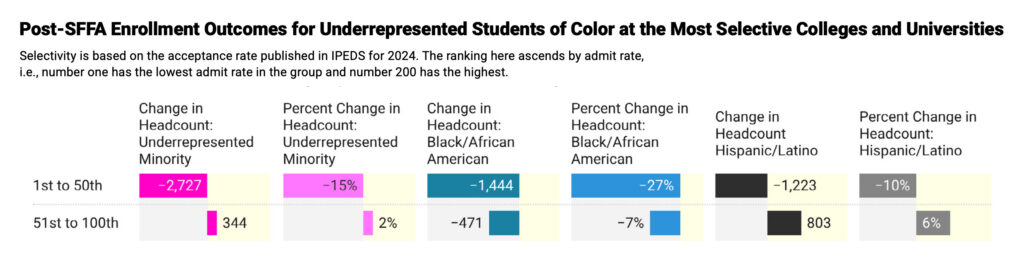
And, White and Asian American students didn’t much benefit. Except for an uptick in Asian American enrollment at Ivy League Plus institutions (Ivies and a small group of other elites, such as Stanford), enrollment was essentially flat for the two groups, puncturing the predictions of affirmative action’s critics. This general pattern, a report by the Progressive Policy Institute (PPI) confirmed, continued into the 2025 freshman class, although there is a ton of heterogeneity across schools, and data is missing from many of them.
The story changes dramatically, however, if we look beyond this sliver of the American educational landscape. In the country’s remaining four-year colleges—which is to say, nearly all of them—minority enrollment grew. In some places, it ballooned: by 50% for Black students at the University of Mississippi, for instance, and 35% for Hispanic ones at the University of Tennessee-Knoxville.
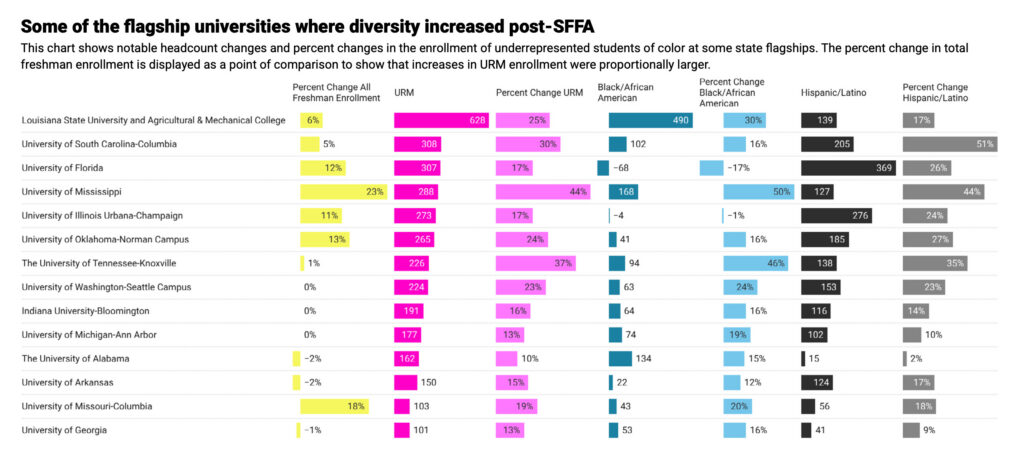
This outcome, perhaps surprising to the public, was predicted by scholars. It’s what is known as the “cascade effect” in action. High-performing minority students who may have gone to Rice or Vanderbilt before the Supreme Court’s decision instead flocked to what were probably their “safety schools”—places like American University or Fordham University, which both realized big increases in campus diversity.
It’s a definite upside for those institutions, if not necessarily for the “cascaded” students, who land in environments with lower graduation rates and after-college earnings potential—not to mention who miss out on what, at certain schools, amounts to a conveyor belt to the nation’s halls of power.
The other potential consequence of the cascade effect is that the influx of those super-qualified students pushes aside applicants lower on the academic ladder, who then end up pursuing associate’s degrees or certificate programs. That hasn’t happened so far—overall, the number of Black or Hispanic bachelor’s students has remained steady. But Murphy does note a troubling increase in Black first-time enrollees in for-profit colleges.
So, on the racial diversity front, it has been a mixed bag—not the disaster many predicted for Black and Hispanic students, but not ideal, either. (On the other hand, I imagine a number of Asian American households were ecstatic when admittance letters came.)
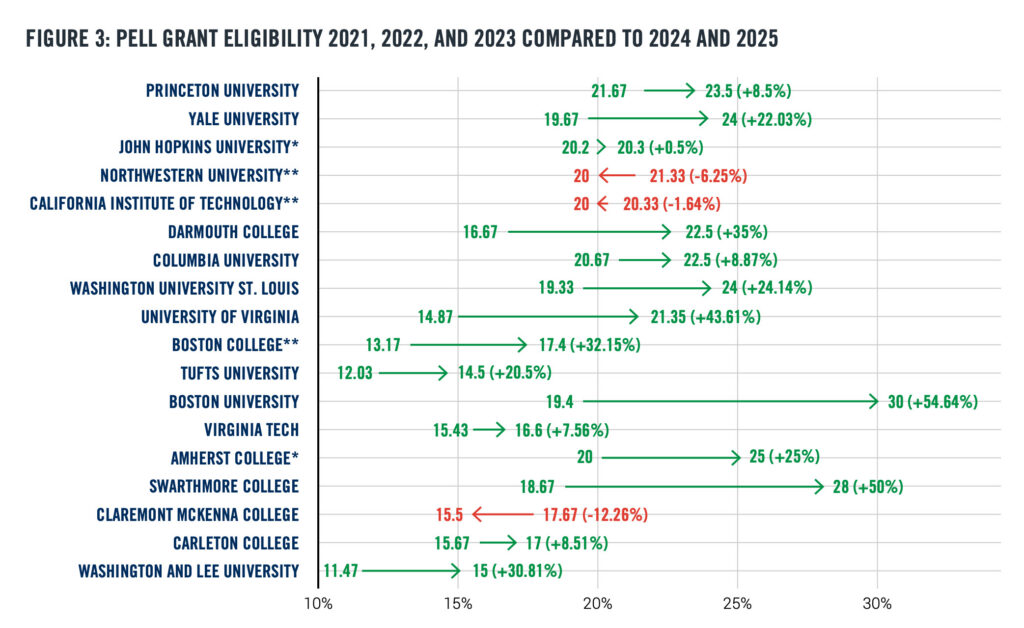
And other kinds of diversity? The PPI report—which advocates for admissions policies that benefit low-income students—suggests that the past two years have been a win for the socioeconomic kind, as elite colleges switched their recruitment and admissions focus. In a sample of top 100 colleges by rank, the authors found that the share of first-generation college-goers is rising. Some schools, such as Yale and Dartmouth, even set records for that cohort in 2024. Meanwhile, the share of admitted students that are eligible for federal Pell grants—which, as they are awarded to middle- and low-income undergraduates, are roughly representative of socioeconomic status—has swelled.
For his part, Murphy stresses that all of this data only illustrates what’s happening, not why it’s happening. College admissions is an opaque process, and plenty of other factors, from an “unprecedented increase” in the number of applicants choosing not to identify their race or ethnicity to how colleges count multiracial students to a return to using test scores may have tipped the scales one way or another. In any case, it’s also entirely possible that once free of Trump administration scrutiny, colleges will loosen up on how they look at race, and numbers will change yet again.
For now, though, they are a reminder that reality often defies expectations, no matter whose.
—Emma Varvaloucas
P.S. A brief update on last week’s Ebola edition: While health officials are still playing catch-up with the outbreak, the WHO has greatly reduced the number of suspected cases, and a handful of patients have recovered.
What Could Go Right? S8 E8: Why AI and Drones Won’t Bring the Apocalypse | with Sarah Kreps
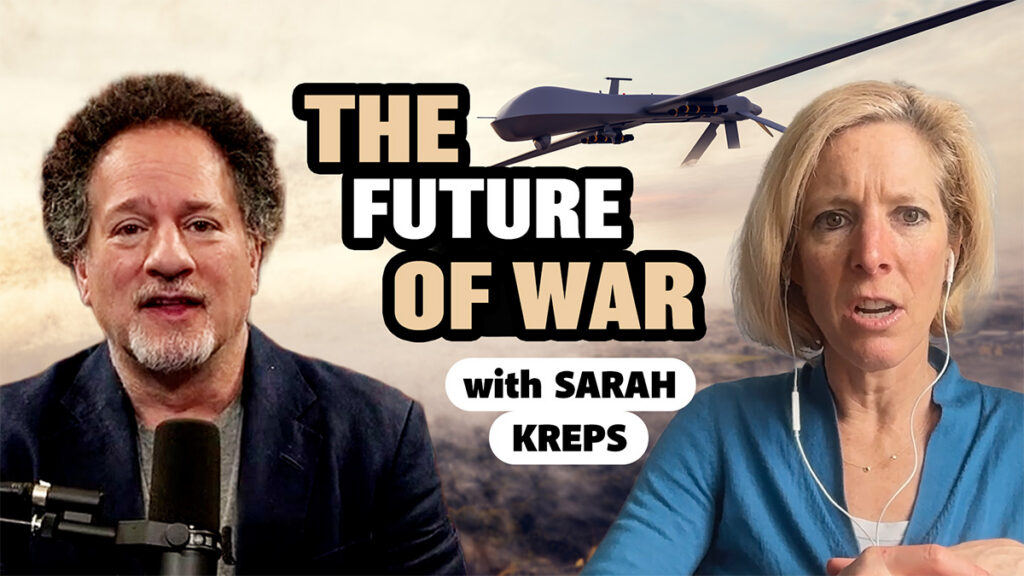
What does a future where autonomous weapons and artificial intelligence collide on the battlefield look like? Sarah Kreps, a Cornell University professor and former US Air Force officer, joins host Zachary Karabell to navigate the rapidly evolving landscape of drones and military AI. | Listen now
By the Numbers
90%: Share of Gambians with access to electricity, up from 60% in 2018
1,450: Count of loggerhead sea turtle nests as Florida’s nesting season heads into a record-breaking year
64%: Share of US adults who say marijuana should be legalized, up from 31% in 2000
58%: Share of the global population that has access to safe sanitation as of 2024, compared to 31% in 2000
8: Crested ibises recently released into the wild in Japan, after the endangered bird had gone extinct in the country
Go Figure
Rural America is experiencing something of a solar power boomlet, a boon to at least some struggling family farms. Multiple states have enacted a host of policies to encourage the adoption of green power, including fast-tracking community-scale solar and incentivizing farms that double up grazing and growing land with panel installations, a practice known as “agrivoltaics.”
Quick Hits
🪸 One of the world’s largest deep-sea coral reefs has been discovered off the coast of Argentina—and it’s home to dozens of species new to science.
🐙 An additional 1,100+ new species have been identified so far during a global initiative to accelerate the discovery of marine life. (Bonus: a golf-ball-sized blue octopus just discovered near the Galápagos Islands.)
🔋 Australia is installing an astonishing amount of batteries—roughly one for every 25 homes this fiscal year alone. The push has helped drop annual emissions by two percent.
📈 Globally, people’s satisfaction with their day-to-day freedoms has reached a record high, with gains in former Eastern Bloc countries offsetting a deterioration in G7 nations.
🍺 Scientists in Czechia are hard at work creating climate-resilient hops varieties amid droughts and heatwaves in the country that drinks more beer per capita than any other.
🔬 Researchers are hailing a “functional cure” to hepatitis B after the first-of-its-kind drug was shown to permit a stoppage in treatment without the virus returning.
💉 An injection has shrunk the tumors of head and neck cancer patients in an “unprecedented trial result,”in some cases eliminating them entirely. Trials involving other types of cancers are ongoing.
🌍 Namibia has received funding to permanently conserve more than 24% of the country in the first investment-for-protection initiative in Africa designed to ensure long-term success.
👷 Brazilians might soon enjoy a two-day weekend as lawmakers move to shorten the workweek to 5 days and 40 hours, with no change in pay. Brazilians currently work 44 hours across 6 days.
📉 Internet prices in the US have fallen across the board for 11 consecutive years, in stark contrast to other categories of household spending. Real prices are down over 43% since 2014, as speeds have dramatically increased. (Related: balcony solar, coming soon to dozens of US states, could also help with electricity bills.)
🚫 Vermont is the first state to ban the toxic herbicide paraquat, and a dozen other states may be next.
🚀 NASA has unveiled its next steps for building a permanent moon base, although many say the proposed timing is unrealistic. China is also aiming to get humans to the lunar surface by the end of the decade.
👀 What we’re watching: Amid GOP backlash, Trump drops his $1.8 billion “anti-weaponization” fund—at least for now.
💡 Editor’s pick: Not all is lost for new college grads: they’re doing better than the vibes suggest.
TPN Member Originals
(Who are our Members? Get to know them.)
- The post-Trump era is beginning | Breaking the News ($) | James Fallows
- Lessons of successful resistance: The water defenders of El Salvador | Lucid | Ruth Ben-Ghiat
- They grew up with AI. Now they’re taking control | Life with Machines | Baratunde Thurston
- The pope’s guide to the AI revolution | TFP ($) | Arthur Brooks
- Be excellent, not efficient | Persuasion | Eboo Patel
- Japan leads space race | Diane Francis | Diane Francis
- Few Americans can afford long-term care—but this state program could be a game changer | MarketWatch ($) | Ezekiel J. Emanuel
- Magnanimity | No Mercy/No Malice | Scott Galloway
- Honey, where did all the male workers go? | Of Boys and Men | Richard Reeves
- Renovating Harvard (and other Ivies) | The Renovator | Danielle Allen
- Seventeen thoughts on Graham Platner | Slow Boring | Matthew Yglesias