
Volcanoes are erupting in The Philippines, but on-fire Australia received some welcome rain. The Iran war cries have been called off and The Donald’s military powers are about to be hamstrung by the Senate. Meanwhile, his impeachment trial is starting, and we’re all on Twitter for a front-row seat.

Chernobyl’s Unintended Nature Reserve
Featuring Emma Varvaloucas
For the first time in over a century, renewables have knocked coal out of the top spot for global electricity generation—and solar is the reason why. Emma Varvaloucas, Executive Director of The Progress Network, breaks down what this energy milestone actually means, and why geopolitics is unexpectedly accelerating the clean energy transition. Plus: 40 years after the worst nuclear disaster in history, wildlife is flourishing inside the Chernobyl exclusion zone.


Prefer to read? Check out the Audio Transcript
Although the transcription is largely accurate, in some cases it may be incomplete or inaccurate due to inaudible passages or transcription software errors.
Emma Varvaloucas: Welcome to the What Could Go Right? Progress Report, where we dive into all of the good news that you probably missed because it was buried under the absolute shit storm of bad news. Hey, if you’re new here, I’m Emma Varvaloucas, and I’m the executive director of the Progress Network, and here’s what we’re gonna be covering today.
You’ve probably heard of Chernobyl, which remains the worst nuclear disaster in history. And yet four decades later, something is happening inside of the Chernobyl Exclusion Zone that nobody had planned for. Also this week, a startup claims to have grown functional human sperm in a lab, solar energy has knocked coal off of its top spot for the first time since 1919, and finally, a story about how NASA might become the DoorDash of human organs. Yeah, you’re gonna wanna stick around until the end.
There’s a lot to get into, so let’s dive in.
You probably didn’t expect the word Chernobyl to be in the same sentence as good news, but here it comes. 40 years after the worst nuclear disaster in history, the Chernobyl Exclusion Zone is experiencing a wildlife miracle—that’s extremely good news.
The zone is a radioactive no man’s land larger than Luxembourg. And yes, Luxembourg is small for a country, but that is big for an exclusion zone. It straddles Ukraine and Belarus, and remains off limits to humans. But wildlife, wildlife did not get that memo. Wolves hunt in the radioactive landscape alongside brown bears, who have returned to the area after more than a century.
Lynx, moose, and red deer have also populated the human-less region. And perhaps the most remarkable species there are Przewalski’s horses, a horse native to Mongolia and once at the brink of extinction, which were introduced to the region in 1998 as an experiment, and are now thriving.
Scientists are still studying what the radiation is doing to these animals over the long term. Like, some frogs have developed darker pigmentation, some birds in higher radiation areas show more cataracts. So of course, the story is complicated. But the zone’s lead nature scientist put it simply: “nature has effectively performed a factory reset.”
Here is one thing that is certain: wildlife has an amazing way of adapting and showing us resilience in a way that’s frankly inspiring.
It’s also worth noting that Chernobyl has very much so been in the news lately for its 40th anniversary, and not only for the wildlife story. Russia’s war on Ukraine has turned the exclusion zone into a military corridor, and Ukraine and the International Atomic Energy Agency are urgently seeking 500 million euros to cover repairs.
Progress comes in complicated shapes. But hey, the horses are doing really well.
Now, that story leads perfectly into our next one. After the horrific disaster of Chernobyl, people were scared of nuclear energy, understandably. I mean, a reactor exploded and sent radiation across an entire continent, so you can’t blame them.
That fear slowed the development of nuclear energy across Europe, but now, four decades later, nuclear is actually going through a revival around the world. And guess what? Renewable energy is having a moment. The reason? Well, for starters, the war in the Middle East. The think tank Ember just published its annual electricity report, and buried inside is a number that I think deserves a lot more attention than what it’s been getting.
In 2025, renewables accounted for 33.8% of global power generation. Coal came in at just under 33%, its lowest in history. Okay, now, I can already hear you. “Emma, .8%? Really? That’s it? That’s what we’re celebrating?” Yes, and here’s why. Coal has held the throne of global energy for over 100 years. In 1919, there was this brief moment when hydropower had a big year and usurped coal’s spot.
But then coal took the crown right back, and it sat there for over a century, through two world wars, the moon landing, the invention of the internet, and approximately 10,000 think pieces about the future of clean energy. This time though, the driving force is solar. Since the Paris Agreement was signed in 2015, solar has multiplied by 10 times.
It now generates 2,778 terawatt hours a year, roughly the total electricity demand of the entire European Union. In 2025, it out generated wind for the first time ever, and it’s on track to surpass nuclear this year.
There’s another milestone in here, though, that’s easy to miss. Last year saw an annual decline in fossil fuel generation, one of only five times that has happened in a century. The other four, economic crises and pandemics. Well, one pandemic in particular—you probably remember it. Last year, though, it happened because clean energy simply grew fast enough to meet all of the world’s new electricity demand, and that’s genuinely new.
Now, here’s a dose of honesty. That decline in fossil fuel generation was 0.2%, itsy bitsy by most metrics. The world still burns a colossal amount of coal, and that amount has basically plateaued and has not started to fall in any significant way, and global emissions are still rising. We’re at the beginning of a new era, not at the end of an old one quite yet.
But here’s why that beginning matters. Solar isn’t growing because of government mandates or climate guilt. It’s growing because it’s now cheaper to build a solar farm than it is to dig in the dirt or burn carbon, and most people, they’re gonna go with the cheaper option.
Also, geopolitics is doing something unexpected, accelerating all of it. The same way Russia’s invasion of Ukraine pushed Europe hard towards renewables, the current tensions around the Strait of Hormuz are triggering a worldwide sprint towards clean energy. I’m not saying we should thank Trump for starting all of that, but okay, silver lining for sure. Countries are falling over one another to buy Chinese solar panels, batteries, and electric vehicles. Exports for all three of those hit a record high in March. And many countries, France, India, Turkey, to name just a few, have announced new clean energy investments in just the past few weeks.
So while it’s far too early to declare the climate fight won, we are at least nearing the time to anoint a new energy monarch. Long live King Solar.
Before we get back to our stories, here are some numbers that will make you smile.
930: miles the Chinese company CATL’s new EV battery can last on a single charge.
567 million: the number of additional people covered by essential health services since 2018. That’s according to the WHO.
3: European countries—Iceland, Portugal, and Norway—that have reached 90% HPV vaccine uptake in girls, which will essentially disappear cervical cancer in that generation.
And onwards and upwards to our quick hits.
Our next story is one that I debated how to introduce for longer than I would like to admit. A startup out of Utah called Paterna Biosciences, check the Greek reference there, says it has successfully grown functional human sperm in a lab and use it to fertilize eggs, producing visibly healthy-looking embryos.
I’ll give you a moment with that.
Okay, so scientists have been trying to do this, it’s called in vitro spermatogenesis, which is a very clinical way of saying making sperm in a dish, for almost a century. A Japanese team figured it out with mice in 2011, but human sperm, it turns out, is significantly more complicated.
Shocking, I know. But the Paterna scientists have cracked the code, or so they say, and here’s why this matters. Roughly half of all infertility cases involve male factors, and about 10 to 15% of infertile men produce no sperm whatsoever, and current options to help with that are extremely limited. The last resort is a four-hour surgery where doctors dig around and very rarely find a solution. Ouch.
Paterna’s version is a small biopsy at a doctor’s office. That tissue gets sent to a lab, they do their thing, and you get the sperm for somewhere between $5,000 and $12,000, which, yes, is a lot, but still less than a four-hour operation with no guarantees.
Now, the caveats, and there are several, which I feel ethically obligated to share with you before you text this to every man you know.
The findings have not been published in a peer-reviewed journal, and they have not been independently verified. Trials could begin as soon as next year, which means that even if everything is as Paterna says it is, we are still some time away from lab-grown sperm babies being born. And when they are, I bet they’re gonna have the most annoyingly symmetrical faces.
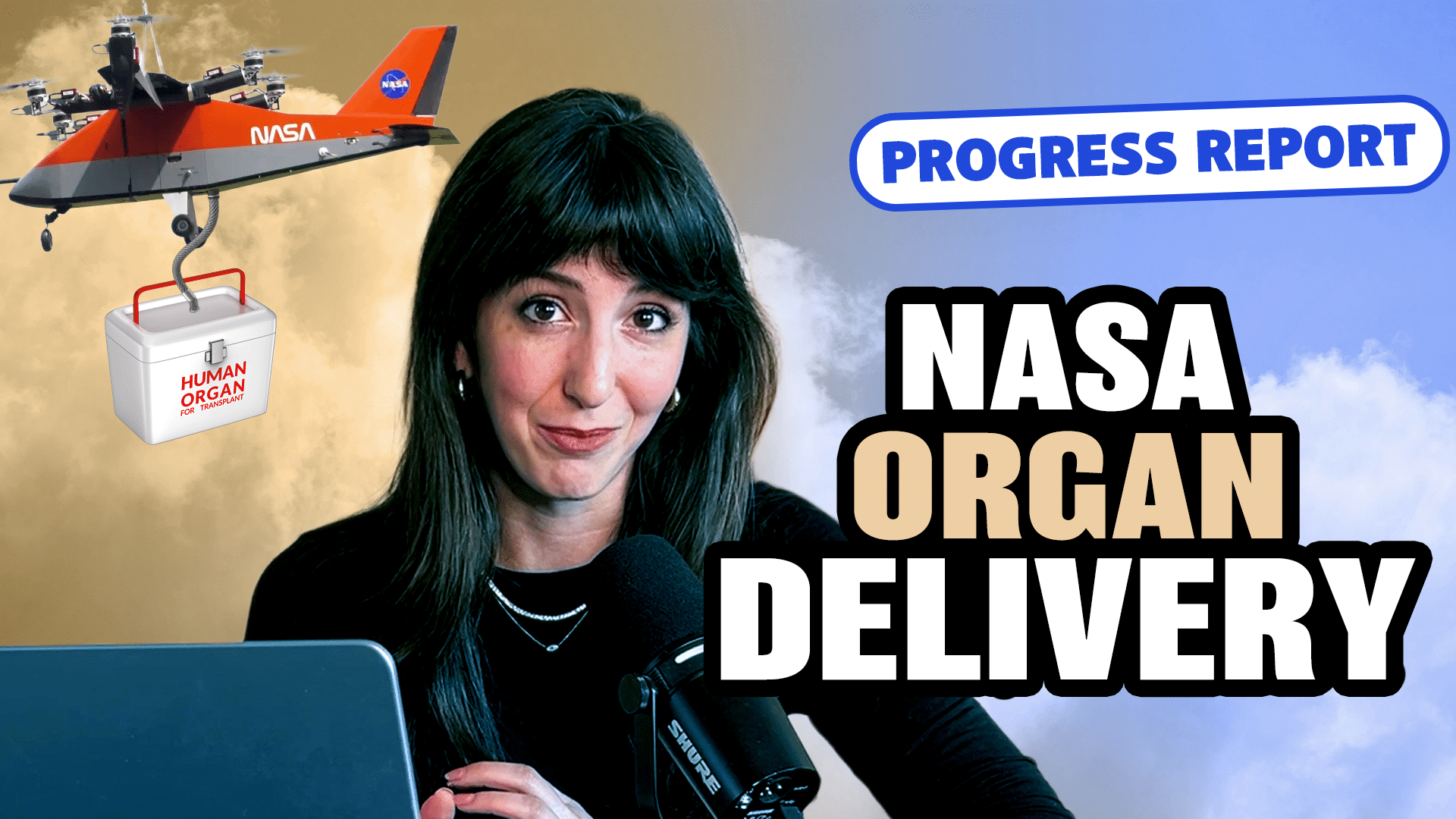
And finally, NASA is getting into the organ delivery business. Drone Dash?
The US organ transplant system has been under serious scrutiny in recent years. Reports of unsafe practices, poor quality control, and organs becoming unusable and getting lost in transit. I mean, I don’t know how you can lose something like that, but okay.
It got so bad that thousands of people actually removed themselves from organ donor registries over it, which is tragic by all accounts. So enter NASA, in a rather explosive and dramatic kind of way. The nonprofit that runs most of the US transplant system just announced a partnership with NASA’s Langley Research Center to study whether drones could fix all of this, and not in a casual, “Hey, what if?”kind of way. We’re talking advanced modeling, flight planning, and research into whether a human organ can actually survive drone transport. That last one seems pretty critical to me to figure out, so…
Drones, as you may have clocked, do not get stuck in traffic, they do not miss connecting flights. They do not accidentally leave a human kidney in a layover in Denver.
NASA has already done similar self-flying testing for air taxis, so the technical groundwork is there. Academic researchers have also been piloting drone delivery for a while, so this partnership could significantly accelerate the whole field. It won’t fix everything overnight, but given that the current system has driven people to opt out of donating altogether, NASA jumping in to save the day and potentially the lives of a lot of people is really good news, and potentially a much better use of their time than some other things that they may have been up to. Am I right? Make NASA useful again.
And that’s all for this week’s Progress Report. I hope these stories remind you of all the good that’s going on out there in the world, so it’s important not to get blinded by all of the bad. So if you got some value from this show, maybe something to bring up at your next paint n’ sip, send this show to a friend who could use some positive news.
And make sure to like and subscribe to our YouTube channel, follow us on your preferred podcast platform, and leave us a review. And if you’d like more of these stories delivered straight to your inbox, sign up for our newsletter. The link is in the description. If you’ve got a good news story that you’d like to see us cover next week, let us know in the comments.
Thanks for watching, and see you next week on the Progress Report.
LOAD MORE
Meet the Hosts

Emma Varvaloucas