
Volcanoes are erupting in The Philippines, but on-fire Australia received some welcome rain. The Iran war cries have been called off and The Donald’s military powers are about to be hamstrung by the Senate. Meanwhile, his impeachment trial is starting, and we’re all on Twitter for a front-row seat.

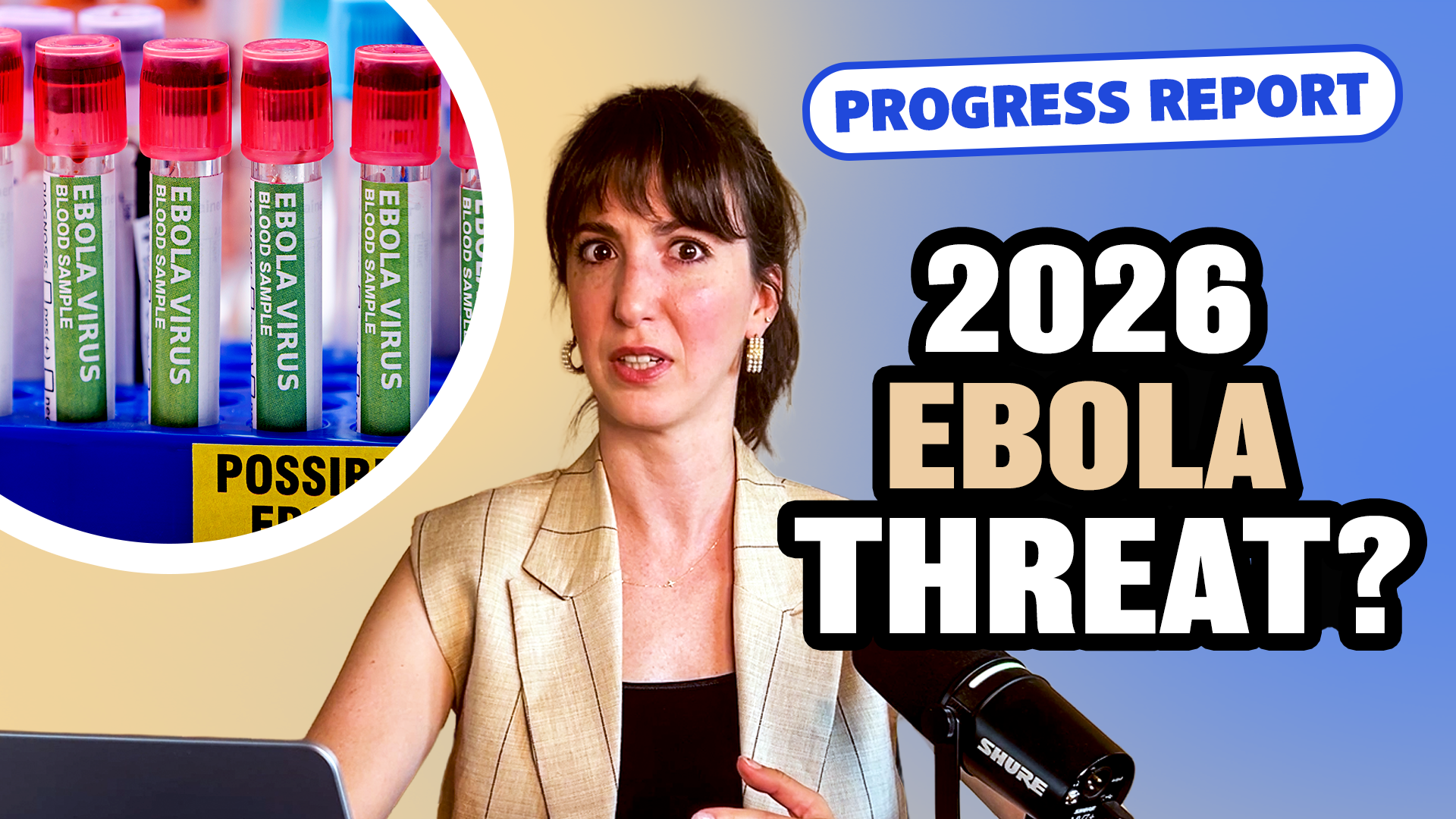
What the Headlines Aren’t Telling You About Ebola
Featuring Emma Varvaloucas
A rare strain of Ebola is making headlines—but before you spiral, there’s more to the story than what meets the eye. The Democratic Republic of Congo has successfully contained 15 previous outbreaks, and scientists are working around the clock on experimental treatments. We know one thing for certain: this is not the 2014–2016 outbreak.


Prefer to read? Check out the Audio Transcript
Although the transcription is largely accurate, in some cases it may be incomplete or inaccurate due to inaudible passages or transcription software errors.
Emma Varvaloucas: Ebola is making headlines again, but there are some silver linings that you might not be seeing in the news. India is on its way to becoming the first major country to industrialize using solar power. Hungary’s new proposed constitutional amendment effectively bans dictators. And a cutting-edge medical story out of Chicago.
Welcome to the What Could Go Right? Progress Report, where we dive into all the good news that you probably missed because it was buried under the barrage of bad news. Let’s get into it.
The last few weeks for global health have been… how do I put this? A dumpster fire and very triggering. Not triggering in the way that a text message from your ex is triggering, but triggering in a way that very frightening headlines hinting at the next global pandemic is triggering.
And while hantavirus hysteria has chilled out as the situation stabilizes, another virus is taking its place in the news cycle. Earlier in May, news hit of the third-largest Ebola outbreak in history. So far, more than 200 people in Eastern Democratic Republic of Congo, also known as the DRC, are suspected to have died from the virus in connection to this outbreak.
Now, if you’re thinking, “Ebola, that thing we were all freaking out about in 2014?” Yes, that Ebola. It hasn’t gotten a lot of news coverage in the last few years, but there have been multiple smaller flare-ups in Africa since then. There’s a reason why those flare-ups have been small. After a massive outbreak in Western Africa that lasted from 2014 to 2016 and killed more than 10,000 people, the world developed and stockpiled the very first Ebola vaccines.
They worked so well for a while that people, including me, wondered if the era of large Ebola outbreaks was over. Yeah, that take aged like milk, because now a rare strain, Bundibugyo, is causing major problems, and unfortunately, those vaccines that I mentioned before weren’t made for it. Even worse, it’s spreading in a conflict zone with an already weakened healthcare system that was victim to the double whammy of last year’s aid funding cuts.
Listen, I know this is the Progress Report, where you come to get good news, not where you come to rethink getting back on your anti-anxiety meds. So I promise by the end of this you will certainly not be thinking about that.
Okay, here come the silver linings. This is far from the first time that the DRC has had to deal with Ebola. Per The New York Times, Congo’s health minister pointed out in a press conference that the country has been able to contain 15 previous outbreaks of Ebola without vaccines. So they’ve got experience on their side. And yes, Ebola does generally have a high fatality rate, but the Bundibugyo strain seems to be less deadly than the more common Zaire one.
My goal here is to transform all of you from nervous Nellies into cool, calm, and collected Carolines. Is it working? Okay, I’ll keep going.
It’s not just the DRC that is taking action. After all these outbreaks, I imagine that the international community leaps into a lab coat, gloves, and face mask faster than you can even say Ebola Bundibugyo.
And now that the outbreak has been declared, they have. Scientists alongside the World Health Organization are testing strain-specific medications and working day and night to launch clinical trials and experimental treatments. The first is remdesivir, which is a general antiviral. It has been tested before in other situations like the COVID-19 pandemic, if you remember that one, but it has only ever been somewhat effective.
Now, there is another one that is a bit more novel and exciting, MBP134. I know, it doesn’t quite have the same ring to it, but… It’s an antibody mix developed specifically for Ebola viruses, and funded, by the way, by American federal research dollars. It works fabulously in monkeys, but its effectiveness in humans is yet to be seen.
Its maker has already shipped over some doses for use in high-risk individuals. So we’re gonna keep our eyes on how that plays out, and we’re hoping that these treatments can help protect and save more lives. A few vaccines for Bundibugyo are in the pipeline, but it’s going to take months to prepare them.
And meanwhile, the Africa CDC is considering trialing a vaccine that targets the Zaire strain. Whether it’ll act against Bundibugyo is 50/50. But the overall takeaway here is that while this current outbreak is definitely bad and is gonna grow for a while before it slows down, there is a lot that has been learned in the past which, odds are, fingers crossed, now going to have a positive impact on the trajectory of this outbreak.
Dr. Amanda Rojek, a health emergencies professor at Oxford’s Pandemic Sciences Institute, made the same point to CNN: “This is not the same situation as 2014.” And if you’re outside the regional area, meaning the DRC and Uganda, you can breathe easy. Ebola requires close contact to spread, and the WHO has set the global risk as low.
Chat, we are not cooked.
Before we get into our shorter stories, here are some numbers that will make you smile. 2017, the year that global sales of combustion engine cars peaked. Soon you’re gonna get a gas-powered car and people are gonna be like, “That was so 2017.”
26, miles traveled by NASA’s Perseverance rover on Mars as it continues to collect data, and that’s basically the length of a marathon. I wonder what its time was.
$25,000, amount that 11 endangered US sites representing the country’s promise of equality will receive for preservation. $25 million, the cost of a high-tech maternal care center in Sierra Leone that is expected to curb the country’s maternal mortality rate, which is one of the highest in the world. More than 600, the number of generic drugs added to Trump Rx.
And here are our quick hits for today.
First up, India is on its way to becoming the first major country in the world to industrialize with solar power. In northwestern India, on the border of Pakistan, lies the Great Rann of Kutch. I love that name. It sounds very majestic. It’s the largest salt desert in the world, and it’s soon to be home to what’s expected to be the largest renewable energy project in the world. Building it has been far from easy. Workers have complained about the harsh environment and working conditions, but despite that, by 2029, about 60 million solar panels will cover the 280 square miles of Indian desert.
To put that in perspective, that’s roughly the size of the Caribbean island, Dominica, or the city of Lexington, Kentucky. So how much power will a plant like that generate? 30 gigawatts. That’s enough to power the entire country of Austria. Austria runs on India. Okay. Not literally, but maybe climate activists can take a note from the marketing execs at Dunkin’ Donuts. I think it’s a good idea.
Anyway, as Fred Pierce points out in a piece for Yale e360, the news of the solar revolution in India is really surprising. This is a country where 10 years ago, the government was obsessed with industrializing with coal, and if you uttered the words solar power, you might as well have been speaking another language. And no, not one of the 121 major Indian languages.
But something shifted in the last decade, quietly, and now with incredible force. This volcano of solar power is ready to erupt. Okay, I can’t front with you guys. That’s really a better metaphor/pun for geothermal energy, but we tried to come up with a solar energy pun, and just everything we thought of was super lame, so forgive me.
The point is, the hope is that by 2050, more of India’s energy will come from renewables than fossil fuels, which is wild considering that they’re in the midst of industrializing, and that has only ever been done before in history using dirty energy, like coal. If you thought India was only known for mouthwateringly good food, soon you’re gonna know them for being one of the most creative and innovative countries at the forefront of the climate revolution.
So, here’s the main thing. If India continues down this track, it could prove that it is possible to build a powerful economy and raise standards of living while also moving towards a sustainable energy future, and potentially giving other countries a blueprint to follow. I, for one, am very excited to see this solar project in full force. Powerful stuff. Ah, there’s the solar power pun. I knew we would get there.
Next up is a story out of Hungary. If you caught our first episode of the season, and if you didn’t, you can go back and listen to it now, you’ll remember that Hungary just got a new prime minister, specifically this very good-looking prime minister. What? We were all thinking it.
Peter Magyar has been in office for a few short weeks, and he’s already proposed a constitutional amendment that would cap prime ministers to eight years in office. Bold move to effectively term limit yourself almost immediately after being sworn in. But the real target of that amendment is his predecessor, Viktor Orbán.
You might have heard of him. Rigged elections, packed courts, inspired far-right politicians in the United States, targeted government critics. Yeah. So by most accounts, textbook authoritarian wannabe. And in true authoritarian fashion, he overstayed his welcome. As in, he stayed in office for five terms totaling 20 years.
This new constitutional amendment would retroactively apply to any term served by prime minister since Hungary’s democratization in 1990. So what this means for Orbán is he’s effectively barred from returning to office. This is a direct result of Madyar’s two-year campaign which centered on restoring Hungarian democracy. You know, the good old days. And unlike a suspicious number of politicians, he actually seems to be doing what he said he was gonna do.
Magyar has a serious mess to clean up and a skeptical public to win back, but the progress and pace of these last few weeks show that he knows that. If the early moves are any indication for what Magyar has in store for us, Hungary might really be able to turn a corner.
And last but not least, some genuinely impressive news from the world of medicine. Jasmine Jones is a 28-year-old woman from Chicago’s South Side who was diagnosed with cystic fibrosis when she was five months old. It’s a genetic disease that can damage the lungs and other organs. Her doctors told her she’d need to do something pretty unthinkable: replace four of her organs at the same time.
In January, surgeons at the University of Chicago performed a quadruple organ transplant. She got a new right and left lung, kidney, and liver all in one 36-hour surgery. And guys, this isn’t like going for a hip replacement. This quadruple organ transplant was the first of its kind in Illinois and only the sixth in the entire United States.
And according to the Chicago Tribune, Jones had no clue how rare this procedure was until months after her surgery, which honestly might have been the right order of operations. Like, can you imagine going into a major surgery knowing only five other procedures of its kind have taken place? I’d probably make a run for it, but Jasmine Jones didn’t know, and Jasmine Jones went through with it, and the results have been positive.
She says she’s “feeling pretty good” about five months after the transplant. That feels like the biggest understatement of the year, but I will take it. I mean, this woman deserves a gold medal for going through what she did. And honestly, so do those surgeons. It’s an amazing feat for the medical field.
Transplant science is advancing faster than anyone could have predicted, and procedures that once seemed impossible are becoming real.
And that’s all for this week’s Progress Report. I hope these stories remind you that there’s so much good going on in the world, so it’s important to shift our focus away sometimes from all of the bad.
So if you got some value from this episode, maybe something you can bring up at your next park picnic, forward the show to a friend who could really use some positive news, or send it to the hypochondriac in your life that’s freaking out about Ebola. And make sure to like and subscribe to our YouTube channel and follow us on your preferred podcast platform and leave us a review.
And if you’d like some more stories like this coming directly to your inbox, sign up for our newsletter. The link is in the description. Got a good news story that we should cover next week? Let us know in the comments. Thank you for watching, and see you next week on The Progress Report.
LOAD MORE
Meet the Hosts

Emma Varvaloucas