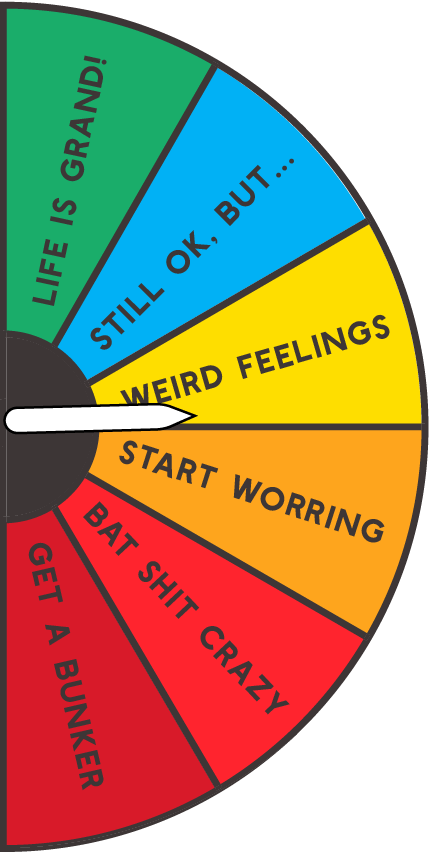
Volcanoes are erupting in The Philippines, but on-fire Australia received some welcome rain. The Iran war cries have been called off and The Donald’s military powers are about to be hamstrung by the Senate. Meanwhile, his impeachment trial is starting, and we’re all on Twitter for a front-row seat.

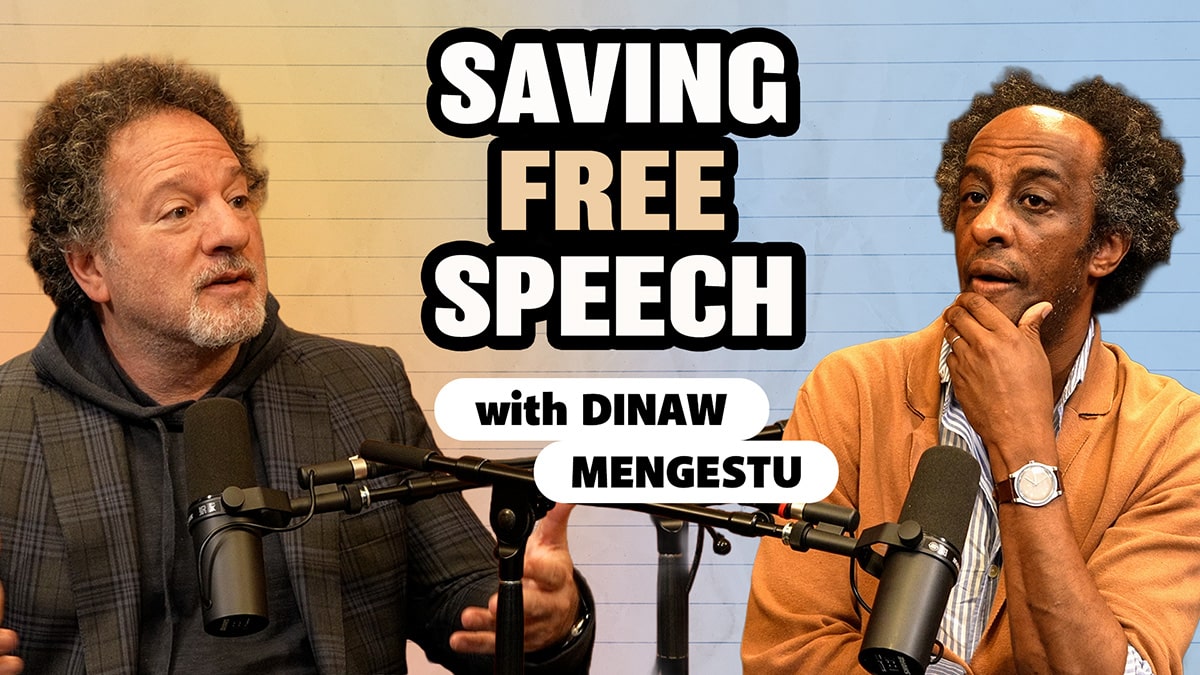
Is Free Expression Actually Under Attack?
Featuring Dinaw Mengestu
We hear often that freedom of speech is under threat. And it’s easy to feel like things have never been worse in that regard. But is that really true? Dinaw Mengestu, an acclaimed novelist, MacArthur Genius grant recipient, and president of PEN America, joins host Zachary Karabell to examine the true state of free speech in the United States and abroad.


Prefer to read? Check out the Audio Transcript
Zachary Karabell: What Could Go Right? Where we try to look at, yes, what could go right instead of everything that is always going wrong. One of the things about American society that is notable is a commitment, first, to free speech, enshrined in the Constitution’s First Amendment, and even more broadly, to free expression.
And we’re going to have a conversation today about whether or not we are in a time where that heralded, vaunted free expression, free speech that is such a hallmark of American society — is it in peril? Is it under threat? Or more importantly, are the threats and perils that are evident any different than any other threats and perils in the past, in form, in substance, in amplitude, or is this just one of those moments where there are challenges to something that remains foundational?
And I’m going to talk today to Dinaw Mengestu, who is a professor at Bard. He’s written four incredibly acclaimed novels. Obama put his most recent one on his must-read list. He’s won a MacArthur “genius grant,” therefore he is a genius, and he is somebody who thinks very deeply about this, as you will see. Dinaw, it is such a pleasure talking to you today, particularly because of the hair thing. I think we’ve both got the sort of early-onset Einstein syndrome going on here.
Dinaw Mengestu: That’s why people keep telling me on the street as I’m walking, “You look smart.”
Zachary Karabell: Yeah.
Dinaw Mengestu: And I think it’s just that.
Zachary Karabell: It’s just the hair. And if you do the glasses right to here, you do that every now and then —
Dinaw Mengestu: I do that a lot. Just to impress them.
Zachary Karabell: I mean, I think that would absolutely do it. So let’s just jump into one thing that we share in common. We’re both on the board of PEN America. You’re now the illustrious president of PEN America, and one of the things PEN America is devoted to, and has always been, for those of you who don’t know, a longtime writers’ organization, I guess 100 years.
Dinaw Mengestu: 103 years and counting.
Zachary Karabell: 103 years, but who’s counting? And free speech, right?
Dinaw Mengestu: Free expression.
Zachary Karabell: Free expression. Ooh, good, good catch.
Dinaw Mengestu: Important distinction, yeah.
Zachary Karabell: Yeah. What’s the distinction?
Dinaw Mengestu: Free speech is protected by the First Amendment, and that’s a very broad category. Free expression is even broader in that it’s not only forms of censorship, but private institutions, for example, are allowed to choose who does and does not speak in their spaces. But free expression sort of suggests that they should hold themselves to standards that are as broad and as vast as possible. You can also impact somebody’s free expression by censoring them, by intimidating them, by refusing to allow them to enter a room. All of those become strikes to free expression, and those aren’t protected by the First Amendment. So we cover, in a very sort of necessary and also problematic and difficult way, a much broader range of things.
Zachary Karabell: You and I are largely, I think, aligned on the imperative of free expression for a thriving democratic liberal society. We live in a time where it is common, I think, to say free expression is under massive assault in places where it has been largely protected. The United States, all these issues about Western Europe, and sort of coming down on forms of hate speech that cast a very wide net.
Dinaw Mengestu: Yeah.
Zachary Karabell: I don’t necessarily feel that we are living in a time where free expression is comparatively under assault. In that, there is a way of looking at the world today where we’re like, more people are saying more stuff —
Dinaw Mengestu: Yeah.
Zachary Karabell: In more venues —
Dinaw Mengestu: Globally.
Zachary Karabell: In more parts of the world, globally, than ever before. And including in these areas where the ideas themselves get contested, and occasionally they get contested by inappropriate use of laws, by coercion of private institutions, higher education institutions. But at least from my vantage point, that’s never not been true. There’s never been some halcyon moment where everybody got to just have their free expression honored in a kind of a Marquess of Queensberry, I deeply respect your difference with me, and I hear it, but I dissent, good sir. Like, I don’t think that’s ever happened.
Dinaw Mengestu: Yeah. And I mean, I agree with you to some degree. I think there are more venues and places and ways for people to express themselves, and that is true globally, right? There are larger platforms, there are more ways that you can make your experience and your perspective heard. There are also more ways that you can be surveilled at the same time. And I think the way we understand the threats to free expression, or free speech, perhaps they need to be as expansive as the new forms and ways that we have of communicating.
So to think of it only as, yes, there are more people who are able to speak, is certainly sort of true, but I think there are more targeted and more sort of specific threats, and I’ll focus just on the U.S., that to me are sort of particularly alarming and are at a scale that I’ve never seen and that I don’t think we’ve actually had before in the country.
So if you look at speech for anybody who is basically not a U.S. citizen, right? There’s not an explicit law that says you cannot say certain things. There is, however, an enormous pressure by the government to make sure that if you are an immigrant, you are afraid of saying certain things, and you will restrict your speech as a result.
I don’t know anybody here in this country who is on a green card or on a visa who feels like they can express themselves honestly, thoughtfully on social media. And this includes a large number of writers. Every writer that I know who is here on an O visa, which are exceptional visas for artists, which cover a whole range of really phenomenal individuals, none of them feel like they can go around expressing their ideas and beliefs the same way that they would have before this administration. So I think that category alone, I mean, that is to me a sort of remarkably repressive place to be in.
Zachary Karabell: I think that’s true generationally, meaning not in our lifetimes have we, dot dot dot. Although, and look, I am pushing back simply for the sake of, a lot of our concerns in the present are framed, I feel, by a reading of the past as a better point that we have now fallen from, and that that whole framework clouds our ability to kind of deal with, at least in the United States, longstanding oscillations and longstanding issues.
So in the wake of 9/11, if you’d been an immigrant, or an American, or an American Muslim, or anybody saying anything that in any way smacked of either sympathy for, or exculpatory language about, Islamic fundamentalism or Al-Qaeda, you risked the FBI seizing your communications. There was a whole series of suits brought, let alone the fact that there was a lot of vigilante justice.
So I mean, that’s a more recent one, let alone, you know, think about McCarthyism as a period of time where, not only was free expression not defended, but you had almost no recourse because it was so insinuated into every single institution, higher education, companies, individual life. There was no court you could go to because there was hardly anything you could prove in a way that would establish it.
Dinaw Mengestu: Yeah, completely. I agree with you. I don’t want to ever be nostalgic about the past. I think the past is sort of riddled with a whole bunch of terrible things, and when we look backward, it’s oftentimes with a rose-colored perspective that obscures lots of difficult things, including something like McCarthyism. And the fact that more people are obviously able to express themselves loudly than they were during McCarthyism is important. But at the same time, I think McCarthyism — I don’t want to get into trying to scale these things. If you were expressing communist beliefs during McCarthyism, obviously you were going to face repercussions for that.
The categories of spaces that I think we’re in now, one, I think the impact of a broader population, right? That’s basically anybody who is not a U.S. citizen in this country, which puts us at, roughly maybe 60 million. It’s a pretty significant size of the population.
And that range of speech covers a whole number of things, and it also means people coming into the United States, right? The fact that they might be able to search your social media when you are entering the U.S. is a terrible, alarming thing, and I know a number of people who are like, I’m not coming to your country because of that.
Post-9/11 certainly, but we actually understood the limits of what the government’s interventions might be, and they were threatening. The vigilante things certainly, I remember Susan Sontag published her piece post-9/11 in The New Yorker, and she was assaulted with a lot of vitriolic speech.
That is different because now we actually have a kind of clear government enforcement strategy, right? Which is where we’ll actually pick you up off the street, we’ll put you in the back of a car, and we’ll send you to a prison in Louisiana for as long as we possibly can. And even if you are released, we will have made your life hell for that period of time.
So that awareness, that’s how speech is chilled the most, oftentimes not because the government gets away with it, but because we have a clear sense of what the enforcement strategies might be.
Zachary Karabell: The response to those actions which the Trump administration took in the early few episodes of the second season of The Trump Show were almost entirely in the first few months of 2025, faced massive legal blowback.
Now, you wouldn’t want to be one of the people who was the person — the Columbia grad student, there was a Tufts grad student. A few of those people have since left. All of them were ordered released. All of them were kind of ordered released with prejudice. And while there have been some things that have gone on that haven’t gotten news coverage, there was a pretty powerful pushback against that that found purchase in the courts and some purchase culturally, to the degree that some of the most intensive efforts have receded. Now, the chilling effect exists anyway, right?
Dinaw Mengestu: Yeah. Which is why I think they did that so quickly. I mean, it was important to do that right away, and I think they targeted, obviously, a vulnerable population that I actually didn’t think of as being vulnerable, like green card holders, right? Permanent residents, which you sort of imagine have a fair amount of stability.
That happened within the first 60 days of this administration, and the targeting of that was very particular, I think, because you go after an immigrant community now and obviously, 1) you impact everybody around them. And 2) I think the consequences of that, they did exactly what they needed to do. They have impacted that speech across a wide range of spaces.
Go on a college campus today and tell me how many students you see sitting outside protesting, right? You don’t. It doesn’t happen. A lot of the students who would be protesting oftentimes were students on visas. They’re not going to go out there protesting any time in the next two or three years, and that is, I think, a very clear and deliberate strategy.
So I think they got exactly what they wanted. They knew there would be blowback from the courts. They knew this would not probably stand. But these cases aren’t over, and the courts might order your release, but again, the damage is done, and that’s what they care about most. That’s what the impact on our speech is. It’s about damage, and you can inflict a lot of damage right away, and the recovery from that damage is hard.
Zachary Karabell: So, you know, we live in a world of imperfect humans, eight and a half billion of them at most recent count. I mean this question actually openly, because it’s an interesting one. If you were going to live somewhere credibly, where would you live in the world today where the widest aperture of free expression existed?
Dinaw Mengestu: Say, like, liberal democracies in Europe, right? They actually have more restrictions on speech than we do, right? There are clear hate speech laws in France and Germany, et cetera, a lot of them created post-World War II. Whether I agree with them or not, what’s important for us is, we have a very large and diverse population. Not to say that European countries aren’t comprised of the same, but we need to hold together so many different cultural identities in this space, and the idea that we will be able to understand and measure lines between hate speech and non-hate speech across all of these different cultural identities I think would be absurd and foolish.
We might know how we might feel about it, how the general idea might feel, but I think to some degree, part of what sustains this really kind of impressive plurality is this kind of general and very generous and broad understanding of what is protected by the First Amendment in ways that don’t happen in Europe. There’s a much more solidified cultural, historical identity. I think here, we still are, and I think what happens now isn’t permanent, but I also don’t want to undersell the scale of threat that we’re under, because I also don’t think it’s finished. I think everything that started with one population is about expanding and obviously increasing and alarming that threat. The use of the FCC powers, it’s all intertwined in a certain way.
Zachary Karabell: I mean, yeah, it’s government harassment designed to silence ideas or voices that are otherwise unpleasant, unwelcome, annoying.
What do you make of the social media bans that are now happening? Australia passed a very explicit one. You have young children, and the reason why I’m asking this in the context of a free expression question is, clearly it is a way of limiting the free expression of people under the age of 18.
Dinaw Mengestu: Yeah.
Zachary Karabell: And there’s always this question that we have as parents of, okay, what’s exactly the right time to loosen some of those restrictions?
Dinaw Mengestu: Yeah. I think that’s, under minors, I think the Supreme Court’s always said they’re not protected.
But I think the social media thing is a really important one and something that I sort of wrestle with. And I’d ask, this is where I would certainly ask you, what degree of content moderation is necessary for, say, YouTube? And what are, because we are both on the board of PEN America, we try not to set standards, because that is the only sort of way to protect all standards, I guess, and so, yeah, YouTube has de-platformed lots of people who are accused of hate speech.
Zachary Karabell: I guess my issue with these things tends toward the more libertarian, both governmentally and institutionally, which is, the basic principle of, don’t give institutions or governments power that you don’t want them to use against you. So that’s where I start with some of these things.
Then the other one is, if you’re going to give them that power around things like content, exactly how do you draw those lines in a way that protects the most and restricts the least?
It’s that question of, if you say to somebody, would you rather one innocent human be sentenced to death or life in jail wrongly, or would you rather one terrible murderer be set free wrongly?
You’ll usually find there’s kind of a parallel in these questions, too, which is, where are you weighing the harms? Are the harms in if you allow too much content, somebody’s going to get harmed? Or are the harms in if you restrict too much content, our expression is going to get harmed? I will go with the wider latitude, and not the less. But that’s with a full awareness of, therefore, you’re basically saying, there will be harm.
Dinaw Mengestu: There will be harm. And I sort of agree with you on that, but it also means having to put ourselves in uncomfortable positions, right? When YouTube bans hate speech, to be able to say, actually, you shouldn’t do that.
Google, Nick Fuentes being everyone’s sort of favorite horrendous thing out there in the world, which I think is very strategic on their part, obviously. He just keeps creating and getting banned, and creating and getting banned.
Zachary Karabell: Although Nick Fuentes is now looking almost quaint relative to an entire other ecosystem that has emerged that has gone even more extreme.
Dinaw Mengestu: Yeah.
Zachary Karabell: It’s fascinating how quickly what was outrageous before feels fine in the face of what’s even more outrageous.
Dinaw Mengestu: Yeah, the first iterations already pushed the bar farther than I would’ve thought we would’ve been comfortable with in society, and then it just keeps getting pushed further and further. And it’s not something that I would want to get up and defend and say, yeah, you really need to let Nick Fuentes have a broader platform, right? Because it’s also about the reach of these platforms. And so the social media content in this space is not just about the ability to say, but how broad of an impact that speech might be able to have, and our ability to counter that. And whether or not these platforms are institutions, government entities, or just editors, right? They have the right to editorialize, and that seems to be the place that they’ve taken, that they are a large Random House, right? They can decide what does and doesn’t, which they make profits on, which is also a uniquely kind of legitimate argument, right? We also believe that private institutions, private venues, have the right to not, they don’t have to follow the First Amendment. Even private universities that we hold to pretty high standards, there are all sorts of exceptions in those standards, right? There are all sorts of ways of getting around what’s clearly uncomfortable, difficult speech. So yeah, we wouldn’t say that a publisher has to —
Zachary Karabell: Right. A publisher doesn’t have to publish any particular book.
Dinaw Mengestu: No.
Zachary Karabell: A newspaper doesn’t have to publish any particular article. Newspapers are these things that used to be printed and show up. Anyway —
Dinaw Mengestu: I’m not sure if that’s true.
Zachary Karabell: I mean, I’ve heard, I think.
Dinaw Mengestu: You know, in Italy they still have, newspapers are declining a little bit, but everyone still has their local newspaper. The newspaper stands are full. It’s kind of fantastic.
Zachary Karabell: You gotta do something while you’re drinking the coffee and having the cigarette.
Dinaw Mengestu: I think that’s the thing. We don’t have —
Zachary Karabell: Well, there’s plenty of coffee. Not enough cigarettes.
Dinaw Mengestu: No.
Zachary Karabell: So your own background, right? You came with your parents from Ethiopia in the mid-’80s.
Dinaw Mengestu: Early ‘80s, yeah.
Zachary Karabell: Early ‘80s, during a period of intense repression in Ethiopia. Ethiopia’s gotten somewhat better, but is still not —
Dinaw Mengestu: We’ve managed to take a step backwards these days.
Zachary Karabell: Well, it’s either two steps forward or one step back, or two steps back and one step forward. How much did this frame your whole, well, I mean, obviously it framed your worldview, but in this particular way, how does it frame your worldview?
Dinaw Mengestu: When I was growing up, I remember my father and I having a debate once where we were talking about America falling into having a coup or something like that happening in the United States, and I was like, well, that can’t happen here. Big country, lots of money, everyone’s educated.
Zachary Karabell: That was Sinclair Lewis, right? It Can’t Happen Here.
Dinaw Mengestu: Yeah. And my father said, well, you’re crazy. And my argument to some degree was sort of predicated upon history. Like, look how long we’ve been around, et cetera. And he’s like, well, Ethiopia, we had a monarchy for about 2,000 years, and that managed to go away pretty quickly as well. So you can’t think that just because it hasn’t happened, obviously it won’t. Don’t be comfortable thinking that these things — there’s a much longer history that everyone thought was really, really fundamentally inviolable, could never be altered, and yet obviously it was, pretty quickly. And obviously other countries in the world have the same history.
And I think that impacted me later as I grew up because I did think, oh yeah, our perspective, the American-centered orientation of things, can kind of occlude a certain possibility. And so I think that has always been there, certainly.
Zachary Karabell: A lot of your novels have an undercurrent of alienation, or at least when I’ve read them, they have that feeling of people not really being of a place, or being in this liminal space between places trying to find one. I mean, is that your experience of being an immigrant to this country, now a citizen?
Dinaw Mengestu: Yeah. Yeah, certainly. I think growing up, when you’re young, you understood that there was some, your parents have an accent, you’re in the Midwest, it’s a little bit like, okay. But then as your identity gets a little bit more realized, you’re contending with things that don’t cohere, right? What it means to be Ethiopian, and my parents’ conception of understanding that. What it means to be an American. What it means to be Black in America. What it means to be a Black male in America.
All of these things suddenly kind of enter into a really tense debate, and there are certainly periods of my life where I didn’t want to be an American. I really found it very unpleasant because I was in a very private Catholic school that sort of thrived on a certain amount of racist discourse. And for me, the alternative to that was to think, well, I don’t belong here anyway, so you can have it. And I held that position for a really long time. I didn’t become a citizen until I was 22.
Zachary Karabell: Did you think of leaving?
Dinaw Mengestu: You know, I didn’t have a passport. I never actually went abroad until I was 25 or 26, and then I’ve spent many years abroad since then.
I think the desire to get away and abroad was there for a really long time. And I would’ve stayed living in France for even longer, not because I necessarily wanted to get out of America, but because I also felt like we had a country and a culture and a home, and we lost it once. And once you’ve gone through that, it’s easier to lose it again.
Zachary Karabell: Right.
Dinaw Mengestu: My feeling of attachment was, I’m attached to the country. I love the country. But I could do it again.
Zachary Karabell: It’s funny. I used to joke that all American intellectuals basically want to be French intellectuals because it’s the one culture where they’re on TV. They have celebrities. It’s seen as sexy and cool to talk about Kierkegaard, have long discussions about existentialism, get really into the meaning of life in this kind of gravitas way, and then people think you’re amazing and you’re written about and celebrated. And of course, that just doesn’t exist in the United States. It hasn’t ever really. I mean, there was a period of time where public intellectuals, maybe in the ‘60s and ‘70s, were cooler.
Dinaw Mengestu: Oh, certainly. I mean, they were on TV.
Zachary Karabell: Right. Reinhold Niebuhr was on the cover of Time magazine twice in the late ‘40s and late ‘50s. He was a Catholic theologian but also a big thinker about things. But in general, right, we don’t celebrate ideas culturally. And we don’t celebrate people of ideas culturally. I mean, maybe that adds to some of the feeling of disconnect, no?
Dinaw Mengestu: I think that adds to some of the appeal of other places. Certainly the first time I was in Paris for a book and realizing there was a whole culture that really valued this thing that you also deeply care about and do. And I was like, oh, yeah, this is pretty great. So there’s an appeal, certainly, but I think the sense of dislocation precedes that. And I think to some degree it precedes that because at the same time that I’ve felt frustrated, like I couldn’t become — it was also because I wanted to be. And that was the sort of tension inside of America, was that when I was younger, I just imagined that I was. And then you get to a point where you feel like actually that is not what the rest of the culture always allows you to feel.
And that tension is, I think, what creates that dislocation because you would imagine that you were naturally as much a citizen and an equal human being as the rest of the people around you, and once that begins to become fraught, you either figure out how you want to fight inside of it. But because I had parents who were like, oh, you don’t have to be impacted by that. We’re not. Because for them, American racism was just this thing that people did, and they’re like, I don’t understand, because it didn’t feel substantial or real to them. For me, it was. And wanting to step away and outside of that, I think, was very much a response to that.
Zachary Karabell: And you’re teaching now, and you have a position at a college, university, Bard. But you’re also not an academic, meaning, you are a writer who teaches.
Dinaw Mengestu: You’re saying I’m not serious.
Zachary Karabell: You’re not serious, no. But you’re now much more aware of academic culture, being in the midst of it, certainly from the perspective of being a professor, also from the perspective of seeing the academic ecosystem.
I left academia in the late ‘90s, got a PhD, decided I wouldn’t be able to write books that would get me tenure.
Dinaw Mengestu: But you did a lot of other things, too.
Zachary Karabell: I did. But my academic point was, I felt even then that academia was a very conservative place, small-c conservative place. Not Republican, Democrat, conservative, liberal. A place that rewarded orthodoxies within the guild of academia. And it didn’t really feel to me even then that students felt free to express their views because they were always trying to calibrate what the views of the professor were or what the views of their classmates were. And I’m saying this as a way of —
Dinaw Mengestu: Isn’t that like kindergarten, too, though?
Zachary Karabell: It is, like, every stage of life.
Dinaw Mengestu: So when people sort of sing aloud, I’m always like, I don’t know any place in the world in which that, when I get dressed up to go to a dinner, I’m calibrating my standards based on my host and what the rest of the guests will do.
Zachary Karabell: But I’m raising this because there seems to be a narrative out there of, whether it was the “woke” culture — we’re just going to use that as a sloppy umbrella term for everything before 2024 — and the kind of anti-woke culture, the anti-woke pogrom of the second season of The Trump Show. Again, all sort of assume that there was a point where students were debating and they were open and they were delving into these ideas without fear, fear of reprisal, fear of ostracism, fear of how their friends were going to react. That there’s always been this kind of — as you said, human nature, stultifying mob conformity.
How does it feel now? Does it feel different in 2026 than it felt in 2024, than it felt in 2019?
Dinaw Mengestu: Yes, because I think the difference is that now the thing to be afraid of is real. I never bought into that, if you were a professor and you were afraid of teaching something because of your students, the failure is on the institution and you, right?
Students, as you said, have always, it’s always been their job to challenge, to yell back, to demand certain things. So I think the idea that there’s not an orthodoxy is not true because it’s already contradictory to what’s happened. People say, well, universities are all the same and they’re all too liberal, but at the same time, these students are canceling everything. So which one is it? Either everyone is homogeneous in their thought, or there actually is a real pushback against the dominant strains of intellectual thinking that happens on a campus. Because if there wasn’t, what would the students be protesting? There’s a sort of impossible incoherence in this position.
If you are an institution and a classroom of people might say, I don’t want to read Homer, great. If you choose not to teach Homer because of that demand, that is on you. At Bard, we have had a very long history of, you just have all the autonomy you need as a faculty member.
I had a white professor who’s from Ireland who taught a course on race and isn’t Black, obviously, and not a single student said anything about it because they trusted him. And I think this idea that students were so terrible and that they demanded a certain type of orthodoxy, I think what they demanded was a questioning of authority, as they’ve always done, right, at any period in our history. And if they don’t do that, something’s problematic, because what the hell else are they there for if not to question authority and ideas? And I think what they wanted was to see if we had a response to that. Did you actually really think about this text and its consequences on me as X person? And if you didn’t have an answer to that, maybe you should. Doesn’t mean you have to give it.
So for me, nothing’s actually changed, except that they are quiet now. And they are quiet because of what is real censorship, and that is what the government is able to deploy, and what institutions have deployed in advance of the government’s position.
So we have already been doing this for a while now, right? We’ve been using Title VI funding to censor and limit certain debates for a long time. We’ve done this for, I’d say, a good decade now already, maybe a little bit more.
Zachary Karabell: What about amongst faculty? Because the other argument, which I think is much harder to dismiss, is that you couldn’t ever be a faculty member, you couldn’t ever be a junior faculty member, writing or saying a set of things that the senior faculty members who were going to determine your tenure path didn’t like, didn’t accept, didn’t want.
And that was often methodological. If you were a scientist trying to do X, you wouldn’t get funding. If you were a political scientist trying to argue Y, you wouldn’t get published. So again, it’s less ideological. I have a lot of friends who went in and out of academia and found that that kind of free expression was not open.
Dinaw Mengestu: How long did you spend in academia?
Zachary Karabell: I mean, like two years. I taught as a lecturer and as a visiting professor. I taught at UMass, I taught at Dartmouth, I taught at Harvard. I actually taught Middle East history at Dartmouth in 1996 as a visiting professor. I taught the Arab-Israeli conflict, which I wouldn’t touch, you couldn’t pay me enough money to teach that course in a university today. And then it was almost like, ah, because there was this weird moment in the ‘90s where we thought history was heading in a good direction. And that the Arab-Israeli conflict was history.
Dinaw Mengestu: It’s not.
Zachary Karabell: Yeah, it’s not. Apparently that was a brief moment in time. I wouldn’t do that now. I wouldn’t even know how to do it now in a way that wouldn’t touch like 14 lightning rods or 12 third rails.
Dinaw Mengestu: You know, I have colleagues, and I think you’re right about the restrictions on ideas to a certain degree being embedded in the academic structure of tenure. Every person I know who comes up for tenure feels, depending on the structure of that particular department, even before the ideas, you go to that person’s house for dinner when they invite you, right? It’s a really weird system. And kind of insane. And it creates a power imbalance that’s so profound.
I mean, I guess I’ve never really worked in… You’ve worked in finance, you’ve worked in business. But the power imbalance is quite profound in academia. I don’t know if it’s the same in corporate America in the same way.
Zachary Karabell: Absolutely. Maybe even more because you’re not supposed to express any ideas publicly in a corporation, right? Just like you don’t get to speak if you’re in government. I mean, the trade-off of all those is you get your job, you get your career, you don’t get to speak.
Dinaw Mengestu: Yeah.
Zachary Karabell: Which is fascinating, right? In a world of free speech, we have structures that are inherently hierarchical and non-democratic, right?
The corporation and government, internally, are not democratic at all.
Dinaw Mengestu: Not in the least.
Zachary Karabell: You do what you’re told, or you are told not to do it. And there is no free expression if you work for GE. There’s no free expression if you work for JP Morgan. There’s no free expression if you’re in the army, if you’re in the Department of Labor. Doesn’t matter whether it’s Democrat or Republican.
And I’ve often wondered, that’s an odd juxtaposition. We’re in an ecosystem that trumpets the First Amendment and, as you said, even more broadly, free expression, but most of us are daily embedded in institutions where none of that exists.
Dinaw Mengestu: It’s really just so you and I can say what we’re going to say.
Zachary Karabell: We get to talk, and you don’t.
Dinaw Mengestu: I mean, but that’s also maybe why the campus is such a contested space, right?
Sometimes I’m always amazed at how much attention we pay to what happens in these spaces, right? Both because there are so many people who are certainly the sources of power in many ways, in this country, but also the fact of the amount of attention we pay when things happen, in protests. I’m so gratified by the fact that we care and we understand that there’s power inside of those places, and that actually what students think and do matters.
The question we were talking about with teaching the Palestine-Israel conflict, I have two colleagues at Bard, a political scientist and a scholar of Middle Eastern history, and post-October 7th they taught a course together around words, right? How do you enter this really contested space while thinking first, maybe people actually are using terms and words that they don’t fully understand, or people understand differently?
And so maybe one way to think about it is through, we have these very large keywords that we talk about and sometimes around. So what would happen if we brought a group of students together and we brought scholars in, people who really were sensitive to them, studied them, wrote about them, to talk about each one of them?
So we’re going to talk about Zionism, so we’re going to have a professor of Hebrew studies come in and talk about Zionism. We’re going to talk about colonialism, so we’re going to have a scholar on that. We’re going to talk about the Holocaust, and we’re fortunate we have Ken Stern, who’s going to talk about that. And that created a really interesting possibility of dialogue because you’re not trying to take everything in at once.
Zachary Karabell: Right.
Dinaw Mengestu: And you’re trying to at least get to a place where the relationship to the words feels somewhat understood.
Zachary Karabell: They only taught it that one term? It’s not been an ongoing course?
Dinaw Mengestu: No, but I’ve talked with them about actually trying to scale it up with PEN and wondering what that might look like, to actually have a series of conversations with people.
Like, say you and I are here, and we’re going to talk about a word, but we’re going to talk not about the definition of the word, but about our relationship to it, right? What is your history with this particular term?
If you ask me what my relationship is to racism, I’ll tell you my relationship and my experiences with that. And it doesn’t ask you to agree with that because I’m not trying to say my experience versus yours. It’s just about my dialogue with that term and for you to hear it, and that’s it. You don’t have to respond to it. You don’t have to agree to it. It’s not about a debate because that’s not ever going to get anywhere.
Zachary Karabell: So where do you see this going? There is this question of cultural turns of the wheel, and we go through periods where things feel much more fraught, and we go into periods where things feel much less fraught. I alluded to the late 1990s, where, look, it did feel for a moment that things were going the world’s way.
Dinaw Mengestu: When was that again?
Zachary Karabell: The late 1990s. But of course, it wasn’t going that way for everybody. But it did feel like the Cold War was over. The European Union was firing on all cylinders. There was increased prosperity globally. China was about to enter the WTO. There was a kind of sense that the perils of the 20th century were going to give way to the promises of the 21st. And that was widely shared. Now, like every other thing, that narrative elided a lot of negative things going on underneath.
Dinaw Mengestu: Of course. But did you believe that in the moment, or is that something that you attach to now in retrospect?
Zachary Karabell: I believed it in the moment.
Dinaw Mengestu: Okay.
Zachary Karabell: I believed it in a flawed sense. Meaning, I didn’t think our problems were solved and things were great. I wrote a book right before 9/11 called A Visionary Nation where I looked at American dreams of a better world, from the Puritans to the New Deal to the whole fusion of markets and internet in the ‘90s, and basically said that we are always overpromising and underdelivering. That all these utopian visions present a world that just doesn’t exist.
And so I certainly felt in the ‘90s that there was an excess of euphoria not commensurate to just how many people were being left out, left behind, not included.
Dinaw Mengestu: Yeah.
Zachary Karabell: Even so, it felt like there was forward momentum in a very positive way, and who knows what would’ve happened if 9/11 hadn’t happened, if the hanging chad election, if, if, and if. There’s a whole series of contingencies that go into which direction history goes. I mean, you didn’t feel that, apparently.
Dinaw Mengestu: I’m trying to remember. I mean, I graduated college in 2000, and it certainly wasn’t a feeling of despair. There was no sense of, oh, what is going to happen next? There was certainly no anxiety in the same way that I think students might feel now. There was some sense of possibility, probably. I mean, I decided I was going to be a writer, so there must have been a better time.
Zachary Karabell: Yeah. Well, people apparently still do, which is great. But I would think if you were to caucus your students today, and maybe you do, that most of them have a pretty grim view of the present and an even grimmer view of the future. No? Is that an accurate statement?
Dinaw Mengestu: I think they feel like we are in a very difficult moment. I don’t know if I would say that they feel grim because I’m surprised by the number of them who still want to make things. And that, I feel like, is harder to sustain if everyone feels grim, right?
This year we have the largest number of students studying who want to be writers in the history of our program. The largest program in the college.
Zachary Karabell: That might be a Bard thing.
Dinaw Mengestu: But I think it’s the way we teach it, actually.
Zachary Karabell: Oh, yeah. It’s you.
Dinaw Mengestu: No. I think it’s my colleagues and I, but probably me first and foremost.
But I think because we talk about writing as a way to understand and relate to the world, not as just the thing that I do in private, but it’s a conversation with the politics and culture that we live in, and it’s a way to understand and engage it.
Zachary Karabell: Actually, let me ask you, because your program is called Ethics in Writing.
Dinaw Mengestu: So we have the Written Arts Program, but then I created a center called the Center for Ethics in Writing inside of it.
Zachary Karabell: So what are ethics? Not Aristotelian, but what are ethics today? Or maybe they are Aristotelian.
Dinaw Mengestu: For me, when I think of ethics in writing and what that looks like, it’s what’s the most ethical representation of an issue? And for me, that is to try to put it into its fullest and most complex light. And to some degree, that requires a kind of non-didactic, non-binary approach, and not having an answer. It means being okay with the indeterminacy of what is good and what is bad. And it means also allowing the space for the reader to engage with and understand and come to their own determinations about that. The ethics means you can’t diminish anything inside of the story or the representation. Every side needs equal weight.
And there’s a line from Camus’ essay, “Create Dangerously,” where he talks about the writer being the freelancer, that you don’t choose sides in the war between the opposing armies, but you stand in the middle.
It sounds like you’re saying neutrality, but it’s not about neutrality, right? Because it is, in fact, a very hard moral position or ethical position to take, because you are choosing to believe that there’s a fundamental humanity to all sides. And that is an ethical place to be. That’s not like, oh, everyone’s neutral. It’s like everyone actually deserves care, and everyone deserves consideration.
Zachary Karabell: That is in such short supply today, right? You will not find any newspaper or — most magazines now, which we both write for, they tend to follow a pretty strong tilt one way or the other. They’re certainly not doing what you just said.
Most of my writing isn’t doing that either, I suppose. I mean, I try, I think, in things I write about, to bring people out of the immediacy of a perspective, to try to give a larger lens. Some of that, I think, helps not plunge too deeply into the dystopian despair of the moment.
Dinaw Mengestu: Yeah. I mean, I think not all writing should do that, though, either, right? When I’ve done journalism or essays, oftentimes I’m coming into it with a very particular set of values. In part because when I’m doing fiction, it’s to not do that. I want my fiction to engage very deeply with politics. I can’t imagine writing without that being a part of the narrative. But I don’t want to have answers to those issues. I want them to be out and present in the world.
But if I’m writing an essay, and sometimes for magazines, there is a thing that I want to do inside of it, which is to argue for a belief or an idea. And I think that’s okay, to have that difference and the different spaces that do that. But I think you’re generally right. It’s also harder to do that. I think it takes more time. It takes a long time to write something that tries to achieve that sort of space, and it’s a different sort of intention because you’re trying to make art, not news. Which is what I like to do with my students: help them kind of see that space between them. And trying to only make news or respond is exhausting.
Zachary Karabell: Yeah. But there is a short supply of trying to understand the inherent humanity. Because the hard thing is always to understand the inherent humanity of something or somebody or some group that you have a viscerally negative reaction to, right? It’s easy to understand the humanity of people you like or support or admire. It’s very hard to do that.
Dinaw Mengestu: Well, maybe you don’t have to understand it. I think you just have to believe in it, right? I don’t have to understand why someone believes what they believe. In fact, I know that I won’t. I’m very aware that there’s a gap here in experiences, and this includes people that I know very intimately, right? Your perception of the world is just fundamentally different than mine, and I’m not going to try to reconcile them, because that’s just experience. But I don’t need to empathize with you in order for me to believe you’re real.
Zachary Karabell: Hmm.
Dinaw Mengestu: And I think sometimes we privilege that idea at the cost of maybe asking ourselves to do something else. We just respect that line, that divide, and not try to find ways over or around it because it’s not going to happen. But to still be able to say, okay, but I, in fact, understand that you are as real and alive as I am because I understand that I don’t understand.
Zachary Karabell: Yeah.
Dinaw Mengestu: Yeah.
Zachary Karabell: But I think on the left, on the cultural left, that’s true of a lot of this audience, it’s certainly true of the worlds that we tend to inhabit, there’s been a really short supply of that when it comes to the right or when it comes to the other. The amount of ability, in the United States, for instance, I find that any particular perspective now has to empathetically put themselves in the place of the other. A New Yorker trying to understand a really conservative Texan. A really evangelical Louisianan trying to understand what it’s like to be someone in the Bay Area. These are micro-parsings of a polity, but there’s not much going on there that is, let me try to understand where this other person’s coming from.
Dinaw Mengestu: I think if we made more accommodations, back to the idea of the keywords, just to hear, just to put ourselves in parallel lines of relationship, right? And not to try to take your experience and put it in dialogue. As much as we talk about how great dialogue is, sometimes dialogue isn’t, you need other conditions before you can enter into dialogue, right? Which is at least a mutual space of being able to understand what a person has lived through and experienced, and to hear that without hearing it as something about you.
If I talk with somebody from Louisiana about their own experiences with growing up racist, it’s very hard to hear that without feeling like it is an assault on my identity. But if I also understand that they are kind of victims of that, and to hear their experiences through that particular way, without trying to take it as mine, there’s possibility in that.
Zachary Karabell: Look, it’s just the reality of we live in a, you alluded to this before. The United States, unlike some of the countries of Western Europe, unlike a lot of countries around the world, it certainly doesn’t have an ethnic homogeneity. It barely has a cultural homogeneity. It may have a constitutional glue in that everybody at some point does refer to this polity as being held together by a set of ideas enshrined in the Constitution.
But look, for the most part, the cultural divides between Americans are immense. And look, they are immense in other countries too. Han Chinese versus Cantonese versus whatever. Rohingya in the face of a dominant group in Burma. The Tamils and the Sinhalese in Sri Lanka. All the different groups in India. Lots of societies have lots of heterogeneity. But certainly, for American democracy to work, it’s a combination of not just free expression, but also listening.
Dinaw Mengestu: Yeah. As you were talking, it made me think actually about the role of power. In order to hear, it’s hard to do any of this sort of work because ideas are in competition. And that competition, especially in this country, the marketplace that permeates everything, and that what people are reacting to is a feeling of one idea, one value, winning against yours. And that is about power sometimes.
Zachary Karabell: And look, I think if you listen to a lot of Americans today, most feel powerless. No matter what part of the spectrum they’re on, most feel that somebody else is calling the shots or has been calling the shots. And one of the powerful messages that percolates around the second season of The Trump Show isn’t just grievance.
Dinaw Mengestu: Oh, yeah.
Zachary Karabell: Grievance is a form of power. Things were done to me.
Dinaw Mengestu: Exactly. Now I will unleash.
Zachary Karabell: I was weak, or I was in a weaker position. It was humiliating, right? And that feeling amongst a lot of the right, that they have been culturally and politically marginalized and humiliated, whether it’s true or not, back to what you just said, it’s real. Certainly a lot of the left feeling like they are now powerless in the face of this kind of right-wing coalition. Everybody seems to feel powerless.
Dinaw Mengestu: Yeah. And I think that’s right. Yesterday evening there was a really wonderful conversation with Yiyun Li and Édouard Louis, who’s a French writer and a kind of remarkable young man.
And he was talking about the difference between France and the U.S., where the idea of being able to speak on behalf of others, for him, he’s like, I don’t have a problem with that. And he gave the example of his mother, who grew up very poor. He said, if she were to write something saying that her condition was not the product of a male-dominant patriarchal structure that did not allow her to be educated and did not allow her to have freedom, if she said those were choices that she made, I would disagree with her because she does not understand her sociological condition because she never went to high school. And in fact, I would feel it is my intellectual duty to be able to actually tell her you are wrong, and I will disagree with you loudly and publicly because I will speak for you because I have been privileged to have a larger contextual understanding. And to take that away is to commit another act of violence. It’s to allow this other thing to permeate and grow.
But we would say, well, you’re speaking for her. Let her have her own thing. Or on the right, that you’re humiliating her.
Zachary Karabell: Right.
Dinaw Mengestu: That in fact your leftist, progressive ideas are overwhelming and speaking to your perspective and not hers. And now we feel humiliated, and therefore we need Trump to come in and equal the scale. So maybe we didn’t speak enough because the right is full of people who are voting against their own interest.
Zachary Karabell: Yeah. So what happens next?
Dinaw Mengestu: I don’t know, but as an interesting counter debate, instead of thinking, oh, the elites actually ruined everything by going too far and too woke, what they didn’t actually do was work hard enough to talk to and speak about the conditions that people were really living in. Right?
And that it’s not because we took on trans issues — that sort of bullshit rhetoric — but in fact we didn’t allow people to try to understand their own conditions to the degree. And I think that’s where institutions have failed the most. They stopped being levers of social equality and movement, and they became increasingly bastions of enormous endowments.
Zachary Karabell: Which is what a lot of people who support Trump continue to feel. You had your chance. You had a 40-year, 50-year run of owning a lot of these cultural institutions, owning a lot of these political institutions, owning a lot of these programs that were designed — I mean, this is where JD Vance came from, right? This was his whole Hillbilly Elegy book, that these institutions have simultaneously created a culture of dependency, which he rejected.
Dinaw Mengestu: Yeah.
Zachary Karabell: Individual responsibility, which he at least seemed to tout, and they failed.
Dinaw Mengestu: Yeah.
Zachary Karabell: Like the worst of all worlds.
Dinaw Mengestu: Yeah.
Zachary Karabell: And here we are in what may actually be the best of all worlds.
So I do want to say that, back to what we were talking about earlier, we are left with the world as it is, not the world as we want it to be. And it still seems, as you have reflected, that at least in terms of expression, speech, and ideas, the United States remains the best place to be able to speak one’s mind, even with the threats against it.
Dinaw Mengestu: Yeah. Frankly, I think you cannot speak about certain issues. I think you cannot speak about Israel and Palestine honestly in this country at all, and I think that has been happening for a decade now. We have passed legislation around that, and I think we’ve now expanded that to include LGBTQ rights. I think it’s included trans. I think it’s starting to move in toward American history. I think the expanding of that, it started here with that issue, and I think it’s expanding outward.
Zachary Karabell: All right. Let me challenge you on that, too. No one’s ever been able to freely speak about just everything. You cannot freely speak about the virtues of sleeping with minors as an adult. You cannot freely speak about cannibalism. There’s a whole series of things that human beings do that we have collectively decided that human beings shouldn’t do, and we’re not particularly open to speech that talks of those things in a neutral or favorable fashion. And that may be all for the best. I’m just saying there is no such thing as, back to our kindergarten, like, there are constraints.
Dinaw Mengestu: There are, but this is outside of those constraints. This is political speech, right? And so if you pass legislation that bans certain types of political speech, that’s not within that same wheelhouse. That’s speech that’s protected in any other category that’s being now enforced by the government. They’re using that as leverage, right? And it’s being used in a very targeted way.
And the danger of that is if you look at anti-BDS laws that were passed starting in 2015 using procurement measures, that same strategy was then later used, that same legal format was used for book bans. The same thing is being used in education. They found a strategy that wasn’t contested, and we understand that it’s actually using a litmus test. Like, if you work with a state government and you want to buy or sell newspapers to them, you have to agree to this position. That is enforced speech on the part of a government, enforced political speech. That is taking away a fundamental expression right, and for me that is an enormous thing that we have carved out. And it’s not nationwide, right? You can track the map of those things in the United States. They’re the same places that are doing the book bans. So it’s the same geographical structure. I can’t think of another issue or moment when speech has been singled out and carved out that way.
And it can’t happen at the federal level because it won’t work. It strangely has — you know, thanks to the Eighth Circuit — managed to be sustained right now. The Supreme Court didn’t hear it. So yeah. I don’t think there’s anything quite like that that I can see.
Zachary Karabell: If your class were the United States and you were giving a grade on how well the United States was doing supporting free expression, what grade would you give today? What grade would you have given, I don’t know, let’s pick 2015?
Dinaw Mengestu: I could give it an F.
Zachary Karabell: You’d give free expression an F?
Dinaw Mengestu: Without a doubt. The fact that you cannot enter this country and not be concerned about your social media activities, the fact that you are a college student on a college campus and you will not be able to make protests around Israel and Palestine, and that has affected every student, every campus across this country, and the fact that that affects all immigrants, I don’t understand how this is anything other than an incredibly repressive moment. If you talk to people in those communities, that is only what they feel. And that fear of being able to speak, that it might actually make you lose your ability to be with your family, I can’t think of anything other than that.
In 2015, 2015 wasn’t great either. But I would put us in the C, D range, at least.
Zachary Karabell: See, I’m probably going to suffer from grade inflation here.
Dinaw Mengestu: That’s why you left academia.
Zachary Karabell: Grading on a curve or something like that. Because I would grade it more relative to the human experience than relative to an abstract ideal of, like, an A is free expression writ large. So I would probably give the United States a B or a B- today, and I would have given it a B+ 10 years ago. And I probably would’ve given it a C in the 1950s and well into the early ‘60s because, again, we had a whole immigration ban from 1924. We opened things up in the ‘60s, but —
Dinaw Mengestu: Yeah, but if you’re in the ‘60s and you were Black, you were not speaking your mind freely.
Zachary Karabell: Right. No. That’s my point. I would’ve given it a worse grade in the ‘50s into the ‘60s. Maybe a better grade in the ‘70s where everything just kind of, one of the virtues of everything falling apart in the ‘70s is that the structures of repression also fell apart more. They were still there.
Dinaw Mengestu: Yeah, but there was a loosening of —
Zachary Karabell: So I’d be much more generous about our free expression, relatively and comparatively, relative to our past and comparatively to the rest of the world.
Dinaw Mengestu: See, when you look at, say, our free index threat and you look at a country like Eritrea, right? They don’t have that many people in prison. I would put them probably near the very top because what they’ve done is they’ve imprisoned 12 people for a very long time.
Zachary Karabell: Right.
Dinaw Mengestu: So I think the fact that there might be more people able to speak doesn’t actually account for the threat. And I think the scale of the threat and the depth of the threat is the really profound thing. If you did it by per capita, China wouldn’t be anywhere near the top 10 because it’s a billion people. The percentage of people who are actually in prison — but the consequences of that speech, and very particular forms of speech, you’re not going to talk about Uyghurs, is profound. And so I think we’re in that space where we can let lots of people say lots of things, but there are a certain number of people who cannot speak about a certain number of things, and the fear of that is profound.
Zachary Karabell: Okay, so I’m grading on a curve, more optimistic about it. If it’s so bad, how do we make sure that it gets better?
Dinaw Mengestu: I think we have to treat all of it together. This is where my utopian ideas come in, that all of that speech has to be understood as under equal assault, which means that if you are thinking about immigrant speech, you are thinking about your own speech. It is all united, right? That means you are fighting for the trans right to speak. You are fighting for Palestinians’ right to speak. You are fighting for Israelis’ right to speak. You are doing it collectively and entirely, and you are doing it with a kind of really profound, not agreement, right? But unity on that.
And until we begin to understand that everything — and I think we’ve let too much space happen where we fight for that thing and that thing and that thing, instead of everyone being like, okay, we actually are all in the same fucking wagon, and we need to be driving it together.
Zachary Karabell: Dinaw Mengestu, thank you so much for a stimulating conversation, a free expression conversation. I mean, this was much more the Marquess of Queensberry, like when we disagree. It’s like, oh, that’s a very interesting point. We didn’t come to fisticuffs. But anyway, thank you so much for your time today.
Dinaw Mengestu: No, thank you, Zach. It was great talking to you.
Zachary Karabell: I want to thank you all for your time. As always, I want to thank Kaleidoscope for producing, and I want to thank the people at The Progress Network for supporting.
Please send me your thoughts, send me your ideas, send me your comments, your criticisms, your hopes, your dreams, and I will try to respond at theprogressnetwork.org or to my Edgy Optimist on Substack. And we will be back with you next week.
LOAD MORE
Meet the Hosts
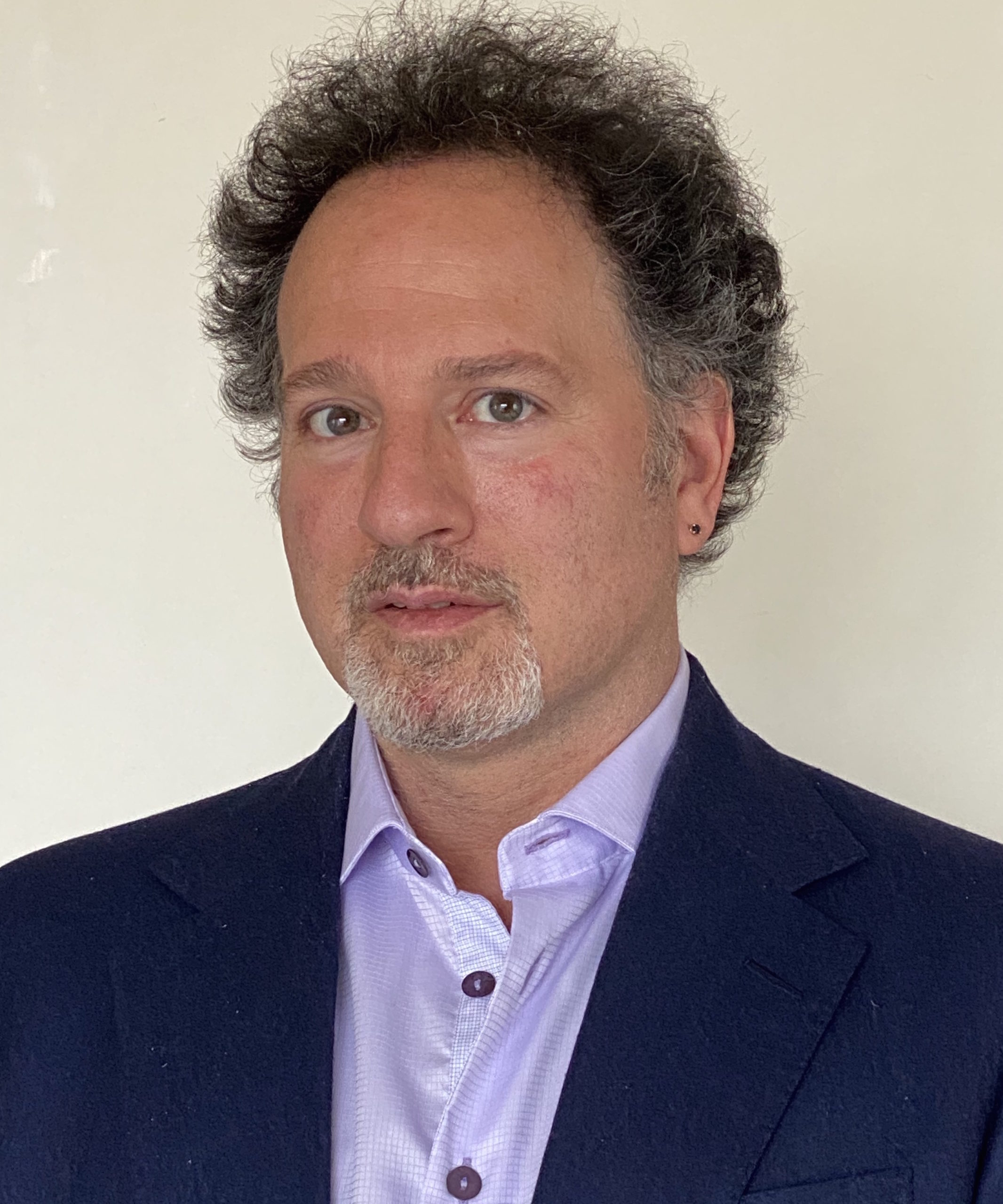
Zachary Karabell