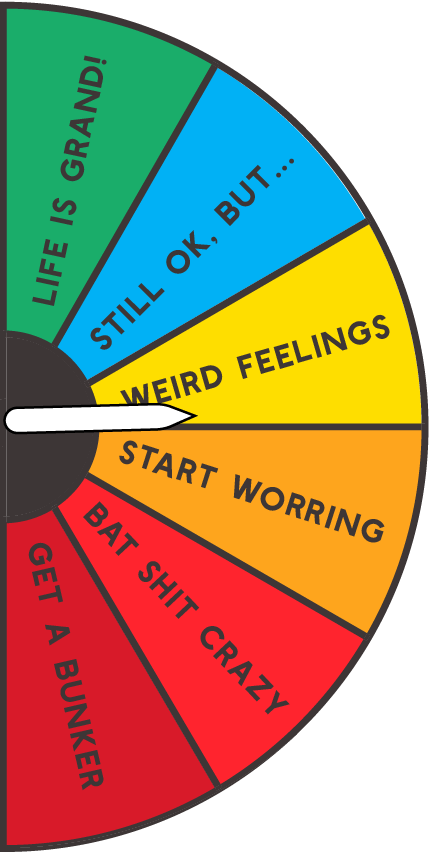
Volcanoes are erupting in The Philippines, but on-fire Australia received some welcome rain. The Iran war cries have been called off and The Donald’s military powers are about to be hamstrung by the Senate. Meanwhile, his impeachment trial is starting, and we’re all on Twitter for a front-row seat.

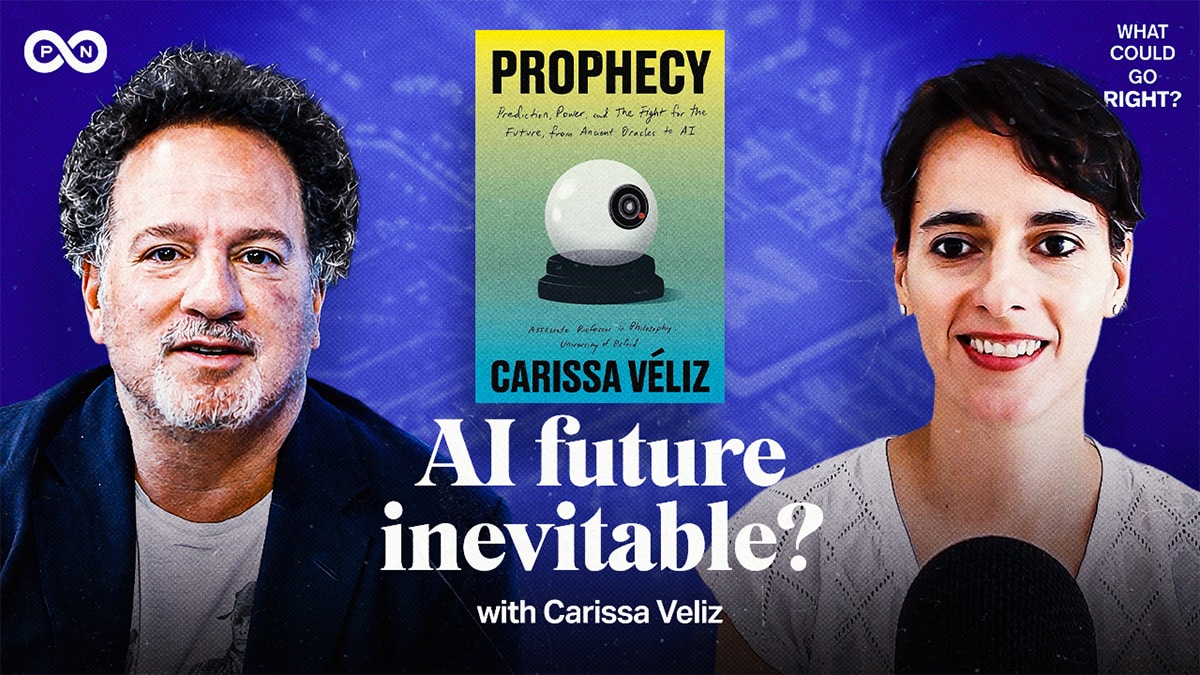
The AI Future Isn’t Inevitable. So Why Are We Told It Is?
Featuring Carissa Véliz
Being a human being is an anxious experience, and to calm the fear of uncertainty, we’re obsessed with predicting the future. Whether spiraling about changes to the economy, politics, or culture, we’re desperate to know what’s coming around the corner. In this episode, host Zachary Karabell is joined by Carissa Véliz, philosopher and author of Prophecy: Prediction, Power, and the Fight for the Future, from Ancient Oracles to AI. They discuss the ways tech executives and AI experts offer predictions for our society that are supposedly inevitable. But what if we refuse to accept these guesses as truth? What if leaning into ambiguity and our own vulnerability makes us better citizens and gives us a true chance to make a better world?


Prefer to read? Check out the Audio Transcript
Although the transcription is largely accurate, in some cases it may be incomplete or inaccurate due to inaudible passages or transcription software errors.
[00:00:00] Zachary Karabell: Being a human being is ever an anxious experience, and to calm the hobgoblins of our fears, we are constantly trying to gauge and predict the future, whether it’s our own individual lives, how long we’re gonna live, what our career is gonna be, what our family life is gonna be, when we’re gonna die, or whether it’s collectively, how the economy is gonna go, who’s gonna be elected, who’s gonna win, who’s gonna win a sports match, whether or not the United States is gonna be on top.
And we live in a world now where technology companies are filling that role, that predictive role that soothsayers and priests and tarot card readers used to play, and they are selling us a prediction of a technology-infused AI future that they treat as all but inevitable. I’m gonna speak with someone today who says that this rush towards certainty in the face of an unknown future is often quite self-serving and, in fact, serves the interests of those who are making the predictions.
Carissa Véliz is my guest today on What Could Go Right?, which is my podcast and part of the Progress Network. Carissa is a professor at Hertford College at Oxford University, a professor of philosophy who focuses on ethics and AI, whose recent TED Talk was a hit, where she focused on those issues I just talked about that come from her most recent book called Prophecy: Prediction, Power, and the Fight for the Future, From Ancient Oracles to AI.
Carissa Véliz, it is such a pleasure to have you on What Could Go Right?. I’ve been following your work and, uh, obviously, the TED Talk that you did in April of 2026, and the books that you have written and the career that you’ve assembled, this kind of eclectic Philosopher, predictor in your own way.
You’re really curious about the intersection of prediction as an act of power and prediction as an act of control, right?
[00:01:59] Carissa Veliz: Yeah, that’s right. And, but also I’m interested in the philosophy of prediction. It’s kind of surprising that we’ve been using prediction for such a long time, and we’ve thought so little about what exactly is a prediction and how does it work, and what’s the ethics of prediction?
I am most interested in cases in which the tag of inevitability gets used as a kind of put-down, and in situations in which it’s up to us to decide whether we want this. So it’s one thing to say it’s inevitable that it’s gonna rain, uh, once, you know, you see the black clouds. But it’s another to, to say it’s inevitable that society is going this way.
Because that’s societal choice. And so when you say that it’s inevitable, you close down the conversation that will, would allow that prediction to not become true.
[00:02:47] Zachary Karabell: At one point in your TED Talk you said that when, particularly in, in tech land, when people come and say something is inevitable, that’s a red flag and that’s a warning sign.
But I do wonder about the science part of it, which is don’t human beings do whatever they can do? Meaning if something is doable, humans will do it.
[00:03:05] Carissa Veliz: I don’t think so So for example, you can kill someone. I hope that you don’t. It is doable, but most people don’t. So I’m not sure that’s true. Um, I think that it’s not only a matter of whether somebody will do it.
So, you know, if, if, if it’s doable to climb a mountain, yeah, may- maybe one human being will do it. But it’s about whether we encourage more people to take on challenges that they might not. So there are very stubborn people out there, and that is often a very good thing for humanity because they will persevere.
But there are a couple of things that worry me. The first is that we might be boxing people so prematurely that they have less leeway to defy those odds, uh, than in the past. So for example, there are countries in which, I think when you’re eight or 10 years old, uh, it already gets decided whether you’re gonna go to one kind of school or another kind of school that is more technical.
Right. And it seems to me like that’s very early, uh, and, and it closes doors. And the other worry is that perhaps if we encouraged more people, if we made it easier for more people, we would benefit from a lot more talent and discoveries. And so it’s not only about whether one person can do it, it’s, it’s how do we want society to work.
[00:04:34] Zachary Karabell: I think at an individual level, right, that’s clearly true. I mean, no one of us will inevitably do anything. I think you could make the argument that even collectively we have finite resources, and if they’re all being channeled in one direction, then they are therefore not being channeled in another. So if trillions of dollars are going to build data centers for AI hyperscaling, that does mean that trillions of dollars are not going to climate change mitigation or v- mass vaccine development and deployment, you name it.
So in that sense, the inevitability statement is a, is, is a power move.
[00:05:16] Carissa Veliz: I think that’s true, and the sleight of hand of the AI industry is to say like, “Oh, but that doesn’t work because if we invest trillions in AI, AI will solve cl- climate change, and AI will solve the vaccines.” And so predictions get used again as a power play.
It’s a kind of sleight of hand in which there’s no winning the argument because it’s, there’s always a prediction that trumps it. But regarding the second point I don’t think that’s true. For example, we can clone human beings and we don’t
[00:05:48] Zachary Karabell: Right. And I mean, talk about predictions, that’s one of these where if I were in the prediction business, I would predict that we will because we can
[00:05:55] Carissa Veliz: Well, a Chinese doctor did it or, or, or tried it and- Right, and then
[00:05:59] Zachary Karabell: he got put in jail or…
I mean, who knows exactly what happened- Yeah … but he definitely wasn’t celebrated for it. So…
[00:06:04] Carissa Veliz: No, exactly. And if, if what you’re saying is true, that means that sooner or later we will use a nuclear weapon that will obliterate Earth. Maybe it’s true.
[00:06:14] Zachary Karabell: Yeah, I was talking more in the we will create the capacity.
How we utilize that capacity I do think is much more in the realm of Both societal, individual. You know, we create moralities, we create ethics, we, we try to structure society. I mean, one, we try to structure society so that we don’t destroy ourselves.
[00:06:31] Carissa Veliz: The other important distinction is between something being likely and something being inevitable.
Yeah. And there’s a very important distinction there. And so when there are- Totally … billions of human beings doing a lot of things, that one of them or a group of them will do X is quite likely. But that’s very different from it being inevitable.
[00:06:51] Zachary Karabell: No, you’re totally right. As more people have access to data and information, the line between possible and probable gets completely blurred.
And it’s very hard diagnostically, right? Because basically anything is possible. A much narrower range of things are probable. That’s also part of the, the real issue of prediction, is that it turns possibilities into probabilities. So do you distinguish when you think about these things between predictions, the psychic, the tarot reader who provides a kind of a comforting future individual path, or someone who says, you know, something about the nature of the economy?
I, I had a conversation a few weeks ago with, with one of the leading economic forecasters, a man named Mark Zandi, and a lot of his profession is, you know, what’s the economy gonna be for the next year, right? Which is always a prediction. But then there are also, like, you know, when you write about the Delphic Oracle, which you do in the book, as one of the progenitors of this, some of those are more about exhortations for self-knowledge or discovery, right?
I mean, there is a difference between this is gonna happen and more general, here’s what you need to do.
[00:07:57] Carissa Veliz: There are degrees of specificity in predictions, and that includes predictions that might be probabilistic in their output. So you might say, you know, there’s a fi- 50% chance that it rains. However, predictions tend to convey a guidance for action.
So even if I tell you there’s an 80% chance that it’s going to rain, what I might actually be saying is, “Take that umbrella, Zachary,” or, you know, maybe postpone that party. And so I think that the difference is more in the degree of specificity. And one of the marks of the Oracle of Delphi was that it was very intentionally vague, and that gave it at least two advantages.
The first one is that it’s harder to get it wrong if you’re vague enough, because you can always- Right … uh, say like, “Well, that’s not actually what I meant. I, I meant this other thing.” But even more importantly, it was a kind of mediator to start conversations. Famously in, in one case, the Oracle says that in a particular conflict that Athens should guard itself with a wall made out of wood.
And there was a lot of debate of what exactly does this mean? Does it m- does this mean we, we should build an actual wall with kind of trees or shrubs or something? And then a general convinces the population that no, what, what they should do is defend Athens with their navy. Right. Which ends up being successful.
But it was a, a way of allowing a democratic process to take place. And one of the things that concerns me about AI is that it tends to have too specific an expression of prediction in, in a way that doesn’t allow for that leeway and that debate.
[00:09:37] Zachary Karabell: Yeah, I mean, that’s the, the famous line about prediction is, if you’re gonna predict the end of the world, just don’t give a date, right?
Because you can you can always say to people, “No, no, just, just wait.” Just wait. You know, it’ll happen soon enough. When it’s about big crises, I mean, I know this more in the economic world, right? Uh, economic forecasters are always predicting a collapse, a, a correction, a, a pullback, a something. You know, usually one of those things happens soon enough or eventually.
So as long as you don’t say when it’s gonna happen, it’s very hard to hold someone to account for it because it’s kind of non-falsifiable without a date, right?
[00:10:14] Carissa Veliz: Yeah. And most predictions, or at least many predictions in the fields that we care about the most, like for example justice, are unfalsifiable because they’re not the kind of prediction about, say, the weather or seasons that are recurrent and that we have, um, enough data on and counterfactuals and s- and maybe even randomized control trials to make it the case, um, that they can be ver- verifiable.
And that, and that is very important because it means that they are nothing like facts.
[00:10:46] Zachary Karabell: Sometimes it’s fun to speculate. Sometimes it’s fun to kind of wonder if there’s some degree of psychic power out there, or lives and fate written in the stars. I mean, is that, is that innocent versus when it’s kind of AI and f- economic and political forecasters who are essentially using forecasting to shape the future?
It would be hard to accuse the tarot reader of being able to shape the future. I mean …
[00:11:11] Carissa Veliz: I don’t know. That’s the honest truth. I think I can imagine scenarios in which it seems pretty innocuous as long as everybody knows what’s going on, and the person who is paying for the service has the right mindset.
But there are certainly pitfalls, and l- let me give you a couple of examples, um, of people I’ve, I’ve met. So a friend of mine, his wife had a reading when she was very young. I tell this story in the book actually. And the tarot reader tells her that she’s gonna live a short life. And she did. And may- maybe she would have anyway, but people, and especially young people, but I think everyone, we’re pretty suggestible creatures.
Sometimes it’s not only about having the right or the wrong genes, it’s about how genes express themselves and whether they get activated, and that partly depends on culture, partly depends on our behavior. Another case is, as a result of the book, I, I struck a conversation with someone at a dinner. who was telling me about how they have an astrologer.
And at the beginning it seemed like they were just curious, it was fun, but he was telling me about how he’s become genuinely addicted to it, and he, he won’t decide anything without consulting with her- uh, his astrologer.
[00:12:29] Zachary Karabell: Yeah, I mean, it, it’s a really fascinating question. I mean, some of these things are even more embedded in culture, right?
I mean, Chinese will use some p- some numerology and, and some, you know, set of things of, uh, there, there’s a right day to get married. I mean, Western cultures have done this as well. Or there’s a right day to sign a business deal because, you know, that, that’s part of the prediction matrix that goes into it.
And maybe that doesn’t really matter if you bas- if you say, “Well, we can’t get married on Friday the 13th ‘cause that’s a bad omen, but so we can only get married on, you know, Saturday the 14th.” Uh, obviously it depends on are these sort of innocent cultural tribalists or are they more troubling ones? And that’s where you get into the question about the way this kind of intersects with, with the tech future.
And on, on this podcast I’ve, we’ve sort of circled through over the years and certainly this season over this question of what do human beings do in the face of uncertainty, and the sort of crushing problem of… I- it’s very human nature, but it’s gotten more acute in contemporary society, where our need for certainty constantly flies in the face of the reality of uncertainty.
I try to define optimism not as the belief that the future is going to turn out well, but from the humility of none of us know what the future’s gonna be and that we should be open to the reality that we don’t know. It’s es- essentially embracing the uncertainty principle, not dictating that we know these outcomes.
Do you think that need for certainty has become more acute or is it just there are more avenues where people can search for, for false certainty?
[00:14:01] Carissa Veliz: I think the need for certainty or the desire for certainty has always been there, but there are moments in history in which first there’s a perception of uncertainty, and that partly depends on people talking about the future as something scary, as something that’s changing.
And I think there are moments in history in which reality is more unpredictable, and so I think that tends to create a kind of anxiety that pushes us further into wanting to ask people about what, what the future holds because we’re not sure what to do.
[00:14:35] Zachary Karabell: So the more fraught, anxious f- in flux a society is, the more people you think look for anchors in the future to guide them through the uncertain present?
[00:14:48] Carissa Veliz: Unless there’s a kind of countercultural weight that embraces uncertainty and that reminds people that this is actually a good thing because if we knew exactly what was gonna happen in the future, that’d be pretty bad news. It would mean that, uh, somebody’s dominating us.
[00:15:02] Zachary Karabell: You wrote an earlier book in 2020 about privacy and the degree to which- The, the current tech ecosystem is largely constructed on the use and deployment of data, often our personal data.
[00:15:15] Carissa Veliz: Privacy is Power is a- about the machinery of surveillance, and Prophecy is about the machinery of prediction that is fed through the machinery of surveillance. So that’s how the two books connect. And it’s one and the same business model that leads to social control. It’s essentially monetizing that which was the territory of police and intelligence agencies, and usually either in the context of a criminal suspect or a terrorist suspect or authoritarianism.
And that’s astonishing when you think about it, because we only surveil in order to predict people’s behavior, and we only predict people’s behavior in order to control it. It’s kind of that simple. So the question that we’re asking when we increase surveillance to this degree, and we allow for so much prediction, is how much social control can liberal democracy take?
[00:16:18] Zachary Karabell: Well, that, you know, that raises a prediction question. You have an imperfect, maybe decaying set of liberal democracies in, in what’s loosely called the Western world, and then you have a sort of a surveillance authoritarian capitalism that characterizes China above all. There’s also a lot of what we should call freedoms within that matrix in China, um, meaning they’re not trying to control everything.
They’re just trying to control a lot of things. Uh, and seem to be using the tools of surveillance and technology, and now AI, to great effect. Which of these two systems is going to be the dominant model? Are they both gonna be dominant? I mean, some of what you’re suggesting is a kind of a grim… We’re, we’re more likely to all become some version of China than we all, are all likely to become some version of an inclusive liberal democracy.
[00:17:12] Carissa Veliz: That is a really interesting way to put it, and I think very much in sync with our times. The first thing is I think China is trying to control everything. Part of what it means to be a totalitarian system, part of the why we call it totalitarian, is that it’s the totality of, of life. It’s, so the social credit system in China, it gives you points or it takes away points, scores you, not only according to how you behave at work and whether you pay taxes, but how good a neighbor are you and whether you’re buying diapers or, or instead of playing video games.
So it is trying to control literally everything from dating, um, to your work life and everything in between. Whether you smoke, um, so it is totalitarian. And I think that asking that question is just the wrong way to go about it. It’s exactly what I’m trying to write against in the book, this kind of utilitarian mindset of like, “Okay, what is more likely?”
And based on what is more likely, I just kind of give up. You know, if somebody tells me, “Well, it’s more likely that you’ll become China and, you know, this is inevitable and this is progress and this is what it looks like,” the kind of incentive is just to stay on your couch and doom scroll. And I’m saying, no, it doesn’t matter how likely it is.
That is the wrong question to ask. The right question to ask is, what kind of society do I want to live in, and what am I gonna do to bring it about?
[00:18:32] Zachary Karabell: Yeah. But, but I find that asking those questions Is the way to a- also get at the what kind of society do I wanna be in? Dreaming of the ideal or dreaming of what’s possible and making it real, rather than just looking around and going, “Here’s my option set.
I’ve gotta pick column A, column B, column C.” Which is unfortunately what we have to do when we vote, right? We don’t, we don’t get an endless spectrum of possibility. We get a very limited spectrum where we have to choose between a couple of imperfect options. So I’m just pushing back saying, I get that that question can lead to, ugh, you know, th- this is all hopeless.
But I, I mean, for me at least, it can also lead to, okay, here are your, here are your set of potentials. Which one would you want to steer to in addition to possibilities that, that, that haven’t yet been real?
[00:19:22] Carissa Veliz: I think that’s, that’s not precise enough. Because what I’m arguing, and I think we are very aligned in this, is the latter, is like l- look at the realm of possibilities and what’s available and which one do you like?
And that is extremely different from calculating the probabilities that something will happen. Very, very different kind of mentality and very different kind of method and very different kind of incentives. So in Buddhist philosophy, there is this tale about one person g- kind of bothering the Buddha asking questions about metaphysics.
And at some point, the Buddha gets fed up and answers something like, “You’re like the person who’s just been shot with an arrow and is wondering, like, what kind of arrow is this? And what material is it made of?” And so I think that when we calculate probabilities, implicitly or explicitly, we are assuming is that- The die has been cast, and we’re just kind of trying to figure out what’s coming our way.
Whereas thinking about what is possible and what do I want is much more agential. It’s saying, “I have power to do something about this. The future is unwritten. Where do we wanna go?”
[00:20:42] Zachary Karabell: Where in that do you find room or do you not find room for that other strain that was at least nominally there in, like, tech land in the ‘90s and aughts, whether it was Google defining itself as “Don’t be evil,” or whether it was this world of people who thought that these tools were gonna allow for human connectivity, that was gonna allow for the collective solving of collective problems to a degree and a pace that had never been for- before been possible?
[00:21:08] Carissa Veliz: For the most part, problems that are at base social and political don’t get solved by technology. They can get worse or they can get better, but at base, they need political and social solutions. And we have invested so much in tech, and we have neglected policy and everything that has to do with the governance of technology.
[00:21:31] Zachary Karabell: There’s a data surveillance sort of ominous, often impersonal, sometimes personal control element of The modern tech world, particularly if it gets fused to government power in, uh, surveillance ways that are tethered to that monopoly on the use of force. But on the flip side, at the– at an individual level, we are all vastly more empowered with information, data, knowledge, and even connectivity to other humans than we ever have been.
I mean, that’s where I get more optimistic about the world, ‘cause I feel like these very tools, back to that Janus-faced question, have a flip side, an inverse to what you’re saying, which is a, a massively liberating one, or the potential for a massively liberating one.
[00:22:16] Carissa Veliz: Yeah, I think the potential is, is more, probably more accurate.
And one story that I find very illuminating is, um, the former Minister of Digital Affairs in the UK, somebody called Peter Kyle. At some point, a journalist, Chris Stogill, asked for a Freedom of Information request, and he asked for the queries that Peter Kyle had made to ChatGPT. And the minister had asked ChatGPT about making policy for AI, and ChatGPT thought that privacy protections were a terrible idea.
They were very burdensome. And so, you know, with the caveat that these systems are not neutral, they are produced by companies with very high financial interests, and it’s not always information that they give us. Sometimes it’s propaganda, sometimes it’s, um, hallucinations or confabulations, sometimes it’s something else.
However, um, you know, ChatGPT and Claude and all of these unusual suspects are not the only game in town. There are other systems that you can modify the master prompt that allow you to have your own data. So Empathy AI is, is an excellent example. Um, Proton, um, I’m f- for full disclosure, I’m, I’m part of the board of the foundation, but Proton has a large language model that is private called Lumo.
So yeah, potentially, potentially we can use technology in, in different ways. And again, it’s partly up to us. How do we design it, and how do we implement it, and, and, and what kind of world do we want? So for example, I don’t, I don’t know, what’s your sense of how people are reacting to Meta’s smart glasses?
You know, they are trying once again to dominate the market. One of the strategies of tech companies has been to normalize surveillance and then, you know, wait for a few years and then try it again. So what, what is your sense of that?
[00:24:10] Zachary Karabell: I mean, partly I have a very mundane one, which is probably not Deeply trenchant, but it’s people don’t wanna have to wear glasses.
I mean, they’ll do it for corrective vision, but then contact lenses. I think if Meta gets to the point where you can embed these tools in a contact lens, we’ll actually be having a different conversation ‘cause then I think more people will actually do it. I think Musk is probably more right about these things, which is that more people will embed something or implant something than they will wear something.
And that does lead you to the question of when that happens, will we be in kind of the next level of VR, AI surveillance state, where basically all of our moves from our heartbeat to our secretions to our thoughts become embedded in some sort of, you know, err cloud consciousness?
[00:24:56] Carissa Veliz: Yeah, but, you know, phrasing it as when that happens, come on.
It, it not, it won’t necessarily happen.
[00:25:03] Zachary Karabell: Unless there is a societal move to stop it from happening. And I’m not saying this as I feel helpless in it, but I do think it’s important sometimes to acknowledge trends in the moment. I’m not predicting 30, 40 years in the future, that seem more or less likely to be, you know, dominant over the next five years.
[00:25:20] Carissa Veliz: I started noticing a lot of marketing for Meta’s glasses. You know, it’s just kind of advertising, and they were pushing really hard. And I’m quite encouraged by some of the responses. There’s currently a whole marketing campaign against them, um, quite aggressive as well. And people are reacting, and I think they are reacting with more force than many people predicted, and that’s kind of encouraging.
It’s a reminder that you make people angry enough and, and we can react pretty quickly.
[00:25:54] Zachary Karabell: Yeah, I mean, my hope in this is there is an empowering reality of these technologies and the connectivity. You and I couldn’t be having this conversation, recording it and disseminating it 15 years ago this way. We could have been having an extremely meaningful in-person conversation, and a set of people could have been there, and they could have written about it and disseminated the information.
They could have recorded it. You certainly could have put it on, on some distribution, but the ability to do all of this is clearly magnified and is getting even more magnified with these tools. And our ability to know stuff, you know? I could have found out about all of your writings, or you could have found out about mine in a library.
If you were a scholar, you did that, but most people didn’t have the time, bandwidth, or access to do that so well. Now we can kind of access everything. So I could certainly imagine a world where these tools are more readily available bodily. You know, I, I don’t really care whether it’s glasses or something.
My issue is less about the technology than the control, and I’m, I’m sometimes concerned that those get conflated. I’m perfectly comfortable fighting the con- the system of control that these technologies become embedded in, while also believing very firmly that there is indeed an ideal. There’s a future that will be better by virtue of these technologies if they’re channeled correctly.
And, you know, whether it’s Proton, which is kind of a … or, or these others, which are their own versions of what Mozilla was or Wikipedia, you know, which I think are very constructive iterations of these same technologies.
[00:27:22] Carissa Veliz: I don’t think they’re the same technologies. I think, for example, technologies are, of surveillance inherently push for social control because to surveil is to track, to track is to surveil, and the more you track, the more you track people, and the more people are tracked, the less freedom we have.
And so when I look at, you know, Proton email, that’s not the same kind of technology. And, you know, Wikipedia wasn’t a company and, and was never a company. So I’m not, I’m not sure. I think that there are certain technologies, like for example, any kind of identifying technology, technology that’s made to, to de-anonymize people, that is corrosive to liberal democracy.
And of course you can use it in a cer- in a different way, but by design it’s made for something that is bad for liberal democracy.
[00:28:08] Zachary Karabell: What about technologies of the need for verification, which is certainly true for financial transactions, for any kind of commercial online transactions, which requires this sort of mix, right, of privacy And data control, but also identity verification.
Like, where, where would that reside?
[00:28:28] Carissa Veliz: Part of what is tricky is that you can do the same thing or achieve the same objective in so many different ways, and it’s very hard for the ordinary citizen to tell apart these different ways. Because some of them are incredibly invasive and unnecessary, like giving up your biometric data to some company that doesn’t, you know, doesn’t have good rules and that they can’t keep data safe, and that’s completely reckless.
There are then zero knowledge proofs in which, for example, you verify that someone is over 18 years old, but you don’t get any other detail. You don’t get their name, you don’t, you don’t know how old they, they are. You get a, a certificate that acknowledges that they’re over 18. Or you have things that I think work quite well, like, like tokens in which, you know, you have this physical thing that creates a number.
It identifies you by proxy. So I think the devil is in the details.
[00:29:17] Zachary Karabell: Hmm. I mean, that’s a really good point. I don’t think you’re saying that it’s better if a government has these tools versus tech companies, right? It’s the misuse and the monopoly on data and the power that that gives whoever has that monopoly.
I mean, ‘cause you certainly have these examples now of multiple governments, certainly in, in the UK, in Australia, increasingly m- multiple American states, where in the name of protecting younger people from the worst aspects of the online ecosystem, you create a very data-invasive system, right? Back to your point about verification.
[00:29:53] Carissa Veliz: Yes. Um, I think that this assumption that the more data, the better just doesn’t stand up to scrutiny, not empirically, and certainly not politically, and that not everything should be data. And in fact, there are many things that should be n- should never be turned into data to allow for freedom, to allow for anonymity.
And when you think about technology, I think we tend to as- assume in this moment in history that technology looks like A screen and of- or like a phone or, or, or, or a computer or something like that. But some of the most important technologies in the history of humanity has, have been political or social.
And when you read about the emergence of democracy or liberal democracies in the context of the nation state, one very important element was the possibility of being anonymous in a city, which wasn’t there before when we lived in small villages. Everybody knew who you were and everybody would recognize even your handwriting.
So it was very hard to act anonymously. But when you have big cities, you get the possibility of anonymous and peaceful protest, and that really has been a very important element in the toolkit of democracy. And if we do away with anonymity, that’s gone.
[00:31:01] Zachary Karabell: Yeah, and you had the EU, right, the right to forget law, which was I think qui- quickly overtaken by other forces, but was an attempt to s- iterate exactly what you’re talking about.
[00:31:11] Carissa Veliz: Yeah. And I remember, you know, back in, I don’t know, 2015, ‘16, ‘17, that already young students were afraid of going to protest to the streets because one day they wanted to be politicians or lawyers, and they were face, uh, afraid that they would be recognized. Like imagine today with, with all the extra tech that we have that recognizes you through anything from facial recognition to gait and when we all have our phones with us.
And if you leave your phone at home, then you can’t contact your family, your friends. Uh, and in the context of a protest, that is sometimes very important. So we’re doing something, I think, more dangerous than we’re realizing.
[00:31:51] Zachary Karabell: It- at one point, the only thing people could talk about was crypto, and now the only thing they can talk about is AI.
I think there was a lot of people who developed Bitcoin protocols in particular who did so largely from the spirit that you’re talking about, anonymity, the ability to transact without a government or anybody for that matter being able to trace the source of that transaction. You know, the idea that you should be able to engage in peer-to-peer commercial transactions that were transnational across borders without either a government or a bank or a company being able to identify that you did it.
Now, yeah, that quickly also became a channel for activities that no government would allow and that most societies forbid, but that, you know, that does not mean that that spirit of everything you’re talking about wasn’t part of it. Or do you, do you disagree with that as a way of looking at part of crypto?
It’s a
[00:32:39] Carissa Veliz: complex conversation. I think it would, it, you know, we could just stay on this topic for, for a whole hour. On the one hand, I feel sympathetic towards people who live, especially in authoritarian regimes or in countries in which realistically you can’t say that there’s a rule of law, and where, for example, the currency has inflation that is just impossible to live with.
I’m absolutely sympathetic to the desire to have a currency that it be more stable and that gives you more control, um, over a government who’s not legitimate in any way. However, in the context of a functional liberal democracy, you don’t want that because it goes against the rule of law, and in my view, we should aspire to a functional liberal democracy with a rule of law.
Furthermore, I’ve never been entirely convinced that crypto is the way to go when it comes to privacy. The whole point of crypto is that it has a ledger that records every single transaction, and that allows to be able to trace back transactions and infer identity. So even though there are ways to hash it and to cover it up, it seems to me, like, by its very design, it’s not designed for privacy.
It’s designed ex- exactly for the opposite. And so I don’t think it’s an improvement, say, on cash. I really don’t, and I don’t think it’s a synonym for cash, and I think we shouldn’t get rid of cash.
[00:34:06] Zachary Karabell: Yeah, I mean, cash is the ultimate privacy defense because it’s untraceable except to the source of issuance.
Other than that, it is truly anonymous. The crypto world obviously tried to balance, I’m probably giving it more credit, but there was a need or at least a perceived need for a balance between privacy on the one hand and back to that question of authentication or verification on the other. So it’s tr- like trying to balance those somewhat incompatible.
And while cash is an answer to that, it’s often not, not an answer to cross-border stuff. Like, if I, if I wanted to engage in a commercial transaction with you, you’re in England, I’m in the United States, and do so without that transaction being part of the data set of any government, right? I, I couldn’t do it with ca- I guess I could send you cash, and you could send me cash, but even then, if it was too much cash.
[00:34:54] Carissa Veliz: The dollar has, has been incr- incredibly important for that historically as a kind of stable currency, uh, in, in which, like, for example, you know, countries very far away from the US have engaged with.
[00:35:08] Zachary Karabell: That was more, one of the more positive aspects of American post-1945 influence, but then the United States began to use the dollar as a coercive tool of control, which of course led a lot of people to go, “You know, this is, this is coming with, with a lot of costs.”
It may have a lot of advantages- Yeah … but it clearly, it, particularly in a digital world where you could start cutting people off from access to kind of international commerce through SWIFT and other protocols, the dollar became truly a two-edged sword if what you wanted was to use it as a non-American, and that remains true today.
I mean, obviously the bulk of c- global commercial transactions are still dollar-denominated, but increasingly a lot of people are going, “Hey, I don’t, I don’t want the costs that come with this transaction
[00:35:52] Carissa Veliz: Yeah. But as you pointed out, there was a moment in history in which it worked better. And so when we ask, you know, what could go right, which by the way, I love that question because we’re so focused on what could go wrong, or at least I am in, in ethics.
You know, that’s kind of the basic, the, the fundamental question. On the one hand, I think that we should believe and, and pursue and recognize that better tech is possible, that we can have cutting edge technology that is just more respectful of liberal democracy, designed for liberal democracy, not designed for surveillance and authoritarianism.
And so it’s not like I think we agree on that, that we’re not, we’re not saying that we shouldn’t have tech or we shouldn’t use tech. It’s just, no, we, this is a pretty bad product and we can do much, much better. But I think the, the other part of it is one guaranteed way to make your life worse is to not acknowledge, recognize, cherish, and value the things that do work in life.
And sometimes we focus so much on the dread of the future and fear and anxiety that we forget to see what’s right in front of our eyes, and that works quite well. And many of the things that works best in our world are analog, and we’re so focused on the digital. We’re so dazzled by its shininess and so distracted by the public discourse.
Everybody’s talking about AI all the time, that we forget that, you know, the things of… The things that we can touch or the things of, of, of beauty, um, the natural world, our homes, which, you know, have a ceiling and keep us safe from the rain, cash. You know, all of these things are the basic blocks of society, and sometimes we’re neglecting it because we’re focusing on a virtual world that we forget depends entirely on the analog world.
[00:37:36] Zachary Karabell: In, in many ways, the, the, the correlate question would be what has gone right? And to appreciate You know, that’s kind of the analog. There’s a whole world now, for instance, and its niche that is embracing, uh, vinyl albums for music because the sound of analog vinyl was often richer, deeper, the tracks were more separate, particularly for classical music than they have been able to be in a, in a digital sphere.
But to apropos your point, there’s a world of recognition of not all technology has been an improvement upon whatever was before. It’s a change, and it’s often a disruptive change. It’s not necessarily better, which is part of the problem of the lure of technology, right? That it is going to be better than, not just different from.
[00:38:26] Carissa Veliz: Yes. And sometimes the product that wins in the market is the product that had more weight from somebody powerful. It’s not the best product. And part of what a f- bright future looks like in my view is preserving the thing, the beautiful things of the past. One of the reasons I love living in Oxford is despite it having some famously ugly buildings, it has beautiful buildings.
And many of these buildings were built, you know, in, in, in, in the year, you know, 1200, 1300, 1400, and the, the most magical thing is that these are not museums. We live them every day. We preserve the wood and stone and the glass, and, and it’s beautiful. And so part of what it means to have a, a bright future…
I was reminded of, of this by a documentary I watched this, this week in which a business person is very successful, and part of what he does with his money is to rebuild his village in Italy, and this completely destroyed castle becomes something incredibly beautiful again, and, and, and there are parks and, and public places, and it’s, it’s quite inspiring.
So it’s not only about inventing new things and making better tech, although that’s definitely part of the equation. It’s also about taking care of the world around us and the things that have worked and, and learning from the past because if we don’t learn from it, we can, we can lose some very valuable lessons, and, and to spend time having to rediscover them is…
would be a shame.
[00:39:55] Zachary Karabell: Yeah, no, that’s really well put. Um, I remember one of the things I loved when I was at Oxford was 5:30 on a December day, taking a walk to New College to listen to Evensong through kind of this eerie, magical, lost in time mist for this eerie, magical, lost in time music. I still am able to sort of hold that with- A certain boyish or childish wonder and delight in some of these technology tools.
I mean, I do think, and I, and I wonder what your, your response is, that there is still a lot of amazement at the magic of these technology tools that we’ve created, about the digitization or connectivity of consciousness that these tools have allowed. And there’s a real sense of wonder and power individually, I find, in these tools, in being able to access information, and stories, and ideas, and words, and music of people everywhere, always simultaneously.
You know, there’s a lot about social media that I find wondrous and not just ominous. And while I recognize that the, the purveyors of that, the ones who are profiting most from it, either may not share that wonder or have very different incentives and different desires that, that auger a much more dark future.
You know, one of the ways to interpret the global surge of kind of anger and discontent in a climate where materially at least, human beings have never had it better. Collectively, I’m not saying everybody obviously is doing well. Is, is that some of the power of these tools has been to a- awaken people to the awareness of what they don’t have to just passively accept, what they don’t have to just suffer and deal with.
You know, that it, it’s created a kind of a, a rising expectations in a really powerful way, apropos some of what you’re talking about, that it’s, that it’s a- awakened people not just to what is possible, but their own individual agency in demanding it.
[00:41:56] Carissa Veliz: I have also another hypothesis, and m- maybe, maybe I’m, I’m wrong, but I, I have the feeling that if, if you kind of think back on the most pleasurable moments you’ve had in the last week or the last month I bet they’re probably analog.
And that’s, has a kind of simple explanation that our bodies are analog. And so it’s probably has to do with being in nature, going for a walk, having a laugh with a friend, something like that probably. Um, it, it’s unlikely that it happened online looking at a screen. So recently I’ve, um, I’ve been reading a book about different piano songs, and then you’re right, that it’s, it’s wondrous and magic to be able to play the song automatically very quickly.
Um, each song that I’m, that I’m, that I’m reading about. And all the experience is magic, but I think of all the magic that surrounds me, and I’m very lucky this way, that I, I do fi- find myself surrounded by incredible objects and, and people. I truly think that the paper book is the most magical object I’ve ever come across.
Mm-hmm. It doesn’t surveil me, it’s light, it’s cheap … it informs me. It doesn’t shorten my attention span, it lengthens it. It allows me to have a conversation with an author who might be dead, who might be across the world. It’s, it’s a kind of bubble of protection, and I, I hope that future generations don’t miss out on the great pleasure that reading is.
And one of the things that worries me is that it takes a lot of practice to get to a stage where you enjoy reading. I think people who think they don’t like reading, it’s probably because they haven’t reached that stage. It’s like saying, “I don’t like food.” Well, it depends on the food. You might not like spicy food, but you might like this.
And, and books, you know, there are books about everything and anything. And so reading about the history of reading has, has made me think about how for most of history, reading was a very social thing. You didn’t read on your own in silence. Right. You read with your family out loud or with your friends.
And I’m wondering whether, whether we, maybe we could, we could recover that practice.
[00:43:57] Zachary Karabell: Well, I think on that note, I wanna exhort everyone to go out and buy, uh, Carissa Véliz’s books. Prophecy, the earlier book, uh, Privacy is Power. Uh, you have another few books as well, which you can all look up on- If not Amazon, then Bookshop, or you could go to a bookstore and, and order it.
Oh my God. But I wanna thank you for your time, and your work, and your insights, and, uh, I hope you’ve enjoyed this conversation as much as I have.
[00:44:25] Carissa Veliz: Thank you so much, Zachary. It’s been a pleasure.
[00:44:28] Zachary Karabell: Carissa Véliz is one impressive human who is thinking deeply and trenchantly about basically the most important issues of our day.
And while the conversation framed a lot of that in terms of this interesting concept of prophecy as a tool of power, it really is also, and primarily, a conversation about technology industry that has it in its own self-interest to convince all of us that there is an inevitability to the way in which AI is going to shape our lives.
And instead, I think urges us to ask, nothing is inevitable, so what kind of future do we want? And that is the promise of, or at least the premise of, the Progress Network and What Could Go Right, which is, we each have a role, a responsibility, and a capacity to shape our collective future, because none of us know what that future’s gonna be.
And it is a product of decisions that we make in the present. And Carissa very much talks about how it is we both need to understand that reality and act accordingly in the face of it. I wanna thank Kaleidoscope, as usual, for producing these episodes, and I wanna thank my team at the Progress Network for being my team at the Progress Network, and scouring the known universe for good stories every week, and bringing them to your attention.
Please sign up for The Edgy Optimist and What Could Go Right newsletters, either or, or both, on Substack. And I wanna thank all of you for your time, as always, for the gift of your time, as always, because we all live in a 24/7 universe where that hour or 45 minutes or whatever is precious, and could be used in a manifold number of ways, and that you’ve chosen to do it in this way is not something I take lightly.
So thank you, and we’ll be back with you next week.
LOAD MORE
Meet the Hosts

Zachary Karabell