
Volcanoes are erupting in The Philippines, but on-fire Australia received some welcome rain. The Iran war cries have been called off and The Donald’s military powers are about to be hamstrung by the Senate. Meanwhile, his impeachment trial is starting, and we’re all on Twitter for a front-row seat.

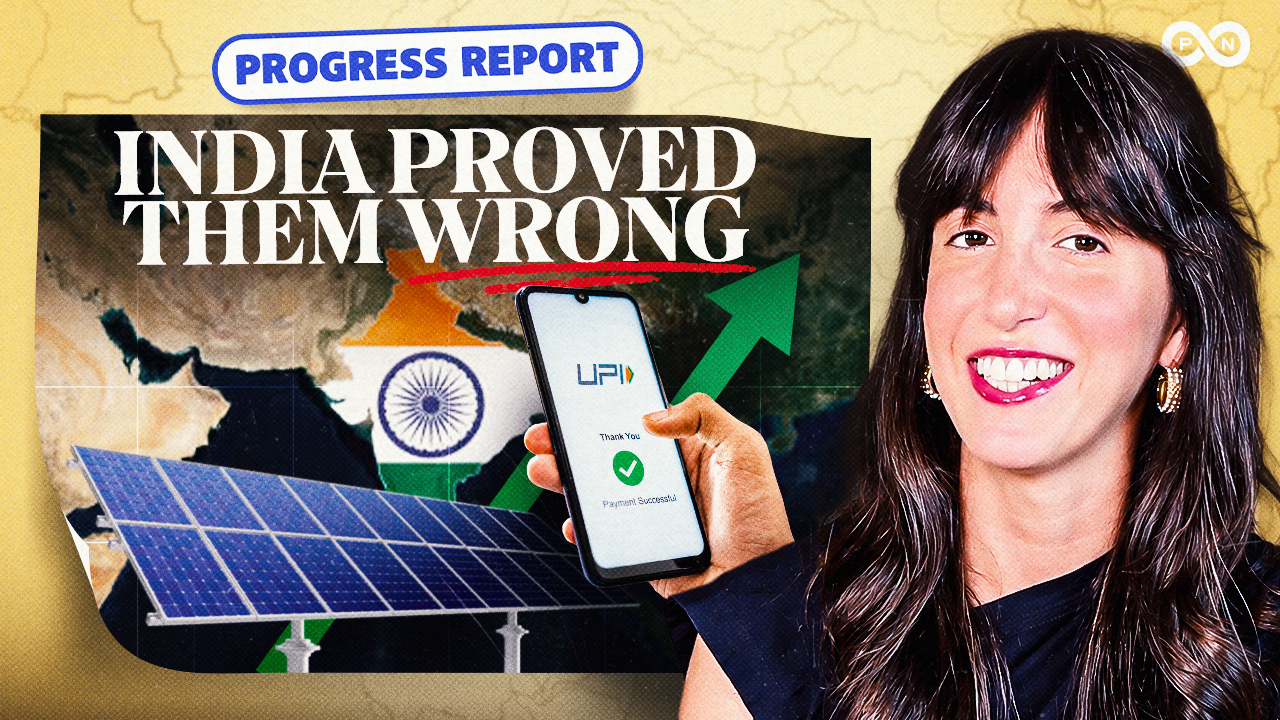
Why the Experts Were Wrong about India
Featuring Emma Varvaloucas
Winston Churchill predicted this nation would collapse, but today India is experiencing a massive economic glow up as it rapidly lifts hundreds of millions out of extreme poverty. We also investigate why crucial historical signs are quietly vanishing from America’s national parks, and how an eccentric doctor’s argument with mother nature saved countless lives from malaria.


Prefer to read? Check out the Audio Transcript
Although the transcription is largely accurate, in some cases it may be incomplete or inaccurate due to inaudible passages or transcription software errors.
Emma Varvaloucas: Winston Churchill said this country would collapse. Pundits called it a hellhole. But it has also lifted hundreds of millions of people out of extreme poverty. That’s our main story on today’s What Could Go Right Progress Report. And stick around, because we’re also talking about why historical signs are quietly disappearing from America’s national parks, and an eccentric doctor whose yelling match with a microscope ended up saving millions of lives.
If you’re new here, hey, my name is Emma Varvaloucas, and I’m the executive director of The Progress Network. Let’s get into it.
There’s nothing like celebrating a birthday when you’ve had a massive glow-up. The best part is the satisfaction of popping up on everyone’s social media feed looking snatched.
Obviously, the caption says something about positive vibes, transformation, and brunch. Well, on Saturday, India had its glow-up brunch. The country of 1.4 billion people celebrated 79 years of independence from Britain. This is a huge deal because a lot of Western scholars, experts, and haters, like Winston Churchill, thought India could never survive.
Yes, the British bulldog is a World War II hero and a fan favorite of History Channel dads everywhere. And while many of his quotes are quite funny, like the time he said, “America invariably does the right thing, after having exhausted every other alternative.” When it comes to other topics, not so much. He once called the sight of Mahatma Gandhi nauseating, and thought India would fall apart if it left the British Empire.
Wrong on that count, but unfortunately India did struggle. Decades after independence, hundreds of millions of citizens still lived in extreme poverty, fueling global criticism. But today, India is a top five global economy, and has the fastest growing economy in the world. And despite some huge changes in recent years, Western public opinion, or at least some Western public opinion, is still stuck in the Churchill era.
In April, podcaster Michael Savage called India a hellhole, and a certain true social loving president loved it so much that he re-shared it. Classy. The West has India all wrong. Think Slumdog Millionaire. India has all these great new answers, but nobody believes them yet. Anyway, it’s time to set the record straight.
So let’s look at some proverbial before and after shots of India, and give the country its flowers. Let’s start with the most vulnerable people. In 2011, over a quarter of India’s population was living on less than $3 a day. By 2023, that had dropped to just 5%. Let me frame that in absolute numbers. That’s about 67,000 people being lifted out of extreme poverty every day.
Another massive change is home access to tap water. When there’s no running water in the house, women and children miss work and school because it falls on them to collect it. So yeah, every time National Geographic snagged a shot of water carriers, it wasn’t a special women’s only day at the well.
Anyway, a government project in India is trying to fix the water problem. The Jal Jeevan Mission has brought tap water to 81% of rural households. That’s up from 17%, and they did that in only seven years. But forget speed. Let’s put the size of that project into perspective. The number of households they connected to tap water equals the total of all households in Germany and Spain combined. Yeah. India is big.
These are changes that transform people’s homes and daily lives in small but profound ways. For example, let’s say 10 years ago, you walked into an Indian family’s house. Unless they were relatively rich, I would bet my Slumdog Millionaire winnings that there’s no refrigerator in that kitchen. Today, there’s a 50/50 chance, and I’m taking my money off the table immediately.
Another change is that basically everybody in India now has a mobile phone, and internet access has skyrocketed. That’s how they watch The What Could Go Right? Progress Report, of course. This is in large part thanks to the Indian telecom company Jio, which 10 years ago expanded their network and dropped the cost of a gigabyte of data from about $2.60 to less than a penny. They are the reason why India’s internet prices are among the lowest in the world.
That isn’t the only way tech has drastically changed life in India, though. In 2016, the government told Silicon Valley to take a seat and launched their own digital payment system, the Unified Payments Interface, or UPI.
What makes UPI different from any digital payment system you know is that it’s a public good, not a private enterprise. The government handles the bill on every transaction, no credit card fees or bank charges, and its coding is open source. So any company, startup, or small business can use it or build on it.
Basically everybody in India now uses UPI, so there’s no need to download three different apps just to split the bill for that tandoori platter. UPI has also changed the way the government can deliver on its social programs. Bank accounts in India are now linked to Aadhaar, the government’s voluntary biometric ID system—think fingerprints and eye scans—that has more than one billion people registered.
Essentially, Aadhaar tracks that government payments like welfare checks or industry subsidies are going to the right person, and UPI gets the money into the accounts lickety-split. Together, the two systems have increased welfare payments by 1,500% and saves the government billions by eliminating fraud and money leakages. In the American context, it’s basically a bipartisan wet dream.
All of this digital infrastructure has even helped kickstart the country’s campaign toward universal healthcare. Meanwhile, Americans are crying when they open their medical bills.
And if that wasn’t impressive enough, India is also taking huge steps to become the first major economy to industrialize using solar power. Everyone else did it on coal and oil, so this could genuinely be the start of a new era. India’s grid is still heavily reliant on coal, but they’re also currently going through an absolutely massive solar boom. This summer, India overtook the US as the second largest solar growth market behind only China.
To illustrate what that takes, in just one year, India built 44 gigawatts of solar power capacity. Imagine the power required by 4,400 NFL stadiums all running the Super Bowl simultaneously. That’s about 44 gigawatts.
Look, let’s be real. India still has problems. Many young people are deeply unhappy with their job opportunities, and India’s zoomers recently treated their government to several rounds of mass protests because of it. The current administration is also really polarizing, with a habit of stifling press freedom and harassing minorities. Wait, that sounds familiar. . . And even improvements such as the Jal Jeevan Project have come under criticism because local authorities have let newly installed pipes immediately fall into disrepair.
But let’s be honest, it’s not like the US is a stranger to water supply problems. Was that a reference to Flint? Maybe. Or it could be a reference to Puerto Rico or Los Angeles or Atlanta. You get where I’m going with this.
And India, like many other countries, isn’t immune to pressure coming from one particular toupee in the US. President Trump may have convinced India’s parliament to introduce a bill that would allow fees on UPI transactions. He’s seemingly angry because the system bypasses American credit card giants like Visa and Mastercard.
So we haven’t exactly reached the musical crescendo and joyous dancing end of a Bollywood film. I’d say we’re more in the almost kiss phase of the movie. Good stuff, but we haven’t quite landed yet. That said, through all of the challenges, India, the world’s largest democracy, deserves credit for 79 years of independence and a glow up that has changed the lives of more than a billion citizens.
Next, here are some numbers that will make you smile.
42%, the decrease in new HIV infections worldwide since 2010.
3,682, the number of wild tigers in India, more than double since 1972.
And 13%, the decrease in US energy consumption per capita since 1975.
And now it’s time for our quick hits, or actually, hit. You’ll see we’re doing things a little bit differently today.
But make sure to stick around for a new segment at the end, and let me know in the comments if you like the format change, and if you don’t, stay quiet.
Anyway, for today’s one and only quick hit, as with many positive news stories, we’ve got one that’s a glimmer of hope wrapped up in a bit of bad news.
But before we get to the good or the bad, let me set the scene for you. You’re on a hike in Maine’s Acadia National Park. It’s lovely, as always, but you can’t help but feel like something is missing. It’s then that you realize that many of the signs that used to dot your path are MIA. Where did the signs go? And why?
No, they didn’t go to the Upside Down. Their disappearing act is part of a new Trump administration campaign to spruce up national parks and historic sites by sanitizing them of specific types of history and context. So what topics earn a sign a one-way ticket to the dumpster? So far, it’s tidbits about things like the impacts of climate change on an area, or the history of a region’s indigenous people, or how slavery shaped the person or place being honored.
But amateur archivists are not taking this lying down, and are rushing to preserve these signs. As they vanish, a crowdsourced project called Save Our Signs is trying to document every single sign across the entirety of the US National Park System. So far, they’ve gathered 7,236 photos. So the Save Our Signs volunteers are doing really important work.
And if you go to their site, you can not only submit your own photos of signs you see during your next national park trip, but also check out a spreadsheet of the signs that have already been removed. It’s definitely worth a look.
And now to our new segment this week. Let’s take a look at a positive news story from the past. Here’s what happened this week in history.
August 20th is World Mosquito Day, celebrated in honor of an experiment done by a British doctor, Sir Ronald Ross, in 1897. Now, there are a few things that make the good Dr. Ross noteworthy. Not only did he change the face of modern-day global health by discovering that mosquitoes transmit malaria, which was honestly a game changer, and one he received a Nobel Prize for.
But also, according to the Nobel Prize website, he was a, quote, “multifaceted person interested in poetry and music, as well as mathematics.” And now this is no longer part of the quote, but he was also a bit eccentric. One of his journals paints a very rich picture of his big discovery. Before actually realizing what was going on, he blames Mother Nature for the discrepancy he was seeing in his microscope and basically yelled at her in the middle of a hospital, saying, “Dame Nature, you are a sorceress, but you don’t trick me so easily.”
Yeah, totally normal reaction. Side note, if you’re into challenging reads that are totally worth it, like Shakespeare or the non-Chris Nolan-ified Odyssey, his memoir is right up your alley. I do feel obligated to mention one thing, especially given that today’s main story was about India. Ross didn’t make this discovery alone.
He was a Brit who was born and worked in India because colonialism, and his unsung lab assistants were critical to the process too. But back to Ronnie boy’s claim to fame. His work is the reason why we’ve been able to make any progress against malaria at all in terms of treating and managing the disease.
While it’s still a major cause of death, we’ve made incredible strides in combating it. The World Health Organization says that 14 million deaths have been averted worldwide just since 2000. That’ll do, Ronald. That’ll do.
I hope these stories remind you that there’s so much good in the world, so it’s important to shift your focus away from all the bad sometimes.
Send this episode to your friend who missed House of the Dragon this week, or maybe didn’t miss it, depending on who you ask. If our main story about India really grabbed your attention, make sure to subscribe to our YouTube channel. We just released a deeper dive into how India is going after something that would make Elizabeth Warren very happy. No, it’s not Indian ancestry. It’s universal healthcare, baby.
And feel free to argue about Winston Churchill in the comments.
LOAD MORE
Meet the Hosts

Emma Varvaloucas