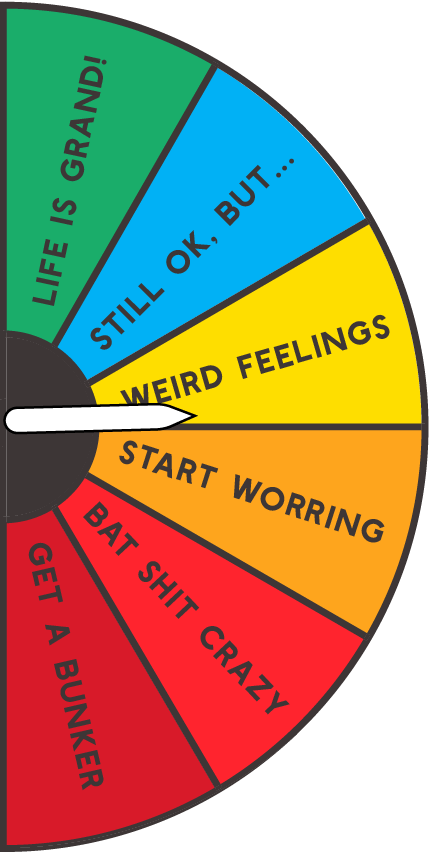
Volcanoes are erupting in The Philippines, but on-fire Australia received some welcome rain. The Iran war cries have been called off and The Donald’s military powers are about to be hamstrung by the Senate. Meanwhile, his impeachment trial is starting, and we’re all on Twitter for a front-row seat.

The Case Against Cynicism
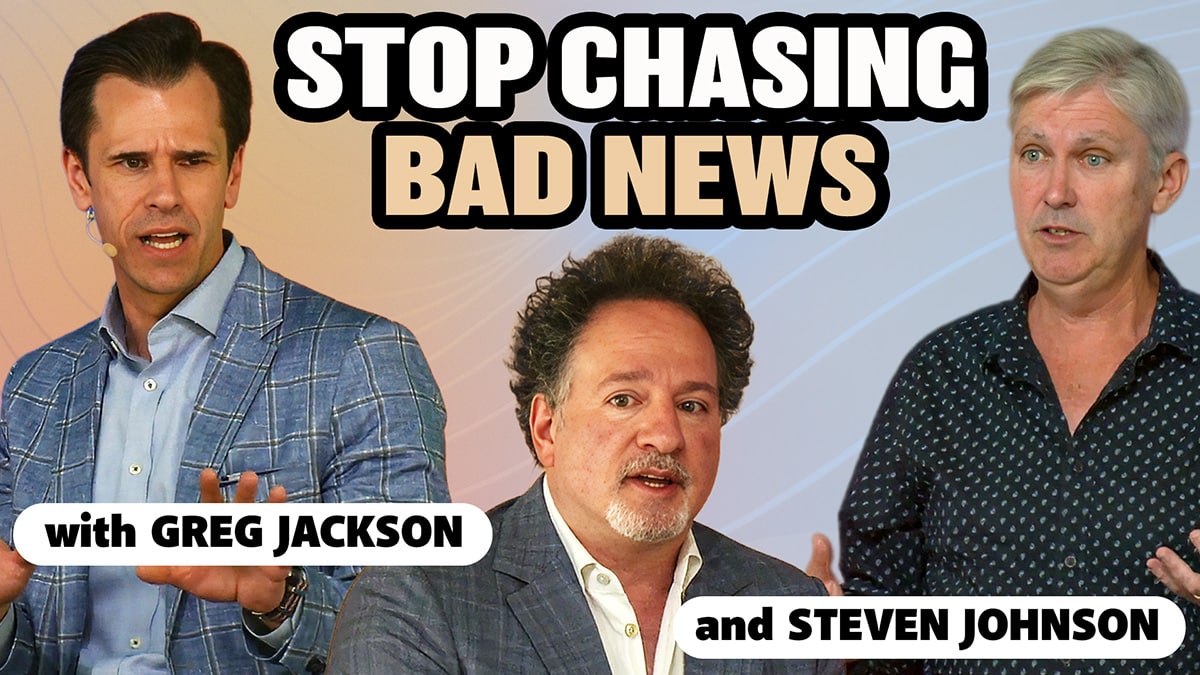
Featuring Greg Jackson & Steven Johnson
Despite record highs in life expectancy and historic lows in violent crime, society remains convinced that everything is completely broken. Steven Johnson (The Infernal Machine) and historian Greg Jackson (host of History That Doesn’t Suck) join Zachary Karabell at the Aspen Ideas Festival to decode our cultural doom loop. Rather than fueling the panic of our daily newsfeeds, the panel zeroes in on the psychological and historical roots of our negative worldview, revealing that our current crisis of faith isn’t nearly as unprecedented as it feels.


Prefer to read? Check out the Audio Transcript
Zachary Karabell: What Could Go Right? I’m Zachary Karabell, the founder of The Progress Network, and this is, as you know, my podcast, What Could Go Right?
In this episode, we are doing something unique. We are using a panel that I was recently on at the Aspen Ideas Festival in Aspen, Colorado, where three people, myself included, delved into the question of what could go right.
This was a really motivating panel. It certainly excited me. It was me, Greg Jackson, who is a professor at Utah Valley University, but more importantly for this, the host of a podcast called History That Doesn’t Suck, it is a great podcast, and I really encourage you all to go give it a listen or a watch, and the author of a recent book called Been There, Done That: How Our History Shows What We Can Overcome. And the other person was Steven Johnson, who has written like 14 books, most recently The Infernal Machine, about the invention of dynamite. He wrote a great book 20 years ago called Everything Bad Is Good for You. He wrote a book called Extra Life: A Short History of Living Longer, and he has also been at Google for the past several years as part of the NotebookLM team.
What I loved about this panel was we were all just animated by this view of a culture that is mired in its conviction of all that is wrong, and does not adequately look at what is going right, can easily consign itself to a doom loop, and that we need to have a more sanguine view of our past, a more measured view of our present, a more humble view of our future, and a willingness to step back, look at where we are, identify where we need to go, and work accordingly, without the constant pall of pessimism clouding everything. So I hope you enjoy the discussion, because I certainly did.
Zachary Karabell: I think, in general, the disconnect between individual attitudes and collective attitudes is pronounced and pronounced-er. This is a feature of our contemporary era, where we are very much in a disjuncture between things we feel locally, things we feel individually, and things we feel collectively. This has been true for a lot of time. It is acutely true now.
And I’m going to leave it at that as a level-set. I’m going to ask each of you to talk for a moment about your definition of optimism. Not that this panel is purely about that, but I think it’s a worthwhile thing. And also Steven, I know you have some views about the title of this session being, in and of itself, indicative of a contemporary problem.
Steven Johnson: The title of this session is “What Could Go Right in a World Gone Wrong?” And I think we are all here — this is supposed to be one of the optimistic panels, right? We are all here because we are going to have a little dose of optimism. All of us are —
Zachary Karabell: The optimistic panel?
Steven Johnson: Maybe the one optimistic panel. And the optimistic panel, in its title, assumes that the world has gone wrong. That is baked into the title of the panel here. So I think part of what we want to explore is, what do we mean by that, when we feel that the world has gone wrong? And are we focusing on the right things when we try to make that kind of assessment?
One of the things I was thinking about last night, we actually have not talked about this before, is that to come to the conclusion that the world has gone wrong, there are three inputs that have to get into your head for you to feel that way.
One of them is the actual state of the world: the facts of the world, what is happening right now, what is out there in reality. Then there is the news of that reality that gets to you, the information filters, whether that is watching the evening news or social media or whatever it is. And if that news is biased toward negativity, if it is sending you more bad news about the state of the world and less good news, even if the state of the world has not really changed, that will change your perception of it. Finally, there is the amount of contact that you have with those news sources. If you have a negative newsfeed and you are constantly interacting with that newsfeed 24/7, you are going to have an increasingly negative view of the world.
So I would submit to you that we can debate the state of the world, but what has happened over the past 15 or 20 years is that the negativity bias of the news sources and the frequency with which we encounter those news sources have definitely increased. And so we are all a little bit in this social experiment where we are being fed a lot of information about the state of the world, and I think it is skewing our judgment a little bit. And we need to figure out, as a society and as individuals, as news consumers, how we counteract that bias.
Zachary Karabell: Before we get to Greg, a question on this. And by the way, Greg Jackson, I mean, we know that Steve Johnson is a rock star, but Greg Jackson is a total rock star. Just watch some of his one-man podcast shows with a band. You are going to be like, I knew this guy before he became the most famous historian in the universe.
So there is the fact, historically, though, that human beings do gravitate toward dramatic news stories. “Remember the Maine” as a kind of yellow journalism moment. “Remember the Maine,” anyone? 1898. There is a human nature aspect to this that is not an algorithmic, technological one, no?
Steven Johnson: Yeah, I think that — well, first off, there is great stuff about yellow journalism in your new book. I think that, in fact, the algorithms are less about the nefarious economics of big social media companies and more about the intrinsic bias we have toward being interested in negative news.
There is kind of an understandable reason. Threats are important. You want to focus on threats if you feel that something bad has happened or something has challenged your expectations about what was going to happen in a negative way. There is a reason why your consciousness, your attention, is drawn toward those things. But in a world that is constantly reinforcing that interest, that kind of attentional focus that you naturally have on negative outcomes, that can get a little pathological, I think.
I had a thought experiment that I borrowed from somewhere else at the beginning of Extra Life, my second-to-last book, which is about the extension of human life expectancy over the last hundred years, the thought experiment was just to kind of ground yourself in history. Which is like, if a newspaper came out once every hundred years, what would the headline be? If we were looking back from 1926 to 2026, what would we look at and say was the most important thing that really happened? In my case, my argument is that you would look at it and say, we effectively doubled the amount of years that the average human being gets to live. What an incredible accomplishment that is.
But that accomplishment came out of a million small improvements. It did not come out of one miraculous doubling of life expectancy that would be a front-page story. It came out of a million incremental things that are happening all around us, but we don’t focus on it, because progress, the most important kind of progress, is slow and incremental, which is the least newsworthy kind of information there is.
Nobody really wants to see headlines about slow, incremental progress. That is the bias that I think gets us in trouble.
Greg Jackson: So first, let me do a little piggybacking there. Sensationalism as a framework for news fully developed in its absolute maturity in the 19th century. We taught the media that we love stories that are sensational. We want to hear about a big figure failing. We love gossip. We want stories about sex. We want stories about things collapsing. So when we buy those news stories, when we buy the newspapers that are pushing that narrative, guess what the other papers learn? That’s what they should produce more of.
So that’s what new journalism started doing. New journalism was then dubbed yellow journalism, and then other leaders of the era started calling it freak journalism. Of course, I like the term that was used in Puck magazine in the 1890s. They called it fake news.
Zachary Karabell: Huh. Go figure.
Greg Jackson: I wonder if it will catch on. Define optimism? Optimism, to me, is not Pollyanna. There seems to be this almost jaded, like all the cool kids can’t be optimistic because you’re dismissing reality, when to me, optimism is being able to see that there is a real risk, there is a real threat, but we are not going to let that stand in our way of trying to move forward. Where we can respect the data that tells us, as we look at our history, that systematically we have moved in the aggregate, to use Steven’s point, if you were to have a headline once every 100 years, it’s dramatic improvement. And in that same way, we absolutely backslide, and we have multiple times. Reconstruction is one of the most horrendous backsliding moments ever in the human experience, and it is for the United States. Nonetheless, can we hold on to these competing concepts: that bad things happen, mistakes are made, we do wrong, and that ultimately we still have the chance to do right?
We vote again and again, and we have the opportunity in a republic to hit reset. And even in a far more limited republic, going back to the early republic and pushing through the 19th century, even into the 20th century, which is where we have to get to to even reach the point where everyone who is an American citizen has the right to vote, even under those more limited situations, we had people without the right to vote who led the charge to improve this nation. If we could do that then, why on earth can we not do that today? So I am optimistic because the data leads me in that direction.
Zachary Karabell: I think we’re done. You got 40 minutes you didn’t think you were going to have.
So, I have thought a lot about this. Why is it okay to ask the question, what could go wrong, but asking the question, what could go right, just doesn’t occur to people? Why does every statement of things happening that are constructive in our contemporary culture have to be followed by a “yes, but,” but every statement of things that are bad and negative can stand on its own? Why is there not a headline of “18,000 planes landed safely yesterday”? Why do we fall so completely for a continual negativity bias?
I think the point — and I have spent years both in academia and in finance, which felt as schizophrenic as it sounds — is that in most rooms, if you are pessimistic, or if you are highlighting risks, or if you are talking about problems, most people will respond to that as a greater level of intelligence than if you talk about things going well, because it falls into the kind of Pollyannish, Voltaire, “this is the best of all possible worlds” trap.
I do not think optimism is the belief that tomorrow is going to be better than today. I think it is, as the theoretical physicist David Deutsch says, and I am going to paraphrase, it is the humility that we do not know future outcomes.
I have no idea whether the present portends a much worse future, whether democracy is collapsing, whether global autocracy is the new normal for the 21st century, whether the dollar is going to collapse, whether the financial system is overvalued, whether AI is going to take over the world, whether climate is going to boil and our children are going to suffer. I have no idea if any of those things are true or untrue. But I am 100% sure that no one else does either. And that the certainty of future outcomes is one of the greatest impediments to both acting on and envisioning better future outcomes. In the face of something that is unknown, it is incumbent upon all of us to believe that we are writing that future, that it is not preordained, it is not written, it is not known, and that it is our responsibility to act as if we can shape a future of our dreams rather than the future of our fears. We can not continue to, in financial terms, over-index for Armageddon and under-index for utopia.
Both of you have thought a lot about these things historically. One thing for me as well, and I think we all agree on this, and I will, I promise, in a few minutes avoid this kind of hosanna chorus of optimism and push all of us to question those beliefs as well — one of my optimisms about the American present is predicated on a much more negative reading of the American past. I know you think about this a lot, Greg.
Greg Jackson: It is my book.
Zachary Karabell: Yeah. So, talk your book.
Greg Jackson: Sure. In my book, I basically take us into the deepest, darkest abyss of American history from the 1790s up to 1900: stories about contested elections, political violence, and early fake news.
And for me, staring into these very dark, ugly moments where the American experiment could absolutely fall apart, this is encouraging, not to say, oh, everything will be okay here in the present as a given. That’s the Pollyanna stuff, and that’s fake, and that’s not worth having.
But rather, to see that, over and over again, our institutions have held, even if we always, to paraphrase what Churchill is said to have said, that you can always count on Americans to do the right thing after they have tried everything else. Our institutions hold, and enough of our better angels, to use Lincoln’s phrase, come to the fore. So we have a sufficient combination of the checks and balances, and separation of powers, and a very well thought through system that in my reading of James Madison’s Federalist No. 51, where he says if all men were angels, we wouldn’t need government — or as I like to read him, people suck — so they envisioned a government that assumed people are awful, even as they realized that there was this need for what they called public virtue to really push the thing forward.
What I see over and over again is that the institutions and the public virtue, even if it is not as much as we would like, the two meet well enough that we continue to choose union. We continue to choose a better future, even if it is two steps forward and sometimes one and a half steps back.
Steven Johnson: I’ll give you another example from history. So the book I wrote two books ago — no, the last book I wrote, The Infernal Machine — is a story about the invention of dynamite, and the anarchist movement, and the invention of modern policing techniques.
One of the things that drove me to write that book in the first place was that I was researching the early history of the NYPD at the turn of the century, 130 years ago. It turned out they had a chief bomb inspector, a guy named Owen Egan, who was in charge of, if there was a bomb that went off, he went and analyzed it. If there was a bomb that was found, he defused it. And between 1896 and 1920, when he died of natural causes on the job, surprisingly, he defused in that period 7,000 bombs in New York City alone. And about half of those were political, acts of political terrorism that were planted. There were also mob, kind of criminal bombs as well.
So just imagine what New York City would be like if you had that level of bombs being set off or planted every other day. If you go read through the Times archives, as I did for that book, it is just every other day there is another headline — a courthouse bombed, a bomb placed at the attorney general’s house. It happened again and again and again.
That was the political reality of the time, that there was bomb-level violence happening day in and day out in big cities like New York. And I think we have just forgotten that. We have no real sense of it. And that is what is so great about the work that you do, and also with The Progress Network, of just reminding ourselves of the progress that we have made.
So one example of this, I just looked up these stats yesterday, is that 2025 is the lowest homicide rate in the United States, we think in recorded history, but definitely in the last 100 years. And last year, we had the highest average life expectancy in the United States, 79 years.
So yes, complicated things are happening in Washington, and democracy is being challenged in some ways. But just ask yourself, have you been walking around in the back of your head being like, This is definitely the safest and healthiest the United States has ever been?
Greg Jackson: Steven, if I may, the thing that I think we are forgetting, this amnesia, is that democracy is always being challenged.
Steven Johnson: Yeah.
Greg Jackson: That is not new and unique. It is constant. Democracy itself, I would argue — I love it, I believe in it — and it’s about as natural as a curated lawn in front of your house. You like your lawn. You like the grass out here around us on this campus. But that is not the natural setting. If we are to leave things to nature, yeah, we get tyranny.
Zachary Karabell: The natural world is not a safe place. By the way, for those of you thinking about writing books as an act of profound narcissism, not only do you as an author sometimes forget your own books, but Greg came up to me after we had drinks last night, we had been talking, we were like new best friends, and he said, you know, I forgot I read one of your books. And I didn’t remember that you wrote it.
Greg Jackson: I remembered the book. I loved the book.
Zachary Karabell: I’m just saying, word to the wise. It’s not the best thing to do if you want recognition.
But these are not just American issues. There is a global tsunami of exactly this in multiple societies. It has different iterations, it has different tones. Certainly, anyone who has been paying attention to anything that’s going on in Western European politics, let alone, other than Hungary, Eastern European politics — and Hungary is now the other example of how things could go right in the face of everything going wrong — multiple parts of the world, even in China, where if you had done some sort of temperature test of public sentiment 10 years ago, it would have been very optimistic about the future. I know that seems odd given our views of China as a relatively surveillance-heavy autocratic state, which it is, but for a lot of its citizens, it also delivers certain basic things, like technology and ease.
But there is a world of negativity that is not confined to America or American history. I wonder exactly what’s going on in a world where those facts that you just said about the United States — I mean, every society’s metrics on material things are markedly better than they would have been 100 years ago. In fact, most societies are markedly better, dramatically better, than they would have been 30 or 40 years ago. Deaths in childbirth rates, nutrition levels, caloric abundance. Caloric abundance is fascinating. There was a really intense panel here before us about the food pyramid.
Greg Jackson: I think some people attended that.
Zachary Karabell: It was the most un-Aspen panel I have ever been in, which was great. I would like some of you to boo at some point during this, just to see how it feels.
Basically, never has there been more caloric abundance on the planet. The United States alone throws away 30% of all of our calories every day. There is no food quantity issue.
Now, saying that immediately makes everyone think you have to say that and then say, yeah, but we are not eating as well, or we’re eating bad food, unhealthy food that is creating obesity and insulin problems, and all the things. And that is a true statement, but it doesn’t have to be said immediately. It does not negate your point about the “and” rather than the “but.”
But I wonder why it is that we could spend the next 30 minutes rattling off statistics about how the world is better, including things like community. Community was great. We belonged. You were in a small town. People knew who you were. It’s the nostalgia of Cheers, right?
But in that small town, if you were gay, if you disagreed with whatever the social or political consensus was, if you wanted to leave, if you wanted to get a college education when nobody was doing that, if you wanted to not go into the family business — I mean, community was great, except if you didn’t like what the community was telling you. We kind of forget that downside.
Steven Johnson: Thinking about this, there was a really good — bringing together two things you just said about the global perspective on this, and then why we are steered toward this —
Zachary Karabell: And why facts don’t matter.
Steven Johnson: Why facts don’t matter. Fareed [Zakaria] did a great panel yesterday about the global energy situation. One of the first things that came up was that if you look at the actual magnitude of the supply shock of oil being withdrawn from the market in ’73 and ’79, what happened earlier this year was way bigger, both in absolute numbers and percentage of the overall market. But in fact, thus far — and it seems like maybe, hopefully, this will continue — the actual impact on the economies was much less severe than it was in ’73 and ’79.
The panel was discussing why that was, and it turns out that over those 40 years, a lot of quiet changes have happened that have enabled us, as a planet, to be more resilient to sudden supply shocks like that. And there are alternate pipelines and alternate energy sources and a whole host of other things that have happened, almost all of which did not get a lot of coverage.
And so we don’t have this catastrophic thing that happened in ‘73 and ‘79, even though the actual change in the supply of oil was much more dramatic than it was back then.
And what I think is interesting about that is like it’s another problem that is a fundamental problem about optimism, which is that a key measure of progress is bad things that no longer happen. The plane that doesn’t crash. The child who does not die of smallpox because of the smallpox vaccine. The car accident that didn’t kill you because seat belts were invented.
And so it’s not just that there is a bias toward negative news over good news. It’s understandable that social media and the news and in our own lives don’t emphasize things that didn’t happen. That is just not something that is natural to think about: all the possible things that could have gone wrong that would have gone wrong in the past. So it requires an extra amount of effort, I think — individual effort and social effort and media effort — to get around those blind spots, I think.
Greg Jackson: Amen. I agree with all of that.
Zachary Karabell: Why don’t facts work? You talk to students and audiences. Do facts work?
Greg Jackson: John Adams said, “Facts are stubborn things,” and I will fall apart on the exact quotation at this point, but basically, whatever our disposition is, that doesn’t change what facts are. And he made this argument while defending the Redcoats in the Boston Massacre, and it’s noteworthy that the New England jury acquitted all but two of the soldiers, who were found guilty of the lesser charge of manslaughter.
I think facts do matter. Facts can permeate. Because in this heated moment in colonial American history, so many patriots, as the term was evolving, were mad at John. We’re on a first-name basis, by the way. They were mad at John for daring to represent the Redcoats, because the emotions were there: tribe, you stick with us. Forget these Redcoats.
And here is John going, “I am a lawyer. They have a right to counsel, and we’re going to do this the right way.”
So I think facts do matter. Our emotions absolutely surmount and can overcome our ability to listen to those facts. What I would say we need to do better at is demonstrating empathy and care for one another. That’s when people become open to those facts.
In fact, I would suggest that John Adams was able to uniquely defend those Redcoats because he was a patriot. So that jury was a little more ready and willing to listen when John spoke. Had they brought in a lawyer who was clearly pro-King George, the same arguments could have been made just as eloquently and I think they probably would have fallen flat.
Zachary Karabell: I want to do one other quick thought experiment. Not a thought experiment — seeing where people are. So how many of you here — and just demographically, it is a little skewed — have or have had children with student loans? How many of you are invested in equity markets, either through 401(k)s, retirement plans, you name it?
So first of all, on that question: How many of you are invested and have student loans? Okay, so almost everybody. By the way, 150 million-plus Americans own some form of 401(k) plan. It’s not purely an elite phenomenon.
How many of you are really worried about the financial system, think we might be in an AI bubble, and think that markets are overvalued?
Okay. The reality is, though, that every single person in this room believes that stocks are going to go up, is invested in the U.S. economy and owns NVIDIA. Irrespective of whether or not we feel those things, those things are true.
That’s not a gotcha statement. It’s just, we’re behaving in ways that fly in the face of what we feel. I think that is one of these global phenomena, where people around the world are living their lives and doing well and yet feeling as if things are really messed up.
I am going to say something that should not be controversial, but it is. This thing that we all carry around, that is increasingly perceived as a source of multiple social ills because of attention, because of news, because of algorithms — I absolutely love this.
I love the connectivity of information. I love the fact that I have the corpus of human knowledge at my fingertips. I love the fact that there are these weird LLM agents that seem to have a quirky take on that corpus, and answers that are often wrong but always counterintuitive. I love the fact that I can connect to everybody I have ever known in a heartbeat, and that they can ignore me just as easily. I love the fact that we can still create communities, even if they are dysfunctional, because communities have always been dysfunctional. And I think the connectivity of technology and the things we have created are absolutely astonishing. I am sure that those words are not often uttered, because I don’t often hear them.
Greg Jackson: Let me add to that. I think we live in one of the most robust eras of information. Yes, is there misinformation? Absolutely. But we’ve got to stop treating the algorithms like we have no choice but to read whatever happens to get fed to us while we are doomscrolling. When you are driving down the freeway, are you compelled, with no choice, to get off at every fast food joint you pass and eat fries?
Steven Johnson: Raise your hand. How many of you are compelled?
Greg Jackson: We know the fast food is there. We know it is tasty. And most of us make decent enough choices to say, I’m not going to always ingest that. We know what it is, and we treat it as such.
Well, these little supercomputers in our pockets give us access to the most rigorous journalism in the world. And let’s think about romanticizing the past before the algorithms. You may have been a rural American living in a place where you have access to one, maybe two newspapers. There is one pulpit in town. This is it. That’s the perspective you have to interpret the entire world. And now you have the capacity, the ability to bring in so many different voices. But we have to be proactive enough to curate and think through what we are consuming when it comes to our minds, just as we do with our bodies.
Steven Johnson: The other thing I’d build on, on the technology front — and I think this is one of the things that’s so good about the “what could go right” phrase, actually — is that, as you alluded to earlier, we don’t have to think about these as purely utopian futures that we’re imagining.
Greg Jackson: And I want to say, I reject the idea that we can achieve utopia. That’s never happening, period. Please.
Steven Johnson: So there’s this risk when you’re perceived as an optimist, that people think you don’t think there are any problems and you just think we’re headed toward this kind of nirvana. I’ve seen this firsthand with AI over the last three or four years.
When I first started looking at the space of large language models, I wrote a long piece for The New York Times Magazine in early 2022, about six months before ChatGPT, which is the piece that brought me to Google in the first place.
I’d spent a bunch of time with these early models, and they were fascinating. I was intellectually incredibly interested in them. But they were flawed on so many different dimensions, and the critiques of them at the time were legitimate ones. They hallucinated wildly. They were very limited in the knowledge you could give them. They had all sorts of latent biases built into them. There were a million flaws that were there, but you could see the seeds of things that were really promising.
And it turns out that over the last three or four years, we have made amazing progress refining the models, refining how we produce the models, adding system instructions and other source-grounding techniques — all stuff that we don’t need to get into on this panel, that have not eliminated the problems altogether, and there are still lots of challenges with them, and there are certainly challenges about how we deploy them in society that we have to work through. But there were a bunch of people, and I got involved with this in part because I wanted to be one of those people, who thought: This is promising. What could go right if we released this technology into the world slowly, and thought about the flaws, and earnestly tried to fix those flaws over time? And we’ve seen, just in three or four years, amazing progress. If you went back to read that piece I wrote in April of 2022, almost all the major criticisms would no longer apply.
So I think it’s the mindset of, yes, there are problems, but if we apply ourselves, many of them are fixable. And they will not necessarily lead to some utopian future, because they will unleash new problems that we haven’t yet anticipated. And we will apply ourselves to those. But we should, as a society, remind ourselves — and again, progress is such a great word for that — that that is how we’ve always done it.
That’s what you should be inspired to do: thoughtful, incremental improvement on the state of things.
Zachary Karabell: It’s interesting. There is this kind of disjuncture of, technology is going to eat us, that AI is going to take over and destroy the world. And by the way, separate from whether you’re optimistic or pessimistic, if there is a palpable reality of AI soon to take over the world, there is nothing we can do about it. So fearing it and worrying about it, is in the most genuinely stoic sense, a complete waste of energy, because we’re just cooked. So, if we’re not, then we can have a conversation about the rest, but there’s not much point, I feel, in the agitation around it.
So let’s ask the question: Given that these things might be materially true, but there is a world of discontent and a world of problems — one, how do we explain that? And I’m going to offer one quick one, which is, the flip side of global pessimism and discontent, and the beauty of what this information universe has provided, is that never have more people on the planet believed that more and better is possible, and that they have a right to it. Never have more people believed that being a human being on the planet means you get a doctor, a school, a home and a meal, and that those are human birthrights. Not constitutional, democratic, Declaration of Independence. Human, global. And there’s something, I think, palpably powerful about that collective belief that will, in fact, express itself as discontent in the face of those things not yet being true, and governments and societies and companies not yet doing everything humanly and inhumanly possible to make them true.
Steven Johnson: The expectations rise, and so when we don’t meet those expectations, we’re disappointed, even though the overall arc is increasing in success and progress.
The other long-term trend — and I was talking about this with my wife last night over dinner — that I think undergirds a lot of this, and I’m curious what your interpretation of it is, and it’s brought up a lot at places like Aspen, is the decline of trust in institutions. That is empirically happening in the world, and particularly in the United States.
We see almost every kind of institution — educational, religious, government, media — trust has declined dramatically. Interestingly, to your original question, people tend to like their particular institution. They like their school they went to, or they like their particular pastor at church, but they feel that overall, these institutions have declined, or they feel less trust in them.
And I think when you have a default defensive crouch to the world, where you feel like the big forces are not trustworthy, that leads to a sense that the world has gone wrong in some way. And honestly, I’m not sure I have a fully realized theory or explanation of why that came about.
Greg Jackson: I don’t know if I can speak to the why, but I will cite Mark Twain’s alleged quote, that history doesn’t repeat itself, but it rhymes. We act like we are the first generation of Americans to doubt and have distrust in our institutions.
Thirty-second summary here: The election of 1876. By the time the dust was starting to settle on it, it had become clear that countless Black Americans had been murdered in the South in their attempts to vote, beyond being chased off from the polls. Attempted bribery. South Carolina cast 101% of its vote. I’m not great at math. I’m a history guy. I think something’s wrong there.
Election boards were demonstrably corrupt. Attempts at bribery. And then four states sent more than one set of electoral votes to Congress.
So you talk about Congress having to weigh out, do we accept these votes? Congress has no choice but to ask that question, because they had to figure out which set of votes to count from four different states. And Florida sent three sets, because Florida.
By the time all of this was said and done, Jeremiah Black, who was the Democratic lawyer representing the party and pushing their candidate in the electoral commission that was established to sort this all out, his closing statement was that we will never have such a thing as an honest election again. That was it. He believed it 100%. The republic was essentially dead. This election was so corrupt, it demonstrated that the system was broken and things were effectively over.
Now I tell you that story, and the vast majority of you probably weren’t familiar with any of it, and a few of you maybe had an inkling of some of it, because we so fully — I want to say, even as I say that fully, I’m not dismissing the compromise that then ended Reconstruction and cast us into the abysmal state of Jim Crow for generations. And, statement, the republic bounced back to be something better, thanks in part to Americans who, even in that Jim Crow status — W.E.B. Du Bois and others — continued to fight to make this place better.
Zachary Karabell: There’s a corollary to the Mark Twain line that I was told in grad school, which is that history doesn’t repeat itself, but historians repeat each other. I want to take three more minutes and then open it up for questions.
I think the trust question is fascinating. Again, I do put the cup-half-full gloss on it, in that I think the presence of all this information at the ready does make people legitimately think that they can question expertise. Historically, expertise wasn’t just the monopoly on the interpretation of information; it was the monopoly on information.
And while I think there’s too much of a bleed of expertise, as the interpretation still should be honored — there’s real expertise in making a semiconductor chip, in making a jet engine — a lot of these tools are allowing far more of us to legitimately go, you know, maybe that methodology wasn’t right, or maybe there are some facts here you didn’t look at.
So let’s each take 30 seconds, because then I want questions. What does alarm you about the world? What is going on that you find is genuinely worth concern, if not pessimism?
Steven Johnson: The two most impressive trend lines of the 20th century and early 21st century, if you zoom out to that 100-year view, were life extension and the reduction in extreme poverty. Unbelievable story of progress there.
And while life expectancy has continued to increase, extreme poverty has stalled and actually started to tick up again in the last 10 or 15 years. A lot of factors going into that, but you could tell a story until about 10 or 15 years ago that the fundamental things — are you on the verge of starvation, and are you dying at the age of 42, or are your children dying in childbirth? — that story was just getting better and better every year. And the economic side of it has stalled. So that’s probably the biggest thing I’m focused on.
Greg Jackson: For me, it’s cynicism. Lincoln, as a very young politician back in 1838, I’ll paraphrase here, effectively said, as a nation of free men, it is our destiny to live forever or die by suicide.
There are plenty of things that I’m concerned about. The thing that concerns me the most is this sense of defeatism that permeates through America and seems to convince so many that their vote doesn’t matter, that their voice doesn’t matter, that they shouldn’t bother writing their representatives, their senators because there’s nothing they can do, when we are replete with examples of Americans, generation after generation, who had such weaker tools to reach these sorts of figures, and yet had the audacity to continue pushing. They’re the ones that delivered us the state that we have today, and we owe it to ourselves and future generations to continue that same tradition. And if that holds, we’ll be okay.
Zachary Karabell: Yeah, and that is actually what I was going to say, or some version —
Greg Jackson: I’m sorry.
Zachary Karabell: No, some version thereof.
Greg Jackson: Historians repeating.
Zachary Karabell: Historians repeating each other. It’s just happening here. The sort of stultifying pessimism — I do think societies can talk themselves into doom loops. And when you lose that precious gossamer thread, not just of hope, but of conviction, that you are collectively able to write a better future, you start believing that you can’t, then the behaviors that follow from that are collectively, and often individually, self-destructive.
I’m going to get what I can while I can get it. There is no such thing as the common good. Why bother investing in anything? Because that’s the future. Hold it and hoard it, or spend it and use it. And I think there is a risk of that, not just here, but in multiple parts of the world.
Questions! And there are mics that will go around. The lady in the hat right back there, and then next to you after that. You’ve got to wait for the mic. Sorry.
Audience Member 1: On that note, how much do you think the press has to do with that negativity and that vicious cycle, that that’s what people actually think sells papers and sells books and gets people to watch television?
To me, I see there’s a major factor with how the press communicates information to us as citizens and the angles that they take. Sorry, I know you’re a journalist.
Steven Johnson: No, no. I think it’s — to Greg’s point, this has a deep history. Yellow journalism took us back to that. “If it bleeds, it leads” is a cliché about news that exists for a reason.
I think it has been amplified by social media in the sense that people then also tend to engage with content that triggers that same sense of anxiety. It seems clear that people want to share things that they are outraged by. That seems to be another mechanism, or part of our psyche, that we’re uncovering through this great experiment with technology.
And again, to the point that Zachary was saying, it’s not necessarily the nefarious economic incentives of the algorithm. It’s just making the choice of what gets recommended more democratic actually tends to steer people to recommending things that they were outraged by, which means that whatever seed news was there that was negative to begin with gets louder because people have amplified it.
Zachary Karabell: And the lady right — yes.
Audience Member 2: Hi, reflecting on your comment about AI futures happening, and your comment about human agency, where do you see that nexus in this collaborative future that we are looking at, and the ability of human agency to actually craft it in a way that’s beneficial?
Zachary Karabell: Look, I think one of the fascinating things about AI is that at some point, we may indeed be creating a different form of consciousness. But of course, we will have created it.
The fear is that it’s the Frankenstein monster, as opposed to an incredibly powerful adjunct consciousness and tool. We’re going to figure this out and find this out. I have no idea. I’m also struck by the fact that even the deepest minds of DeepMind have no idea.
But I do have a great deal of faith in the human capacity to create. I also have a great deal of faith in the human capacity to destroy. And every new technology has opened up a wider and wider hope-and-fear juncture, because our capacity to do both — nuclear weapons, bioweapons, Internet — all these things augment our capacity to destroy and to create. Right now, it is a temperament question. Like do you believe that’s going to work itself out?
Greg Jackson: I’ll add that, yes, we’ve seen — obviously with AI, we can’t say exactly. And us historians, we are better at predicting the past than the future, I have found.
But these same fears, with the Industrial Revolution going all the way back to the 1790s, they’ve played out again and again. I remember watching an old Twilight Zone episode that predates my birth that explored machines taking over. So it’s always been there.
But I’m willing to bet that if we did another thought experiment, raised hands, most of us would not choose to give up our current technology to go back to a different generation. What we’ve found is that we seem to be able to adapt and grow and meet the new challenges that come with new technology.
Steven Johnson: Very quickly, one other thing that I think is worth pointing out. There’s a wonderful artist who does a lot with AI named Holly Herndon, who has probably been at Aspen in the past. She has this great point, which is that we misnamed AI, at least for the language models. We should have called it collective intelligence. Because it is truly the first technology to come along that is the sum total of human knowledge embodied in this machine. It is made of us in a good sense — not in the Soylent Green kind of sense.
And I think that If we remind ourselves of that, that this is something we are actually collectively making and that we can steer, I think that that frames it in a slightly better way.
Zachary Karabell: Over in the front, please, and then we’ll go over here.
Audience Member 3: Hi, thank you so much. I so appreciated your point about cynicism and voting and how that’s something that we need to be concerned about. I run a nonprofit for high school civic engagement, and I started it when I was 16, and now we’re in around 1,000 high schools across the country.
Zachary Karabell: Cool.
Greg Jackson: Nice.
Steven Johnson: Thank you.
Audience Member 3: Thank you. I’m 26, and I find that the worry about something happening is what drives the optimism, right? I guess my question is: I find there’s a distinction between when you guys were talking about optimism for something possible in the future, and then feeling grateful, maybe, for things that are happening right now.
I find when my generation brings up something is wrong, like I’m not going to have Social Security, we’re told, oh, it’s worse in other countries, or this is what we have in our country.
So I guess my question is, why is it important to be cognizant of the things that are good right now? I take it as a way to learn and understand what’s happening in the future. But I really struggle with the idea that we need to be optimistic about a better future being possible, but also that future is never going to happen if we don’t reckon with the things that are going wrong right now.
Zachary Karabell: I totally agree with that as a flat-out statement.
Greg Jackson: I almost take that as a statement.
Zachary Karabell: Yeah.
Greg Jackson: Super agree.
Zachary Karabell: I do think, though, that if you believe that things were better, that’s a huge impediment to making them better, because rarely were they. A lot of people’s discontent in the present, in every culture, is predicated on a false read of the past.
It’s one thing to say, we’ve got a lot of work to do, and there are a lot of problems in the present that if we don’t address will get worse in the future, with an acknowledgement of, hey, look, there’s a whole corpus of people grappling with things that we have, in fact, solved. And that is a hopeful statement.
As opposed to, there used to be a formula. It used to work. We’ve messed up. We’re in the darkness. We’re struggling in the wilderness.
Greg Jackson: It’s broken and we’re destroyed. For me, my mind goes to the idea of a Sisyphean task. We often use that in a very negative way, right? Like we’re never going to accomplish it. I actually see that as a positive thing.
Democracy, the United States — this is a Sisyphean undertaking, where we are constantly trying to leave a more perfect union for the next generation, even as we can acknowledge at the same time we can’t make it perfect. We will not get there.
So we can hold on to that tension of accepting that, yes, we are an imperfect and flawed species, ergo, what we make will be imperfect and flawed. But at the same time, we can burn our energy to its fullest extent in trying to deliver the best that we can. That, to me, is the sweet spot.
Zachary Karabell: Yep. One more question. Final question.
Audience Member 4: Just so I can help you out: boo, you suck. Now you know how it feels.
I’m not a historian, so I don’t know if I’m right or wrong in what I’m feeling from what you’re saying. I feel like society has been shaped by the few — the few who push against and the few who push forward, and that contention.
I get worried more about the people in the middle who just don’t care at all, who kind of just say, I’m protecting my own. I don’t really care what happens. I find a lot of people in my life like that, and it annoys me. I’m trying not to be annoyed by them not having a position, but just living.
So what does history say about that, or what do you all think about that? And I love NotebookLM. Thank you.
Zachary Karabell: I mean, look, we’re almost done here. I totally agree. I think apathy is actually a far more dangerous public stance than angry engagement, as long as that angry engagement doesn’t tip into antinomian rage and revolutionary fervor.
So I totally agree with you. I think one of the things that you see a lot, and that I think is very positive in the United States and throughout the world, is that a lot of people are just not content. They are not apathetic. They are actively expressing their voices and demanding things to be different, à la your point.
It’s not, hey, things are fine. It’s things aren’t, and let’s do something about it. And I think that’s magnificent.
I hope you enjoyed that as much as the three of us clearly did.
For those of you who have been listening to episodes, I want to encourage you to go listen to other episodes. You can do that on Spotify, Apple, Pocket Casts, Castbox, anything you get your podcasts on, or YouTube, for that matter, if you’re watching. Because there’s a whole corpus back there, including what we’re doing recently.
Please subscribe on any one of those places. Please subscribe to my Edgy Optimist on Substack or/and the What Could Go Right? newsletter, which The Progress Network does.
And on that, I want to thank the team at The Progress Network for all the work that they do weekly, daily, finding stories, finding ideas, and the team at Kaleidoscope for producing What Could Go Right?
And to all of you for your time, which I certainly honor, do not take for granted, and feel humbled that you have taken 57 minutes of your time and devoted it to this. So we’ll be back with you next week.
LOAD MORE
Meet the Hosts
Zachary Karabell