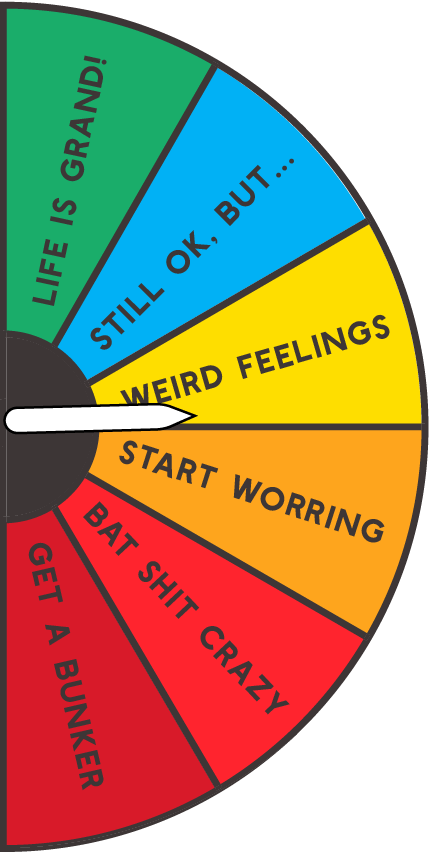
Volcanoes are erupting in The Philippines, but on-fire Australia received some welcome rain. The Iran war cries have been called off and The Donald’s military powers are about to be hamstrung by the Senate. Meanwhile, his impeachment trial is starting, and we’re all on Twitter for a front-row seat.

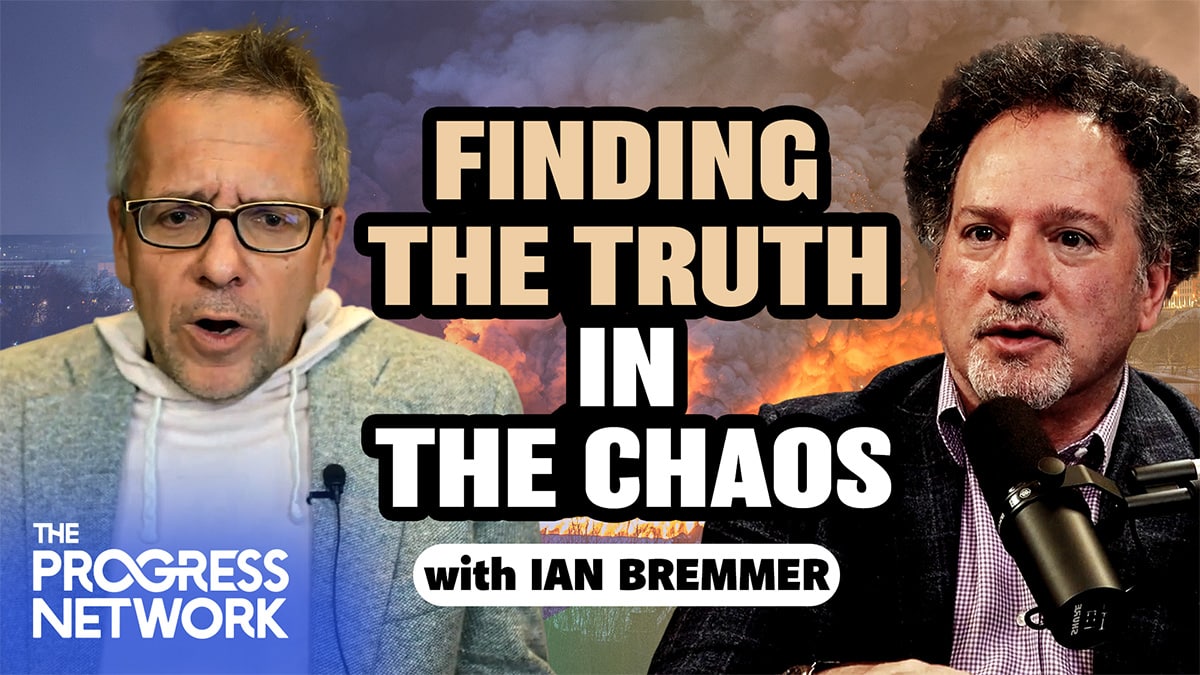
Is the World Order Actually Disintegrating?
Featuring Ian Bremmer
What happens when the rules of the global game are being rewritten in real-time? Ian Bremmer, the founder of Eurasia Group and GZERO Media, joins host Zachary Karabell to discuss how to navigate a world defined by a “long geopolitical recession” and the erosion of the post-1945 order.


Prefer to read? Check out the Audio Transcript
Ian Bremmer: The Iranians are putting out these memes, and the memes are doing extremely well, and the American government’s putting out memes, and the memes are doing extremely well, and there’s enormous amounts of disinformation, and so people, they don’t know what to believe.
Zachary Karabell: What could go right? I’m Zachary Karabell, the founder of The Progress Network, and that’s Ian Bremmer, who you likely have heard of, who created the Eurasia Group, who is one of the most astute, independent voices in the world today, and even though he consults with governments and companies, he marches to the beat of his own drum. It is deeply refreshing and incredibly important to be able to talk to someone who says what he thinks and not just what he thinks he should say, and is, I think, therefore, one of the more acute commentators about what’s going on in the world today. So given all that. I’m looking forward to this conversation.
Ian, it’s a pleasure to have you back. So we had this conversation more than two years ago, right after October 7th, 2023. If you’re gonna look at the past two and a half years in the Middle East from a risk perspective, I imagine things have probably gotten worse than one would’ve expected, but how much of this would you have anticipated? Not, obviously, in its specificity, but in its general chaos.
Ian Bremmer: So, the big picture thing that was not surprising is that Israel, given its military escalation, dominance in the region, was gonna continue to be able to call the shots. Some of the abilities that they displayed, in terms of targeting and assassinating all of the leaders of Hezbollah, for example, I mean, the trade craft is, is quite something, but that’s not surprising.
I think the surprising thing is that Trump decided to go much bigger on Iran, as opposed to a repetition of the Twelve-Day War, and he’s now gotten himself in the thick of it. And the result of that has been that the, the one thing that has been the most extraordinary development coming out of the Middle East in the last 20 years, which has been the globalization and these world-class economic models that are being developed out of the Gulf are now being proven to be geopolitically extremely vulnerable.
Ian Bremmer: That is a surprise. It’s not a surprise that they’re in the Middle East, it’s just a surprise that the tacit deal that had been made to keep them out of the fray has completely unwound as a consequence of Trump deciding to decapitate the Islamic Republic. He went bigger than the rules of the game allowed, and now the dominoes have all come tumbling down.
Zachary Karabell: So we’re recording this at a time where we don’t really know, you know what’s gonna happen by the time you’re listening to this, the Strait of Hormuz could be open, it could be closed, it could be open and closed, there could be ground troops, there could not be ground troops, so we don’t really know right now exactly where this is headed in the next couple weeks, between this conversation and when people are listening to this conversation.
I have to say one thing I’ve been struck by, and I don’t know if this is just my own lack of focus, is, you know, if you step back from the strategic vulnerabilities of all the Gulf states and the degree to which they have been drawn into this conflict, literally, palpably, that their air defenses and their missile defenses and their drone defenses seem to be extraordinarily good. You know, it seemed for years, particularly the Saudis, were just sort of buying vanity hardware to make their state look better, but that their military capacity was fairly limited. It’s kind of surprising how adept they are at their own self-defense and how much they have clearly prepared. I don’t know if they were preparing for an Israeli attack, but they certainly were preparing for some sort of airborne attacks.
Ian Bremmer: So, I guess, I agree with that, Zach, but, you know, the funny thing is, I don’t think I would’ve taken that as a conclusion. I mean, the Iranians have done a lot of learning. They have been much more capable of hiding and dispersing their weaponry to be able to continue to fire even ballistic missiles after now, as you and I are talking, some four weeks of getting just the crap pounded out of them by the Americans and the Israelis, never mind the drone capabilities that we knew that they had, and that while the numbers of ballistic missiles that have been used has gone down since the opening days of the war, the percentage of targets that have gotten hit has gone up, and the reason for that is not about capability, it’s about how much hardware these countries still have, that they are running out of the adequate defenses to ensure that they can keep Iran off of them.
When I saw that the Prince Sultan Air Base in Saudi Arabia, which is the hardest target in Saudi Arabia to hit, it is the most defended, was hit directly by an Iranian missile after four weeks of the war, that makes you think differently about war fighting. And when I see $20 billion of damage done to a Qatari LNG facility that will take a minimum of three years to repair, by a drone from Iran that costs maybe a hundred thousand dollars, probably less, the answer to that is, we are in a much more asymmetric war-fighting environment, where the Ukrainians can do a lot of damage to Russia and where the Iranians can bring the global economy to their knees. To me, that is the more surprising outcome from the opening weeks of this war.
Zachary Karabell: There’s always the kind of, the bigger picture part, which is obviously this particular kinetic conflict is gonna end, there’s still gonna be massive capacity for energy production, fertilizer production, LNG oil in the Gulf, there’s still likely, although provisionally, let’s just say we don’t quite know, going to be an entrenched Islamic Republic in Iran for X period of time, albeit a weakened one.
I’m not sure what sort of lies on the other side in terms of the global system, other than there will be a continued preaching of, we need to be more resilient, we can’t be so dependent on any one choke point. I assume there will be lots of money spent by lots of people to create alternate supply chains for these things, but kind of like all the things that were said during COVID, where we were gonna make all these supply chains more resilient and never again, I’m sort of struck in a way that even I had not really — and what I mean by even I, is like, I’ve written about this stuff, I’ve thought about it — but I hadn’t been as palpably aware that, here we are again, right?
Ian Bremmer: European diversification post Russia-Ukraine has helped them respond to this crisis in a way that the Asians, for example, are more vulnerable. I think that’s interesting. But your broader point holds, I mean, desalination, is an absolutely critical node. It’s not hardened facilities. And you’ve got countries that are relying on those plants for 90%, in some cases, 98% of their water, and they are being held hostage by the Iranians right now. If they are taken out, then you are gonna have a mass exodus of major cities. So, that, that’s a huge vulnerability.
But also, I mean, I don’t see any amount — because supply chain resilience is expensive, and you can do it in limited ways to deal with, you know, sort of, more expected shocks, but taking more than 10 million barrels of oil a day off of the market, not to mention all the natural gas, the fertilizers, the plastics, and the rest, taking that off the market for a month or two months or more, I don’t see a world where you’re gonna have people spend to prepare for that. I don’t see that.
What I see, is that there are certain countries that have been investing longer term, that are in better shape by virtue of the nature of their political system. So the Chinese have just much more full stockpiling in every commodity known to man, that’s helping them now. And they’re also investing much longer term and moving away from oil and gas and towards renewables. And think about what this means for the importance of their electric vehicle, you know, sort of capabilities. And BYD, which was looking problematic because of involution competition, suddenly looks amazing again, because Europeans and Asians just are gonna continue to turn away from fossil fuel automobiles. So China, to me, looks much stronger, not because they’ve got suddenly resilience for 10 million barrels of oil off the table, but rather because they’ve been investing for the long term for a long time.
Zachary Karabell: You know, one of the peculiarities I find of the past month or two is we’ve got a lot of satellite imagery of how war is playing out. We’ve got a lot of pictures. The Israelis clearly had a lot of on-the-ground intelligence, otherwise they couldn’t have carried out various and sundry assassinations of people in specific locations.
But there seems to be very little publicly disseminated information about anything that’s actually going on inside of Iran. Like, why is that? Is there information that just isn’t being publicly disseminated? So whatever the Israeli government has at its disposal, or the American government through human intelligence and/or other signal stuff, is just not getting out? I mean, that is possible. It’s unusual that none of that gets out.
Ian Bremmer: One problem is that state media in Iran is a propaganda organ and unuseful from that regard. Second problem is that there’s almost no foreign media allowed into Iran. CNN was allowed one journalist with a cameraman and a driver. He was there for a bit and, and you got a lot of information, but you don’t have different outlets that are providing information, so you’re not getting those conversations. Internet’s shut down, so we’re not hearing from average Iranians on the ground, citizens and the rest, but also the Iranians are putting out these memes.
And the memes are doing extremely well, and the American government’s putting out memes, and the memes are doing extremely well, and there’s enormous amounts of disinformation also. And so people are getting maximally, their attention is grabbed, and they don’t know what to believe. Meaning that the space for the limited amount of real war journalism that’s occurring, and there’s not much of it, is just not getting to people. I mean, if you were following Al Jazeera on a daily basis, you’d be getting a better sense of what’s happening in Iran on the ground, but you’d also have to do your own fact-checking because a lot of it turns out to be badly sourced and false, and not many people are willing to do that. And certainly, and understandably, the mainstream media in the United States and in Europe is not gonna take that at face value.
So, you know what you’re missing, I wanna see VICE on the ground, right? Like, I mean, seriously. I mean, like, who are the people, like the local war correspondents, that have their phones, and it’s gritty and it’s not well produced, but they’re at least getting real stories out to Americans about, here’s what’s happening, right?
Like the Houthis. Who’s talking to the Houthis? Everyone understands that they are in an utterly indispensable position. If they decide to go after the Saudi East-West pipeline, individually, 7 million barrels of oil — off the table. And it’s because they’re now getting bought off by the Saudis. We have heard from sources on the ground in Yemen, that are very credible, that, Houthi fighters have now, in the last week, for the first time in months, gotten half salary. They were not getting paid at all. And it’s because the Saudis have provided them money. Not a lot of money, but some. And that’s really important because it makes it —everyone saw the headlines, the Houthis are in the war. No, they’re not. The Houthis launched a missile against Israel. The Houthis are not shutting down the Red Sea. They’re not attacking Saudi energy. That is incredibly important. No one is talking to the Houthis.
Zachary Karabell: Except other Houthis.
Ian Bremmer: It’s exactly your point. It’s exactly your point. It’s a problem.
Zachary Karabell: Let’s broaden this for a moment. Because there’s that sort of information asymmetry, and I’m struck in the past month or so, you know, we live in a world where we talk about just the sheer proliferation, tsunami of information and data. And yet in these, in certain areas of the world — Turkmenistan, North Korea, Iran, to a large degree, some aspects of Yemen — we have remarkably little visibility, and the capacity of governments clearly to control that information outflow, and I suppose information inflow as well, seems remarkably high. I mean, not even including China, obviously, where, there, it’s more information as control, more than it is actually controlled information. But I mean, I wonder if you’ve thought about this, or what does this portend, are these the kind of the exceptions to the rules? Or are these gonna be the new rules and the more open is gonna be the exception?
Ian Bremmer: Look, I don’t think the United States is gonna become Turkmenistan, but obviously, when Trump is meeting with Xi Jinping and talking with him over the last year, Trump’s top priority in those bilateral conversations has been the acquisition of TikTok before the midterm elections. Look, they allowed TikTok to keep running in defiance of a piece of legislation, as ruled by Congress, which has the right to do that. So they were ignoring law and, China eventually allowed the sale to politically sanitized, acceptable people. It was not feasible that that sale was gonna go to someone that was a political opponent of Trump in the United States. Why not? In an open media environment, where your ostensible concern is that you don’t want the Chinese surveilling your data, it just needs to be an American company. That was never what was gonna happen.
So I do worry that, increasingly, as, you know, we talk about CNN and Fox, but very few people watch those channels, and they’re, they’re mostly over 70 years old, so those are literally dying channels. And people are getting their news from social media, they’re getting their news from TikTok and Instagram and YouTube and the rest, and algorithmically, the control of what you see is increasingly in a small number of hands, which are themselves politically influenced, or at least subject to political influence, susceptible to political influence. And that, I think, makes it a lot harder to imagine that we’re going to see a perpetuation of more free flow of information, where high-quality outlets are available to the average person. I think high-quality outputs are still available to a small number of people that are prepared to pay for them, but that is very different than the kind of information flow that you and I are talking about.
Zachary Karabell: Actually, let’s pivot for a moment and talk about that information flow as it pertains to you and GZERO. So look, you have a good deal of influence, you have a certain amount of fame, you also have a lot of elite access, but one of the things that has done best for you over the past year, almost entirely via social media, are your puppets, and the social media virality of the puppets. I mean, anyone who hasn’t seen the GZERO puppets — am I calling them right, just as a title?
Ian Bremmer: Puppet Regime, which is the right name, it’s definitely the right name.
Zachary Karabell: It’s political satire, it’s political commentary, it’s a good degree of embedded information, meaning, it’s all of the above at the same time.
Zachary Karabell: So clearly there’s a, kind of a mixed bag, right? We’re in a moment in time where the evils and ills of social media, either as control as you just talked about in the TikTok sale case, or as Jonathan Haidt, and the ills of which social media has done to a generation, and laws banning that in Australia and states in the United States, and suits coming down against Meta at a state level in the United States, and yet you do have this kind of social media virality and education that is powerful, reaches a lot of people, is clearly, it’s not counter-cultural, right, but it is speaking some truth to power, it is a voice of independence, that if you were someone who wanted power and control, you wouldn’t probably be that fond of, right? I mean, how do you square those trends?
Ian Bremmer: Well, I think that it’s, again, it’s not centralized control. It’s just a wave of bots and my view, and it’s sort of similar, you know, that I started my education on the Former Soviet Union, and my friends were dissidents, and they were people that believed in the free flow of information and they weren’t gonna get shut down, but they just weren’t very influential.
And I think that this is a similar environment. Like okay, I’ve got, you know, over a million followers on Twitter and if we put out a video with puppets, it’ll get, some of them will get 5 million views, which is pretty cool, and nobody owns us. Nobody influences us, so we can do what we want. I can’t get fired in the way that CBS would not do a show like this, no matter how well they thought it would perform, they just wouldn’t do it because it’s too vulnerable for them politically given their relationship with the government. And yet these are tiny drops in an ocean compared to the vast majority of information and disinformation that is being algorithmically promoted to people in the United States and elsewhere. I mean, when Elon owns the platform, when Zuck owns the platform, when Trump’s buddy owns TikTok, the information that you’re going to get is largely going to be different than if the people were just creating things that they thought were interesting and worthwhile.
So, I don’t pretend that most of what people are doing is interesting and worthwhile, but the more we can do, and if I had 10 times as many resources, I’d have a lot more reach, and, you know, you can aim and aspire towards that, but, you know, as long as I’m here, I’m gonna at least try. That’s, I guess, the way I view it, is that you’ve gotta try, you’ve gotta try. Even if it’s not super effective. And the fact that I’ve got a platform and I’m pretty well-known, if I’m trying, that will also inspire younger people. And other people in my field that don’t have the same reach, they say, well, Ian can get away with it so I can get away with it. It’s important that they feel like they can also be more public in their commentary and saying what they think.
At the end of the day, the Soviet Union succeeded because people were censoring themselves. Self-censorship is the worst kind of censorship. It’s the most pernicious. You make an example of one person, or 10, and then a million decide that they’re going to not act in certain ways because it’s not worth the risk. And so you’ve gotta, you’ve gotta do what you can to try to erode the horrors of self-censorship.
Zachary Karabell: It’s funny, I mean, I think of it a little differently in that The Progress Network also does these social media clips, some of which get millions of views — and I’m only saying that by way of, yeah, relative to hundreds of billions of trillions of views, a few million is not necessarily any more significant than any other few million, and the AI cat video, and the — Bill Maher had a hilarious reference the other day saying the combined viewership of Fox, MS NOW, CNN is less than the guy power washing his driveway on a TikTok video, right?
Ian Bremmer: Probably right.
Zachary Karabell: I mean, at that moment I think he said, you know, the amount they’re watching any of the cable channels on a nightly basis is three million, maybe four million. Even one of the puppet videos or one of the viral Progress Network videos can get three or four million views.
Ian Bremmer: Yeah.
Zachary Karabell: It’s more that the noise drowns out all of it. And I think there’s that interesting question, and I don’t know how you feel about this now, I mean, you’re so immersed in the risks of the world, it can be difficult, I think, to keep that in perspective, and maybe that’s entirely the right thing. But there’s also the question of, is the noise a form of its own control? Because you could make the argument that the best way to control an open society that prizes the theory or the abstract theory of its openness is to just flood the zone with noise, Because then you can get away with things because there’s so much noise you just won’t get noticed, rather than go through the really herculean efforts of control, which you do see in other societies, like the closed societies, or like China, which has spent you know, a good 15 years building —
Ian Bremmer: I agree completely with this, completely.
Zachary Karabell: But you could say the other side, which is the noise is our source of freedom.
Ian Bremmer: The noise would be a source of freedom if it was actually random noise coming from all the citizens. It’s not. The noise is actually meant to induce anger and concern and stress, and it’s addictive. It’s not just random walk through the park, all these different people doing different things, noise. And Putin, this has always been his strategy, is, I don’t need to have the truth. I just need for people to not know what the truth is. As long as everything out there is plausible, then you can’t turn anything away. And that, that itself is a mechanism for control, and absolutely, I think that this is part of the strategy. When Steve Bannon says, flood the zone with shit, I think that’s part of the strategy.
Zachary Karabell: And yet you do have the optimism of, I mean, maybe optimism is too extreme, but you do have the belief that within that reality, putting out information, in the case of the puppet satire, in the case of your own commentary, is unarguably unbiased, you know, no one’s paying you to put out a set of views for a political purpose, right?
Ian Bremmer: Yeah. I could be wrong, it happens all the time, but it’s purely my being wrong. It’s not because someone’s paying me to be wrong,
Zachary Karabell: But you also believe that that noise will have an audience, and a constructive one, as you said, that if someone sees you doing it, they might go, hey, this is doable. You know, even within that more grim description, there’s a reality of, they may not be neutral funnels, but they are not completely controlled ones either, right? There are things that can coalesce and get out. I’m still struck by, somewhat of the eye of the beholder, in that information ecosystem, where you can find a lot of information about everything. That can be incredibly valuable, it can be entertaining, it can be both entertaining and valuable, a la the Puppet Regime, and I take some hope from that. Meaning I’m not as grim about the noise as control, even though as I — I mean, I brought it up in the first place — I’m acutely aware of the degree to which that is a theory of the case.
Ian Bremmer: I just think that objectively the information environment is worse today than it was 20 or 30 years ago, and we don’t believe as much in our established media organs, and I think with good reason. And there’s much more disinformation out there, and that’s a problem. And people are getting more addicted in their own filter bubbles and they’re not listening as much across those streams. And that’s a problem.
But, it is very different from saying that the information environment is controlled, that you don’t matter, that you can’t make a difference. I’m very sympathetic to people that are in positions. They’re senior positions. They’re in the establishment media, but they are working for someone else, and they understand that that means that they can be fired. And the media companies right now are mostly downsizing. They’re mostly shedding employees because they’re not performing as well. The ad revenue isn’t what it used to be, and so these people are scared. And they’re not doing the same job that they were doing 20 or 30 years ago.
And I think that that means for someone like myself, I don’t answer to anybody, it’s more incumbent on me to be out there. I think the person who’s doing a better job is someone that you and I both know and like quite a bit, and that’s Fareed, because Fareed, in my view, has been every bit as forthcoming and honest and speaking with authenticity and integrity, as I have tried to over the last five years, but he’s working for CNN, right? Actually much harder for him to do it, much more consequential for him to do it, and I speak to him about this a lot, and how much I appreciate and respect the fact that he continues to speak truth to power. And frankly, in some ways, it’s kind of uncomfortable for him. My natural personality is to be out there and say what I want, and, you know, I get on stage, and Fareed is a little bit more buttoned up, he’s a little more cautious, right? I don’t think he’d wear a hoodie with a blazer, I mean, that’s just Fareed, right? But he understands the importance of the moment.
And for me, the optimism doesn’t come from the system. It doesn’t come from the institutions. The optimism comes from the people. The optimism is that despite all of our lack of belief in the fact that so much of this is coin-operated, so much of this is non-representative, that actually individuals, when you sit down and talk with them, are good people and they still want the truth, and they want people to believe in, and they can sniff it out when you’re full of crap, and they’ll turn the channel when they think you’re inauthentic, and they want that, they want people that they can really connect with, and that at the end of the day, that still matters. And it mattered, even in a system like the Soviet system, people understood. They used to say, you know, we pretend to work, they pretend to pay us, which is a very empowering thing to say in a dictatorship. It’s a very empowering thing to say in a place where what is truth is determined. I mean, Zamyatin was out there for the Russians, just like Orwell was in the West, but they were living that, and I think that the Soviets damn well knew truth when they heard it. And I think at the end of the day, so do Americans. So do people all over the world. That to me is what drives optimism.
Zachary Karabell: Yeah. I mean, oddly, one of the things that many people who support Trump say that they appreciate about Trump is this feeling of his authenticity. And I suppose, you know, compared to how politicians tended to sound in the United States, in the latter part of the 20th century into the 21st, he does sound authentic, meaning he’s not beholden to the same conventions and, you know, third rails or things you’re supposed to say and not to say, and there is, at least in a nominally democratic society, some degree of, people kinda like that, right?
Ian Bremmer: Well, I think that Trump is authentically a bad person. And I, I wish that weren’t true. But I do. He was raised badly, I mean, if you’ve read any of the history, right? I mean, like, it was a very challenging and kind of emotionally abusive environment, and he wasn’t really cared for adequately. And he’s a bully, and he cares about himself, and he doesn’t really have affect for others around him. He certainly doesn’t care about his country. He’s very short-term oriented, but I think he’s authentic about all of those things.
That does not make him a good president, but it does make him someone that people wanna listen to, because they’re sort of interested. They know that when, when he says something, probably is the way he actually cares. Trump does not give a fuck. Right? And there’s something very liberating about not giving a fuck.
Now, I’m very different from that. People in my firm will tell you this. You’re a good friend, Zach, so you know this. I’m a chaos monkey, right? But I do care about my fellow people. Like, I like to cause trouble, I’m mischievous, but I’m fundamentally good. So I’m chaotic good. Trump is not good. And at the end of the day, as much as we need authenticity, we also need to keep people that aren’t good away from us. And we certainly don’t want them in positions of leadership because they destroy shit. And that’s, that’s what’s happening with Trump. A lot of people out there say that I sane-wash Trump. That’s not true. I don’t. I analyze him and I try to help people understand what’s happening without having my hair on fire.
Zachary Karabell: Yeah.
Ian Bremmer: But I firmly believe he’s unfit for the job.
Zachary Karabell: Yeah. I mean, I described in an earlier piece, I described Trump as a narcissistic chaos monkey, which I kinda liked as a phraseology.
Ian Bremmer: That’s too bad, because since I just used Chaos Monkey to describe myself, that’s really bad.
Zachary Karabell: No, I know. I know. But not the narcissistic part.
Ian Bremmer: No.
Zachary Karabell: And that’s all the difference.
Ian Bremmer: But the, throwing his poo at the wall, perhaps part.
Zachary Karabell: The narcissism part makes a big difference. I know everyone uses the word narcissism these days, like everybody’s a narcissist. But there are some, and he is one.
Ian Bremmer: I think that mostly men by the way, but that’s beside the point.
Zachary Karabell: I mean, there is this larger question, right, which we’ve had about democracies in the world today, and there’s the kind of, you know, a lot of these democracies, particularly in Northern Europe, have seemingly succeeded in a lot of what governments were supposed to do from time immemorial. They’ve made sure that people are fed, they’ve made sure people are housed, they’ve created social safety nets, and yet everywhere we see these things fraying intensively with a lot of populist anger. The United States is by no means singular in this. It’s particular in the Trump story, right? But the trends and the flows are not unique to the United States by any means. When you kind of look around the world, and then you go to somewhere like China, which for the moment, has huge issues, but those are not its issues, right? How do we explain all this in the world today, this really easy question to answer?
Ian Bremmer: That when people feel, for a host of reasons that are well-known, that their leaders do not represent them, and they do not believe that they can elicit change through the existing system, they will operate outside that system. Now, in some cases, that means that they will have a gray market, or a black market, or they will lay flat as they, here in China, among a lot of young people, they’re laying flat. They don’t want to work, they’re not gonna be a part of a state-owned enterprise, they don’t wanna join the Communist party ‘cause there’s no benefit for it. In some cases, they’ll turn to violence. They’ll demonstrate.
You know, we just did a survey at GZERO of the greatest number of political demonstrations in the world over the last year, number being described as people gathering, nonviolent, more than three, for a political purpose. India was number one, not a surprise, also the most populous country in the world. The United States was number two, and Iran was number three in the last year. So, interesting mental table, maybe not the one you would’ve expected.
But there also is increasingly political violence, right? And, and I worry, in the same way that when the CEO of UnitedHealthcare is gunned down by, you know, a relatively articulate college student who decides the only way out of the system is through, that’s a really bad signal. It’s not data, it’s just a signal. But you and I are seeing more signals like that.
Now, I believe that some of those signals are constructive. I believe a No Kings rally is a constructive signal. I believe that FDR was a constructive response in the United States to a kleptocratic system that provided for its elites, and FDR tried some things that were against the law. He tried to pack the Supreme Court, he tried to purge his own Democratic party. He failed, but he eventually created an administrative state that was professional, that provided for the people, he provided a New Deal. He created the basis for a working class and a middle class in the United States.
I think that we are going to see more political revolutionaries in America after Trump fails, but they don’t need to be like Trump. And in fact, it’s highly unlikely they will. Because Trump is a fairly singular figure, right? I mean, not just in the kind of person he is, but also in how talented he is. Like, he’s an extraordinary communicator, world-class communicator, and awareness of how to build and maintain a brand. So bringing those two things together, that’s hard.
I suspect that it’s at least as likely, maybe more likely, that the next political revolutionary in the US will be more like FDR and less like Trump. And I think that’s great, because obviously much of the system needs to change. And it’s not gonna change through its existing institutional frameworks.
Zachary Karabell: So as we wrap up, you know, we both sort of came to frame the world in the 1990s, at a time when the primary frame, you were citing the Soviet Union, it had fallen apart, the Berlin Wall had fallen, there was the formation of the EU after decades of effort, Fukuyama’s been made fun of for prematurely declaring the end of history, but it was a view of the world that felt very palpable at the time, that much of what had ailed the 20th century, let alone human history, had been resolved in a much more favorable fashion than most people had dreamt of, and that there was a really bright future on the other side of that, of technology, of prosperity. And a lot of that, as we can look back at 30 years, 25 years, whatever the decades are, was clearly excessively starry-eyed about the world, and didn’t acknowledge all the problems that remained. I just wonder if we have the privilege of having this kind of conversation 25 years from now, will we feel as well that we were too focused on all the things that were ailing us?
Ian Bremmer: I don’t think so. I think that geopolitics are cyclical. And in the same way that economics are cyclical, there are boom and bust cycles, and if you’re in a bust cycle, are you too gloomy about everything? I mean, a lot of traders say like, at the worst moment, that’s just when things are gonna get great, that’s when you should buy. But I mean, the point is that geopolitical cycles are long cycles. I wrote about the GZERO world in 2012. It was obvious that we were coming to a period where the balance of power was no longer aligned with the rules of the road, with the international architecture. And as that plays out, you’re going to need to reform your existing institutions, create new ones, and you’re gonna see a lot more conflict and war. And that’s what we’re going through right now. So of course it’s gonna feel a lot more negative, because you’re going through the long geopolitical recession. We will get through it. There will be something afterwards. There will be new rules, there will be new leadership. And that’s happening institutionally inside our countries too.
So I think the fact that something is cyclical gives you that push and pull, and when things are at the peak, you start to feel really ebullient and think that trees can grow to the heavens, and they can’t. And when things are towards the trough, you know, you end up seeing a lot more negative news coverage and not recognizing that you’re gonna rebound. That to me is the way I think about the geopolitics.
Zachary Karabell: Well, that’s a good way to end it. Or a good way to end the discussion, not a good way to end the cycles. Thank you for your time, as always. If you take one thing away from this conversation, go check out Puppet Regime. I mean, if you know of Ian’s work, that’s great, but if you haven’t been paying attention to the puppets, it’s the best way to feel like you’re on top of what’s going on in the world. But you can also laugh about it.
Ian Bremmer: And if you take one other thing away from this conversation is if you’re at a basketball game ,and you see me and Zach, you want to hang with us, because that’s where the real conversation is happening.
Zachary Karabell: Absolutely. Please send me your thoughts at theprogressnetwork.org or to my Edgy Optimist newsletter and we will try to take them up.
I certainly value the time that you are dedicating to listening to this and hope to be with you again next week.
LOAD MORE
Meet the Hosts
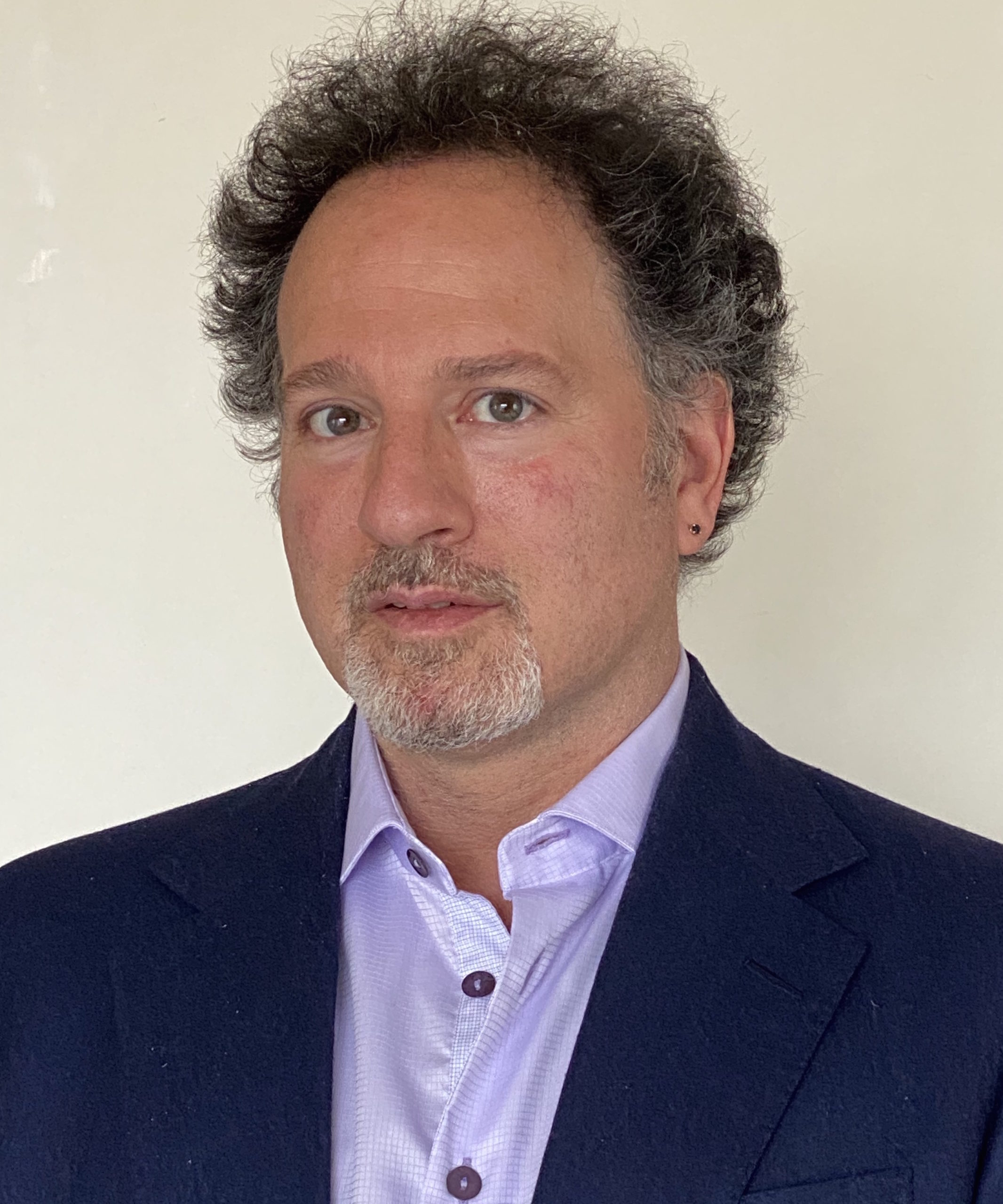
Zachary Karabell