Volcanoes are erupting in The Philippines, but on-fire Australia received some welcome rain. The Iran war cries have been called off and The Donald’s military powers are about to be hamstrung by the Senate. Meanwhile, his impeachment trial is starting, and we’re all on Twitter for a front-row seat.

What Could Go Right? The Third Psychedelic Renaissance
Has reached the White House

Emma Varvaloucas
This is our weekly newsletter, What Could Go Right? Sign up here to receive it in your inbox every Thursday at 5am ET. You can read past issues here.
The Third Psychedelic Renaissance
Around the time that then-President Richard Nixon declared drug abuse to be America’s “Public Enemy No. 1” and the counterculture icon Timothy Leary its “most dangerous man,” one bet I’m sure no one would have taken is that 50 years later, a Republican White House would endorse the fast-tracking of medical research related to psychedelics-based treatment.
Yet, that is the aim of the executive order signed by the current president this past weekend. It follows a similar one in December that directed the attorney general to reclassify marijuana and cannabidiol (you may recognize it by its acronym, CBD).
And while the latter, a process begun by the Biden administration, has since stalled out as a result of the DEA’s “vehement” opposition to it, the former actually has legs.
Indigenous cultures have used psychedelics in rituals and ceremonies for centuries, of course. But after a flurry of interest in the years preceding the day-glo 1960s, psychedelics’ potential in the United States was cut short by the Controlled Substances Act, passed in 1970, which first classified psychedelics such as LSD, psilocybin, and peyote, but also marijuana, as Schedule 1 substances—unsafe under all circumstances and with no redeeming medical benefit.
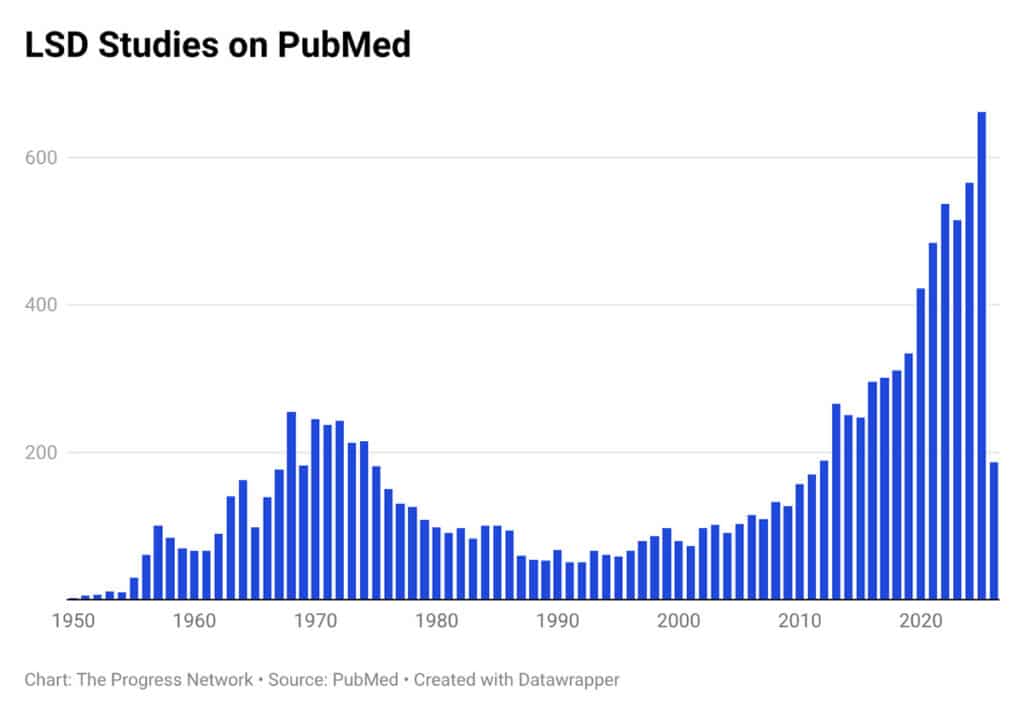
This quashed scientific inquiry for decades. It only picked up again early this millennium, before surpassing 1970s-levels in the past few years.
This research has upended long-held assumptions—at least in the political mainstream—about the therapeutic potential of psychedelics. (I used to run editorial at a Buddhist magazine, so let’s just say that for some of us, discussing what psychedelics can do is about as new as a wooden spoon.)
The order specifically mentions ibogaine, for instance—a plant-based psychoactive substance that Joe Rogan has championed on his massively popular podcast—which has been shown to help people recover from PTSD and overcome opioid and cocaine addiction. Ibogaine treatment centers in Mexico are popular with American veterans; they exist in Germany, as well. In other countries, the drug can be prescribed for addiction. Meanwhile, Colorado is currently considering whether to integrate it into already existing psychedelic therapy centers, and the commissioner of the FDA said that the new executive order will pave the way for human trials in the States.
Drugs that are further along in the trial process may receive FDA priority designation as early as this week. One candidate, COMP360, uses a synthetic form of psilocybin—the stuff in magic mushrooms that makes them so magical—to ameliorate treatment-resistant depression. Another, Definium, is an LSD synthetic that relieves anxiety symptoms.
Along with getting certain treatments in the FDA fast lane, the order also asks that federal agencies review all enforcement laws governing any drugs that show promise in late-stage trials, instructs them to allow early access to patients with life-threatening conditions under right-to-try laws, and allocates $50 million to states for psychedelic treatment programs.
The saying goes that history repeats itself, but a half-century later, we seem to have arrived at its inverse, at least politically speaking.
Meanwhile, the research continues. In addition to mood and anxiety disorders, scientists are studying psychedelics’ pain-relieving properties as well as their side effects and when they might be contraindicated. And as Americans have begun to view them more favorably, usage has surged. In fact, more Americans now microdose than smoke cigars.
It’s as Trump summed up at the order’s signing: “I never heard anything about it in the past,” he said, referring to ibogaine. “It was almost like, taboo. It’s not taboo anymore.”
—Emma Varvaloucas
P.S. Missed our edition last week about Hungary’s democratic win? It’s now available as a podcast! Watch or listen here.
What Could Go Right? S8 E2: Is the World Order Actually Disintegrating? | with Ian Bremmer

What happens when the rules of the global game are being rewritten in real-time? Ian Bremmer, the founder of Eurasia Group and GZERO Media, joins host Zachary Karabell to discuss how to navigate a world defined by a “long geopolitical recession” and the erosion of the post-1945 order. | Listen now
By the Numbers
1.9%: Drop in Japan’s greenhouse gas emissions in FY 2024, bringing them to a record low
16%: Paraguay’s poverty rate in 2025, down from 50% two decades ago
47M: Number of galaxies and quasars mapped on the most detailed survey of the universe to date
81%: Share of Indian households with tap water, up from 17% in 2019
Go Figure
Once-parched San Diego County is free to hydrate once again, after having pretty much achieved “water independence.” So complete is the reversal that deals are in the works to sell its excess H₂O to still-thirsty Arizona and Nevada. Shower credit on a decades-long effort to decrease usage and expand storage capacity, plus a state-of-the-art desalination plant and, yes, even a little sewage treatment.
Quick Hits
🚀 NASA is aiming to build the first nuclear reactor-powered interplanetary spacecraft and get to Mars with it by 2028. The timeline is ambitious, but the technology is feasible.
🔬 Scientists have taken a first step toward breaking transplant patients’ dependence on immunosuppressants, by infusing them with certain cells taken from the donor pre-surgery that teach the body to not reject the transplant.
🐋 Sightings of humpback whale “super groups”—20 or more of the mammals—are skyrocketing now that humpbacks are recovering from the industrial whaling of the 20th century.
💊 A group of new treatments is the first real change in pancreatic cancer in years: one drug doubles survival compared to patients receiving chemotherapy; another shrinks tumors in half. Last, an mRNA vaccine keeps patients alive for years longer than standard prognoses.
🍌 A non-browning banana, the first new variety in 75 years, is coming to Brazil and Japan. The fruit’s “browning gene” has been turned off, so it stays fresher for longer and cuts food waste.
📈 The share of renewables in global power generation hit nearly 34% in 2025, rising above a third—and overtaking coal—for the first time.
🔋 The stage is set for a wave of mega battery installations on the global grid this year. The rapid growth has been fueled by falling costs, growing energy demand from data centers, and now, fuel disruptions.
🦠 New research suggests that many humans have an immunity to H5N1 bird flu, a strain with potential to trigger a global pandemic.
🧑🎓 In the US, reenrollment rates of college “stopouts” are rising. Working-age adults who left school before finishing are being lured back by new college- and state-run programs.
👀 What we’re watching: A Finnish startup says it has developed the holy grail of electric car batteries.
💡 Editor’s pick: Historically, presidential attacks on the Supreme Court have served only to make it stronger.
TPN Member Originals
(Who are our Members? Get to know them.)
- Moving on from Trump | The Renovator | Danielle Allen
- Evolution explains the human condition | Persuasion | Steven Pinker
- The Washington Post’s optimistic read on aid cuts doesn’t hold up | CGD | Charles Kenny
- Does Project Hail Mary help Project Up Wing? | Faster, Please! | James Pethokoukis
- Meaningful coincidences are signs of hope | WaPo ($) | Theodore R. Johnson
- Why reactionaries are taking over the world | The Atlantic ($) | David Brooks
- The future does not belong to America or China | FP | Parag Khanna
- Kim Jong Un’s winning nuclear bet | GZERO | Ian Bremmer
- Digital and real life don’t have to be at war | Flourishing Friday | Clay Routledge
- College won’t get fixed. But it also won’t disappear. | TFP ($) | Tyler Cowen