
Volcanoes are erupting in The Philippines, but on-fire Australia received some welcome rain. The Iran war cries have been called off and The Donald’s military powers are about to be hamstrung by the Senate. Meanwhile, his impeachment trial is starting, and we’re all on Twitter for a front-row seat.

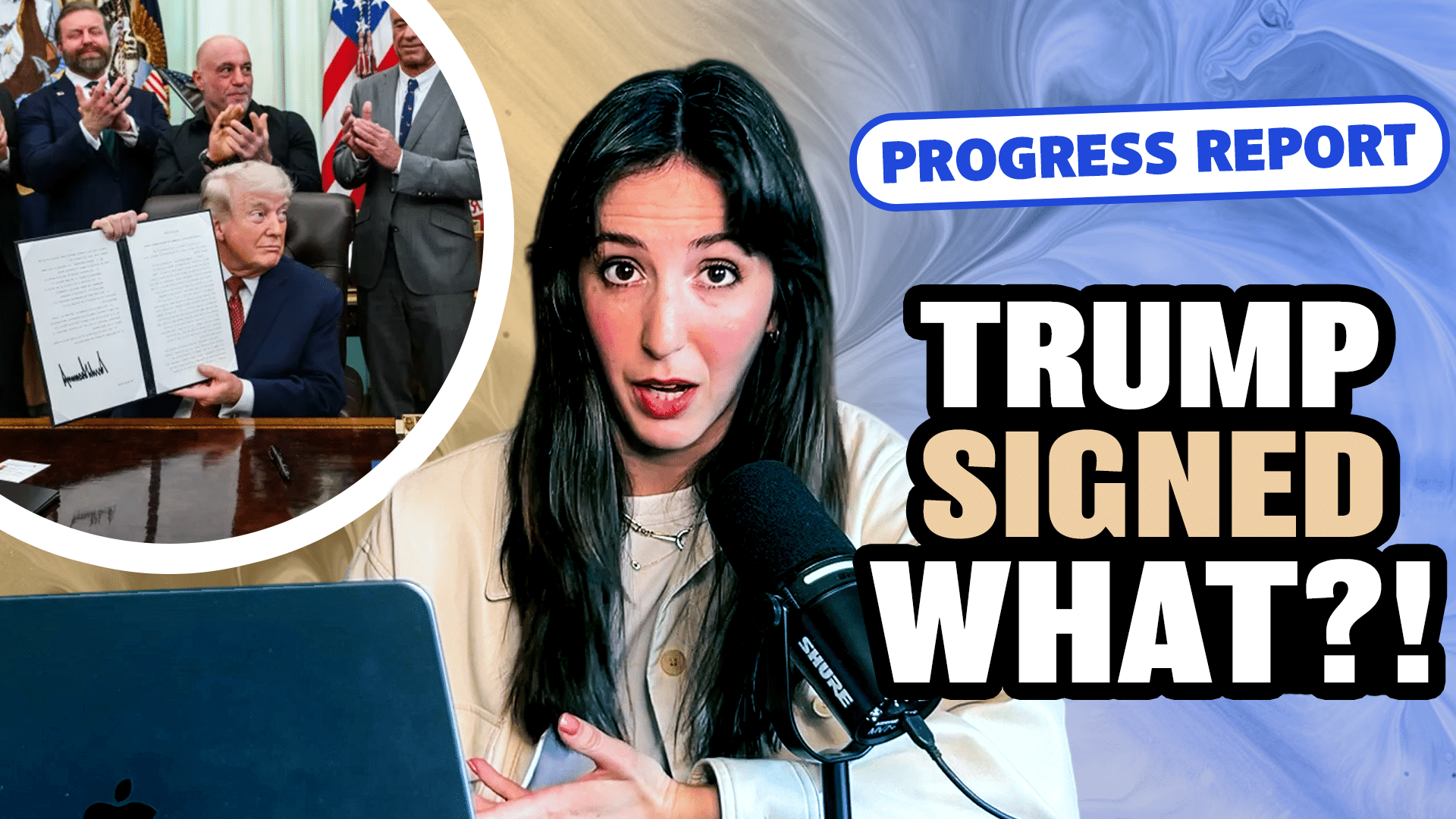
Trump’s Surprising Move on Psychedelics
Featuring Emma Varvaloucas
Trump just signed an executive order to fast-track psychedelic medical research. Emma Varvaloucas, the Executive Director of The Progress Network, breaks down how a 50-year political taboo went mainstream.
Plus: San Diego achieves water independence and starts brewing beer from recycled sewage, a humpback whale stampede breaks a sighting record off South Africa, and gene-edited bananas that don’t turn brown are finally here.


Prefer to read? Check out the Audio Transcript
Although the transcription is largely accurate, in some cases it may be incomplete or inaccurate due to inaudible passages or transcription software errors.
Emma Varvaloucas: Welcome to the What Could Go Right Progress Report, where we dive into all of the good news that I’m sure you missed because it was buried under the tsunami of bad news. If you’re new here, Hey, I’m Emma Varvaloucas. I’m the Executive director of The Progress Network, and here’s what we’re gonna be covering today.
Have you ever heard of something and thought to yourself, there is no way that this is real? Well, that was my reaction when I saw the headline that Trump had signed an executive order to fast track medical research on psychedelics.
President Trump: An 80 to 90% reduction in symptoms of depression and anxiety within one month.
Can I have some, please? I’ll take some.
Emma Varvaloucas: Unsurprisingly, that video spread like wildfire. So in this episode, I’m gonna break down what happened, why it’s actually a yuge deal, and what it tells us about shifting attitudes around mental health treatment. We’ve also got a story that’s definitely gonna make you smile about humpback whales, how San Diego turned itself into an epicenter for water conservation—so much so that they actually are brewing beer out of recycled sewage—and a gene edited banana that doesn’t turn brown.
Stay for the banana, ‘cause it would stay for you. Let’s get into the good stuff.
To understand why this executive order is such a strange but significant moment, we need to back up and give a little history.
In the early 1970s, president Richard Nixon declared drug abuse to be…
Richard Nixon: America’s public enemy number one.
Emma Varvaloucas: The Controlled Substances Act, which was passed in 1970, classified most psychedelics like LSD, psilocybin, peyote, and marijuana as Schedule One substances. The official position: These drugs were unsafe under any circumstances and had zero legitimate medical use.
That classification effectively shut down scientific research into psychedelics for decades, and it held largely unchallenged for 50 years. Until now. President Trump just signed an executive order directing federal agencies to fast track medical research related to psychedelic treatments and reconsider enforcement laws around any that have potential.
So what’s driving this? A few things. First, the science: the order specifically mentions ibogaine. It’s a plant-based psychoactive substance that has shown real promise in helping people recover from PTSD and overcome opioid and cocaine addiction. Veterans have been traveling for years to get ibogaine treatment in centers in Mexico because they can’t access it in the US.
Colorado is currently weighing whether or not to integrate it into existing psychedelic therapy centers there, and the commissioner of the FDA said that the new executive order will pave the way for human trials in the states. Pretty exciting stuff. Meanwhile, two other drugs may get priority attention from the FDA. One is a synthetic form of psilocybin, the thing that makes magical mushrooms so magical. It’s used to treat severe treatment resistant depression. Another is an LSD synthetic that relieves anxiety symptoms.
Second driver: cultural momentum. At some point in the last few years, psychedelics quietly became kind of mainstream. Joe Rogan, who has a massive platform and a friendly relationship with Trump, has been a vocal champion of ibogaine.
Specifically celebrities talk openly about ketamine therapy.
Sharon Osborne: I had ketamine treatment!
Emma Varvaloucas: And more Americans now microdose than smoke cigars. I promise I’m not making that up. That’s a real statistic.
Third, the mental health crisis. The US is facing an epidemic of depression, anxiety, PTSD and addiction.
Conventional treatments work for a lot of people, but they don’t work for everyone. Psychedelics represents a genuinely different solution that the world is ready for—well, at least the Trump administration thinks so. This quote from Trump kind of sums it up. This is what he said about ibogaine: “I never heard anything about it in the past. It was almost like, taboo. It’s not taboo anymore.”
I wanna highlight that that’s what this new executive order represents: a 50-year political taboo, cracking open.
Before we get into our shorter stories, here are some numbers that will make you smile
1.9%. That’s the drop in Japan’s greenhouse gas emissions in fiscal year 2024, bringing them to a record low.
16%. That’s Paraguay’s poverty rate in 2025, which sounds high until you learn that it’s down from 50% two decades ago.
47 million: Number of galaxies and quasars mapped on the most detailed survey of the universe to date, which was just completed.
And last but not least, 81%: share of Indian households that now have tap water, up from 17% in 2019. That is incredibly fast.
And upwards and onwards to our quick hits. Apparently, all those shorter showers that you were taking in an effort to save the world actually worked—well, at least for San Diego. They’ve reached water independence by cutting their water use 50% over the past 25 years, and now there’s a new deal in the works to sell its excess H2O to still-thirsty Arizona and Nevada.
They’re so into the idea of letting nothing go to waste, that they’ve even started to brew beer from recycled sewage. Wait before you throw up in your mouth—unless you have already—let me explain.
The city has branded their recycled water as Pure Water San Diego. Genius branding move, in my opinion, and it’s apparently a hit with local craft breweries because of its low mineral content.
One beer that it’s made with is AleSmith Brewing Companies sold out Re:Beer, which they describe as a crisp, dry hopped lager, to which I would add, including notes of something a little too questionably funky. Just jokes. I haven’t actually tried their beer. It might taste delicious. It might taste like sewage. You won’t know until you try it. And if you do try it, let me know, ‘cause I’m kind of curious.
Our next story is a sweet one. It’s kind of a smelly one, actually. The humpback whales are back, baby! 512 of them were just sighted on two consecutive days off the west coast of South Africa, with 304 seen on just one day.
We’re getting specific, because that breaks the record for the biggest number of large whales ever identified in one day. Not that anyone’s counting. (Clearly they’ve been counting.) This is welcome news from marine conservation, though, because it signals that the once endangered species is recovering from the industrial whaling of the 20th century that nearly totally wiped them out.
What’s wild is that when a whale blows, the spray can rise 23 feet in the air. And the photographer who spotted the incredible sight said that when 200 humpback whales are together, it looks like a Manhattan skyscraper skyline. Just to extrapolate on the sensory details for a moment, apparently you can spot humpback whales, not only with your eyes, but also with your nose.
Who knew? But whales burp and fart all the time. And the photographers who captured the hundreds of whales seen describe the smell as very pungent and fishy. To be fair, I guess if I were the size of a school bus, my gas would also be uncontrollable and lethal.
And for our final story, I know you’ve been patiently waiting, the non browning banana is here.
You say banana. I say ba-nah-na. The agricultural biotech company Tropic says that it’s the world’s fourth most important crop and central to global food security. They’ve been busy creating the first new banana varieties that the world has seen in 75 years, and there are three. The first banana variety stays all fresh and yellow looking long after you peel and slice it.
This helps a lot, the company says, to reduce spoilage across retail, food service, and supply chains. The second banana variety extends the shelf life of the bananas in the peel by 12 days, cutting down significantly on food waste. And the third, coming in 2027, will be resistant to a common banana killer.
I know that some people have complicated feelings about gene editing, but rest assured that these bananas are still 100% banana. The banana scientists basically just turned off the browning gene. They haven’t added any foreign material. Personally, I cannot wait to not feel the insufferable pressure to not make banana bread. We’ve all been there, right?
I hope these stories remind you that there’s so much good out there in the world, so it’s important not to be blinded by all the bad. So if you got some value from this show, maybe something you could bring up at your next Heated Rivalry rewatch, send this show to a friend who could really use some positive news and make sure to like and subscribe to our YouTube channel.
Follow us on your preferred podcast platform and leave us a review. And if you’d like more of these stories delivered straight to your inbox, sign up for our newsletter. The link is in the description. Thanks so much for watching and see you next week on the Progress Report.
LOAD MORE
Meet the Hosts
Emma Varvaloucas