
Volcanoes are erupting in The Philippines, but on-fire Australia received some welcome rain. The Iran war cries have been called off and The Donald’s military powers are about to be hamstrung by the Senate. Meanwhile, his impeachment trial is starting, and we’re all on Twitter for a front-row seat.

What Could Go Right? A Mystery from 79 AD, Solved
The epic intellectual treasure hunt to read the only library to survive from the time of Pompeii

Emma Varvaloucas
This is our weekly newsletter, What Could Go Right? Sign up here to receive it in your inbox every Thursday at 5am ET. You can read past issues here.
A Mystery from 79 AD, Solved

When Mount Vesuvius erupted 2,000 years ago, Pompeii wasn’t the only Roman city it ravaged. Just a couple hours’ chariot ride away, Herculaneum was also buried—under 50 feet of volcanic ash that similarly preserved its buildings and artifacts underneath.
One of those buildings was the Villa of the Papyri, a massive waterfront structure likely owned by Julius Caesar’s father-in-law that was home to the lone library from that time to survive. Comprising thousands of papyrus scrolls, scholars believe it is a trove of ancient plays, poetry, and philosophy, and may hold unknown works by the likes of Sappho, Sophocles, and Aristotle.
“Believe,” because while we’ve known about this gold mine of historical riches since excavators first discovered it in 1750, we’ve never been able to confirm its contents. Although the interiors of the scrolls are essentially intact, their exteriors were carbonized by Vesuvius’ scorching-hot gas blast; over the years, attempts to open the scrolls resulted in their destruction. So what’s inside this ancient library has largely remained a mystery since at least 79 AD.
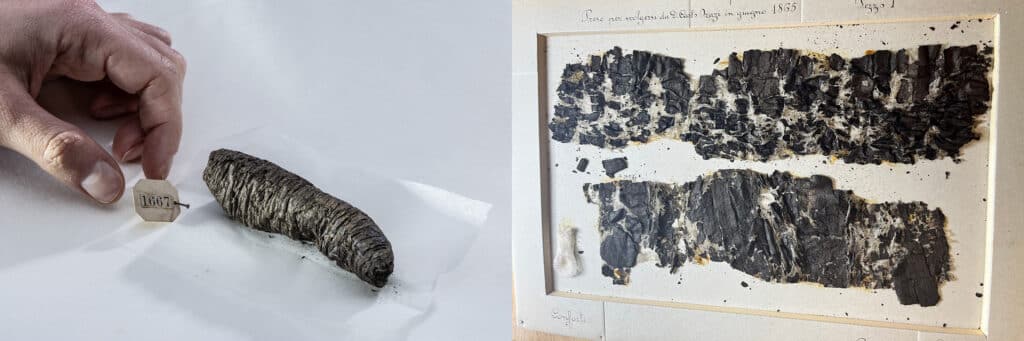
That began to change in 2023, when citizen scientists responded to an online challenge to see if any at-home geniuses could develop a way to render text from a sample of X-ray scanned scrolls. They could—dozens of columns of it—by using an AI-based technology that can detect ink patterns from the inside of a rolled-up papyrus. That included the very first entire word read from the inside of a Herculaneum scroll: “purple.”
I first wrote about the scrolls in this newsletter then, and again in May 2025, when dozens of them were on their way to France to be scanned in high, high, high definition (that’s not an exaggeration; the scanning requires a particle accelerator). At the time, I wrote, “After the scanning comes the decoding, which is slow going. No scroll has yet to be fully decoded.”
Until now! In late June, researchers announced that the first scroll, referred to as PHerc. 1667, had been virtually unwrapped and read in its entirety.
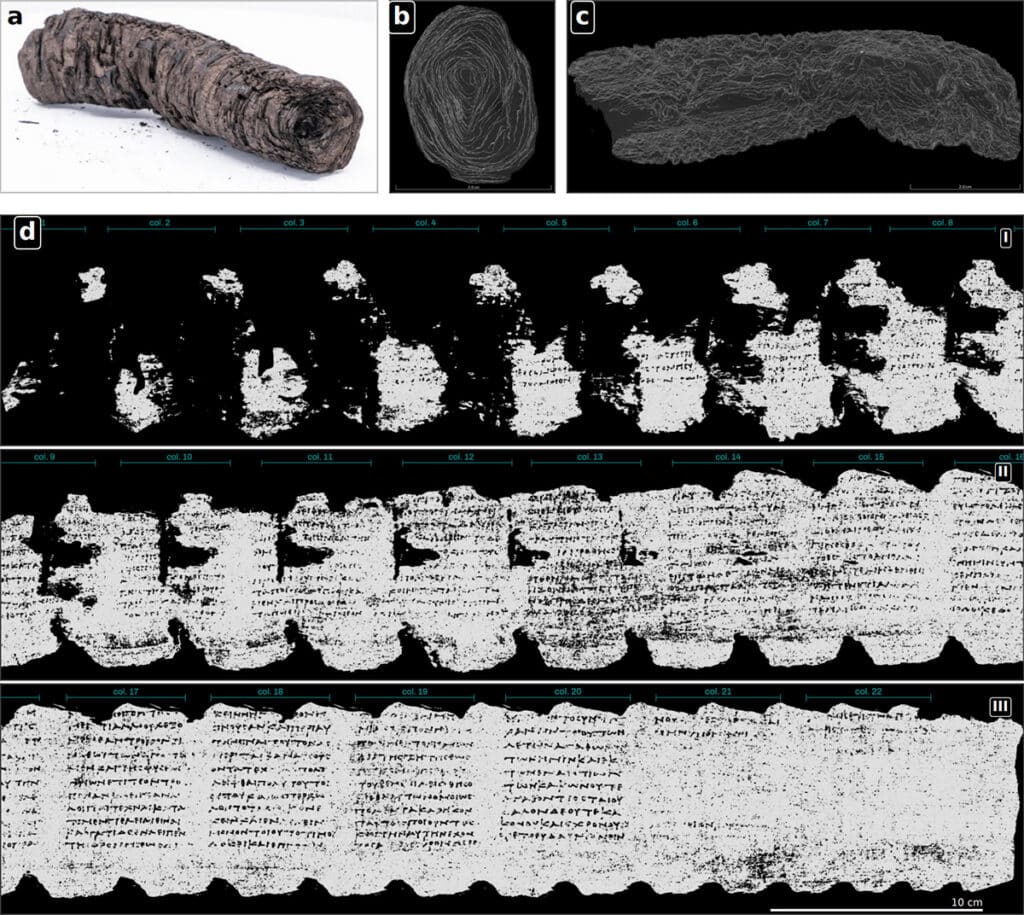
Granted, its “entirety” is somewhat limited: Several layers were ruined sometime in the 19th century, as well as in the 1960s and ’80s, when conservators tried to physically open the scroll. It was subsequently assigned a readability score of zero, according to Federica Nicolardi, assistant professor in papyrology at the Università degli Studi di Napoli Federico II.
After all that, what was left of the papyrus surface inside is about the size of an A3 sheet of paper. It’s also damaged in places, and the ink degraded in others, so the text isn’t complete. Still, the team behind this accomplishment has identified PHerc. 1667 as the “lower portions of the final columns of a philosophical treatise.” Specifically, one on ethical theory, likely having to do with the “moral perfectibility of human beings,” a favorite of the Hellenistic philosophers. That we’re now able to follow an argument across multiple columns of text instead of select words or fragments is a “transformational shift,” said Nicolardi in a press release.
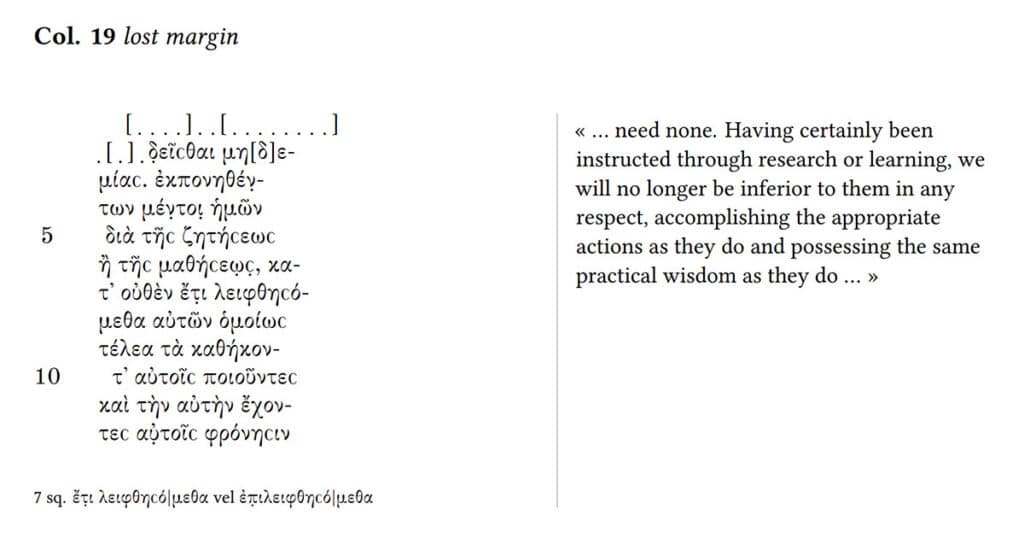
For example, one column of the treatise, as translated by a committee of eight papyrologists, goes like this:
While the author of PHerc. 1667 is still unknown, the current theory is that it’s Chrysippus, the third head of the Stoic school, perhaps better known as the guy who died laughing at his own joke. (If it’s true, not a bad way to go.) On a more serious note, much of the philosopher’s writings didn’t survive, so to find one that might be his is exciting. “This is not just a technical recovery—it’s the return of a philosophical voice,” said Nicolardi.
Along with PHerc. 1667’s full reading, the team was able to pull another scroll’s metadata—title, author, and book number—from the ancient Roman equivalent of a title page, which allows works to be identified even when the body text has been lost. A third new process renders the ink “directly visible inside the scroll itself,” as part of the 3D X-ray data, so patterns can be independently verified outside of the machine learning model that extrapolates them. (Good news: the two methods matched up.)
The bottom line is that it’s no longer a question of whether the secrets of the Herculaneum scrolls can be revealed. Instead, it’s how “broadly, robustly, and efficiently” this end-to-end workflow “can be extended across the still-unopened library,” as the team writes. That depends in part on the condition of each remaining scroll, of which hundreds have already been excavated. The work is still slow going—PHerc. 1667 alone required 775 hours of manual annotation.
But, after 2,000 years of waiting, reading this ancient library is now much more a matter of time than possibility. If it’s achieved, it could be the largest discovery from the ancient world ever made.
—Emma Varvaloucas
What Could Go Right? S8 E14: The Era of Mass Incarceration May Actually Be Ending | with Alex Duran

Alex Duran spent 12 years in New York maximum security prisons before earning a liberal arts degree through the Bard College Prison Initiative. Today, he leads the criminal justice portfolio at Galaxy Gives. He joins host Zachary Karabell to discuss his surreal personal journey from Rikers Island to the world of high level philanthropy. | Listen now
By the Numbers
51M: Estimated number of lives saved by vaccines in Africa over the past five decades
10%: Older Americans with dementia, down from 30% 40 years ago
3.65M: Number of heat pumps purchased in the US in 2025, nearly outselling conventional air conditioners
44%: Estimated climb in global nuclear capacity over the next decade
10K: Population of Taiwan’s mangrove land crab, which doubled after safety measures were put into place to protect its migratory path during breeding season
Go Figure
We cannot stop battling deforestation—especially in the Amazon—but it’s worth remembering that forestation also can and does happen. In fact, the woodland comeback taking place in the northeast US is the “greatest forest recovery in the history of the world,” according to a scientist who would know.
Quick Hits
⚡ The US will still retain about two-thirds of new clean energy capacity and emissions reductions in the power sector despite the rescission of Biden-era climate legislation, a new study found.
📉 Infant deaths have declined significantly in India over the past decade, with some states approaching developed-world child survival rates.
💰 The world continues to grow richer, with only 11% of countries now classified as low income. Related: There has been a 40% drop in the number of economies with high inequality over the past three decades, according to the World Bank.
👁️ Resuscitated human retinas responded to light 10 hours after death, a doubling of the previous record and a significant step toward sight-restoring eye transplants. Obstacles, such as regrowing the optic nerve, however, remain.
👏 Cambodia is the first country in the Asia-Pacific to achieve the global HIV-related targetsof 95% of people living with HIV diagnosed, 95% of those on treatment, and 95% of those virally suppressed.
🚀 China and Japan have each reported the safe landing of reusable rockets, in ongoing attempts to match the cost-cutting achieved primarily by Elon Musk’s SpaceX.
📺 Hungary has begun to reform its public service media, for decades a propaganda arm of the Orbán regime.To mark the overhaul, last week, all public radio and television stations published a black screen and an apology for four hours before resuming broadcasting.
🦈 Drones are less of a nuisance and more of a life-saver on Australia’s beaches, where they scan for sharks and even fly into the water to alert swimmers of their presence.
🤖 Engineers have developed a robot that can swim underwater then emerge to fly through the air, mimicking diving birds like gulls and puffins. The “aerial-aquatic vehicle” may one day be used for exploration in spots inaccessible to traditional ocean vessels.
👀 What we’re watching: For the first time since the country banned child marriage, Sierra Leone is bringing alleged perpetrators of the crime to trial.
💡 Editor’s pick: After years of trying to understand why Americans are so down about the economy, The Atlantic’s Annie Lowrey changed her mind about the cause: it’s a vibes problem, not an economic one, she argues.
TPN Member Originals
(Who are our Members? Get to know them.)
- Wall Street on SpaceX: ‘Everything depends on Starship.’ And they’re right | Faster, Please! | James Pethokoukis
- Regime change | The Preamble | Sharon McMahon
- The Resistance’s favorite poker metaphor makes no sense | Slow Boring | Matthew Yglesias
- When corruption is a family affair | Lucid | Ruth Ben-Ghiat
- The US will pay for the chain reaction Trump set off in NATO | WaPo ($) | Fareed Zakaria