
Volcanoes are erupting in The Philippines, but on-fire Australia received some welcome rain. The Iran war cries have been called off and The Donald’s military powers are about to be hamstrung by the Senate. Meanwhile, his impeachment trial is starting, and we’re all on Twitter for a front-row seat.

What Could Go Right? A Single Strand of Hair
A tiny detail in an upcoming movie reveals how far animation has come.

Emma Varvaloucas
This is our weekly newsletter, What Could Go Right? Sign up here to receive it in your inbox every Thursday at 5am ET. You can read past issues here.
The Progress in a Single Strand of Hair
About thirty years ago, a small computer graphics studio in Richmond, California, was struggling. Financial losses had forced a sell-off of the company’s hardware division. More than half of its employees had been sacked. The owner, a tech entrepreneur busy with other projects, was trying to find a buyer even as the company locked down the biggest animation deal it had ever signed.
Then came a film that would stun audiences and transform the industry forever: Toy Story, the world’s first CGI-animated feature. The company was, of course, Pixar, and with the winds of considerable critical and commercial success at its back, its owner, Steve Jobs, suddenly reconsidered his decision to sell.
Since then, a lot has changed in the animation world, even as Pixar has continued to ride . . . and ride . . . and ride its breakout hit. Putting aside the debate over whether Pixar is what it used to be, the studio does continue to reliably push industry boundaries—even on a fourth recycling of the same story; Toy Story 5 comes to theaters next week. (Those looking for a riskier move will have to wait until 2027 for Gatto, a reinvention of the studio’s signature visual style.)
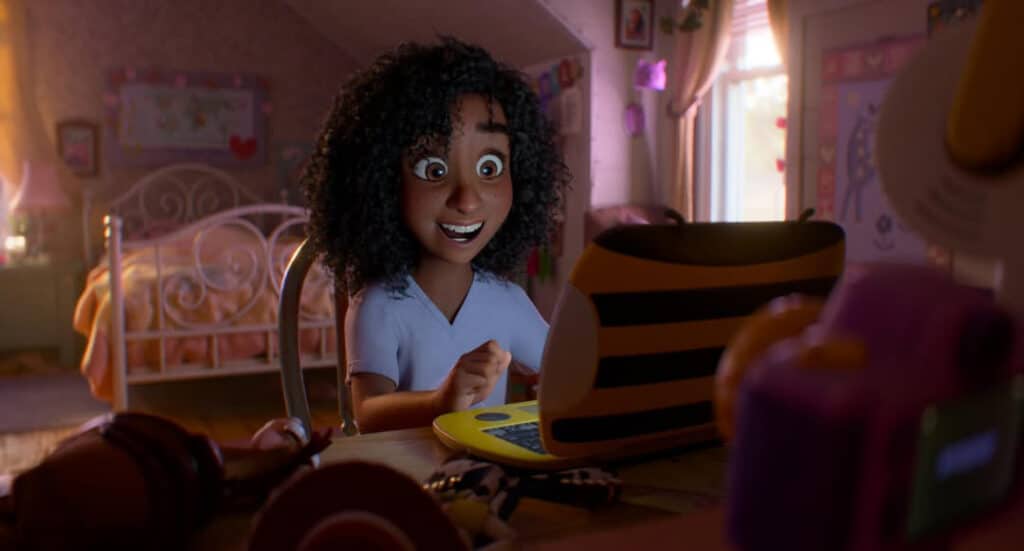
If you go to see the latest Toy Story, pay special attention to a new character, Blaze. She’s a half-Black, half-Armenian eight-year-old, with long, curly, extraordinarily detailed hair that has already brought the internet to tears. Really.
So what’s the big deal about the hair?
Hair is hard to animate. Think of each individual strand as a tiny, independent object that needs to interact naturally with the countless other strands on our heads—not to mention with body movement, clothing, the elements, and so on—and you see the problem. It also takes a ton of computing power. In 1995, Toy Story was an enormous technological leap forward, but the characters’ hair looked like this:
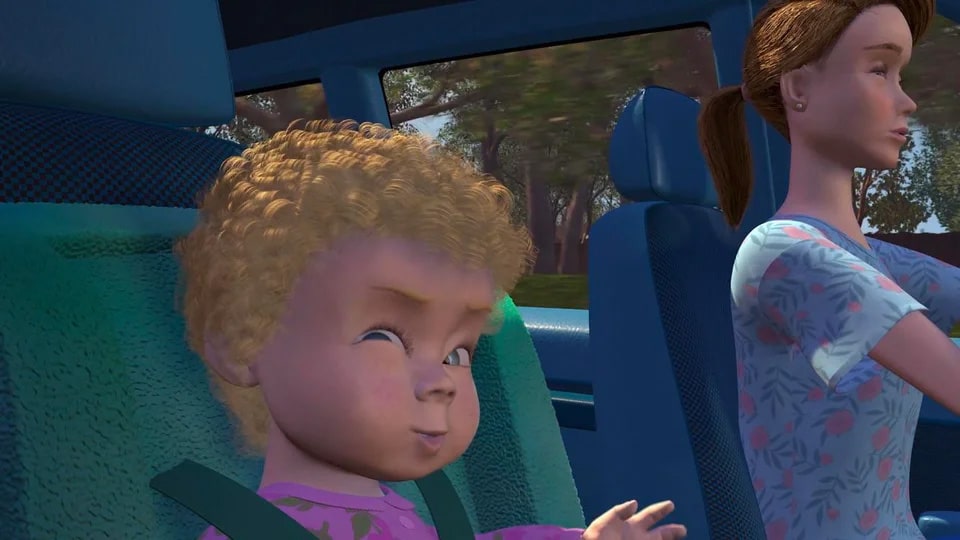
The difficulty of animating hair is a big reason why Tangled, Walt Disney’s 2010 retelling of the Rapunzel fairy tale, was at the time the most expensive animated film ever made. And Rapunzel’s hair was pretty darn straight.
Curly hair is another beast entirely. Pixar tackled it first in 2012’s Brave. The process of developing the fiery-red curls of the spirited Scottish princess at its center, Merida, took three to four years and included the close study of real curly-haired people, who visited the studio so the animators could scrutinize the movement of their manes. The result was fantastic, but it required lots of hand animation: Merida’s mop was made up of more than 1,500 individually sculpted curls.
As curly-hair technology evolved, room opened up for people of color to take center stage. After tackling the hair challenges of Tangled and Frozen—that one made complex by the Scandinavian braids and near-constant presence of snow—Disney next took on the waves of a Polynesian chieftain’s daughter in 2016’s Moana and the bouncy bob of Colombian girl Mirabel Madrigal in 2021’s Encanto. Moana was the first Disney movie to feature curly, dark hair, and Encanto the first with all 12 hair types, from the pin-straight 1A to the dense coils of 4C.
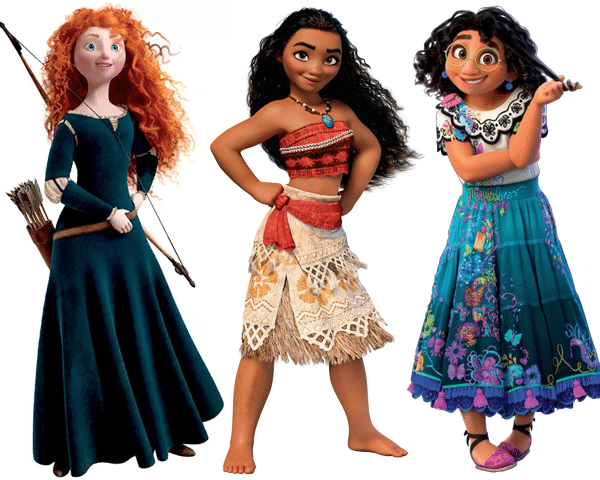
But from Merida to Mirabel, the curls of all of these main characters have been relatively loose. Blaze’s curls are the much tighter type 4. They were made possible by a newly built system that uses a physics simulator to model hair’s natural movement; rather than the hair itself being animated, the character’s head is, and the hair responds. As Pixar VFX supervisor Thomas Jordan explained, “each curve or curl knows about one another, so that they can bounce and collide off of each other.” It’s super neat! Have a look:
It also means that Pixar is setting themselves up to include a greater variety of high-quality hairstyles in the future, opening up avenues for storytelling and perhaps finally reflecting the country’s—and the world’s—full diversity. Judging by the comments on this video, plenty of curly-haired people are already quite moved by the thought of seeing their tresses represented with such sophistication on the big screen.
And they won’t be the only ones that will see their hair situation depicted for the first time in Pixar’s most famous franchise: Woody, I regret to announce, has a bald spot.
—Emma Varvaloucas
What Could Go Right? S8 E9: Surviving the 80-Year Cycle of American Crises | with Anthony Scaramucci

Famous for his turbulent eleven-day stint in the Trump White House, Anthony Scaramucci joins Zachary to ask the big questions: Are we just trapped in a predictable 80-year cycle of national crisis? And if so, how do we push through the chaos to reach an era of renewal? Moving past the usual partisan talking points, the two discuss the future of the Republican party, the heavily debated utility of cryptocurrency, and the responsibility of the wealthy. | Listen now
By the Numbers
16%: Decrease in “deaths of despair“ in the US between 2021 and 2024
16.9: Gigawatts of solar panels imported by Pakistan in 2025, effectively making it the world’s No. 1 solar importer
7 in 10: Share of American cancer patients that now survive at least five years, up from less than half in the 1970s
260K: Estimated number of premature deaths from pollution prevented by EV adoption in China
Go Figure
The Dutch once again top the developed-world ranking of childhood happiness. Credited causes include strong social connections, a focus on personal autonomy, gender equality, greater parental availability as a result of less work time and, yes, a blanket ban on smartphones in schools.
Quick Hits
🧑🦼 It’s boom times for accessible adventure travel as opportunities for people with disabilities expand, from off-roading to white-water rafting to paragliding. (NYT $)
✈️ Meanwhile, a growing African middle class is exploring the continent for the first time, shifting travel from luxury good to everyday part of life.
🌏 The world has been gaining more mangrove forests than losing them since 2010, an unexpected change driven by legal protections and increased public awareness of their importance in soaking up planet-warming gases.
🧠 Twenty-one people have now been implanted with Neuralink, a brain interface that allows those with debilitating diseases to control a computer with their thoughts.
💉 AI has been used for the first time to create a new type of vaccine that gives protection against a family of viruses rather than a single strain.
🏳️🌈 Hungarian police have approved Budapest’s Pride march this year, a reversal of a crackdown on LGBTQ rights by former Prime Minister Viktor Orbán. Charges have also been dropped against the city’s mayor, who held the parade last year despite an official ban.
👩🍼 Japan’s youngest female mayor will become the nation’s first elected official to take maternity leave. Shoko Kawata, who plans to take 16 weeks, hopes her decision will be a “catalyst for changing the system.”
🕷️ An expedition to a remote plateau in eastern Angola has yielded dozens of species potentially unknown to science, including a fluorescent spider and another that mimics the appearance of a toxic insect in order to deter predators.
🚘 In Ethiopia, the share of electric vehicles now rivals that of the EU, after the African nation became the first in the world to ban the import of gas and diesel cars in early 2024.
🫁 A set of proteins in the blood can accurately predict lung cancers more than five years before diagnosis, a research team found, and an existing anti-inflammatory drug could significantly reduce the risk of their development.
🔬 GLP-1s may protect against cancer, a growing body of research shows.
👀 What we’re watching: Scientists have precisely gene-edited embryos for the first time, engendering enthusiasm—and alarm.
💡 Editor’s pick: No, AI is not conscious.
TPN Member Originals
(Who are our Members? Get to know them.)
- Why you should be a techno-skeptic | After Babel | Jonathan Haidt
- The triumph of capital | Slow Boring | Matthew Yglesias
- The Trump savings accounts | Tangle | Isaac Saul
- Bernie’s AI fix | Diane Francis | Diane Francis
- Anthropic might be the most powerful company in the world | WaPo ($) | Zachary Karabell
- A great reverse migration is shifting the balance of power in the US | WaPo ($) | Theodore R. Johnson
- The axis of US decline: anti-data center, anti-AI, anti-nuclear | Faster, Please! | James Pethokoukis
- Human intelligence will win out over AI | WaPo ($) | Fareed Zakaria
- Optimization: Metrics maxxing | No Mercy/No Malice | Scott Galloway
- Is America’s racial reckoning over? | TFP ($) | John McWhorter
- US Supreme Court cases that could change the presidency | GZERO | Ian Bremmer