Volcanoes are erupting in The Philippines, but on-fire Australia received some welcome rain. The Iran war cries have been called off and The Donald’s military powers are about to be hamstrung by the Senate. Meanwhile, his impeachment trial is starting, and we’re all on Twitter for a front-row seat.

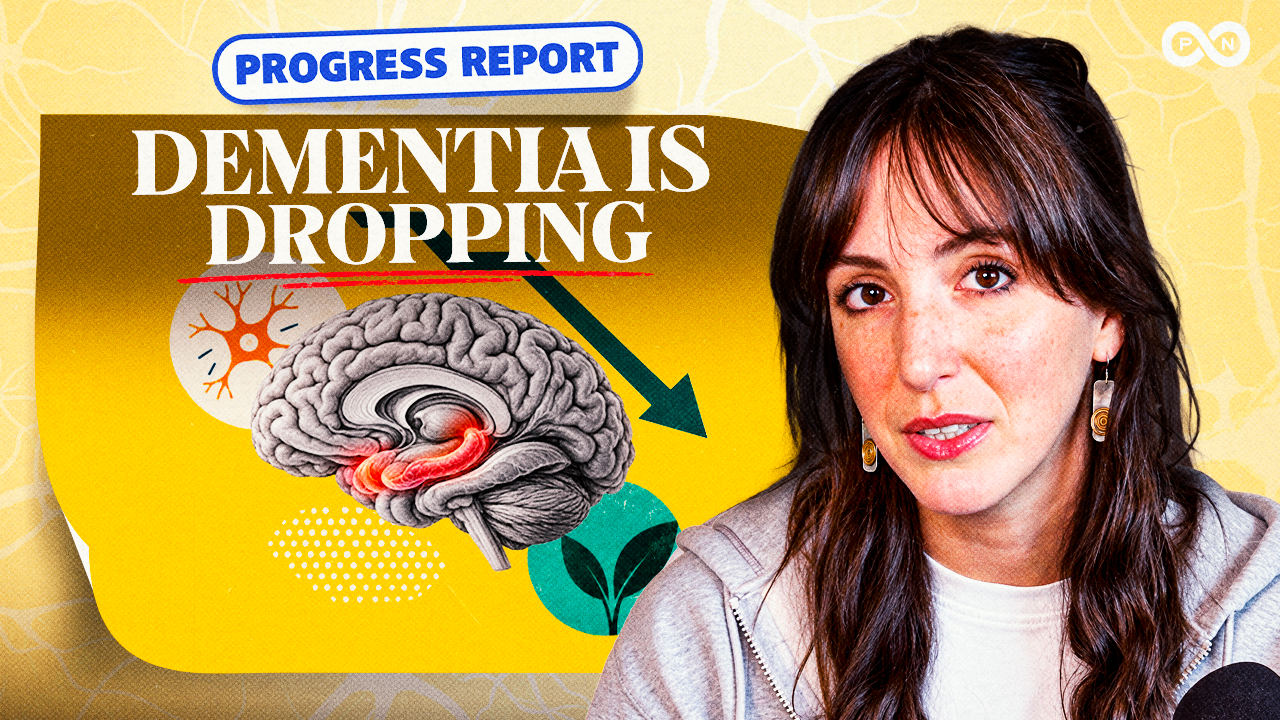
Why Scientists Are Suddenly So Optimistic About Alzheimer’s
Featuring Emma Varvaloucas
Why are researchers and doctors who treat dementia so happy right now? Experts think we’re in a new optimistic age for Alzheimer’s research with new treatments and new diagnostic tools that are changing the landscape.


Prefer to read? Check out the Audio Transcript
Although the transcription is largely accurate, in some cases it may be incomplete or inaccurate due to inaudible passages or transcription software errors.
Emma Varvaloucas: Why are researchers and doctors who treat dementia so happy right now? That’s our main story today on the What Could Go Right? progress report. And stick around because we’re also talking about batteries you can eat, and an agreement from 30 years ago that probably saved our planet. If you’re new here, hey, my name is Emma Varvaloucas, and I’m the executive director of the Progress Network.
Let’s get into it. There’s a large group of Americans who love to put the hazy positive lens of nostalgia onto our past. They think that everything was better back then, and constantly complain that the world is getting worse and the new generations are terrible. But hold on, Don Draper, a little optimism for you.
Younger generations have a big one-up on our grandparents: our brain health. Believe it or not, we are much less likely to develop dementia than the generations before us. Dementia is a term for a group of conditions that cause a loss of cognitive functioning, like thinking, memory, and mood, and eventually halt your ability to take care of yourself.
40 years ago, one in three Americans between the ages of 85 and 89 had dementia. For those of you at the back of the class during middle school math, that’s one-third or a bit over two and a half slices out of a standard pizza box. But by 2024, the rate of dementia had fallen to one in 10. Again, for the back of the class, that’s less than one slice of pizza.
As someone who has lain awake at night wondering what my brain, earlobes, and eyelid skin will be like at 87, this is amazing news. We have now entered the age of the dementia drop. And I guess we have retinol for all that other stuff. But why are we doing so much better at avoiding dementia? There are a few reasons.
We’ve got to remember what our parents and grandparents were getting up to. Let’s Open the old family album. There’s your mom fashionably smoking a cigarette in bell-bottoms. And there’s your grandpa throwing five slices of bacon on top of his eggs for the 25th day in a row. Today, we have much better ideas about smoking and cholesterol, and we collectively avoid them much more.
It does seem like bell-bottoms are back, though. Anyway, researchers say that our changes in lifestyle and nutrition have played a big part in lessening the rate of dementia in the population. There are even some medical advances that have unexpectedly reduced our risk of dementia, like the shingles vaccine, depression treatments, and treatments for vision and hearing loss.
And despite our current debates about public education and reading abilities, better schooling may have reduced the risk of dementia as well. A high school experience at a good school with good resources actually helps us maintain stronger cognitive skills as we age. We all should have moved to the front of the math class.
But scientists aren’t just letting dementia sort itself out through the generations. It’s still an urgent concern because humans are living longer than ever, and this is a condition that primarily affects elderly people. It’s estimated that 139 million people worldwide will have dementia by 2050.
Thankfully, there’s also some super good clinical news happening as we speak when it comes to the treatment of Alzheimer’s disease, the most common cause of dementia. In 2023, the drug lecanemab was the first drug approved in the US to slow the progression of Alzheimer’s. A year later, the drug donanemab was also approved.
The drugs work to clear the buildup of specific proteins called amyloid beta from the brain. And Surprising everyone, they work. They’ve been shown to slow cognitive decline in early stage Alzheimer’s by about 30%. What does that mean exactly? Research shows that in cases of very mild Alzheimer’s, lecanemab could give a patient an extra 10 months of independent living.
10 months may not seem like a lot, and scientists definitely hope to build on it, but that extra time is a big deal if you have to organize a care plan and figure out money and resources. Lecanemab does have some serious risks, to the point that at first the European Medicines Agency declined to recommend it, but it later reversed that decision.
Despite the limitations, these drugs showed that changing the course of the disease is possible, and there’s been an explosion of clinical trials for other drugs. Some of these also focus on amyloid buildup, but others target inflammation, immune dysfunction, and the loss of neurons and synapses. Just last week, researchers at UC San Diego announced that they had identified a new protein fragment called catestatin.
It could reduce the buildup of not only amyloid, but also tau proteins, which are also associated with Alzheimer’s disease. This is important because our current treatments for neurodegenerative diseases target either amyloid or tau proteins, but not both. In addition to new potential treatments, there have also been advancements in testing.
New diagnostic blood tests were approved by the FDA last year that may be able to catch Alzheimer’s up to 10 years before symptoms appear. This will help doctors start treatments earlier while cognitive impairment is still mild. All of these advancements are a huge deal, and they’ve given formerly jaded scientists an incredible surge of hope.
In the 2026 World Alzheimer’s Report, which is hot off the presses for the freaks in the audience who like that kind of thing, neuropathologist and Alzheimer’s researcher Colin Masters said, “The feeling of optimism has never been so strong. We’ve moved from a great nihilistic, pessimistic era five years ago towards an era of extreme optimism.”
But why has it taken us so long to get to this big period of hopeful change? To be honest, in terms of Alzheimer’s research, we’ve missed a lot more free throws than we’ve made. Plus, there’s been some funny business. Let’s start with the honest failures. Alzheimer’s research is just plain hard. Decades of testing have provided some new methods for symptom management, but not much else.
Between 2000 and 2020, experimental dementia drugs in clinical trials had a failure rate of more than 99%. In middle school, you would definitely be held back. And now for the funny business. The history of Alzheimer’s research is full of frauds and tricksters. There’s literally a book on it called Doctored by journalist Charles Piller.
Here are just two of the highlights. A 2006 paper published in the journal Nature turned out to have doctored images to support its results. That fraudulent paper was cited in more than 2,000 other academic papers. And in 2024, the SEC ordered the company Cassava Sciences and some of its top executives to pay more than $40 million for misleading statements about the results of a phase II clinical trial for an Alzheimer’s drug.
And there is some more recent funny business in the news. In August, it was reported that a man who developed a surgery to treat Alzheimer’s is being held by Chinese authorities for a whole year. No one knows exactly why, but many people are skeptical as to whether his surgery actually works.
Dr. Qingping Xie is a reconstructive surgeon who specializes in what’s called super microsurgery, so tiny things in the body that he operates on with a microscope. And when I say tiny, I mean tiny. Stuff that’s half of a millimeter in diameter, more or less. For those still in the back of the math class with me, to be honest, the smallest distance a school ruler can measure is one millimeter.
Anyway, in 2020, Dr. Xia operated on an elderly man, connecting the lymphatic vessels in his neck to nearby veins to improve drainage. Xia claimed that it was a medical breakthrough, and that the procedure improved the man’s dementia. The surgery started popping up all over China, with Alzheimer’s patients rushing to get it.
However, skeptics say that there’s no solid evidence that it works. The Chinese government thought it was kinda sus too, because they banned the surgery from being offered outside of clinical research. But despite the history of corruption and muddy water in Alzheimer’s research, experts believe that this time we are truly entering a historic era similar to the breakthrough years for cancer research in the 1990s.
Let’s hope by the time that I’m in my 80s, the only thing I’ll have to worry about is the price of retinol and what time The Golden Bachelor is on.
Next, here are some numbers that will make you smile. $30,000, the tuition drop for the 2027-2028 academic year at the University of Tulsa, an example of a growing number of American private colleges that are slashing costs.260,000, the number of soccer fields that fit in Norway’s new marine protected area. And $131.5 million, the amount DoorDash delivery workers in New York City will collectively receive to settle claims of non or underpayment. It’s the largest worker settlement in city history, so says Mamdani, anyway.
Here’s some good news for your gut. You might not know this, but for about a decade, scientists have been able to make digestible capsules that can monitor vital signs, deliver drugs, and even detect an overdose from inside a patient’s stomach. It sounds like something out of a James Bond movie, but it’s real.
So why aren’t these at every local doctor’s office yet? Glad you asked. Like Miss Frizzle would say, “Let’s climb on the Magic School Bus.” By the way, we’ve made some adjustments for adults. There are more cup holders, and the seats are wider and more stable for your back. We’re headed into the intestines, next to the remains of those tacos and margaritas you had last night.
Once one of these high-tech ingestible capsules is down in your stomach floating around. It’s time to get to work. If the capsule is meant to dispense medication, it does that. Or if it’s meant to sense a drug in your system, it does that. Some of the capsules are good to go on their own, but many of them need a power source to accomplish their task.
In those cases, researchers can wirelessly transmit power, which is a bit complicated since it requires an external source. Or they use small coin batteries. There’s also a problem with the coin batteries, though. If the protective coating on the outside of the battery is damaged in the GI tract, the lithium, silver oxide, or other dangerous metals the battery is made out of could leak out and cause a safety risk.
So scientists at the Massachusetts Institute of Technology wanted to figure out a way to make a safer, tiny ingestible battery that didn’t need any external power. It’s time to pull out your old periodic table. To accomplish the task, they turned to magnesium and molybdenum trioxide, which are safe for human consumption in small amounts.
Small amounts like the amount of time you can safely spend with your in-laws, or listen to slam poetry written by somebody who went to private school. Last month, scientists announced that the tiny batteries are being tested in two ways. One, they use them to power radio frequency identification tags that can transmit from the stomach.
An RFID tag is a very small barcode system that transmits data. They’re used in things like toll booths to track cars, retail stores to track inventory and goods, or road races to track runners. Yeah, the race organizers definitely knew when you took that 15-minute break in the middle of that 5K. The other way scientists tested the battery was with a capsule that was designed to produce a hunger hormone in the stomach.
Both worked. The ingestible batteries function as normal for about three days, and then performance slowly starts to decline. Then the entire battery is absorbed by the body and fully gone in a few weeks. These batteries could be easier and safer for the patient, and also create less environmental impact than traditional batteries. MIT, no notes.
And now it’s time for This Week in History with a positive story from the past. What do you know about Antarctica besides the fact that it’s the coldest place on Earth and surrounds the South Pole all the way at the bottom of the map? Maybe you think about images from the Discovery Channel or National Geographic.
Penguins, whales—both humpback whales and the Free Willy kind—by the way. Or maybe you’ve watched Mr. Beast survive 50 hours in Antarctica. But Antarctica is a lot more than a wildlife photographer’s wet dream or a challenge for a YouTube influencer. Human beings need Antarctica to survive on this planet.
The enormous ice sheet that covers Antarctica deflects a significant amount of the sun’s rays away from Earth, keeping temperatures cooler. Plus, the super cold water around the continent affects water circulation for the entire planet. So we should be pretty happy that on October 4th, 1991, a handful of countries decided to protect it against enormous pressure and keep other human beings from messing it up.
But let’s back up. This whole story starts with oil. In 1973, Arab nations in the Organization of Petroleum Exporting Countries, or OPEC, put oil restrictions on countries like the United States that supported Israel during what was known as the Yom Kippur War. The embargo caused crazy gas shortages, super high prices that were almost quadrupled in the US, and general panic about oil. This all feels very familiar. . .
Anyway, that got some countries thinking, “Hey, maybe there’s some oil over there in Antarctica.” At the time, there was no certainty that oil did exist over there, and drilling in those harsh conditions would be extremely challenging. But it did start some serious conversations.
In 1988, after six years of negotiations and stressing about what we would do if OPEC got mad again, 33 countries, including the US, signed the Antarctic Minerals Convention Treaty, which would have allowed mining and oil drilling in the region. Doesn’t seem like a great idea when the whole planet needs Antarctica, but people really wanted that oil.
But in an unexpected twist… Oil started the conversation, and oil would end it. In January of 1989, an Argentine supply vessel grounded off the Antarctic Peninsula’s west coast and dumped 160,000 gallons of petroleum into the ocean. This was a big environmental disaster. Arthur Harbor, where the spill happened, is still being studied for damage to this day.
But that horrible spill may have actually saved us. The spill and the media attention surrounding it happened in the same year that the Antarctic Minerals Convention Treaty was scheduled to be ratified. However, when it was time to decide to drill baby drill, France and Australia stood up as conservation heroes and said, “No.”
Well, France probably said, “Non,” like the candlestick in Beauty and the Beast, and Australia was probably more like, “Nawwwrr.” Listen, I don’t get paid for my Australian accent imitations, clearly.
The rumor was that the French government was heavily influenced by the famous explorer Jacques Cousteau, who became an advocate for Antarctica after one of his expeditions brought back never before seen footage of the region.
Additionally, India, East Germany, Italy, and Belgium abstained from the vote. The rules of the treaty required a unanimous decision to drill, so it was blocked. The agreement, the Protocol on Environmental Protection to the Antarctic Treaty, was signed in Madrid on October 4th, 1991, and the protections kicked in in 1998.
The protocol says that Antarctica is, “A natural reserve devoted to peace and science.” So the Antarctic is safe from drilling, mostly. Russia—why is it always Russia—did engage in some drilling off the coast of Antarctica a couple of years ago.
But we also need to keep Antarctica safe from our greenhouse gas emissions. Antarctica’s temperature is warming, and experts worry that global sea levels could rise and overtake low-lying areas around the world, including major American cities. But one thing to take away from the story of the Antarctica protections is that global cooperation and long-term thinking can save the planet.
I hope these stories remind you that there’s so much good in the world, so it’s important to shift our focus away from all of the bad. Send this episode to your friend who loved Principal Belding on Saved by the Bell. Make sure to subscribe to our YouTube channel. We release 60-second good news stories daily.
See you next week.
LOAD MORE
Meet the Hosts

Emma Varvaloucas