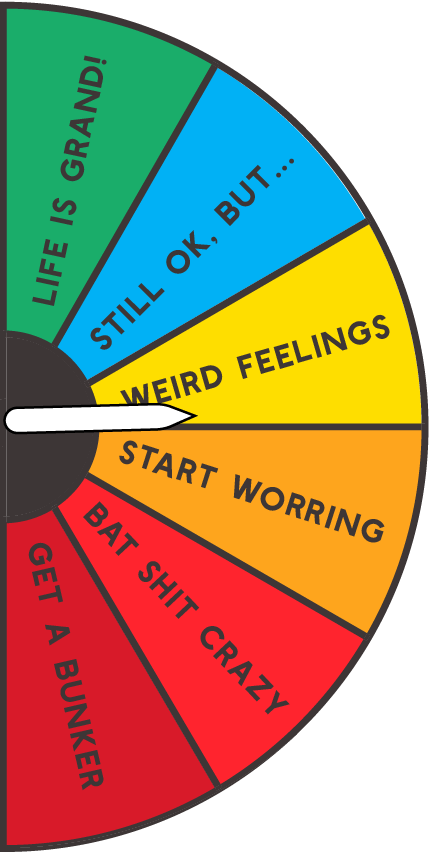
Volcanoes are erupting in The Philippines, but on-fire Australia received some welcome rain. The Iran war cries have been called off and The Donald’s military powers are about to be hamstrung by the Senate. Meanwhile, his impeachment trial is starting, and we’re all on Twitter for a front-row seat.

The Crime Wave Is Over. Why Does Nobody Believe It?
Featuring Emma Varvaloucas
The media is constantly telling us that danger is everywhere. Between true crime binges and political rants, we’re led to believe that our streets are a war zone. However, recent statistics released by the FBI tell a completely different story. Plus, we’ll get into why video game fans have the resume the FAA is looking for. Then in our this week in history segment, we’re taking a look at a bad deal that sparked a massive non-violent protest in the form of a human chain.


Prefer to read? Check out the Audio Transcript
Although the transcription is largely accurate, in some cases it may be incomplete or inaccurate due to inaudible passages or transcription software errors.
Emma Varvaloucas: Between true crime binges and political rants, we’re led to believe that our streets are a war zone, and sometimes it feels like the purge is about to break out at any minute. The only problem? The numbers tell a completely different story. That’s our main topic on today’s What Could Go Right? Progress Report.
And stick around, because we’re also taking a look at a 50-year-old bad deal that sparked the most massive non-violent protest you’ve never heard of, and why your favorite waste of time hobby might be the exact resume the FAA is looking for. Hey, if you’re new here, I’m Emma Varvaloucas, and I’m the executive director of the Progress Network. Let’s get into it.
It’s late. You’ve had a long day at work, and now you’re on the couch watching the latest true crime hit. The name of the series is something like A Killing At The Spooky Pond Next To The All Girls School. The algorithm recommended it because last week you watched Killer Equestrian and Moms Murdering Moms.
After tonight’s episode, you treat yourself to a doom scroll, featuring local news stories about shootings, burglaries, and assaults, and you’re starting to seriously think about hiding your kids and your wife. Then you see a viral clip of some politician ranting about gangs and dangerous immigrants attacking people.
Wait. Was that a noise? Did you lock the doors after you came in? Better double check. This is an unsettling but relatable scenario for a lot of us. The media is constantly telling us that danger is everywhere. But I have good news. The reality is, as a country, we are the safest we have ever been. That’s right.
In terms of crime, if you wanna make America great again, you’d stay right here in 2026. So power down the MAGA time machine. We’re in the middle of a great American crime decline 2.0. Yes, number two. You may be asking, “Okay, but when was the first one?” It was in the ‘90s when crime dropped 44% between 1991 and 2000.
This was a big deal because murder rates in America were pretty high in the 1970s and ‘80s, so much so that the anxiety around it even seeped into pop culture. Think about classic films like Dirty Harry, Taxi Driver, and Scarface. In our current 2.0 version of the Great Decline, we’re going on four years of crime decreases.
Newly released FBI data puts the 2025 murder rate at a record low, with 4.1 murders per 100,000 people. That ties 1955 and 1956 for the lowest ever recorded. Keep in mind that experts say that FBI data before 1960 was a bit unreliable and was probably an undercount. That means that it’s likely that 2025 had the lowest murder rate in American history, period.
And the trend doesn’t seem to be stopping anytime soon. 2026 reports show that New York City homicides through April were at their lowest point since 1960, and cities like Philadelphia, Baltimore, Chicago, and New Orleans are also showing historically low numbers.
To be clear, this isn’t just a return to normal after the high crime spikes during COVID. It’s lower even in comparison to pre-COVID years. And it’s not just murder. Violent crime in general is also down. The Council on Criminal Justice did a comparison between 2026 so far and 2019. It shows that the homicide rate, which is slightly different but tracks with the murder rate, is down 31%, and robbery 41%.
Carjackings are also down by half, and sexual, gun, and aggravated assaults have all dropped. Numbers like these are why superstar criminologist Jeff Asher is betting on another year for the history books. He expects that by the end of 2026, the murder rate will be between 3 to 3.8 for every 100,000 people.
That would be the all-time lowest rate by a Grand Canyon-sized margin. It would be an even larger drop in a shorter timeframe than the Great Decline Volume One in the 1990s. That sounds like the name of a cassette tape my mom bought me at Tower Records in 1999. I was probably on my way to buy butterfly clips at an Orange Julius.
Anyway, however you wanna slice it… In a totally normal, not murder-y kind of way. You’re living through some of the safest times the US has ever had. Congratulations.
But what’s less clear is why the great decline is happening at all. Maybe we’re all too busy watching true crime documentaries to actually commit crimes.
But unfortunately, there are no easy answers. The president of the Council on Criminal Justice says the reasons are “About as clear as a glass of milk.” Crime rates, he says, are falling in cities with different public safety strategies, economic conditions, and political leaders. To make the glass of milk even thicker, violent crime is also falling in other places, like Canada, London, and Argentina.
But investigators and researchers hate not having answers, so in lieu of certainty, they do have some hypotheses. The Council on Criminal Justice outlined 40—count them, 40!—potential factors that may be responsible for the drop in crime. They included policing that targets local violent hotspots, real-time monitoring of social media, and people carrying less cash these days. Mugging someone is just less of a come up if they only use Apple Pay.
In a surprising twist, even GLP-1s made the list of factors. Think medicines like Ozempic and Wegovy that make patients feel full. Some research suggests they may even curb violent impulses. If you get hangry like I do, you can see it. Like, how many fist fights are caused by a long wait time at your local Red Lobster? We may never know.
But just because we don’t know exactly what’s going on doesn’t mean that politicians aren’t lining up to claim credit for the crime decline. The right is pointing to a surge in immigration officials and National Guardsmen under Trump.
The left says, “No, it was funds released by the Biden administration that gave local governments the resources to rehire for critical positions, such as police officers and social workers, and to broaden violence prevention services.” For what it’s worth, experts are more convinced by the left’s arguments than the right’s, and that’s not a partisan point.
First of all, there’s the timing, because the decline began during the age of Biden, and the math just doesn’t math when it comes to the immigration stuff. To begin with, studies show foreign-born immigrants are less likely to commit crimes than US citizens. And while it is possible that the deportation of some violent criminals may have had a very small impact on the trend line, it in no way would explain the whole thing.
So we’re not sure exactly why the Great Decline 2.0 is happening, but it would be good to figure it out so we can try our best to make this dip last. For now, we should feel confident that we’re fairly safe, unless you live next to the spooky pond at the all-girls school. If that’s the case, though, why does it feel like the purge is about to break out at any second?
The answer is probably a mix between brain science and media manipulation. Human brains naturally have a bias toward negative information and detecting threats. It might seem annoying, but it’s what helps protect us from harm. That’s how we used to stay alive when a lion was stalking us. It makes way more sense to pay attention to the creeping, deadly lion than it does to the beautiful tree nearby.
Although most of us are no longer outrunning lions, our brains still respond more strongly to perceived threats. Like crime than cute, nice things online. Unless maybe it’s the guy that built a walking elephant costume for his kids so they could retrace Hannibal’s crossing through the Alps. I cannot get enough of that. Too niche?
Anyway, the people behind the 24-hour news cycle and social media algorithms are aware that we’re drawn to fear and outrage, and they use it to their advantage. If you watch a neighbor’s Ring camera video of a burglary on TikTok, you will be fed more videos of local crime. Even if you live in a safe city, it gives you the impression that crime is everywhere.
Crime becomes a pride of lions circling you. Studies also show that negative, highly emotional content from biased sources tends to spread the most rapidly. So talking up crime nonstop can be a great political tool to grab our attentions and make politicians or a political party seem like heroes for rescuing us from a problem.
The thing is, while there really was a big crime spike during the COVID years, the problem is now in the rear view mirror, so it’s time to update our perceptions to match the data. Speaking of perceptions, part of the promise of Make America Great Again is that the country will return to that nostalgic, safe feeling that mostly white Americans had in the 1950s.
But we don’t need to look to decades past for a time when American streets were exceptionally safe, because that time is now.
Next, here are some numbers that will make you smile. 114, the number of countries that have abolished the death penalty. Lebanon is the latest in a decisive break from the region.
12, the number of states that have passed new gun safety laws this year. And 15%, the national poverty rate in Laos as of 2024, down from 25% in 2012.
And now it’s time for our quick hit. It’s a story about not a bird, not a plane, but air traffic controllers. You’ve probably noticed that recently air travel has been a disaster, literally.
One of the reasons is there’s a big shortage of air traffic controllers in the US. Why is a whole can of worms, a ton of them retiring at once, hiring freezes after years of government shutdowns, the pandemic, yada, yada, yada. And despite these people needing to make life and death decisions in seconds while being overworked and understaffed, oddly, nobody really wanted the job . . . until the government started to poke around in mom’s basement.
A decade ago, people who spent a lot of time playing video games got no respect. If you were dating a gamer, you may have worried, is this hobby a red flag? Shouldn’t all that wasted time playing games be spent developing real skills? Well, we all owe the gamers an apology, because it’s their time to shine at an airport near you.
In April, the Federal Aviation Administration, or FAA, started specifically recruiting gamers to become air traffic controllers in a faster, more streamlined process. And as my grandma would say, these are good jobs with benefits. An entry-level air traffic controller typically makes about $60,000 a year, but the median wage for air traffic controllers overall is about $145,000 a year.
Applicants have to be a US citizen under the age of 31, but only 25% of controllers hold a college degree, so having one is not required. Job candidates do have to go to an air traffic controller academy in Oklahoma and take a challenging exam before they’re hired. US Transportation Secretary Sean Duffy posted on Facebook this month that his department has hired more than 2,000 gamers and have now reached 94% of their hiring goal. He said that it’s a record for hiring speed.
So, why gamers? The exit interviews of air traffic controllers who retired or quit led to this solution. They said that gamers have the skills to think quickly, manage complex issues, and stay focused at the task at hand, not to mention uncover the Legend of Zelda.
So, if you’re a gamer, send this episode to your haters. You could be clearing their next flight for landing.
And now, let’s take a look at a positive news story from the past. Here’s what happened this week in history. When you were a kid, did you ever play Red Rover with your friends? For the non-Now and Then crowd, each team had to make a big chain to stop the other team from breaking through.
As it turns out, its most iconic use might not be from the 1990s cult classic, but rather an event that took place a few years before that. Back in the ‘80s, three countries probably made the biggest Red Rover team in history. On August 23rd, 1989, an estimated two million people made a giant human chain that stretched 370 miles.
It was called the Baltic Way, and ran between Estonia, Lithuania, and Latvia. They were, of course, not playing the classic neighborhood game. The human chain was a touching form of non-violent protest against a 50-year-old bad deal. In 1938, the Soviet Union couldn’t reach a collective security agreement with Britain and France against Nazi Germany.
Essentially, a collective security agreement is where if one of us has to fight, we all have to fight. But they couldn’t quite get there. So in 1939, the Soviets went over to the Nazis and were like, “Look, man, can we figure something out?” And the Nazis said, “Yes.” So, the two countries agreed to not attack each other.
It was supposed to last for about 10 years, with the possibility of an extension, kind of like an NBA contract. At least, that was the public part of the deal, but there was a secret portion that the Nazis and the Soviets hid. It gets a bit complicated, but essentially, they secretly decided to divide several European countries between the Soviet Union and Germany’s control.
All Hitler really wanted out of the deal, at the time, was to invade Poland without any opposition from the Soviets. So, Germany took western and central Poland. The Soviet Union took eastern Poland, Lithuania, Latvia, Estonia, Finland, and part of Romania. The deal was called the Molotov-Ribbentrop Pact, or the German-Soviet Non-Aggression Pact.
However, the non-aggression part of the deal didn’t last very long. It was effectively dead by June of 1941, when the Nazis attacked the Soviet Union without warning. Everyone is always going on about bewaring Greeks bearing gifts, but I really think it’s time to update that to never trust a Nazi, or make deals with them.
Fast-forward years after World War II, and Estonia, Lithuania, and Latvia are still under Soviet control. Activists in these countries had spent decades organizing and protesting for their freedom from the Soviets. And by 1989, independence groups were truly sick of it. Organizers in all three countries united to let the world know that they wanted out.
They created the Baltic Way, this giant visual protest to bring global attention, and they got it. Although there were many factors leading up to it, seven months after the protest, Lithuania had gained its independence. And by 1991, the other two countries had as well. The Baltic Way didn’t win independence for eight million people by itself. However, it was a stunning symbol of collective action and the power of the people.
I hope these stories remind you that there’s so much good in the world, so it’s important to shift our focus away from all the bad sometimes. Send this episode to your friend who keeps hearing the saxophones getting louder, and make sure to subscribe to our YouTube channel. We release 60-second good news stories every day.
LOAD MORE
Meet the Hosts

Emma Varvaloucas