
Volcanoes are erupting in The Philippines, but on-fire Australia received some welcome rain. The Iran war cries have been called off and The Donald’s military powers are about to be hamstrung by the Senate. Meanwhile, his impeachment trial is starting, and we’re all on Twitter for a front-row seat.

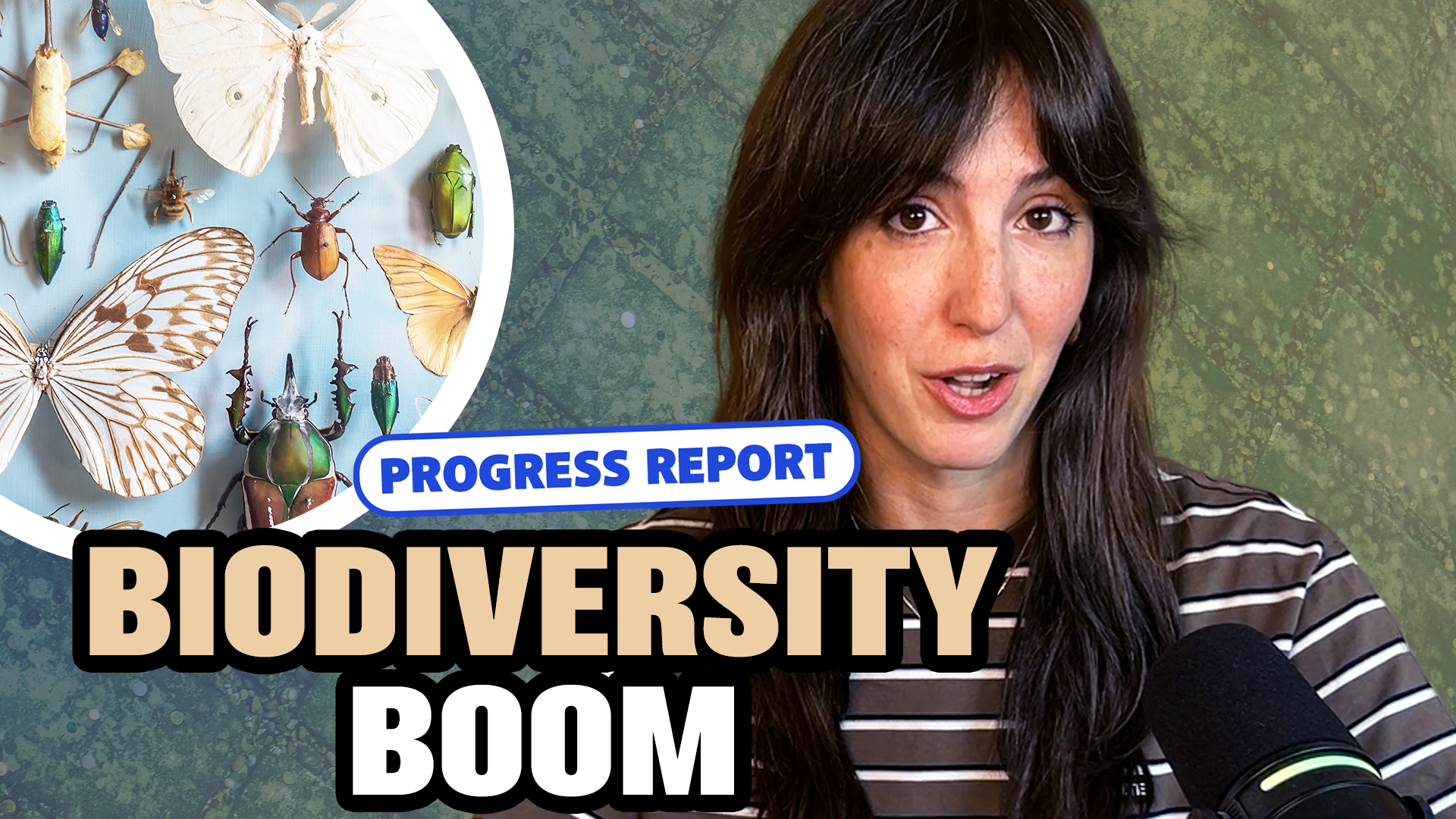
The Race to Catalogue Biodiversity
Featuring Emma Varvaloucas
On this week’s progress report, we’re in the golden age of species discovery. We’ll also get into the incredible story of a paralyzed man who can continue to work and communicate thanks to a groundbreaking brain implant, and researchers at Arizona State University hope a shivering, breathing, sweating robot can help us better equip ourselves for extreme weather conditions.


Prefer to read? Check out the Audio Transcript
Although the transcription is largely accurate, in some cases it may be incomplete or inaccurate due to inaudible passages or transcription software errors.
Emma Varvaloucas: Technological advances are helping scientists catalog the earth’s biodiversity before it’s too late. A brain implant has helped a climate activist keep his job, and a robot that does something you hate to do in the name of saving your life. Welcome to the What Could Go Right? Progress Report, where we dive into some of the good news that almost all of us missed because it was buried under the barrage of bad news.
Hey, if you’re new here, I’m Emma Varvaloucas, and I’m the executive director of The Progress Network. Let’s get into it. First up, you’d have to be living under a rock not to be aware that earth’s biodiversity is under pressure. The share of species at risk of extinction has risen as we went all Hexxus from Ferngully, chopping down trees, digging up soil, and generally wreaking havoc on ecosystems.
And of course, the threat of climate change looms as large as an Arctic shelf on the verge of collapse. Side note: if you haven’t seen Ferngully, you’re missing out on some peak ‘90s tree-hugger content, but back to the story at hand. Wanna know something really crazy? When it comes to the life forms inhabiting our planet that we’re all trying to actively save or destroy, scientists say we’ve only classified about 14% of the world’s eukaryotic species.
If you don’t know what eukaryotic means, absolutely no judgment here. Middle school biology was a long time ago. For me it was, anyway. So I’ll help you out. That classification includes all animals, plants, and fungi. Now, here’s the thing: if we don’t even know about an estimated 100,000 plant species or 2 million fungal ones, how are we supposed to protect them from, well- us.
One of the first steps is figuring out what those species are, which brings me to why this story belongs on the progress report. Biodiversity science is entering a golden age. Thanks to digital tools and technological advances, we’re learning about life on our planet faster than ever before, and that knowledge might just be the key to saving it.
Now, if you’re like me and wanted to be an explorer when you grew up, but thought that all the great discoveries had already been made, I have good news and bad news. The bad news is you were wrong. So theoretically, you could be off exploring where the wild things are instead of letting your butt fall asleep at that desk job.
The good news is you were wrong, and you weren’t the only one. For a long time, scientists thought that the peak of new species discovery was over a century ago when colonial powers were still shipping off naturalists to go bushwhacking around the world. Picture guys like Alfred Russel Wallace, who back in the 1850s cataloged more than 5,000 new species across just a few years in modern-day Malaysia and Indonesia.
Pretty impressive. But still, Wallace has nothing on what scientists have been up to recently. In fact, a study published just last year found that between 2015 and 2020, scientists described new species at the fastest rates ever recorded, more than 16,000 every year. Sorry, Wallace. They’ve identified so many animals, insects, fish, and arthropods that according to the study, up to a fifth of our current knowledge about these creatures has been accumulated in the past two decades alone.
Pretty wild, considering that’s about the same amount of time Dora has been out there exploring, although, to be fair, she has found quite a few Spanish words. So how do we explain all these discoveries in a world that already felt pretty discovered? It’s partially thanks to technology. DNA sequencing has become much more affordable in recent years, going from tens of millions of dollars in the early 2000s to just a few hundred today.
Plus, we are actually exploring parts of the planet we haven’t previously had access to. Remember that cute little fluorescent blue spider that we talked about on a recent episode? He’s from a plateau in the highlands of Angola, which was previously inaccessible due to civil war. And we’re also studying parts of the deep ocean, for example, which can only be explored by state-of-the-art robots.
Now, so far, when it comes to plants, classification has been slower. Identification of new flora has been holding steady at about 2,500 a year. But A new report from London’s Kew Gardens claims that digitization and AI are about to utterly transform plant taxonomy. Kew’s recently completed digitization project consists of 7.4 million plants, and similar projects are popping up around the world in biodiversity hotspots like Brazil and South Africa.
Classification still requires human experts to confirm new species, but AI is helping them crunch the data faster, especially in places where resources and expertise are lacking. Plus, it’s also helping researchers find errors and better assess extinction risk. Advances in technology are also allowing conservationists to be more precise.
For example, a new global assessment of coral reefs used machine learning to locate an additional 166,000 square kilometers of coral reefs that are actually resistant to climate change. That’s triple what had been found in previous studies. So What makes these reefs different? Some are located in cooler water areas.
Some have developed adaptations to be more resilient, and others just bounce back from damage better, like your friend that can knock back three tequilas and still go to the gym the next day. Not me. Plus, the AI-assisted map of the reefs is 10,000 times more detailed than its predecessors. Ultra-precise research like this helps conservationists pick their battles better by advocating for the policies that will have the most impact.
Who’d have thought that conservationists would be among the people most excited about AI? It’s not just for tech bros anymore, folks. Now, the big question on everyone’s mind is whether we can classify and conserve species faster than they’re being wiped out. As the Key report states, the race is on, but the information at our fingertips has never been better.
So watch out, Hexis. We’re digging our hiking boots out of the closet and coming for you. Before we get into our shorter stories, here are some numbers to make you smile. 1,100 pounds, the annual fuel cost savings of EV owners in the UK. Congratulations. About two times, that’s the global increase in rice production between the 1960s and 2010s, despite climate change.
$10 trillion, the market value of the green economy, a record high. 916, the number of turbines now operating at the US’s largest wind farm in New Mexico. And zero, the number of cervical cancer deaths recorded amongst young women in England between 2020 and 2024. A first ever. And if you don’t know, that’s due to the HPV vaccine, and it’s an amazing miracle story that maybe one day we’ll cover on the podcast.
And here are our quick hits for today. First up, a paralyzed climate activist has been able to continue his work for three years, thanks to a brain implant. Casey Harrell is 48 years old and lives in Oakland, California. Six years ago, he was diagnosed with a motor neuron disease, which left him paralyzed.
In 2023, he participated in a study that involved attaching 256 electrodes to his speech motor cortex, which were then connected to electronic recording devices. It only took the computer about 30 minutes to decode his brain signals, and once researchers spent nearly a year making the software plug and play for him and his care partners, Harrell could use it entirely on his own, at home, outside of a clinical setting, which is groundbreaking.
Sounds Pretty comparable to the effort that went into me learning how to fold a fitted sheet, but that’s neither here nor there. It’s called a brain computer interface, or BCI, and it allows Harold to write, use a computer, send text messages and emails, and continue his job in climate advocacy. It even has a text-to-speech function, which enables him to talk.
And here’s the coolest part: it’s made from recordings of his own voice, so it sounds similar to before he was diagnosed. A new study from the University of California at Davis examined two years of Harold’s use of the system, which is, quote, “The most extensive data set and the longest-running speech communication of anyone with such a device.”
The study found that Harold used it to communicate almost 200,000 sentences, which were decoded correctly by the BCI approximately 92% of the time. So it’s basically a, like a teenager that needs to get a touch better at listening. Looking forward, researchers hope to make the device more portable, more accurate, and to develop the ability to translate brain signals directly into speech.
And finally, coming in hot, we’ve got some research out of Arizona State University. Scientists at ASU have been working on a one-of-a-kind robot that lives in a sauna and was born to sweat. Andy can shiver, walk, breathe, and sweat like a human, all in the name of science. Those might seem like odd activities for a robot, but Andy has a really important mission.
In the US, extreme heat takes more lives than hurricanes, floods, and tornadoes combined. About 2,000 people every year, yet we still don’t fully understand what it does inside the body. So researchers created Andy and even programmed the robot to react to heat like different people, say, an elderly person with diabetes, an active 30-year-old, or even a child.
Andy lives in a heat chamber called the warm room, where researchers sometimes crank it up to 140 degrees Fahrenheit and recreate scorchers straight out of Mad Max, although probably missing the self-sacrifice for Valhalla. Andy is unique because it’s the only mannequin of its kind that also works outdoors.
It goes for walks with its bestie Marty, a heat-sensing robot that measures the environment while Andy measures what it does to our bodies. The duo have been traipsing around Phoenix, Arizona, together every summer since 2023, collecting real-world data that’ll help us better prepare for climate change.
Candidly, I kind of hope I don’t run into them on my next walk around town because they’re a little creepy looking. But hey, this is exactly the type of job we want our robots doing. Maybe if we keep them busy enough, they won’t turn on us and become our overlords. Am I right? And that’s all for this week’s progress report.
I hope these stories remind you that there’s so much good going on in the world, so it’s important to shift our focus away from all the bad sometimes. If you got some value from this episode, send it to your friend who won’t stop talking about Kate Verd’s 40-year-old goalkeeper. Because they’re obviously into good news anyway.
And make sure to like and subscribe to our YouTube channel, follow us on your preferred podcast platform, and leave us a review. If you’d like more of these stories delivered right to your inbox, use the link in the description to sign up for our newsletter. What’s a good news story we should cover next week?
Let us know in the comments. Thanks for watching, and we won’t see you next week as I’m going on vacation, but we’ll be back for the next one.
LOAD MORE
Meet the Hosts

Emma Varvaloucas