
Volcanoes are erupting in The Philippines, but on-fire Australia received some welcome rain. The Iran war cries have been called off and The Donald’s military powers are about to be hamstrung by the Senate. Meanwhile, his impeachment trial is starting, and we’re all on Twitter for a front-row seat.

What Could Go Right? King Solar
Solar is the fastest-growing energy source in the history of energy.

Emma Varvaloucas
This is our weekly newsletter, What Could Go Right? Sign up here to receive it in your inbox every Thursday at 5am ET. You can read past issues here.
King Solar
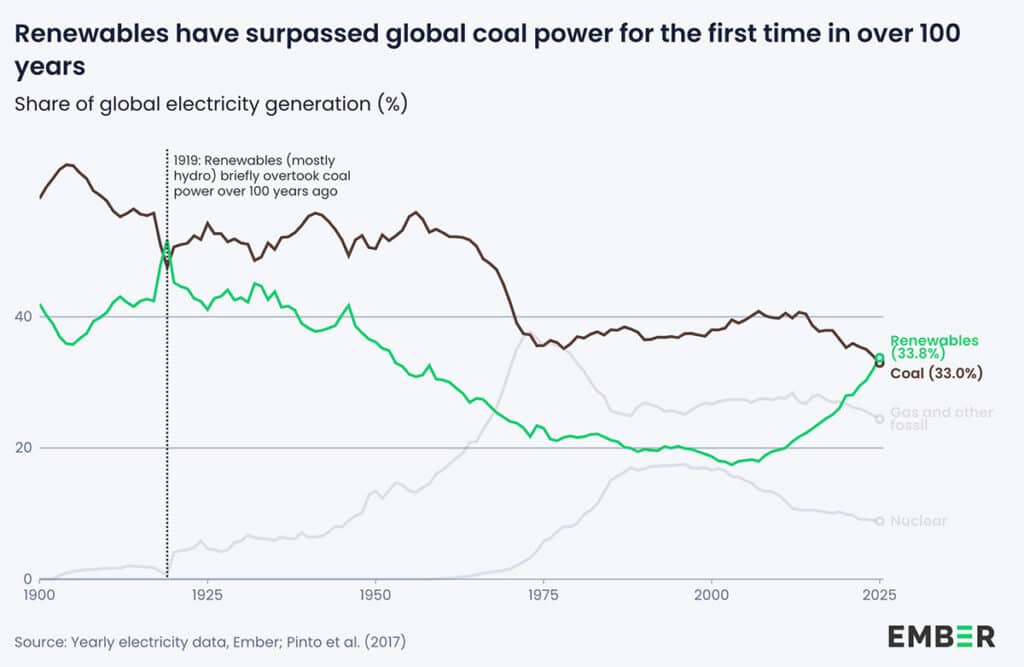
The last time coal lost its lead as the world’s largest electricity source, the Bolsheviks were fending off a counterrevolution, the Treaty of Versailles was in review, and Congress had just established a national park in Arizona named for its big hole in the ground. The year was 1919, and as it happened, a banner one for hydropower.
Renewables wouldn’t overtake coal again for more than a century. In its most recent annual global electricity review, the think tank Ember reported that in 2025 renewables accounted for 33.8% of global power generation, edging out coal, at just under 33%—its first time below a third in history.
The change has most to do with solar’s breakneck expansion. Wind power is growing too, but at a pace that can’t compare to solar’s exponential rise: It has multiplied tenfold since the Paris Agreement was signed in 2015, to 2,778 TWh, or enough to meet the total electricity demand of the EU. The output, which was larger than wind’s for the first time in 2025, is set to outgrow nuclear this year as well.
Last year also saw an annual decline in fossil fuel generation, one of only five times that has happened in the past century. But it was the first time that the drop was the result of clean power growth and not a one-off shock such as an economic crisis or pandemic. Wind and solar together were enough to meet essentially all of last year’s new electricity demand, most importantly in China, the world’s largest emitter.
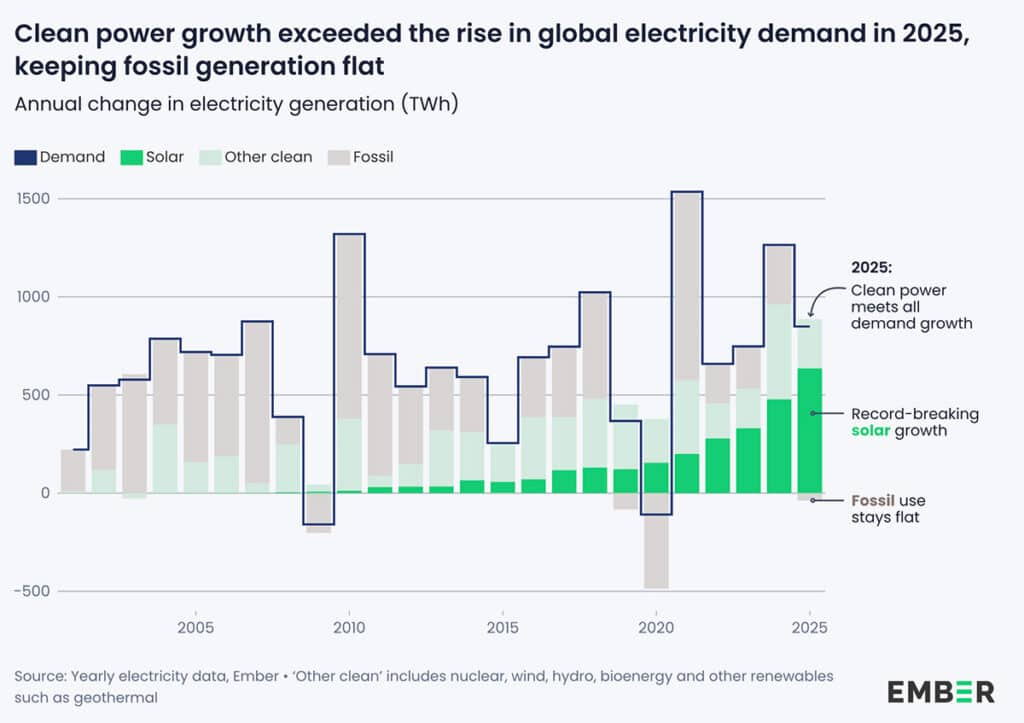
This is real progress that marks, as the Ember report notes, an entry into “an era of clean growth.” But it is still only an entry. That decline in fossil fuel generation was an itsy-bitsy 0.2%. The world still burns a gigantic amount of coal, which having plateaued at a peak, has not begun to tumble. And global emissions continue to rise, if more sluggishly than in the past.
Still, clean energy has moved from “ambition” to “structural reality,” says Ember, now that the falling cost of solar panels has made harnessing the sun a better economic prospect than digging in the dirt or burning carbon—and especially now that batteries are finally becoming cheap enough to store and deliver its energy 24/7 in the future.
And much like the 2022 invasion of Ukraine pushed the EU toward renewables, today’s brouhaha over the Strait of Hormuz is spurring—along with, yes, a short-term return to coal in some countries—a worldwide surge in clean energy. Countries are falling over one another to buy Chinese solar technology, batteries, and electric vehicles; exports for all three reached a record high in March. Several, such as France, India, and Turkey, have announced new clean energy policies and investments.
So while it’s far too early to declare the fight against climate change won, we’re at least nearing the time to anoint a new energy monarch: King Solar.
—Emma Varvaloucas
P.S. Some updates to last week’s edition on psychedelics and the Trump administration: Three treatments have received an FDA priority review voucher. And, it turns out Trump is moving on marijuana, too. Medical marijuana is to be reclassified as a Schedule III substance, and recreational marijuana could be next.
What Could Go Right? S8 E3: Can We Achieve “Super Abundance” Without AI Doom? | with Sebastian Mallaby

What happens when the person building the world’s most powerful technology is just as worried about it as we are? Sebastian Mallaby, the Pulitzer Prize-nominated author of The Infinity Machine, joins host Zachary Karabell to pull back the curtain on Demis Hassabis, the founder of DeepMind who is currently leading the global charge into artificial intelligence. | Listen now
By the Numbers
~930: Miles that Chinese company CATL’s new EV battery can last on a single charge
567M: Additional people covered by essential health services since 2018
3: European countries—Iceland, Portugal, and Norway—that have reached 90% HPV vaccine uptake in girls
30: Countries that have eliminated the eye disease trachoma; Australia is the latest
Go Figure
A San Francisco shop being managed by AI is having some issues. Among the hiccups at Andon Market: missing storefront signage, weak merchandising, and staff-scheduling snafus resulting in days-long closures. The future of retail is not quite here.
Quick Hits
☎️ The rate of suicides among young people in the US dropped 11% below projections after the rollout of a national suicide prevention hotline.
🤰 More than half of US states now cover doula care under Medicaid, up from just two prior to 2020. Studies show that doula support is associated with higher breastfeeding initiation and better postpartum care.
🪸 Coral reefs off a chain of Australian islands survived a massive heat wave intact, offering scientists clues to what might protect reefs elsewhere.
🦠 Scientists have discovered a new bacterium that may cause noma, a neglected, deadly tropical disease that affects children. The hope is that a simple gingivitis test could soon prevent the 90% mortality rate and lifelong disfigurement associated with the disease.
🌲 Rainforests can bounce back much faster than researchers thought. One, in Ecuador, recovered 90% of its biodiversity in just 30 years.
🧫 A startup says it has successfully grown functional human sperm in a lab and used it to make seemingly healthy embryos. Assuming the findings can be independently verified, the technique could help men with infertility.
🚗 Electric vehicles with sodium-ion batteries are set to go on sale this year, offering a shield against volatile lithium prices. Sodium is more globally abundant.
🫀 NASA is testing drone delivery for organs in an attempt to solve medical transport issues. Meanwhile, its Mars rover is collecting more evidence to suggest the planet was habitable around the time the Earth originated.
☢️ Four decades on from the Chernobyl disaster, nuclear is reviving around the world. What’s more, while radiation’s effects on wildlife are still being studied, many animals—including a rare horse—have thrived in the accidental rewilding project that is Chernobyl’s exclusion zone.
🧬 The FDA has approved the first gene therapy for inherited deafness—and the drugmaker is giving it away for free.
💉 Measles immunizations are skyrocketing in states experiencing outbreaks as anti-vaxxers undergo a measurable change of heart.
👀 What we’re watching: Mexico is about to open enrollment for its new universal health care service.
💡 Editor’s pick: Is the swagger of global strongmen fading?
TPN Member Originals
(Who are our Members? Get to know them.)
- Debating democracy renovation | The Renovator | Danielle Allen
- Why Virginia went back on its word | WaPo ($) | Theodore R. Johnson
- Russia is ruined | Diane Francis | Diane Francis
- Theft is now progressive chic | The Atlantic ($) | Thomas Chatterton Williams
- The costs of Trump’s contempt are starting to show | WaPo ($) | Fareed Zakaria
- The White House correspondents’ dinner shooting | Tangle | Isaac Saul
- Cuba on the brink | GZERO | Ian Bremmer
- Where DOGE hit DC hardest | Slow Boring | Matthew Yglesias
- Republics demand loyalty to principles, not party | The Preamble | Sharon McMahon