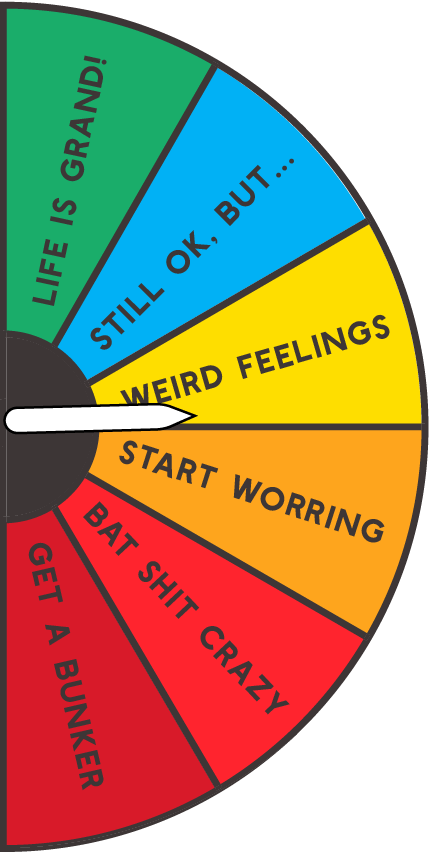
Volcanoes are erupting in The Philippines, but on-fire Australia received some welcome rain. The Iran war cries have been called off and The Donald’s military powers are about to be hamstrung by the Senate. Meanwhile, his impeachment trial is starting, and we’re all on Twitter for a front-row seat.

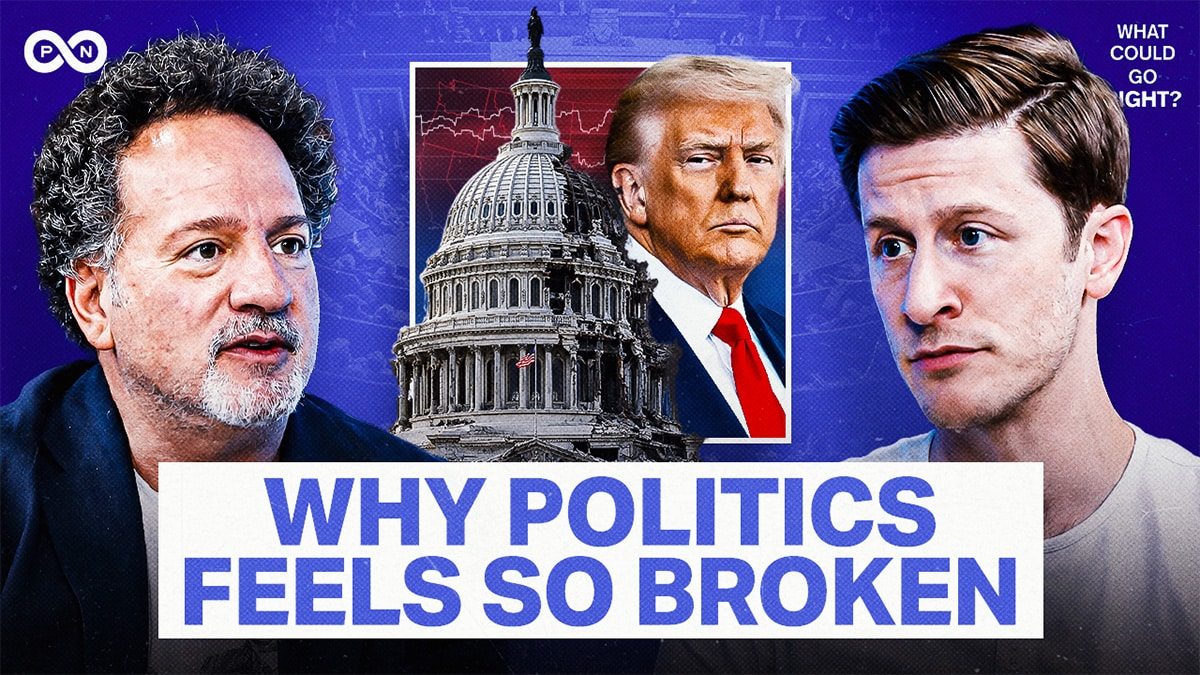
Social Media Is Making Politics Feel Worse Than It Really Is
Featuring David Pakman
David Pakman is the founder and host of The David Pakman Show, one of the most watched independent progressive podcasts and online political shows. He’s built an audience of over 6.7 million subscribers across social media platforms through calm, fact-based analysis and critical thinking. David joins host Zachary Karabell to discuss his new book, Pay Attention, coming out on September 22. They dive into the missed messaging opportunities for the left, the ongoing culture wars that lend themselves to clickbait headlines, and strategies to expand the progressive political tent within the limitations of the American two-party system. David offers his perspective on building an audience while protecting his values and integrity, and why the future of American political discourse might actually be brighter than the headlines suggest.


Prefer to read? Check out the Audio Transcript
Although the transcription is largely accurate, in some cases it may be incomplete or inaccurate due to inaudible passages or transcription software errors.
[00:00:00] Speaker: Are we slaves to the algorithms? Is this its own version of online social media rise of the machines? Is there anything we can do about it rather than be passive victims or tune out all together? That is the major focus of my conversation today with David Pakman on What Could Go Right, which is my podcast and part of the Progress Network.
David is one of the most successful and famous political commentators on YouTube, if not on the planet, then certainly in the United States, and he’s been doing this long before it was cool to have a YouTube channel, for more than 15 years. And his new book, Pay Attention, is a fascinating melange of confessional of how it is he came to understand how to maximize his own impact within that ecosystem, but also how we can all constructively use it and not simply be passive victims of it.
So I’m really looking forward to that conversation today. Like, you’re now in the category of, of an old-timer in sort of- … social media, YouTube land, which is amazing when you think about the recency that these things, like, just didn’t exist 20 years ago in the form that they do now. But you’ve been doing this for a really long time, and you’ve been doing the political commentary for a long time.
What’s different now from when you started doing this?
[00:01:16] Speaker 2: Few things. One, the pie is not getting bigger as quickly in terms of the audience, because a lot of the people that were switching over to independent media, they’ve done that. So that, combined with more players in the game, so to speak, there’s a more fixed amount of audience, and there’s more people kind of competing for it.
Whereas when I started, you could basically build your audience just from people who found you and came over from legacy and corporate media. So in that sense, it’s kind of more competitive, if that makes sense. At the same time, a lot of these platforms that now are around that generate billions of views, they weren’t around when I started, so there’s also a lot more tools to get visibility.
So the, the whole feel has really changed.
[00:01:57] Speaker: But does that mean that you feel that everybody who is following you is, is by definition then not following someone else? If it’s kind of a-
[00:02:05] Speaker 2: To a degree, yeah. I mean, it’s not so, I mean, the, there’s a limited amount of hours in the day, and there’s, you know, people sleep for part of that, and presumably work for part of it, and so yeah, I do think there is more of a competition.
In 2011, when I was starting on YouTube, or even before that, it was people who were used to getting their news on certain platforms, certain times of day, certain formats, and then going on YouTube or getting a podcast was a completely new thing. People are used to the platforms now, and so that’s a lot different.
[00:02:30] Speaker: It’s funny, ‘cause I think of these things sometimes as any one of us, each, you, I, anyone, we all have 24 hours, seven days a week. We have a finite amount of attention. And so, you know, when I end the show, I always, I thank people for giving me their hour. It’s, you know, which is a, a donation of time and attention.
So in that sense, it’s zero-sum. But I still feel like at kind of a global level, the amount of people who are tuning in, it’s funny, you know, you, we used to talk about tuning in in the ‘60s, but now it’s tuning in in a different way, that that is more of an expanding pie. But you’re suggesting you feel like even that has become more of a, a finite set.
[00:03:09] Speaker 2: At the absolute global level, I think you’re right. A lot of that is outside of news and politics, and so news and politics, the space I inhabit i- is sort of a little bit of a different animal, and it’s never going to be as big as some of these other verticals. So I, I think that it is true that at a global level it is expanding, but in news and politics, especially US news and politics, which is where, where I focus, it, the whole space is not seeing the growth that it did at the beginning of this.
[00:03:36] Speaker: Y- the other thing people say has changed is never have Americans been so polarized, never have we been so divided, never has there been such fractures geographically, demographically, in terms of class. Do, do you feel like 2011 was some sort of halcyon moment where everyone was kumbaya-ing their way into a collective future?
[00:03:55] Speaker 2: No, I mean, the thing is, like, what do we mean by division? So I think it’s true now, and it was true in 2011, that if you got a random group of Americans in a room, you could get general agreement as to most of the underlying principles and values. Should we have an income tax? Most people would say, “Yes, we should.”
Like, what should the top marginal tax rate be? You’d have some difference there for sure. But just as far as, like, very basics, there was this overlap then, and I think there still is. The difference now is that none of the digital platforms are optimized for that because content around, “We all agree there should be an income tax,” is extraordinarily boring.
Nobody’s gonna share that. Nobody’s gonna comment on that. And so what happens is the platforms create these silos of more extreme perspectives, and people who are in one silo Are exposed to what is emotionally salient to them.
[00:04:48] Speaker: Right.
[00:04:49] Speaker 2: And same for people in other silos. They interact much less. When they do, like on Twitter for example, there’s a predisposition to focus on the differences rather than the areas of agreement.
Sure. And this generates very unproductive types of conversations. And so in practice, it is perceived as more polarization because our interactions are highly polarized, even though, again, I think if you kinda de-politicize and get 20 people in a room, you’d get a lot of agreement as to, as to the, the basics of what is going on in this country.
[00:05:18] Speaker: So in a lot of ways, this is what, around the time you were starting this, this guy named Eli Pariser came out and talked about filter bubbles. Yes. That this thing would happen that you are now describing happened, and then i- is magnified by both the algorithms and then presumably will be even more magnified when AI can super juice those algorithms.
[00:05:35] Speaker 2: Exactly right. I think that, like the filter bubble, it’s almost quaint in retrospect now, where it’s like, whoa, if we could only go back to that, we would be much better off. Oh,
[00:05:43] Speaker: if we could only have
[00:05:43] Speaker 2: filter
[00:05:44] Speaker: bubbles.
[00:05:44] Speaker 2: If we… But no, now, now it’s, it’s gotten much worse. And then the other thing also is sometimes there’s an instinct to attribute political bias to the way a lot of these algorithms work for people in news and politics, where you go, “Well, what’s, what’s shown on Facebook is determined by the personal politics of Mark Zuckerberg or some engineer- Right
or something like that. And that’s not really the case. Uh, not that Mark Zuckerberg doesn’t have political views, and they seem to have evolved over the last 10 years, but it’s really about- Or, or, or
[00:06:07] Speaker: devolved, depends
[00:06:08] Speaker 2: on who you ask … Or devolved. It’s really about just what is gonna keep people on the platform, what is going to get people to react and share and, and pull more people in.
And I think if we want to do the partisan analysis, I think the political right is much more well-suited to the sorts of arguments and content that naturally algorithms like.
[00:06:27] Speaker: Hmm. ‘Cause, and again, what you’re describing is less a more polarized populace- Than a more polarized, I guess, what stands for the public square that we have available.
But I do think it’s important, like cognitively, and correct me if you think I’m wrong in that, to distinguish between where most people are residing in their self-conception of what it means to be a citizen or what it means to be a person, and where they reside digitally or where they are, where they are channeled to residing digitally.
[00:06:55] Speaker 2: You’re saying that there, that there’s a difference between those two things? Yeah. I think that’s absolutely the case, and it’s even, it’s even the case just in terms of what people think about. In the offline space, I don’t think people devote even a fraction of the time to the topics and subject matter that they’re devoting to- Right
in their online consumption. So that creates these, these gaps that can be very difficult to bridge. The other effect that it has had is because of what our interactions mostly are online, eh, I’m speaking as someone in the news and politics space in a sort of partisan space, the interactions online are so horrible and, and negative and destructive.
There are some people who apply that to the real world, and if they have an interpersonal disagreement with someone, it’s very triggering and, and sort of makes them wanna run away from that relationship, where it’s sort of normal, as I see it, to have people where you agree on a lot of things and not others- Right
and that’s sort of okay. You might agree, your, you know, your kids are in on the same soccer team, and you agree about what’s going on at the school, how the team should be coached, et cetera, but maybe you have a different view about abortion, for example. That’s scary and paralyzing to a lot of people, I think because of what’s happening online, when that is just sort of normal to me.
We, we’re just not gonna agree on everything, and that’s okay.
[00:08:07] Speaker: And it’s also true, I mean, clearly online, people are much more willing to give voice to their unfettered id than they ever would be in person.
[00:08:14] Speaker 2: Without a doubt. And in fact, the only negative interaction I guess I’d say I’ve had in person with a viewer of, of my show, which was actually someone on the political left, I, I, I think, that there was one of those.
Online, it’s 98% of the interactions- Right … and emails that I get, and I think there is a disinhibiting nature to being behind a screen or behind a keyboard or, or behind a phone that is really, if applied to in, in-person behavior, would be extremely antisocial. It would be very difficult to keep a job, friends or, or family, quite frankly, if people behaved in person the way they behave online.
[00:08:49] Speaker: No, it’s extraordinary. And, and I mean 98% of it, as you said, is negative. You know, every now and then a positive comment pops up. And look, the point about virality, and I wanna get into this ‘cause you write a lot about this in, in your new book, Pay Attention. I’ve struggled a lot with in that- A lot of the messages that I’ve been trying to put out for the past seven or eight years are, you know, they’re not kumbaya moments and everything is fine, but they’re, they are exactly the headlines of, “Hey, there’s good things going on in the world.”
And those aren’t headlines, right? Or if they are headlines, they are headlines that, that both disappear in the analog media. You know, The New York Times never ran a headline going, “It’s a nice weekend.” And algorithmically, that never will get, you know, attention. I mean, unless you say, “It’s the last nice weekend,” or something vaguely apocalyptic.
There was a great line that Lillian Hellman had, famous commentator, very spicy and acerbic, who was brought up in front of the House Un-American Activities Committee and questioned about her affiliation with communism, and she says, “I will not cut my cloth to fit today’s fashion.” Basically saying, “I’m not gonna make these compromises.”
But you’ve read a lot about making the compromises. Now, you also say you feel organically that you’ve been privileged enough that the compromises you’ve made in order to inc- increase attention, you haven’t felt have, like, crossed some sort of inner-
[00:10:05] Speaker 2: Easy for me to say, right?
[00:10:06] Speaker: Right. Well, no, but I mean, I mean, I believe you when you say that.
Yeah. Right? That you’ve found a way to kind of, like-
[00:10:11] Speaker 2: Be at peace with the compromises …
[00:10:12] Speaker: or juice who you actually are.
[00:10:14] Speaker 2: Yeah.
[00:10:15] Speaker: And enhance who you actually are- Yes … rather than try to don some other cloth. But, you know, I wonder about this, doing a show called What Could Go Right? or trying to say that we’re, we’re insufficiently paying attention to things going well in the world relative to so many things going on in the world, but it’s unclear how to juice that.
You know? Like, it’s, it… You can juice drama, but it’s not clear how you’d juice things that are good.
[00:10:36] Speaker 2: No, I mean, the, there is a predisposition, I think, that conflict, especially if there’s a villain or a scapegoat or someone who’s behaving poorly, just by its nature is going to be kind of more titillating and, and exciting in a l- in a lot of ways.
I don’t think, you know, it, maybe it’s more of a question for a marketing professional. How can you take the most kind of, like, anodyne bit of news and make it interesting and, and viral? I don’t know if you can, but the way I, I try to think about it is I’ll use the stuff that does generate more interest to buy me some attention with an audience, and then I have the, an opportunity to talk about that other stuff.
So, like, for example, the, the show I did today before coming over here, there was a lot about, you know, Donald Trump had another disaster press gaggle yesterday, what’s going on with Mitch McConnell, the US is out of munitions, all of this stuff. But then I also interviewed an economist about wealth taxes, and it’s a relatively, I, I use this term not in the literal sense, but it’s a relatively boring conversation in that we’re talking about Income taxes and capital gains taxes and the proposal Prop 40 in California, et cetera.
That’s not going to do as well as all of the other stuff, but hopefully what I’ve done is, like, structure the totality of the day so that the more salacious stuff brings people in, and then a bunch of people are staying for the economist conversation. And that’s kind of like the compromise I’ve made with the system.
This is the system. I, I can’t change it, but I can try to work within it.
[00:11:59] Speaker: Yeah, you said before you thought that there was something about Republicans and MAGA land that was sort of better suited for the algorithmic world that we’re in. Oh, yeah. But it seems like if you look at where the Democratic Party kind of is or where the more left side of the Democratic Party is going, that a lot of people are, are essentially mimicking or copying the same things that have worked, which is it’s not a boring conversation about a wealth tax.
It’s a ra- you know, it’s a, an aggressive, angry railing against the wealthy. Right. I mean, you could have a conversation about a wealth tax or about the Piedà Tax in New York City and talk about how do we collectively pay for what we need to? You know, what does that mean? What would that look like? I don’t know.
That would be a non-clickbait way of having the conversation, but the, the thing that grabs people politically is the wealthy aren’t paying, the billionaires are robbing you, you know, it’s, it’s immoral, and therefore we should have it.
[00:12:46] Speaker 2: It’s true, and also sometimes the concept of this is what billionaires are doing doesn’t even really grab people that much because it’s an abstract concept to the average person.
Billionaire, so that’s like someone with a lot of money, right? It’s like, yes, but do you really understand the scale of what we’re talking about? So I, I still think that- The left can and should learn to play the games with these platforms to get attention, and to some degree it’s, it, it is happening more.
But if you just pick an issue and look at the two sides of it, sometimes it’s, it can really illustrate the difference. So like sometimes I’ll talk about taxes. The right will take these positions that are really good for the algorithms. Like for example, “It’s your money. You should get to keep it. They’re stealing the money from you.”
That is really pithy and short. On the other side, nobody is saying, “It should all be taken from you. Every last penny should be collected in taxes.” No, we have this conversation where we go, “Well, listen, we live in a society and we have certain expectations, and we need to centralize some stuff like police and water system, and so what we need to find is the right level of taxation of…”
Th- that’s a structural thing. Yeah. Now, can you kinda like, like putty reshape what I’m talking about for the left and make it more interesting? Yes. Pay their fair share is something that Democrats have been trying for a while. Kinda works okay, you know, not, not necessarily. An example of, of, you know, Warren Buffett pays a lower rate than his secretary.
That can maybe have a little cachet, but it’s, it’s tougher, so I think that’s like a really good structural example.
[00:14:13] Speaker: I mean, it reminds me, there was a Senate hearing and, uh, Bernie Moreno, who’s the Republican senator from Ohio, was questioning, I think it was a law professor, older, older white guy, a- about health sc- uh, healthcare.
And basically he was saying in response to the fact that, you know, in emergency rooms around the United States, if you go into an emergency room, you get care. Doesn’t matter if you have no money, it doesn’t matter what country you’re from, you know, if you walk in with a gushing wound, someone’s gonna sew you up.
[00:14:43] Speaker 2: You’ve gotta be stabilized at least. Right. Yeah.
[00:14:45] Speaker: And so he was saying, if someone br- it, and he was saying about this, about, you know, the Republican talking point of we’re providing free healthcare to illegal immigrants, people who enter the country illegally. And he said, “If someone broke into your house-” Would you make them dinner?
And, you know, it’s a great, it’s a great unfair line.
[00:15:03] Speaker 2: Yes.
[00:15:04] Speaker: And so the guy’s sitting there going, “Well, no. I mean, I wouldn’t, of course I wouldn’t make them dinner, but Senator, it’s not the same thing when you…” And, like, the minute-
[00:15:12] Speaker 2: Defensive …
[00:15:12] Speaker: the minute you’re down that path- Yeah … you, you, you’ve essentially lost whatever argument you have.
But I’m not sure what you, I mean, should the guy have turned around and gone, “That’s a ludicrous comparison, Senator,” and-
[00:15:22] Speaker 2: I don’t know. You know, there, there’s media trainers who would have answers as to what should happen. I, I don’t know what should have happened in that situation. Those, those hearing situations seem pretty, pretty high pressure.
But that, that is, that is interesting. It reminds me of one where I believe it was Rand Paul years ago, it might have been during the debate around Obamacare, but it might have been more recent than that, but Rand Paul said something about how universal healthcare would make doctors slaves. And of course, it was a crazy thing to say because, of course, doctors aren’t forced to work in any particular hospital or be doctors at all, and they’re getting paid, and it, it, it…
But it got a lot of attention because there were some people who liked the imagery of it. You’re enslaving a doctor by a system where everybody gets care, and it, for a, it has a short lifespan, but it did, it did kinda work in the same kinda cartoonish way that you’re describing.
[00:16:11] Speaker: But so I wonder then if we’re in a world where, you know, we’ve described some parts of the, the left or some parts of the Democratic Party are learning better these sort of tools- Isn’t that an even worse situation?
I mean, this is the classic race to the bottom, isn’t
[00:16:28] Speaker 2: it? It is. And one of the things, uh, I can’t change everything, is the approach I have. You, you can’t? Right.
[00:16:34] Speaker: Damn.
[00:16:34] Speaker 2: So right now, in 2026, with the coming AI flood, synthetic influencers, content where you’ll see a video of an elected official, and that may represent something that happened in the real world or, or it may not, and elections are arguably going to be decided by the attention that things get online.
As a stopgap, in order to even just get power back to try to change some of this stuff, if that’s what we think needs to happen, the Democrats and the left need to figure out some way to grapple with the fact that this is the environment that we’re in. Would it be great to change the environment? Sure.
Are you going to convince for-profit companies to retool tho- their algorithms to your liking? I don’t think so. Is regulation potentially a tool? It is, but in order to do that, you need to get back into power. So I, I think it’s just if we’re being realistic, there has to be some reckoning with the fact that the left has to get better at this stuff.
[00:17:25] Speaker: Although you could also say, I don’t even know if I believe what I’m about to say, but you could say there’s that old adage of when your enemy is self-destructing, just don’t get in the way. You know, you write about the sort of moms to QAnon, the, the ecosystem in your last book, which came out disturbingly recently compared to your next book.
[00:17:44] Speaker 2: Yes.
[00:17:44] Speaker: Did you, did you spend any time, like, having fun? Did you watch any shows- … during that time?
[00:17:50] Speaker 2: I did. I, I watched The Diplomat.
[00:17:52] Speaker: Okay. Well, so that’s- Yeah … almost like work.
[00:17:54] Speaker 2: And then I went and bought, you know, wrote another book. Okay. One of the things that I think is maybe going to change is right now- It is working, I think, for the right more or less to use these tools in the way they’re doing You know, I think it’s fracturing.
I
[00:18:09] Speaker: mean, so you, I mean, you are, you know, you know this better than anyone. I mean, if you look at audience metrics for whatever w- was called the manosphere or- Yeah.
[00:18:16] Speaker 2: Oh, yes, yes. You
[00:18:17] Speaker: know That’s
[00:18:17] Speaker 2: declined
[00:18:17] Speaker: It, it, it is declining. The, it is fracturing as a … It was never g- quite one voice, but you know, it, it had one voice in 2024.
It had- Yeah … an increasingly unitary voice, let’s say ‘22 to ‘24. That is- But
[00:18:31] Speaker 2: I don’t think that’s failing now because of the platforms and what we’re talking about. I think it’s failing because they joined in with a bunch of promises from Donald Trump, and they said, “We think this is the guy,” and then he broke those promises.
Right Notably on the tariffs are going to be great, and I’m not gonna start any new wars. So I think there’s like a credibility crisis right now for the manosphere. I don’t think it’s r- necessarily reflective of the platforms or what, what the left needs
[00:18:57] Speaker: to do. No, no, I agree. I don’t think it’s, I don’t think that anything’s failed algorithmically or- Yeah
or platform-wise. And Meta continues to make, I mean, no mat- matter how much Mark Zuckerberg … And, and when we talk about Meta, I mean, it really is Zuckerberg. He controls all the voting shares. It’s one guy who gets- Yeah … to determine, just like Musk with SpaceX. You know, he spends an inordinate percentage of the profits on the glasses and the beliefs-
that you’re gonna create some world in that. But just the sheer cash from Instagram alone, let alone Facebook and increasingly WhatsApp, those models are not at all broken
[00:19:29] Speaker 2: From their standpoint
[00:19:30] Speaker: From their, from their monetary standpoint
[00:19:32] Speaker 2: Yes,
[00:19:32] Speaker: of course They may be culturally broken Right They’re, they’re not financially broken.
And there isn’t a huge amount of evidence. I mean, I did a podcast with someone, with, uh, Carissa Véliz who, you know, there’s Proton, there’s a few of these sort of other AI/less, uh, for-profit worlds, but for the most part, those are, uh, you know, barely a gnat on the, on the, on the system. But it is true that even as that works financially, it is not working politically in the same.
And that’s kind of what I meant of aren’t there risks in copying those tools at a time when the, the, the most brilliant utilizers of those are themselves no longer able to utilize them
[00:20:07] Speaker 2: as well? Absolutely. No, there’s a risk. You, you have to at some point be able to deliver at least some part of what you’re promising through the use of these tools, and I think that’s why…
I mean, we’ll see what happens in the midterms in the US, you know, in, in ‘26, but there’s sort of an accounting that’s happening now as to what were we promised and, and what did we get. Right I think that’s what underlies a lot of what you’re talking about, and you have to be able to eventually deliver, deliver something.
At this point, there have been hundreds or thousands of these videos of the I’m a three-time Trump voter, but it was this that finally got me, and- Right … the question is how will that turn into people voting differently, if at all? We don’t know yet.
[00:20:41] Speaker: Yeah, and, and I do get concerned that by creating sort of a nuclear arms race of escalating algorithmic partisanship, which then, as we’ve talked about, will be AI enhanced and AI synthesized and AI generated, whatever constitutes a center, and I
Look, I totally get the fact that there is no re- there really isn’t a political center. I mean, arguably Bill Clinton carved that out, and maybe for a nanosecond Obama carved that out as well, but it’s not really a space. But the constant dialectic of one extreme bouncing off of another. You know, so you get MAGA, and then you get DSA, and then you get the next thing, and then you get the next thing, and all we get is decades of contestation, very little actual legislation, very little answering the needs that people have in a way that we collectively feel like, oh, we created a system here.
I mean, doesn’t that … Like, I don’t, I, I don’t know a way out of that. I just know that I fear that as an outcome.
[00:21:32] Speaker 2: I think that that’s a legitimate fear, but I think you also should keep in mind that if you look back in, at recent history, last 150 years or so, the three periods during which there was the most advancement for the left, which were the Progressive Era in the early 20th century, the New Deal era towards the end and right after World War II- And, and the
[00:21:53] Speaker: 1960s
[00:21:54] Speaker 2: and the Civil Rights era. Right It felt kind of slow at the time, and it felt like there was a lot of push/pull In retrospect, we kind of see that there were really big advancements, including the creation of things that are now just, it would be crazy to think of the United States without them. If you think about women’s right to vote, Social Security, desegregation.
At the time, it felt kind of slow, and these were periods of 20, 30 years. I am sort of hopeful that still through the kind of Ted Kennedy process of incrementalism rather than burn it all down to build it back up, but then maybe the wrong people build it back up. I, I still think that it is possible to make progress in that environment.
It’s not very exciting. It’s not good for algorithms, for sure. But I don’t think that just because it feels like not much is changing when you’re in the middle of it, you can’t look back and then say, “Oh, that was a 15-year period during which there were actually five to seven significant accomplishments.”
[00:22:43] Speaker: Right. But even those periods, I mean, there were people in each of those times who we would’ve considered, uh, radicals driving part of it, but they were not driving most of it, you know? Hmm. Like civil rights is because Lyndon Johnson as the icon of the Democratic Party in the wake of Kennedy’s assassination, just, like, embraces a series of things that were, had been percolating.
And, you know, the New Deal is a response to a massive crisis in sort of a 2008, 2009 times 10, right? With- without any of the government things that creates a safety net. Even though most people suffered mightily from the financial crisis in 2009, it, we did not have a systemic collapse the way we did in 1932, and so we didn’t really have a systemic reform movement From 2010 to, you know, that would’ve been the parallel, right?
1932 everything collapses. 2008, 2009, if everything had collapsed, we probably would’ve had more than the Dodd-Frank Bill, which was the one major piece of reform legislation that flowed from the crisis.
[00:23:45] Speaker 2: Maybe the jury is still out a little bit. I mean, it- it’s possible that in 10 years we might look back and say, “Okay, some of the regulation to get out of the recession, Obamacare.”
It’s, it’s conceivable, I’m open to the idea that maybe we are in the middle of a, a, a move in the right direction with admittedly kind of a lost decade here since Donald Trump became president in 2017, during which not so much was accomplished or even actually certain things went backwards, the repeal of Roe v.
Wade, for example, or, or deregulation. But I agree with you that it’s not feeling like right now is a very exciting time as far as progress is concerned.
[00:24:19] Speaker: Yeah, and I, you know, I wonder, you’ve been talking about this a bit over the past weeks, particularly in light of a series of Democrat socialist victories in primaries.
You know, so kind of what’s your view of, of the big tent phenomenon in that there was a lot about the Democrats in 2024 that suggested purity tests. I mean, I don’t even know if I believe that as much as it was talked about, but there were certainly a bunch of shows and a bunch of media and a bunch of consultants, and a bunch of people on the left and the center who were trying to write each other out of the script of the party.
One really interesting thing about kind of the right and the manosphere, it has struck me that there’s a lot more heterodoxy in kind of the right-wing podcasty social media world, where, like, once you’re kind of understood to be on the general side, there’s way more kind of give and take and heterodoxy and, and, and looser, I don’t know, positioning than there is on, on the left.
[00:25:12] Speaker 2: I think that’s true. The, the way I’ve said it is that for the purposes of winning elections, the right is really good at saying, “You have any minute doubt at all about my enemies on the other side? Come join us.” Right. “You’re with me on everything other than abortion? Let’s just not talk about abortion.”
Right. “Come join us,” for the purposes of winning. They win and then it gets completely crazy and sometimes what happens on the left is the, the intra-fighting rears its head before anybody’s won anything. Right. And it hurts there. And then you don’t get to the point of, well, now that we have power, then now maybe we dissolve into groups.
This is not a perfect one-to-one, but, but I think that generally that’s something we’ve seen over the last probably 15 years.
[00:25:58] Speaker: So shouldn’t the Democratic Party in general just kind of embrace the DSA and say, “You know what? We’re not gonna all agree on a lot of things, but in the greater scheme of things, we’re more on the same side than we’re not, and so be it.”
[00:26:09] Speaker 2: Yeah, I, I think that there’s an argument to be made for that. I think the, the counter is will the DSA also say, “Hey, even people like,” you know, people I, I’m not huge fans of, uh, uh, politically, “even Chuck Schumer is part of our movement-” Right … “at the end of the day.” I, I think if, if both did it, that would be useful.
I think that what’s going on right now, you know, I’ve, I’ve said on my show to m- much, uh, uh, anger from some that I’m not personally a socialist or a communist, but that I, I know some socialists who say, “Listen, David, we’re partners here because the next stop on the bus is the same for both of us, which is going more in the direction of, like, a Northern European social democracy.
So we’re together. Let’s get power back on that basis and then we can debate do we go into socialism or do we go into communism.” Right. That I respect ver- very much. I think it’s gonna be really interesting to see in November because there was a mix even in recent primaries, and also if you look at polling, people like John Ossoff, who is much more of an establishment Democrat- Sure
I think you would say, in a red state leading by almost double digits, which is, which is incredible. Cooper in North Carolina. There’s a lot of these more establishment examples that are doing really well. You also have primaries where we haven’t had the general elections yet, but in the primaries, the DSA type candidates have done well.
I think the results in November are going to be extremely useful and informative in solving some of these questions. One question is the following. There’s one view about primaries which says, by definition, the winner of the primary is the best suited person for the general because they won the primary.
Right. That’s, that’s one view. Another view is, depending on the state, depending on the race, the dynamics in who votes in a primary are different enough from the general election that the winner of the primary may not be the most electable. We’re getting a bunch of different tests of that this, this cycle.
I think that the results should be used to figure out what should happen, rather than just coming from above and going, “It should be this or it should be that.” Let’s actually see how some of these races shake out.
[00:28:07] Speaker: And we’re gonna have a really fascinating one in Michigan where in 2024, Elise Slotkin, who is by every definition a centrist Democrat- Right
I think a very impressive one, and full disclosure, you know I supported her campaign. I’ve known her for years, when she was still, uh, running for office before she was in Congress. I think she’s quite impressive. A lot of people find her, you know, way too centrist, I guess. So she beats Mike Rogers, w- who is now the candidate who’s gonna run against El-Sayed.
So it’s like- Right … it’s almost a, a perfect test case. I mean, nothing is perfect ‘cause times change, electorates shift.
[00:28:41] Speaker 2: Certainly.
[00:28:41] Speaker: But hers was a much more unfavorable situation. His is gonna … I mean, the, the current race is a more favorable situation for the Democrats, so that’s gonna be an interesting-
[00:28:49] Speaker 2: That’ll be an interesting
[00:28:49] Speaker: one
like, you don’t tend to get that option of, like, literally, uh, it’s a, what’s the Facebook one of, uh, uh, or YouTube one of, uh, A/B testing? A/B
[00:28:58] Speaker 2: testing,
[00:28:59] Speaker: right. Yeah. You don’t, you don’t usually get that in politics.
[00:29:00] Speaker 2: Yeah. No, that’s true. I think the timing difference is relevant, but it, it, it’s gonna be an interesting test.
I think also what happens in Maine will be interesting- Yeah … with the late replacement of
[00:29:08] Speaker: Platner. With the, with the, the, uh, uh, Whac-A-Mole-
[00:29:11] Speaker 2: Yes …
[00:29:11] Speaker: revolving door of who’s gonna be the Democratic candidate.
[00:29:13] Speaker 2: And then Texas also will be interesting. Yeah. You know, Texas has this thing that often happens, which is over the summer the Democrat’s ahead a little bit, and then ultimately the Republican ends up winning.
I think it might be different this time because Talarico is leading in polls by margins that, for example, like Beto never led by. Right.
[00:29:28] Speaker: Everybody was like, “Oh my God, Beto’s amazing. He’s gonna win.” Yeah. And then he gets trounced by- Yeah … you know, I mean, I don’t think it was double digits, but if it wasn’t, it was close.
No. I
[00:29:35] Speaker 2: think it was five or seven or something like that. Yeah. Yeah.
[00:29:36] Speaker: But it was certainly a significant, it wasn’t close.
[00:29:39] Speaker 2: It wasn’t close. Yeah. Yeah. So I think all those will be really interesting. Also, a- all of this is going to set up what happens in 2028.
[00:29:46] Speaker: Yeah. I’m a little unclear. I mean, are you, do you agree with the big tent idea, or are you uncomfortable with the big tent idea?
[00:29:51] Speaker 2: No, as a general concept I agree with it. I just think it has to be big tent all around. Like, we can’t say, well-
[00:29:56] Speaker: Oh, you mean everybody has to big tent.
[00:29:58] Speaker 2: Everybody has to be, exactly. Yeah. That’s exactly right.
[00:30:00] Speaker: Yeah. So it can’t just be we will, but you won’t. Although even then, like, there’s a degree of I, I will tolerate everyone who, except those who don’t tolerate me.
There are gonna be people in a big tent Who deeply resent being in that tent
[00:30:12] Speaker 2: Right
[00:30:13] Speaker: and have nowhere else to go. I mean, in an ideal world, our democracy would be different in that the DSA would be its own party and MAGA would be its own party
[00:30:20] Speaker 2: and- And I’ve seen that argument made, and, and I guess the counter is there’s a sort of reality of the two-party duopoly that we have.
Right. And there’s really no practical path. But I, I don’t think it’s a crazy thing to say there are, there are diverse enough views at this point within both of the big parties that these really should be different parties.
[00:30:38] Speaker: Yeah. No, I mean, there’s no question that they should be, and they’re not, and they’re not going to be.
I’m just pushing back on the It should be a big tent all around. You’re right, it should be. But, you know, maybe there is a stance that says, “I don’t need a group of people to willingly be in that tent to embrace them.” Like, I don’t have as much issue with kind of being okay with the DSA and fighting it. I mean, I, I’m a Democrat.
I’m not a happy Democrat. I’m not an easy Democrat. There are many ways in which I would occupy, uh, uh, some interspace that doesn’t exist.
[00:31:08] Speaker 2: Between what and what?
[00:31:09] Speaker: Between the two parties, you know- Oh … that would be more- More centrist … libertarian. Okay. Probably not even more centrist. More libertarian, more like don’t delegate power to the government that you don’t want it to use against you.
Everybody always wants the government to do what it wants the government to do, but it never wants the government to do what it, you don’t want the government to do. Right.
[00:31:26] Speaker 2: You’re happy to give it power to do the stuff you want.
[00:31:29] Speaker: And, and usually power is, is a one-time delegation. You know, you don’t, like, give it and then take it away.
It’s, it’s once, one, once given, it’s really hard to wrest- Yeah … power away from any group. So I’m much more in the just don’t let government do something you, you don’t want it to do to you.
[00:31:43] Speaker 2: Which historically was a very small government conservative perspective that’s kind of gone from the MAGA.
[00:31:49] Speaker: Oh, yeah.
Like, they’re like, “We want to be able to do everything and them to do nothing.”
[00:31:53] Speaker 2: Yes.
[00:31:53] Speaker: And also, that alarms me going forward. Like, tools that exist will be utilized by someone else. Trump built on some of the executive power tools that Obama innovated in the space of a Congress that he couldn’t sway- Right
and that wouldn’t work with him. You know, Obama inherits a lot of the national security powers that Bush and the entire country embrace in the wake of 9/11. Trump uses Patriot Act powers to enforce immigration laws and classify gangs as terrorists or, I mean, all these things are a, a multi-year accumulation of, of powers that were, were accreted that, you know, if I had to play God, I, I would never have granted the presidency in the first place.
[00:32:36] Speaker 2: I find it to be a waste of time to have these abstract conversations about principles, not because they aren’t relevant or interesting, but because since Donald Trump took over the Republican Party, they’ve really just been window dressings that are repeated only until they’re inconvenient. And so why would I argue with someone about their sincerely held beliefs if they aren’t really sincerely held?
Just as some examples, how much power should the president have? Very little, until we have the opportunity to give Trump a bunch of power for things we wanna do. Right. How much should government be involved in the day-to-day of private businesses? Very little, until we wanna force Twitter to publish our messages or whatever the case may be.
So this, I, I, I caution a lot of people who wanna engage with the political system, don’t get involved in what I call these black hole philosophical debates that go nowhere because they’re about things that are only held while they are convenient to people. I think it’s a waste of time.
[00:33:30] Speaker: But it does shape- who you vote for and who, and what laws then get passed.
I mean, these are systems that created that can be reined in.
[00:33:37] Speaker 2: Of course.
[00:33:38] Speaker: They won’t get reined in unless we say, “Hey, we, we don’t think the president and Xi should have this power.”
[00:33:42] Speaker 2: No, I, I, I agr- Okay … what I, what I mean is in, in the digital spaces I inhabit-
[00:33:46] Speaker: Okay …
[00:33:47] Speaker 2: I find that the, the four-hour debates about this stuff in the abstract are what are a waste of time.
[00:33:52] Speaker: So how do we then get to that change, though? I mean, aren’t we picking people based on how they articulate that? Or you’re basically saying no one articulates what they’re gonna do anyway?
[00:34:00] Speaker 2: I don’t wanna say, no, no, no. I don’t, I don’t wanna say- … no one articulates what they’re gonna do. I think the, the broader message that, that I’m thinking through is let’s demand from our elected officials more specificity with regard to the policies that they are putting forward.
Okay. And let’s not allow the conversations between voters in the online space to devolve into, you know, where does the line between liberty and necessity get draw- It’s like that’s the part I think in a practical- Okay … sense is a waste of time.
[00:34:26] Speaker: I mean, it’s good coffee shop talk. Sure, yeah. Right? It just, you’re saying it’s not, it’s not useful politically.
So do you think these things are going to change? I mean, obviously you wouldn’t do a lot of what you’re doing if you didn’t believe your voice had effect. I mean, you’re- Presumably not just talking ‘cause you like to hear yourself talk- … or you like other people to listen to you. I mean, that’s part of it for all of us.
I
[00:34:46] Speaker 2: think for all of us, we, we sort of, I don’t think we would do it if no one were
[00:34:49] Speaker: listening, right? There’s a, there’s a- Yeah … a, a certain modicum of narcissism- Sure … w- within all this. But- I
[00:34:53] Speaker 2: think that’s true …
[00:34:54] Speaker: taking that aside, there’s also I think a belief that a voice matters-
[00:34:58] Speaker 2: Yes …
[00:34:58] Speaker: and that people listen even in a compromised way, right?
Yeah.
[00:35:02] Speaker 2: I think that the, the North Star for me is have I identified a system that I think is objectively the best system, and which would improve things if we adopted it? I think the answer is yes, and it’s roughly the Northern European model. It’s not these, you know, libertarian capitalist utopias. Right.
It’s not socialism. It’s not communism. I think, I think that’s the model. To the extent that I can articulate that effectively and more people can, and we can elect candidates that would kind of fulfill that as their political offering, that I think is kind of the North Star of what I’m doing.
[00:35:38] Speaker: So can I push back on that?
I actually agree that those systems are magnificent and represent a kind of an apex of societal collectivism with a certain amount of individualism that is absolutely celebrated. You know, whether-
[00:35:51] Speaker 2: And backed up, I would say, by quality of life measures- Sure … health, happiness, education. Right.
[00:35:55] Speaker: Yeah, whether they get that matrix right all the time, you know, I don’t care, ‘cause- No, nothing’s perfect
human beings are gonna be that. Yeah. The flip side is it’s 20 million people who are relatively ethnically homogenous. Mm-hmm. I mean, the Finns are a bit different from the Swedes, the Danes, and the, and the Norwegians, but the, you know, the three and the one. They spent hundreds of years trying to conquer each other, kill each other, and rule each other.
They kind of got to a place where they’re like, “You know what? It, it, w- we, we are who we are. We’re not going anywhere. We’re not conquering the rest of Europe. There’s gonna be no Swedish King Gustav II Adolf’s rushing into Germany, you know, saving Europe against the Nazis. We d- we, you know, we are who we are.
We, we’ve, we’ve come to a set of collective values that we, that we believe work for us, and we’re willing to take care of ourselves.” Faced with a lot of immigrants coming in from 2011, that equation showed itself to be also very racial in its way and, and much less noble than we would’ve thought, but very human and very typical.
And by the way, I’m not saying the United States does any of this well. And then you get to a multiethnic roiling democracy of 350 million people that come from everywhere. You know, we all come from somewhere. You know, I know you grew up in Argentina, totally different context. Amazing, like Argentina and the United States, 1900, everyone thought these were gonna be the two countries that were gonna be ruling the Western Hemisphere.
And
[00:37:07] Speaker 2: Canada and Sweden.
[00:37:08] Speaker: Right. But, you know, we saw how that went. So again, my pushback is it’s a great model-
[00:37:13] Speaker 2: Yeah …
[00:37:13] Speaker: but it’s not a realistic model for us.
[00:37:15] Speaker 2: Yeah. This is not a, not that you’re saying that you just came up with that critique, but this is not a new critique. No. This is, and, and I deal with this critique extensively in my first book actually, The Echo Machine.
You can, you can sort of push back against this critique a couple different ways. You know, the multi-ethnic thing, if you actually go and look at, for example, in Sweden, the percentage of the population today that’s foreign-born, I think it’s, like, around 20%. Yeah, no, it’s quite high. The, it, it’s, it’s a lot less mono-ethnic.
These countries are less mono-ethnic than sometimes the antagonists like to say. But on the 350 million people versus 20 million or whatever, what, what I say is, well, then we’ve got a bunch of states that would be great candidates for experiments, and in fact, I would argue that these experiments are ongoing and that they’re succeeding, and the metric that I look at Is HDI Plus.
So HDI is the Human Development Index- Yeah … which tracks, I think it’s five or six metrics. HDI Plus pulls in a couple of more. And so basically this is a number that you get, and it tells you, all right, if you look at quality of life, education, longevity, inequality, business environment, all these different things, how do countries score?
And what you find is that the states in the US right now that score the highest, roughly equivalent to some of the countries we’re talking about, have very similar systems of government. And so if you look in the US and you say, “Okay, well, Washington State and Oregon, Massachusetts and Connecticut, the state of New York, Maryland, Illinois,” they have HDI Plus ratings that are very similar to Denmark, Sweden, Norway, et cetera.
So I think that we have a really good test, which is at least at the state level, this stuff can be, be mirrored in a lot of places. Do you impose it federally all at once? May- maybe not.
[00:38:52] Speaker: Mm.
[00:38:52] Speaker 2: But the tests we have from these states are good enough proof to say, “Hey, maybe North Carolina should organize itself more like this, or maybe this other state.”
So I don’t think that, like, there’s so many more people in the US is the kind of gotcha that some people think it is.
[00:39:06] Speaker: No, I mean, that’s a totally fair pushback. I think the one thing that you also get in the Scandinavian countries is you do get better governance, or you get- You do … better, you, you get more competent bureaucracies.
[00:39:15] Speaker 2: You know what’s really interesting about that? There’s a metric, I don’t remember if it’s part of HDI Plus or HDI, but it’s basically how confident are people in the sort of foundational rule of law. And what, what I mean by that is perception of corruption. Is it really bureaucratic or relatively simple to start a business, for example?
Right. The, these things that indicate how well is government working, it’s very high in those countries. And I think especially in a lot of red states in the US, and to some degree in the federal government as well, that we don’t score very highly on that in the US.
[00:39:48] Speaker: We also, I mean, this doesn’t show up as much, but y- one of the things that the Scandinavian countries have done, and a lot of Western Europe post-World War II, is there is a safety net by right.
And look, I’ve been saying for a while now, and I’ve repeated this, that in an affluent society, nobody should be without a job, a home, a meal, and a doctor. And you shouldn’t have to establish your right to those things. You know, the United States has done something very weird since the 1960s, which is we, we spend an amazing amount of money on our safety nets, on healthcare, on Social Security, on childcare, but we tend to make people feel insecure and humiliated when they try to obtain those in a way that you just don’t get in those countries, right?
Right. We don’t say, “Here’s your healthcare.” We say, whether it’s Medicare or Medicaid, “Here’s what you qualify for,” and you have to constantly establish-
[00:40:39] Speaker 2: That you
[00:40:39] Speaker: still qualify … your, either your poverty or your lack of affluence- Yeah … or your br- your band, and your interactions with government in that process, and this is true with state government, are almost by nature threatening and humiliating, right?
They’re not, “Here, I’m, I’m, I’m interacting with you in order to obtain this benefit.” It’s, “I’m interacting with you in order to not lose this benefit that I desperately need.” Right.
[00:40:58] Speaker 2: It feels much more adversarial.
[00:40:59] Speaker: Yeah.
[00:41:00] Speaker 2: Yeah.
[00:41:00] Speaker: And that’s, like, a bad way to go about a safety net. It is. It’s a safety net that makes people feel insecure that we spend a lot of money on.
[00:41:06] Speaker 2: And the, the specifics of it also contribute to why some of these countries are very good places to live objectively because who is more productive, the person who’s working in the job they enjoy or the person who’s working in a job they hate because their healthcare is linked to the job? Right. The answer is very, very obvious.
Or the same could apply to whether you’re working at all because of the, uh, childcare that you have access to. So it’s also reflected in, you know, people talk about how do we score the business environment and whether people can b- create their own business. Well, one of the things that enables people to do that and to kinda self-determine what they wanna do is not foregoing that because they need to get a job they hate in order to get healthcare.
So I think it also trickles down in a very real way to a lot of these other areas.
[00:41:51] Speaker: So is this kind of conversation the kind of conversation you’re saying we shouldn’t be spending time on online?
[00:41:57] Speaker 2: No, this is a good one.
[00:41:58] Speaker: Okay. I’m just wondering, like, ‘cause, like, where the demarcation is between where the benefit of stepping back and having a theoretical framework versus a more pragmatic one of, like- Yeah
how do we win and how do we do things? No,
[00:42:08] Speaker 2: l- like, here’s an example. So the, the abortion debate.
[00:42:10] Speaker: Yeah.
[00:42:11] Speaker 2: The abortion debate is about a lotta different things. Focusing on when different parties believe, quote, “life begins” is not a path to solving that issue- Right … electorally or from a policy standpoint. I think that’s, like, the, the sort of example that I’m going to.
[00:42:25] Speaker: So let me ask you about some of the stuff you wr- write about in the, in the, uh, Pay Attention book. You know, it’s a fascinating book ‘cause it’s both a critique of a system, but it, it’s also a little bit of a how-to manual- Yeah … if you wanna read that.
[00:42:37] Speaker 2: It’s a s- it’s a system that is absolutely terrible, which I teach you how to succeed in.
[00:42:41] Speaker: Which, and, and you do it in a kind of a non-didactic way. Yeah. It’s, it’s almost like there’s a degree of confessional, there’s a degree of memoir.
[00:42:47] Speaker 2: The big picture is that in order to succeed on a lot of these platforms, you have to play the games by the rules that have been established. Now, what’s different than when you play pickleball is in pickleball they tell you all the rules up front, and in these systems you kind of have to figure out the rules over time, and the rules can change, and there’s really no one you can appeal to if you feel that the rules are being ignored or, or whatever the case may be.
But a lot of these rules are sort of about how do you package content, how do you, how do you talk about issues in a way that maybe TikTok likes if you do it this way, or YouTube or podcasts do better that way. And the way that I sort of justify it to myself, and, and I think is justifiable, is that these platforms and the conversations that happen on them are moving public opinion.
There are endless candidacies at this point that have basically been built and succeeded or failed just on the basis of how well they communicate on a lot of these platforms. So option A is I leave these platforms because there’s problems. I totally cede the ground to- Right … people with ideas that I think are terrible.
That doesn’t feel so good. The complete opposite version is, in a completely cynical and dishonest way, I weaponize what I’ve learned about how these platforms work to distribute and promote straight-up dishonest stuff that is both untrue and maybe I don’t even believe in, just for financial gain. Okay, that would be, like, the other side.
That doesn’t sound so good. So basically, like, the confessional of the book is, in order to get to a place where the stuff I want to talk about is attracting an audience from which I can make a living, and I can feel good that I’m really putting stuff out that I believe in, not that I’m putting out because I think it’s going to get clicks, here are the sorts of sacrifices maybe you have to make, and here’s how I think through why and how I’ve done that.
That’s, like, the big picture of it.
[00:44:31] Speaker: Right. And you have an interesting, I mean, you say it i- in a number of ways in the book, but essentially you do say there’s a degree of, I’m gonna call it clickbait. You call it, what are the, uh- Packaging … thumbnails, packaging. That is buying people’s attentions. There’s a degree of it’s, it’s manipulative, it’s playing to the algorithms, but it is for the purpose of Bringing someone in in a, in an ecosystem where if you don’t do that, you just won’t get them.
[00:44:56] Speaker 2: It’s basically an ends justify the means argument- Yeah … which isn’t gonna be, n- not everybody will respect that sort of argument, and I-
Yeah,
[00:45:02] Speaker: and I found- I understand that … you know, I found myself kind of, look, I’ve weighed these things for a long time as well- Yeah … which is do I write a book that I think is gonna e- get attention to get sales, or do I write a book that I want t- to get attention and get sales?
Right. And I, I’m sure to my detriment, have constantly chosen- Okay … the latter and never chosen the former, of like, do I wanna write something ‘cause I think it’s gonna grab people, or do I wanna write something because I want it to grab people? And I’m comfortable with that it, it might not. Yeah. And I clearly have, you know, in the sense of pure metrics, right, I’ve made the wrong choices.
[00:45:35] Speaker 2: Okay.
[00:45:35] Speaker: But I’m not sure I feel like I’ve made the wrong choices, in that I don’t know how much I wanna make the right choices.
[00:45:40] Speaker 2: No, that’s fair. I mean, I, I remember, I describe in the book when I did a debate with a content creator who had spent a bunch of time accusing me of clickbait, and we sort of had a very, what I thought was a very productive conversation about, like, what do we really mean by that?
I mean, am I, am I describing something in my video titles that is not in the video? And it’s like, no, no, you’re describing what’s in the video, but you’re putting a sort of emotional opinion- opinionated slant on it. It’s like, okay, right. If I’m going to take the time to create a piece of content, do I then want to promote it so that it gets a big audience or a small audience?
Of course once I’ve taken the time to create a piece of content, I wanna put it in front of as many people as possible, up to the point where I’m being dishonest. And the example I give in the book is if Donald Trump signs an executive order in the Oval Office and the title is that Trump fainted and was taken out in a stretcher and was brought to a hospital, that is very clearly over the line.
Right. But on the other hand, the difference between press secretary answers questions and Trump’s press secretary can’t stop lying, the second one is editorialized, but I think it’s completely defensible. Mm-hmm. It is, I argue in the video that, that she’s telling lies, and I think that that’s, that’s a reasonable way to play the game.
[00:46:51] Speaker: There’s the other question though, which is- You know, what, what gets lost in playing that game? And, you know, I don’t, I don’t certainly know the answer to this. I just wonder about does that mean that just certain topics, because they won’t get attention, can’t be discussed? ProPublica starts as a recognition that major media companies, major newspaper companies, were no longer gonna spend the same amount of money to subsidize deep investigative journalism.
Right, it’s too
[00:47:20] Speaker 2: expensive.
[00:47:21] Speaker: It could take a year- Yeah … there’s no stories. And so they’re like a nonprofit way of supporting work that sometimes is the only way in which you can get a really, really deep story, the Erin Brockovich, you know, deep stories. So is the commercial, is by, is by needing to have that be a commercial incentive already part of the problem?
I mean, maybe that’s a critique of capitalism, not a critique- I, I,
[00:47:42] Speaker 2: I think it is a part of the problem. The counter and some of the things I suggest in the book are there are still spaces that are not touched by this stuff. And so, like for example, reading an entire long-form book about this where you sort of like follow the author’s trajectory.
Reading,
[00:47:57] Speaker: reading a what?
[00:47:58] Speaker 2: That, that is already sort of like an act of putting in a little bit of friction and a little bit of resistance. Audio podcasts, which are still mostly not in this algorithmic space, where most people are still coming to new long-form audio podcasts because of a recommendation from someone else or because they read about it in an article.
Those are really outside, I mean, you look at the titles to my hour-long podcast episodes, they’re very boring. Like I almost sometimes wonder if the, the, the, it should just be called the date of the show because it’s an hour. How can you summarize an hour with, you know, a title? The long-form podcast I still think is one of the sort of acts of resistance against this sort of thing.
So it’s a, it’s available, and we just have to choose to, to, to seek it out, and sometimes it’s easier to open TikTok and scroll for 15 minutes than to actually put on headphones and listen to- Right … an hour podcast.
[00:48:44] Speaker: Yeah, I mean there’s a recent cover story of The Atlantic that talked about not just the death of reading, but the kind of the broad spectrum effects, attention-
[00:48:51] Speaker 2: I read that
[00:48:52] Speaker: filtered through, you know, the immediacy of social media- Yeah … versus the, the time and the attention, the focus that it takes. Yes. You know, I don’t wanna get into that. It’s a, it’s its own debate about whether or not people are actually paying less attention, or whether they’re just paying more attention to more things, and I, I don’t believe most people ever read anyway, so I’m not sure.
I mean, you’re very unusual in writing several books while also being in a, in a world where most people aren’t reading.
[00:49:16] Speaker 2: True.
[00:49:17] Speaker: So why do you write the books?
[00:49:18] Speaker 2: I like writing them, and it’s just, I, you know, one of the things that, one of the downsides of working in the space I work on- At the most, we have an interview scheduled 10 days from now, but that’s about as far ahead as I’m ever thinking, and for the most part, I’m talking about what happened in the last 24 hours.
It’s nice in that it’s different to take a project that you conceive of over a period of months, and then spend months writing it, then spend months promoting it, and then it comes out. It, it’s different in a way that’s nice.
[00:49:45] Speaker: So it’s an interesting thing about numbers, attention, and fame. I did a podcast recently with Ronda Rousey, who’s the, you know, MMA fighter.
Very famous. I mentioned to a few friends, and this may be dating myself, that I’d done this. Their reaction was, “Who?” So one of the things that happens within these e- echo chambers and ecosystems is you develop a, an audience that’s very loyal and very passionate that are really engaged with you Which can make you feel like there’s a lot going on, and the numbers are huge.
And, you know, look, I’m t- I’m saying this just observationally, and some of the stuff that I do with the Progress Network, these clips get 500,000, a million, two million, three million views. And I have no idea whether those numbers ultimately translate into anything in particular. And Bill Maher had a great line about, you know, the combined viewership of this broad- the still broadcast evening news, ABC, CBS, and NBC, is like seven and a half million, and then he shows a video of a guy power washing his driveway on TikTok that gets eight million views.
[00:50:42] Speaker 2: Yeah.
[00:50:43] Speaker: Now, arguably, the n- nightly newscasts do in fact have more cultural impact than the eight million views, but then again, you know, I don’t even know if that’s true. I don’t know what the numbers mean. And then you write a book. Yeah. If your book is a massive bestseller, it sells 100,000 copies, like that would be, that would be a big deal- Yeah
in nonfiction land. Yeah. Maybe it sells 150,000 copies. That is still fractional to the amount of eyeballs you get, and attention. Arguably, though, it’ll have more influence. I’m just saying, like w- how do you think about these things, in that the aperture of the online world is vast when it comes to just sheer clicks and views.
Yeah. But do they mean anything?
[00:51:17] Speaker 2: The only real metric I can have that is abstracted from just looking at these numbers is whenever people recognize me out in the world, I tend to ask them, “Oh, like where do you, where do you watch or listen to me?” It’s extremely informal and unscientific, but it’s really all I have, because I could go online and go, “Okay, YouTube got this number of views.
TikTok got that. Which number’s bigger? I, I don’t know what the impact is. The TikTok clips are short, but I don’t know.” And I’ve seen changes in this over time, and for example, over the last two years, it is really common that people say, “It’s because I follow you on Instagram,” or, “I, I follow you on TikTok.”
That’s a material change, and so that’s a signal that that is having somewhat of, of an impact.
[00:52:02] Speaker: But a lot of people would then say, “Well, why bother writing the book when the book’s never gonna have that kind of reach?”
[00:52:06] Speaker 2: Well, I think, I mean, listen. Uh, like I said, I enjoy the experience- I mean, I ask myself-
and it’s valuable … the same
[00:52:09] Speaker: question. I write books. I’m like-
[00:52:10] Speaker 2: Yeah, it’s never going to have that re- but I, I think your point that the deach- the, the reach is deeper is a, a, an interesting point, and I already see this with existing platforms. The audio podcast audience, which is not the 70 or 80 million views a month I get on YouTube, it’s much smaller.
The people who are listening to the hour podcast are way more engaged. They’re way more likely to come to an event or to buy a book, and so just because the number is smaller doesn’t mean that the connections aren’t deeper or more valuable. So I think I, I’ve always taken an all of the above kind of approach.
[00:52:43] Speaker: So you write a lot in the Pay Attention book about training your feed, about being aware of what- is coming at you and how you can shape that.
[00:52:54] Speaker 2: Yes.
[00:52:54] Speaker: The executive director of The Progress Now, a woman named Emma Varvaloucas, has a book coming out early next year that’s kind of similar. I think this is kind of in the air.
People are realizing that i- the opt-in, opt-out is, it’s not a binary choice. You know, we basically all have to opt in if we wanna be informed and aware, but we get to, we have much more agency in thinking about what it is that comes at us than maybe people have thought traditionally. Yeah. You know, I still wonder, like, about my own predilection to see these things as inherently wondrous rather than seeing these things as inherently toxic.
I feel like we’re living in a t- in a moment where the general cultural presumption, not just in the United States, but certainly in Western Europe, Australia, China, is to, i- is to see the, these systems as more or less toxic, that you can create a little more of a healthy diet within. And I tend to sit back and go, “Man, it is just incredible That we have this power of connectivity at our fingertips, that we can kind of listen to anything, see anything, know anything, learn anything, discover anything instantaneously in a way that would’ve been one, you know, magical and inconceivable to any other group of human beings from time immemorial.
But then I feel a little like some strange outlier in that- … view.
[00:54:05] Speaker 2: No, I mean, I, I, I’m naturally optimistic in, about these platforms, and sort of adopt the, the views of, um, the theorist Neil Postman, who argued- I love
[00:54:15] Speaker: that. In the book, and he wrote this book, by the way, called Amusing Ourselves to Death- Yeah
which was an early version of some of the stuff that you talk about.
[00:54:21] Speaker 2: Yeah. And Technopoly, I believe is- Yeah … the other one he wrote. You know, and the idea is by the time that there’s this amount of conversation about a technology, you’re not gonna beat back the technology and get it to go away, and so it’s not particularly useful to spend time on that.
I would even say to waste time on that, and it’s more about if it’s persisting to this degree, there’s probably some good that can come from it. What do we need to do to maximize the good and limit the bad? And it becomes a much more practical conversation. There are still people, you know, as recently as last year, I was interviewing people who were saying, “We need a moratorium now globally on AI.”
Right. It’s like, this is, it’s not gonna happen. Right. It’s not gonna happen. And even if you achieve that in one country, not every country’s going to do it. Like, that’s not really a useful conversation. Let’s understand the risks and figure out what regulatory infrastructure and social infrastructure and technological limits do we need to maximize the good and, and limit the bad, and I think it’s the same thing.
I’ve had friends who didn’t realize, you know, one, one friend said, “I’m getting a lot of stuff about just, like, people who are seriously ill, and it’s not good for me to be seeing that on my algorithm.” And I said, “Oh, you know, like, if you go in here, that’s probably listed. You can remove that.” And in fact, they went in, it was on Instagram, and it listed as Things We Think You’re Interested In, Serious Illness.
They removed that. They don’t see that stuff anymore. And so I do think that there is m- we have more agency than maybe people think to control what it is we’re, we’re seeing.
[00:55:36] Speaker: And I mean, I’m gonna assume that you do feel there is an inherently constructive aspect of these, of these tools, even if they are controlled by companies who t- are completely amoral about what it is that these things boost.
I do. Otherwise, you wouldn’t spend the time-
[00:55:52] Speaker 2: Yeah …
[00:55:52] Speaker: in
[00:55:53] Speaker 2: it. And, you know, to some degree- You can look at a partic- like, let’s just take, for example, TikTok. You don’t even have to believe that the stuff people are going to do on TikTok is what’s useful. You might just believe that TikTok is useful to get people aware of what you’re doing somewhere else- Right
in a healthier format and getting them to that. Well, then that’s still a purpose- Right. I mean- … that they can
[00:56:14] Speaker: identify … one of the best ways to promote a book now is BookTok, because there’s so few places that run reviews and, and do all that. And on that note, I wanna thank you. I wanna tell everyone to go out and buy the Pay Attention book, buy your earlier book, The Echo-
[00:56:27] Speaker 2: Machine
[00:56:28] Speaker: Echo Machine. But I wanna thank you for a really stimulating conversation.
[00:56:31] Speaker 2: Thanks for having me.
[00:56:32] Speaker: So as expected, I loved that conversation. I mean, I love all my guests, just like I love all my children, and this idea of we are not simply passive participants in our own information universe, that we can, should, must decide what it is we wanna hear, what it is we want to listen to, and essentially what kind of lives online we want to lead, is absolutely crucial, and I hope you’ll all take that away from this conversation and from his book, that, you know, we can all do that, and we all should.
I want to thank Kaleidoscope, as usual, for producing these episodes, and I wanna thank my team at the Progress Network for being my team at the Progress Network. I encourage all of you to sign up for the Edgy Optimist and/or the What Could Go Right? weekly newsletter on Substack. They are free, though you are welcome to contribute to them for the greater good of this endeavor.
And I wanna thank you all for the time you have spent today. It is a gift of time that I don’t take lightly, and which I honor. So thank you as always, and we’ll be back with you next week.
LOAD MORE
Meet the Hosts

Zachary Karabell