
Volcanoes are erupting in The Philippines, but on-fire Australia received some welcome rain. The Iran war cries have been called off and The Donald’s military powers are about to be hamstrung by the Senate. Meanwhile, his impeachment trial is starting, and we’re all on Twitter for a front-row seat.

What Could Go Right? Giant Tortoises, Nuclear Clocks, and the Nation’s First EMTs
Good news from October

Emma Varvaloucas
This is our weekly newsletter, What Could Go Right? Sign up here to receive it in your inbox every Thursday at 5am ET. You can read past issues here.
Giant Tortoises, Nuclear Clocks, and the Nation’s First EMTs

Dear WCGR? readers: Our team was off for Columbus / Indigenous Peoples’ Day, so our newsletter is shorter this week. We’ll be back to our full-length version next week.
By the Numbers
3.7%: Share of Indonesians living in extreme poverty in 2025, down from 86% in 1984
180K: Giant tortoises living on one of the species’ two natural habitats, the highest count ever recorded
4.8M: Cancer deaths averted in the US between 1991 and 2024
Go Figure
It turns out that Americans have more trust in science than most of the planet. According to a new survey of more than 140,000 people in 140 countries, 52% of Americans say they have “a lot” of trust in science, compared with just 26% globally. And while the percentage of folks worldwide who believe science benefits most people has declined since 2018, the share of Americans who feel that way rose from 48% to 57%. Alas, Americans are more polarized about science than people in other wealthy countries. But that divide has widened in part because those who already trusted science have grown more enthusiastic about it.
Quick Hits
🔦 What if you could turn your tattoo “on” and “off” with a light? New photochromic dyes are being tested to create visible-invisible tattoos, which could be especially useful in medical tattooing.
💧 A startup is working to harvest water from air using waste heat from data centers. The technology, which creates distilled water from low-level industrial heat, is in prototype trials.
⏰ Scientists have invented a new kind of clock—nuclear clocks—that could be more portable and reliable than regular ones, and even search for dark matter.
🦗 The world’s heaviest insect has been brought back from the brink, with its population now officially increasing. The wetapunga, native to New Zealand, can weigh as much as a mouse.
⚖️ Bulgaria has passed a law to protect the media against abusive legal actions known as SLAPP lawsuits that are designed to censor or intimidate critics.
📉 Germany has nearly halved its use of fossil fuels for electricity in the past eight years. Almost 60% of German electricity is now produced by renewables.
🧬 Scientists have sequenced the DNA of the world’s oldest known land animal, a 194-year-old tortoise named Jonathan. They hope to uncover new knowledge about aging or longevity.
🧑⚕️ Maryland has become the first state to mandate notification of arterial calcification alongside a mammogram, at no additional cost. Calcification is linked to events like heart failure, heart attack, and stroke.
🐋 The first treaty to govern activity across the high seas is nearing universal ratification. The treaty will protect ocean life in international waters that make up two-thirds of the ocean.
🏥 All California hospitals must proactively screen patients to assess eligibility for financial aid by next summer; public health officials are currently working to help set up the new system, which is meant to prevent medical debt.
👀 What we’re watching: We could be within striking distance of the global goal to protect 30% of the world’s land and inland waters by 2030.
💡 Editor’s pick: Weep no more for millennials. They’re doing just fine.
TPN Member Originals
(Who are our Members? Get to know them.)
- How the US can once again lead on human rights | FP | Suzanne Nossel
- Real choices and a legislature that listens | The Renovator | Danielle Allen
- Two democracy heroes on America | NYT ($) | Thomas L. Friedman
- Less Dune, more Foundation | Faster, Please! | James Pethokoukis
- The violence sweeping France was never really about schools | The Atlantic ($) | Thomas Chatterton Williams
- MAGA pushback on White male welfare villain reveals much about race | WaPo ($) | Theodore R. Johnson
- What if everyone on my ballot is equally bad? | The Preamble | Sharon McMahon
- China expert on the AI race | The Argument | Matthew Yglesias
- Do human beings have souls? | The Atlantic ($) | David Brooks
- Trump treachery | Diane Francis | Diane Francis
- Don’t pursue happiness | TFP ($) | Arthur Brooks
- Appreciating how far we have come | Flourishing Friday | Clay Routledge
This Week in History: The Nation’s First EMTs
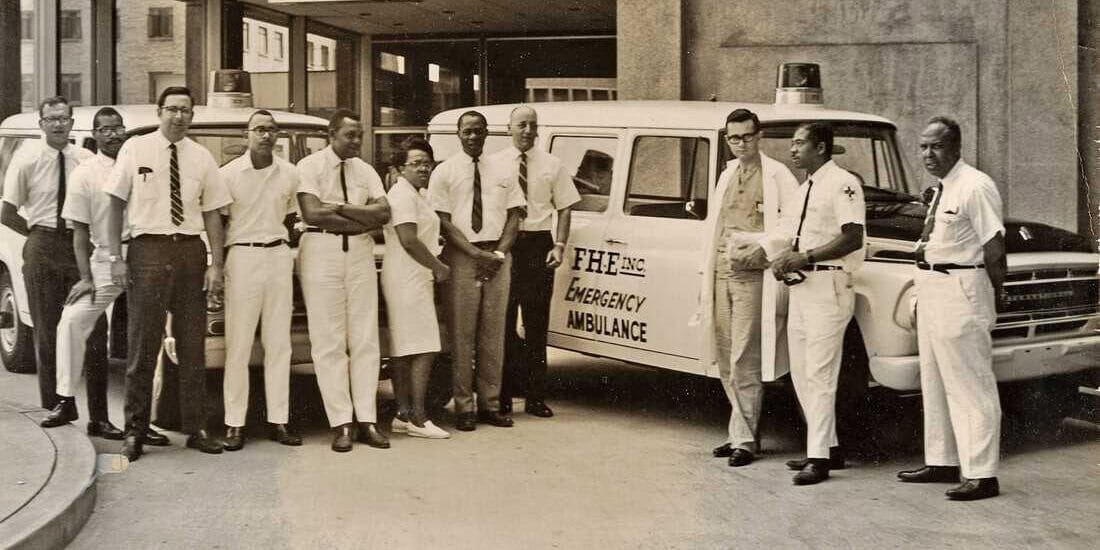
Before the invention of the modern ambulance system in the mid-1960s, you may have ridden to the hospital in a van staffed by volunteers or even the back of a police car. We can thank a group of Pittsburghese Vietnam War veterans for the fact that nowadays we’re taken care of by trained professionals in a special medical transport vehicle.
These veterans were part of the Freedom House Ambulance Service, created in 1967 specifically to solve the problem of Pittsburgh’s black residents needing to phone the police for medical assistance in a time of great racial tension. Trained by the “father of CPR,” Dr. Peter Safar, the first cohort consisted of 25 black enrollees—many of whom were chronically unemployed, had criminal records, or were Vietnam vets—who completed nine months of on-the-job training before they began running two secondhand ambulances donated by the city.
In its first year, Freedom House Ambulance Service transported more than 4,600 patients, handling an average of 15 calls per day. Before long, it was serving the entire city of Pittsburgh. These were the country’s very first “paramedics,” and they set the standard for the whole country. They basically invented the profession of being an EMT.
Unfortunately, the Freedom House Ambulance Service came to a crashing halt when the city decided to create its own, mostly white ambulance service in 1975. They stripped the Freedom House Ambulance service of its funding, and it closed on October 15th of that year.
Some in Congress, however, are now trying to give these men some much deserved recognition. In February of this year, a bill was introduced in the House to award the Freedom House Ambulance Service a Congressional Gold Medal “in recognition of its dedicated service to the Pittsburgh community and contributions to the field of emergency medical services.”