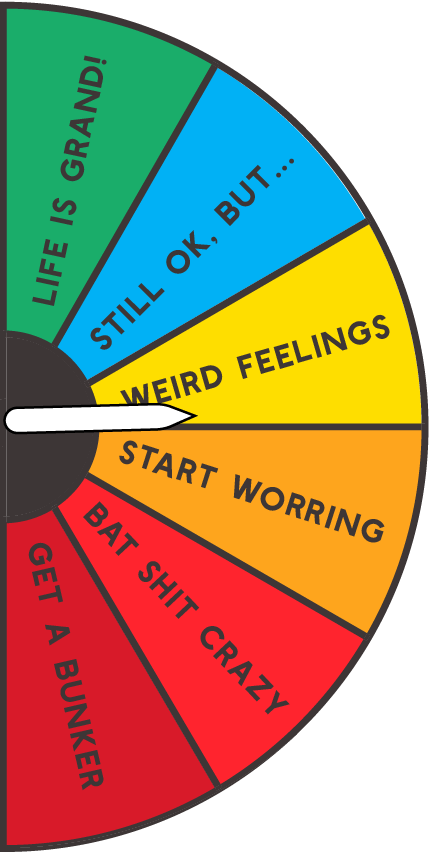
Volcanoes are erupting in The Philippines, but on-fire Australia received some welcome rain. The Iran war cries have been called off and The Donald’s military powers are about to be hamstrung by the Senate. Meanwhile, his impeachment trial is starting, and we’re all on Twitter for a front-row seat.

What Could Go Right? The Tide Turns for Sharks
The world’s most feared fish is finally getting serious protection.

Emma Varvaloucas
This is our weekly newsletter, What Could Go Right? Sign up here to receive it in your inbox every Thursday at 5am ET. You can read past issues here.
The Tide Turns for Sharks
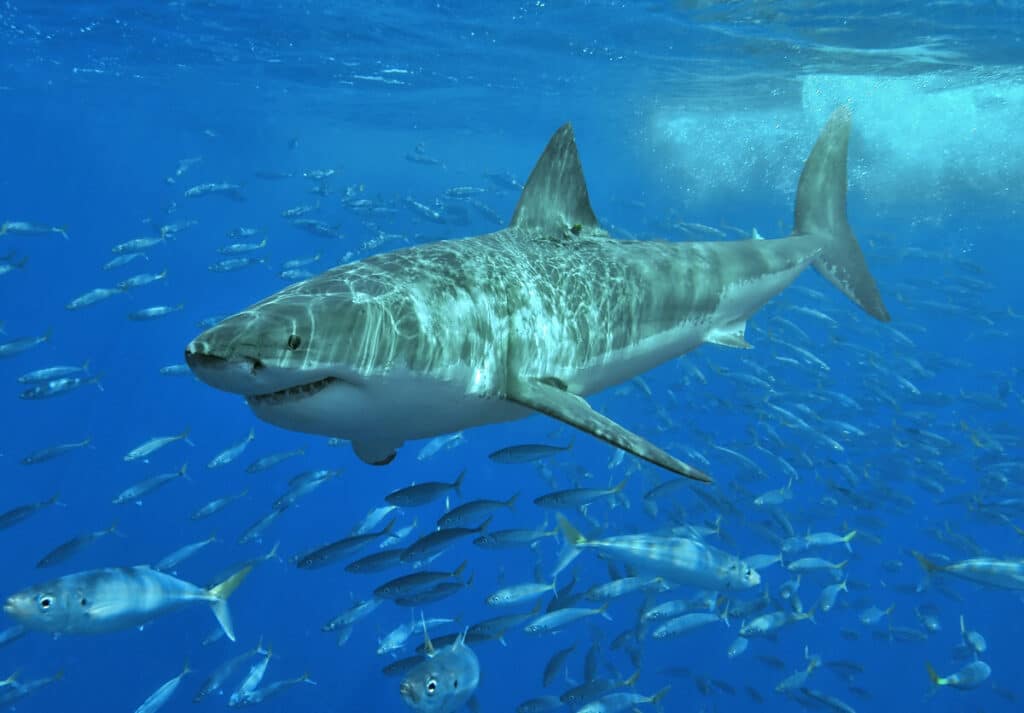
A century ago, fish scientists would have been surprised to hear that millions of people tune in every year for a week of adrenaline-packed entertainment about sharks. The prevailing attitude at that time, even among experts, was less “apex predator of the ocean” and more “harmless water-dweller”—at least when it came to humans.
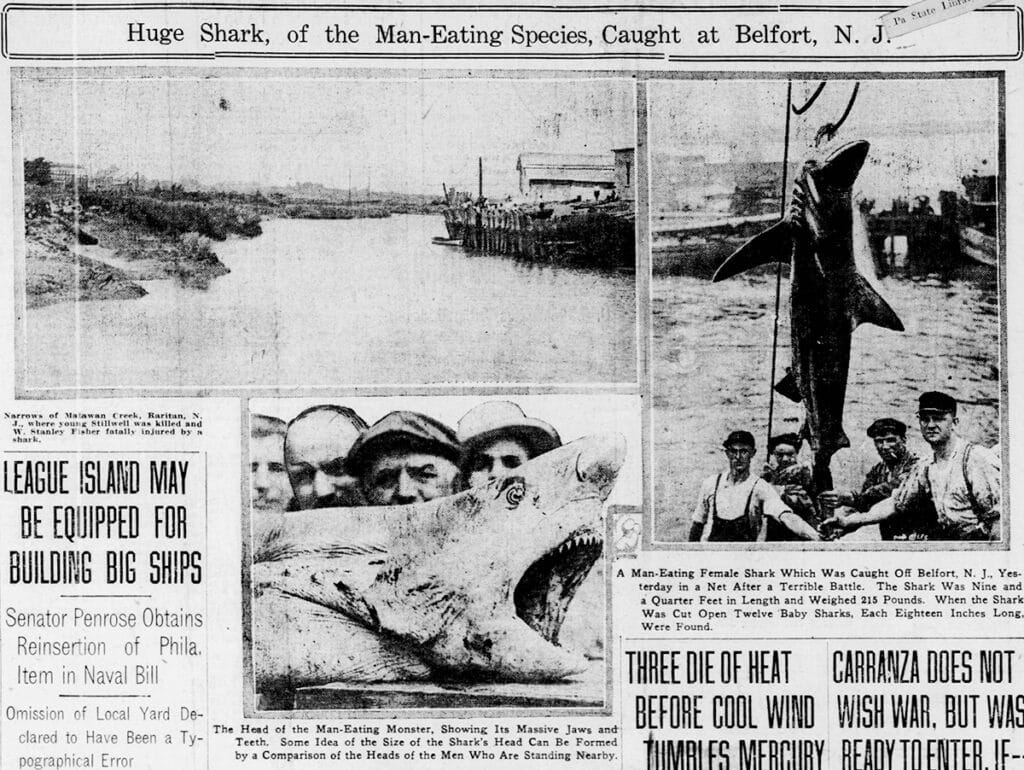
That all changed in the summer of 1916, when a series of shark attacks on the Jersey Shore killed four people and unleashed a frenzy to hunt down the “man-eaters.” Frightened tourists vanished from beaches and hundreds of sharks were killed as American culture first sank its teeth into the narrative of sharks as vicious slayers. The cultural trauma was so deep that the event would eventually inspire the 1975 blockbuster Jaws.
This perception of sharks lasted for decades. Even in the 1990s, when data first began emerging that sharks were being overfished to perilous levels, scientists were still concerned about “the Jaws problem” stymieing budding efforts to protect the animal. “The question is,” Juan Sabalones, then curator of fishes at the National Aquarium, told The Washington Post in 1997, “can we turn people’s fascination with sharks into respect—instead of a just kill them mentality?”
Save the Whales Sharks
The debate over whether Shark Week helps or hinders in this regard aside, there is evidence that the tide is turning toward a serious global effort to, well, save the sharks. The issue is urgent. Of the thousand-plus shark and ray species catalogued by the International Union for Conservation of Nature (IUCN), a third are at risk of extinction, largely due to the international demand for their fins.
Recent decades, however, have seen a sea change in regulation. Twenty years ago, writes Luke Warwick, director of shark and ray conservation for the Wildlife Conservation Society, CITES—the major international convention that regulates trade in endangered species, with 184 member countries—had nearly no rules governing shark or ray products.
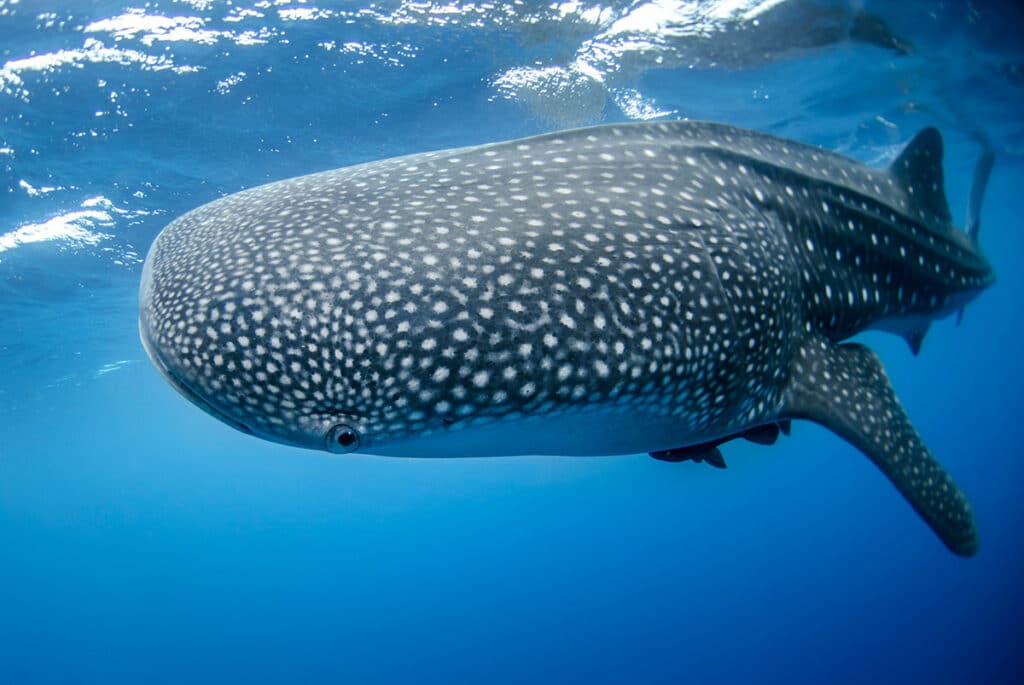
But today, CITES regulation covers 96% of all shark and ray species traded for their fins, and 70% of those for meat. Seventy of the 180 total species on the list were added just last year, when the convention also agreed to full commercial trade bans for all manta and devil rays, the oceanic white tip shark, and the whale shark, as well as what amounts to one for wedgefish and giant guitarfish—the first time it has enacted such strict measures for species that are regularly traded.
What’s more, explains Warwick, last year was also the first time that new marine species policies weren’t viewed as “highly controversial”; last year’s listings passed by a comfortable margin, a marked shift away from previous years in which just one or two votes meant the squeaking by of proposals. It’s a change he calls “hugely encouraging.”
Compliance, of course, remains a challenge, and varies country to country. In places that follow the rules, however, there is already evidence that tighter (legal) nets yield results: following a 2023 update to CITES, shark fin exports dropped 15% in the European Union between 2024 and 2025. The hope is that the most threatened sharks will follow the remarkable trajectory of green turtles, a trade ban for which was adopted in the 1980s. It was so successful that the IUCN reclassified the turtles from endangered to a species of least concern in 2025. (Now we just need Pixar to write a whale shark character—I’d argue that the gentle giants are just as chill as Crush and not at all as untrustworthy a friend as Bruce. Unless you’re krill, I suppose.)
It has already been demonstrated that with genuine protection, shark populations can be rebuilt. In the US, for example, the Atlantic blacktip shark is no longer considered overfished, after commercial quotas were introduced in the late 1990s, and sandbar sharks are on their way to recovery as well. Smaller projects involving local communities, from Brazil to Indonesia, are popping up around the world, and the idea that a live shark is a better economic proposition than a dead one is becoming increasingly apparent, particularly in island nations dependent on tourism. Since 2009, when Palau declared all the waters under its jurisdiction a sanctuary for sharks, triggering a “tsunami of conservation”—as one punny tour company describes it—16 other shark sanctuaries have been created, in the Maldives, Honduras, the Bahamas, and elsewhere. Just last month, Madagascar and Zanzibar announced full national protections for dozens of species of sharks and rays.
Swimming Like It’s . . . 1915
This is all far from a declaration of success. Sharks are highly migratory, which means that national policies can only do so much. As slow reproducers, they also require a long time for their numbers to rebound. Researchers are sounding the alarm that unless further action is taken within the next decade, some shark species will face extinction.
Still, attitudes have changed mightily from the times in which vigilantes roamed the waterways of New Jersey looking for child-snatching sharks—although in some ways, we’ve come full circle from one hundred years ago, when shark experts didn’t consider the animals to be a threat. The crucial difference is that now we have the knowledge to back that up.
The species behind the 1916 attacks was never identified, but some theorized that it was a great white. In the US, their population is likely increasing, and thanks to warmer waters caused by El Niño, great white sightings are reaching record highs this summer. But years of behavioral data collected by tagging and drones have scientists unconcerned about swimmers, surfers, and boaters sharing the water with these sharks—despite the plot of Jaws, they are uninterested in human snacks. Shark bites happen, of course, but they are extraordinarily rare. You’re more likely to die digging a hole in the sand.
Fun Facts About Sharks in Honor of Shark Week:
- Three new shark species were discovered in 2025—a catshark, houndshark, and lanternshark—as well as a new manta ray!
- Also last year, scientists learned that sharks deliberately produce sound. Rigs make a clicking sound by forcefully snapping their teeth together. In case this sounds scary, don’t worry. Rigs, also known as lemon fish, are very small, with flat teeth.
- A hot debate in animal behavioral science is whether or not sharks play with toys.
- Earlier this month, the largest great white shark ever tagged, aptly named Contender, was spotted off the coast of North Carolina.
—Emma Varvaloucas
What Could Go Right? S8 E16: Why the Economic Numbers Don’t Match How You Feel | with Mark Zandi

There is a massive chasm between what official data tells us about the financial landscape and how average Americans actually experience their daily lives. Mark Zandi, chief economist at Moody’s, joins Zachary Karabell to break down why this disconnect exists and how a skewing of income distribution means different classes are living in entirely separate realities. | Listen now
By the Numbers
500: New bacterial species discovered by the mapping of the Great Barrier Reef’s microbiome
48%: Drop in Beijing’s air pollution levels between 2010 and 2024, in part thanks to mass EV adoption
281M: Male chicks saved from culling globally by in-ovo sexing technology since 2021
52: Number of African countries that have improved their pandemic preparedness since Covid
Go Figure
India’s Cockroach Janta Party may have started out as something of a joke, but the increasingly powerful Gen Z political movement can now claim credit for causing the country’s education minister to resign. Youth activism in action, once again.
Quick Hits
📉 Global hunger declined on every continent last year, but nowhere faster than in South America, where it has fallen by one-third since 2020.
🎓 Graduation rates are soaring across the US Bureau of Indian Education, reaching a record high of 79% by 2025, the result of a curriculum shift to technical training and career readiness as well as better reporting.
🌍 An unexpected mix of factors has resulted in more water in the African Sahel than in decades. Some climate scientists are forecasting an agricultural renaissance in the region long associated with drought and famine.
🌲 The area burned in Brazil’s Amazon dropped significantly between 2024 and 2025, driven primarily by the lowest number of fires recorded in the rainforest in 41 years.
✒️ Maori facial tattoos are making a “jubilant comeback” in New Zealand after a colonial-era ban suppressed the Indigenous practice for a century. (NYT $)
🔋 Morocco has secured a $110 million loan to build Africa’s first EV battery factory. With the use of electric vehicles soaring across the continent, Morocco is hoping to become a hub for green technology manufacturing.
🚑 Dutch students have created the world’s first solar-powered ambulance, a prototype soon to be tested in rural Kenya. They hope commercial interest will scale up the invention.
🧂 Senegal’s “pink lake” has recovered its unique color after flooding in 2022 disrupted the natural conditions and devastated the local economy. Salt extraction and tourism can now resume.
📉 Homicide rates continue to fall across major American cities. If the post-pandemic trend continues, 2026 might see the lowest annual rate in over a century.
🧊 Scientists have lengthened the time that organs can be “kept on ice” to 72 hours via a hermetically sealed box. The test worked well on pig parts, and if the FDA plays ball, human tests are coming soon.
👁️ “A cochlear implant for vision” can restore some sight to those with age-related macular degeneration, enough to read books and see road signs clearly. The implant is already available in Europe, but not yet in the US.
🚨 Opioid settlement funds in Baltimore are bankrolling expanded services for 911 calls, which now include mobile crisis teams that can handle mental health and other non-police-related issues.
🦾 A new type of robotic mastectomy that better preserves skin and nipple sensation has been performed in the US for the first time outside of clinical trials. The required incision is smaller, too—the length of a paperclip.
👏 Two American species have been downlisted from endangered to threatened: the Hawaiian stilt, a long-legged waterbird, and the razorback sucker, a freshwater fish that lives in the Colorado basin.
💡 Editor’s pick: Regulatory bottlenecks might matter more than advanced intelligence when it comes to AI and the promise it holds for medicine.
TPN Member Originals
(Who are our Members? Get to know them.)
- Stop pathologizing ordinary life | NYT ($) | Clay Routledge
- What the world should learn from Australia’s social media law | Time | Jonathan Haidt
- Will you still have a job in 2030? | The Argument | Matthew Yglesias
- Looksmaxxing is repulsive | TFP ($) | Arthur Brooks
- Data center distortions | Faster, Please! | James Pethokoukis
- Washington DC’s democracy renovation hero | The Renovator | Danielle Allen
- Building digital public parks | Life with Machines | Baratunde Thurston
- New Jersey’s voter registration scandal | Tangle | Isaac Saul
- Place names change with time, and that’s OK | NYT ($) | John McWhorter