Volcanoes are erupting in The Philippines, but on-fire Australia received some welcome rain. The Iran war cries have been called off and The Donald’s military powers are about to be hamstrung by the Senate. Meanwhile, his impeachment trial is starting, and we’re all on Twitter for a front-row seat.

What Could Go Right? The Great American Crime Decline 2.0
We’re in the midst of one of the most successful public-safety moments in American history.

Emma Varvaloucas
This is our weekly newsletter, What Could Go Right? Sign up here to receive it in your inbox every Thursday at 5am ET. You can read past issues here.
The Great American Crime Decline 2.0

In early spring, the last time I wrote about the Great American Crime Decline 2.0—which is occurring right now—we were waiting on the FBI to confirm that 2025’s murder rate was at record low levels.
Well, the data is here, and it was: at 4.1 murders per 100,000 inhabitants, the FBI notes that 2025’s rate tied with 1955 and 1956 for the lowest ever recorded. It’s also the largest year-to-year decrease ever for murder and violent crime overall.
Some experts have quibbles about trusting FBI data from so far back; they’re fine with proclaiming the 2025 rate to be the lowest in American history, period. But any way you want to slice it, you’re living through some of the safest times the US has ever experienced. Congratulations!
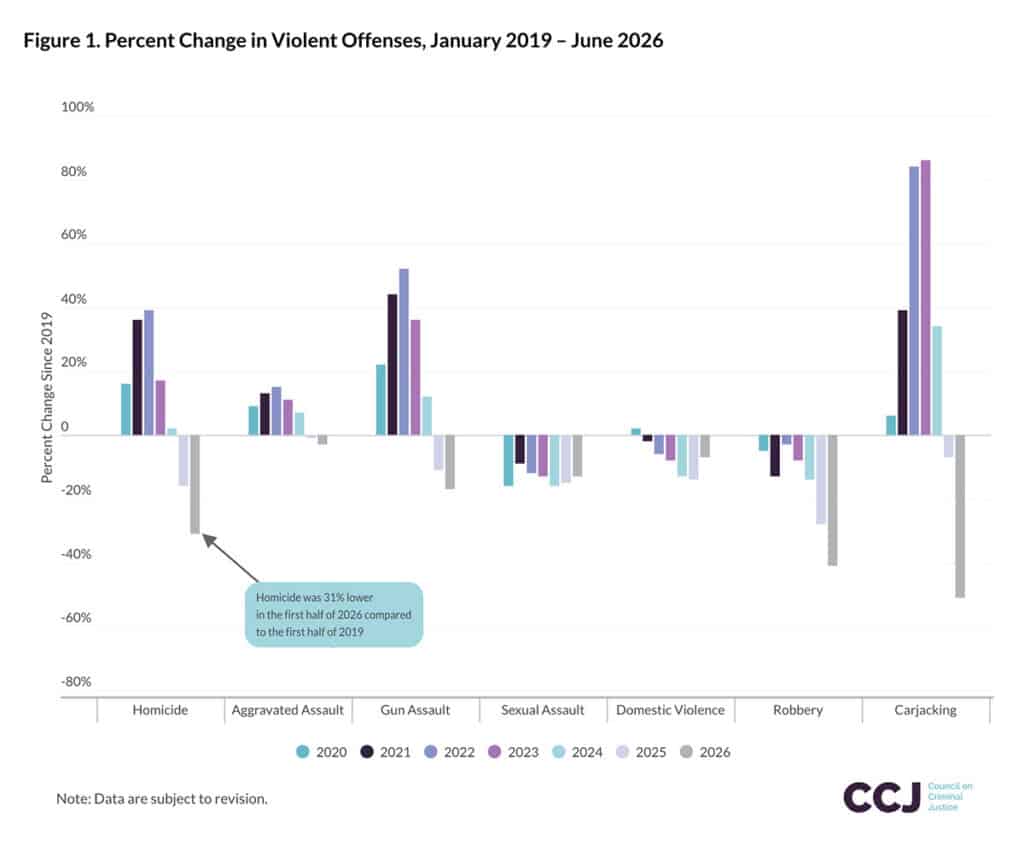
What’s more, two major reports—one representing police chiefs in America’s largest cities, the other from the Council on Criminal Justice (CCJ) that samples 36 major cities—show the decline continuing this year. And it far exceeds a “return to normal” after the pandemic-era crime spike. The CCJ one notes that compared to 2019, homicides are down 31%, and robbery, 41%. Carjackings have been cut in half, and aggravated, gun, and sexual assaults have all dropped as well.
In fact, criminologist Jeff Asher is forecasting that the 2026 murder rate “should come in at an astonishing 3 to 3.8 per 100k,” which would be the all-time lowest by a wide, wide margin, particularly gobsmacking given that the population has ballooned by more than 170 million since Leave It to Beaver was must-see TV. That kind of rate represents “about ten thousand fewer people murdered in 2026 than in 2020, 2021, and 2022,” Asher writes. “That’s an even larger drop in murder than occurred in the 1990s in an even shorter timeframe.”
Which, of course, raises the question of why. To explain the Great Decline, the right credits the increase in immigration officials and national guardsmen under Trump. The left points to funds released by the Biden administration that gave local governments the resources to rehire for critical positions such as police officers and social workers, and broaden violence prevention services.
Analysts, though, advise caution before leaping to conclusions. What’s driving the homicide drop is “about as clear as a glass of milk,” said CCJ President and CEO Adam Gelb. “Rates are falling in cities with very different public safety strategies, economic conditions, and political leadership.” Nor is the trend unique to the US—violent crime is also ebbing in Canada, and record low homicide rates are cropping up in places from London to Argentina.
Even if scholars can drill down to find an explanation, it will almost assuredly be a matter of multiple drivers. A webinar hosted by CCJ lists more than 40 potential factors, many of them falling outside neat partisan explanations—from smarter policing that targets local violent hotspots to real-time monitoring of social media to society’s move away from cash. (“The returns on mugging somebody have gone down,” quipped one expert on the call.) Even GLP-1s made the list; early research shows that they may curb violent impulses.
The “why” conversation will gain more urgency as time passes and we see if this dip can last. For the moment, however, we don’t need to look to decades past for a time when American streets were exceptionally safe. That time is now.
—Emma Varvaloucas
What Could Go Right? S8 E19: The AI Future Isn’t Inevitable. So Why Are We Told It Is? | With Carissa Véliz

In this episode, host Zachary Karabell is joined by Carissa Véliz, philosopher and author of Prophecy: Prediction, Power, and the Fight for the Future, from Ancient Oracles to AI. They discuss the ways tech executives and AI experts offer predictions for our society that are supposedly inevitable. But what if we refuse to accept these guesses as truth? What if leaning into ambiguity and our own vulnerability makes us better citizens and gives us a true chance to make a better world? | Listen now
By the Numbers
15%: National poverty rate in Laos as of 2024, down from nearly 25% in 2012
2,000+: Number of video gamers recruited and hired by the Federal Aviation Administration to fill a shortage of air traffic controllers
12: Number of states that have passed new gun safety laws this year
Go Figure
For those who wonder whether a flu shot is worth it, the numbers are in. During the unusually severe 2024–25 flu season, vaccination cut children’s and adults’ risk of being hospitalized with the sickness by 51% and 43%, respectively. It also reduced flu-related ER and urgent-care visits by roughly half. Not bad for something you can get while you’re picking up toothpaste.
Quick Hits
🚫 Lebanon has abolished the death penalty in a decisive break from the norms of the region. It is only the second Middle Eastern country and second Arab League member to do so.
🌾 The global food system is more resilient to this year’s “super” El Niño than to previous iterations of the weather event. Near-record inventories and improved technology—from better weather forecasting to drought-tolerant seeds—are “poised to cushion much of the fallout.”
💊 England is on track to be one of the first countries to eliminate hepatitis C. An NHS program has treated more than 100,000 people over the past decade.
📖 Saudi Arabia has been modernizing its school curriculum, introducing lessons that challenge intolerance and encourage compassion toward vulnerable groups such as migrant workers.
👸 Liechtenstein has ended male-only succession in favor of firstborn inheritance, opening the throne to women for the first time since the House of Liechtenstein was established in 1608.
🐦 Americans are becoming more wholesome. Fewer adults say that they gamble, and “grandma hobbies” like birdwatching and mahjong are exploding in popularity as a lonely population looks to connect.
🖼️ AI is the latest tool to invigorate the field of art provenance and repatriation—one recently built chatbot is even helping to locate art looted by the Nazis during WWII by streamlining archives into one easily searchable database.
🦧 Four notable animal conservation efforts: Once thought extinct, Caspian tigers are returning to Kazakhstan; a biodiversity hotspot in Papua New Guinea has received legal protection from logging; a reintroduction project has bolstered the population of wild orangutans in Sumatra; and Florida has announced the creation of a “coastal corridor” spanning much of the state.
🔬 And, three early-stage scientific developments: THC—the main psychoactive component of cannabis—reduces nightmares in people with PTSD; obesity drugs mitigate the symptoms of the hormonal disorder PMOS; and a new triple-dose regimen may permanently clear HIV in infected newborns, although it has yet to be tested in humans.
👀 What we’re watching: Bolivia has recognized its first same-sex marriage after a landmark court ruling. The decision doesn’t affect Bolivia’s legislative framework, which defines marriage as between a man and a woman, but opens the door to future legal challenges.
💡 Editor’s pick: We take so much of the progress around us for granted. Shake off that disregard with a digital tour of “ordinary abundance.”
TPN Member Originals
(Who are our Members? Get to know them.)
- How academia created Jason Arday | TFP ($) | John McWhorter
- AI’s water problem isn’t where you think | Life with Machines | Baratunde Thurston
- Here’s what middle powers can actually do | FP | Suzanne Nossel
- El-Sayed’s winning path in Michigan | NYT ($) | Thomas L. Friedman
- The $20 burrito tearing the Republican Party apart | Slow Boring | Matthew Yglesias
- Todd Blanche, the latest tool: How autocrats use personal lawyers | Lucid | Ruth Ben-Ghiat
- On liberalism and the 21st century | The Renovator | Danielle Allen
- We still want to gather. Gen Z is proving it. | Flourishing Friday | Clay Routledge
- How America’s retreat from foreign aid is changing the world | GZERO | Ian Bremmer
- The USS Abraham Lincoln shows the cost of endless war | WaPo ($) | Theodore R. Johnson
- A conservative case for liberal immigration | TFP ($) | Tyler Cowen
- The long shadow of the Iran shock | Foreign Affairs | Jason Bordoff
This Week in History

One hundred and twenty-nine years ago this week, the lab of British doctor Sir Ronald Ross was abuzz with trying to solve a longstanding mystery: How did people get malaria? On August 20, 1897, all the buzzing paid off, as Dr. Ross discovered the offending parasite in the stomach of a mosquito. Uncovering the disease’s method of transmission set the stage for its eventual management and treatment.
While malaria remains a serious global health threat, killing hundreds of thousands every year, we have made incredible strides in combatting it; the WHO says that 14 million deaths have been averted worldwide since 2000 alone. We still celebrate World Mosquito Day on August 20th to commemorate Dr. Ross’ achievement.
By the way, we should perhaps also commemorate the good doctor’s flair for the dramatic, not to mention good practical sense: On the day of the discovery, confused by a discrepancy he was seeing in his microscope, Dr. Ross yelled in frustration, “Dame Nature, you are a sorceress, but you don’t trick me so easily!” Then he took a nap.
It must have been rejuvenating, because upon waking, he made history.