
Volcanoes are erupting in The Philippines, but on-fire Australia received some welcome rain. The Iran war cries have been called off and The Donald’s military powers are about to be hamstrung by the Senate. Meanwhile, his impeachment trial is starting, and we’re all on Twitter for a front-row seat.

What Could Go Right? Everyone Should Know What’s Going On in India
67,000 people lifted out of extreme poverty every day, and other facts that will surprise you

Emma Varvaloucas
This is our weekly newsletter, What Could Go Right? Sign up here to receive it in your inbox every Thursday at 5am ET. You can read past issues here.
Everyone Should Know What’s Going On in India
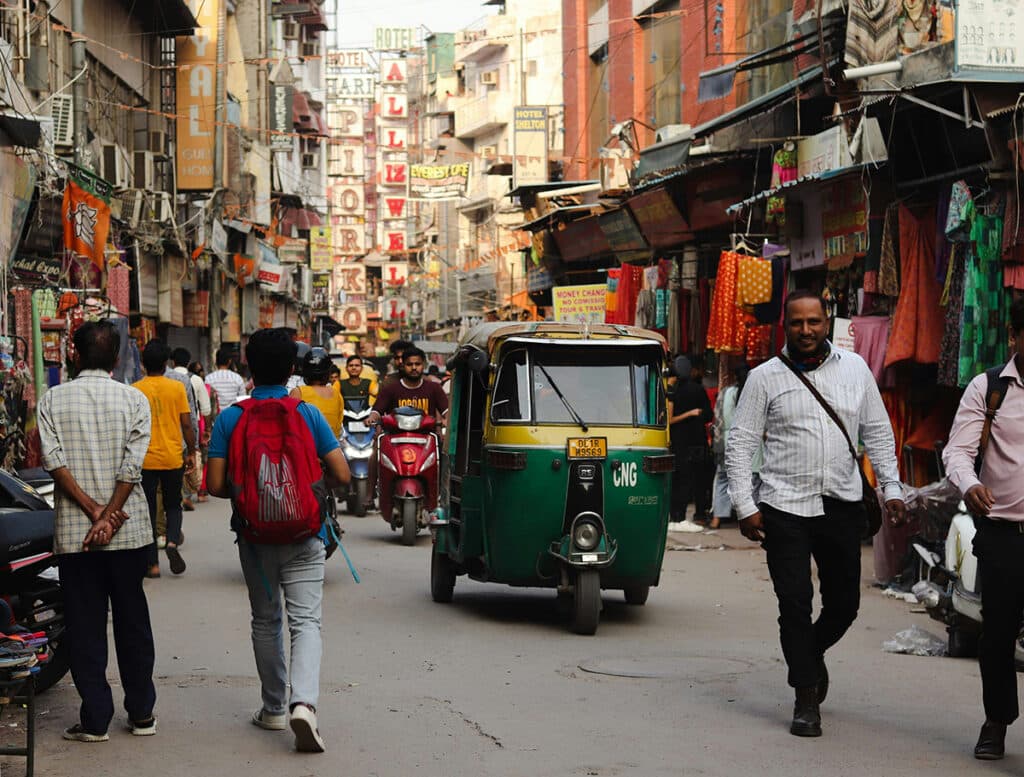
On Saturday, India will celebrate 79 years of independence. Over the decades, the gigantic country has defied a lot of Western pessimism—in the 1950s, for instance, about whether it could govern itself, or in the ’70s, about whether it could feed its people. Scholars put the debate over whether collapse was in the cards to bed only by the turn of the millennium.
But the India of today is not the India of 75, 25, or even 10 years ago, when hundreds of millions of its citizens still lived in extreme poverty or lacked access to toilets. Despite what podcasters—and presidents—past their expiry date have to say about it, today’s conversation is less about India’s shortcomings and more about how to qualify its successes: whether its economy is actually the fourth- or fifth-largest in the world, for instance, and how long until it is third.
One thing is for sure: that economy is definitely the fastest-growing in the world. And while India still has a ways to go, developmentally speaking, some recent statistics might surprise even those who have never heard of Michael Savage. Some Indian states, for example, now have an infant mortality rate that is lower than Ukraine’s and approaching the United States’—and that’s just a sliver of the inroads the country has made.
Many are familiar with China’s dramatic, rapid turn from poverty to prosperity. Fewer know India’s story—one slower and still unfolding, but no less historic. In honor of India’s Independence Day, here are some big-picture trends everyone should know:
India will likely be the first major economy to industrialize with solar.
To a one, the modern world’s major economies were built on the back of coal and oil. Industrializing without fossil fuels as the energy backbone? It wasn’t just not done—it wasn’t possible. Ten years ago, India, too, was determined to follow the black brick road to economic power. Now, it’s on track to be the first major economy to industrialize using solar energy.
The country is currently going through a massive solar boom. With an installed solar capacity that is already third in the world, it is adding more so fast that this summer, it overtook the US as the second-largest solar growth market, behind only China. Let me put how much solar power they are installing into perspective: In the 2025–26 fiscal year alone, India added 44 gigawatts of capacity. Imagine holding a sold-out game at every single professional sports stadium in the US simultaneously—then multiply the amount of power that would take by 10. That’s just barely 44 gigawatts.
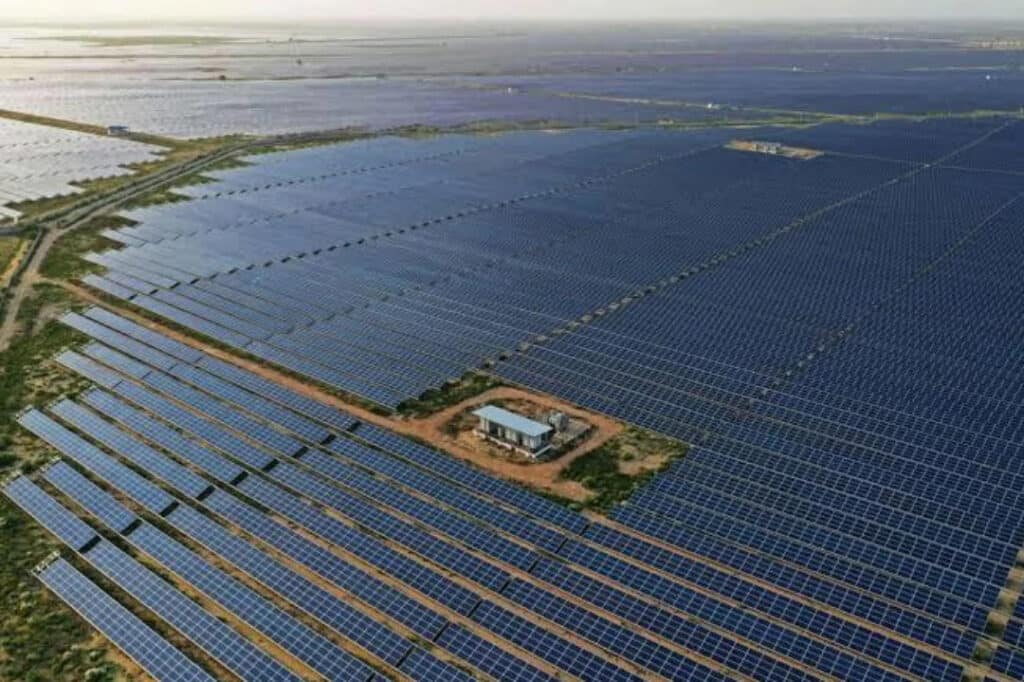
The future is not quite here; India’s grid remains heavily dependent on coal. But the International Energy Agency predicts that coal’s share of electricity production in the country will fall to 50% by 2035. What’s more, India’s path could provide a blueprint for other developing nations to follow.
Life has been transformed for India’s poorest.
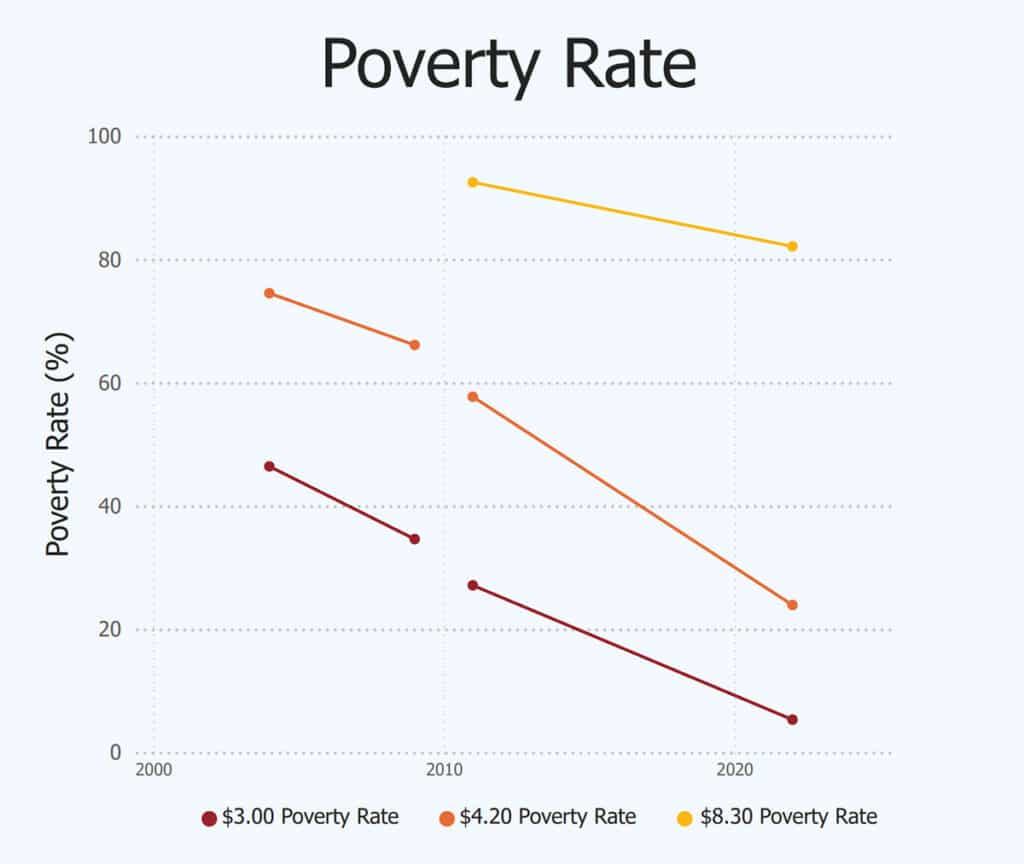
In 2011, over a quarter of India’s population—hundreds of millions of people—were living in extreme poverty (defined as surviving on less than $3 a day). In just a decade, that rate has collapsed; as of 2023, it stands at about 5%. That’s nearly 67,000 people lifted out of extreme poverty—every day.
That economic boost extends beyond India’s worst off. Over half the population used to live below the poverty line of $4.20 per day. Now less than a quarter do, and the percentage of those living on less than $8.30 has dropped as well.
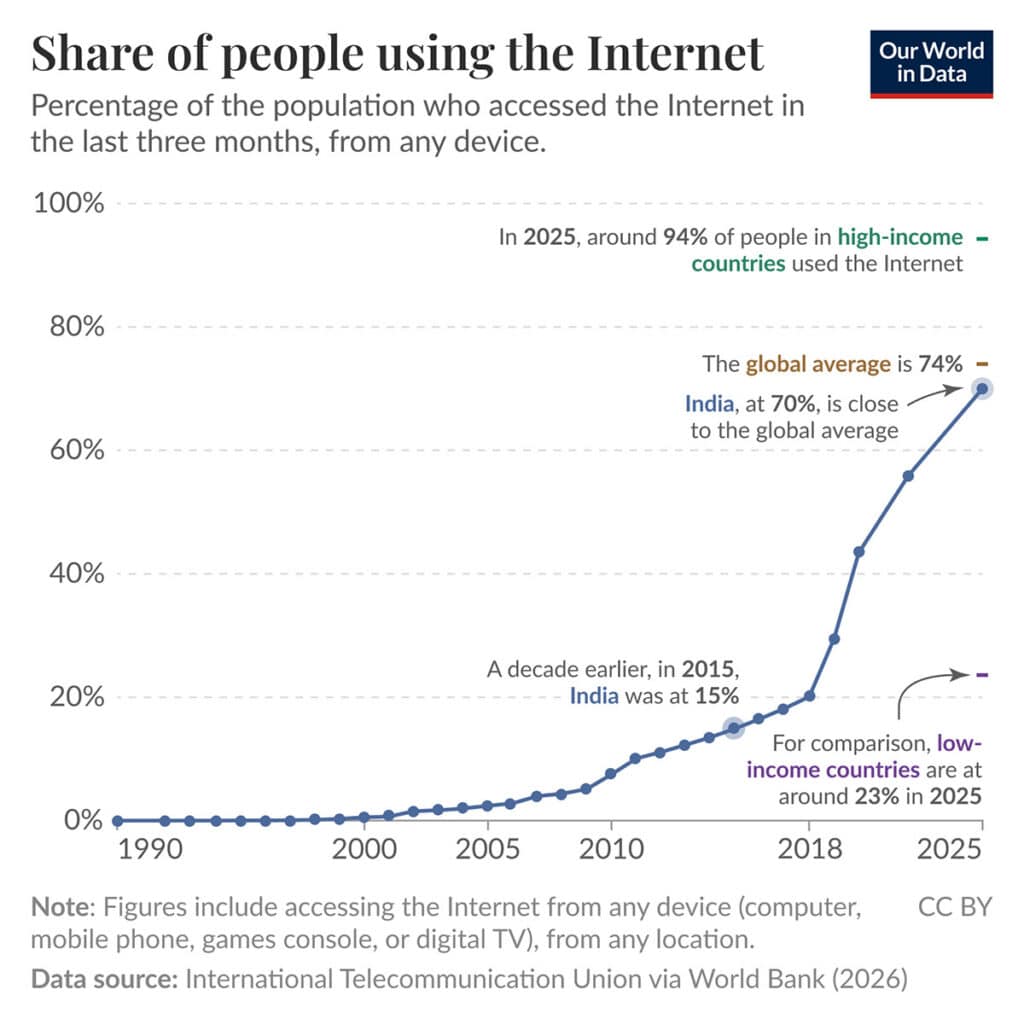
Families have been putting their new disposable income to good use: a working paper from the government’s economic advisory council found that Indians are increasingly affording things like cars, motorcycles, televisions, sports equipment, jewelry, kitchen appliances, and so on. It was vanishingly rare 10 years ago for a poor Indian family to own a refrigerator. Now there’s about a 50/50 chance they do. Basically everybody has a mobile phone, and Internet access has skyrocketed, an expansion largely due to the 2016 network launch of Indian telecom company Jio, which brought data prices down from about $2.60 per gigabyte to less than a penny today. Indians now enjoy internet that is among the cheapest in the world.
The government has also embarked on some absolutely massive infrastructure projects aimed at the rural poor. Perhaps the most impressive is the Jal Jeevan Mission, which in only seven years ballooned the percentage of rural households with tap water from 17 to 81. That percentage comprises as many households as exist in Germany and Spain combined.
India’s digital infrastructure is genuinely innovative.
Which country handles nearly half of the world’s real-time digital payments? India, of course, and the system that processes them all wasn’t built by a Silicon Valley company, but by the Indian government.
It’s called the Unified Payments Interface (UPI), and it makes it easy to, say, charge for a chai to-go or split the drinks bill. The difference between it and any digital payment system you’re likely familiar with, though, is that it’s open source and completely free. It’s a public good, not a private enterprise; anyone can build on it, so you don’t need the same app, phone, or bank—or an agreement between a tech company and a bank—to move money.
UPI is obviously convenient, but when combined with the country’s biometric ID system, Aadhaar, it’s actually a crucial reason why India has been able to make its government programs count. Those falling poverty rates didn’t come out of nowhere. In the past decade, India has increased welfare payments 16-fold, yet the government has actually saved billions, because it can now route payments directly to Aadhaar-linked bank accounts. Goodbye, leakages and payroll ghosts.
All of this digital infrastructure has even helped kickstart the country’s campaign toward universal healthcare:
India still has plenty to get on with. For one, its zoomers are deeply unhappy with their economic prospects, recently taking to the streets in a show of their dissatisfaction. While India has managed to retain its democracy, the current administration, on top of stifling press freedom and harassing minorities, has intensely polarized the public (doesn’t this all sound familiar?). It’s still a lower-middle income country with a low rank on the United Nations Development Index—even things aimed at improving it, such as the Jal Jeevan project, have come under criticism because local authorities have let newly installed pipes immediately fall into disrepair. And India, like many other countries, isn’t immune to pressure coming from one particular toupee in the West: unhappy that UPI bypasses credit card giants like Visa and Mastercard, President Trump seems to have convinced India’s parliament to introduce a bill allowing small fees on the platform.
But still, credit is due where credit is due. These trends, working together, have already created an upward spiral that has uplifted the nation’s billion-plus citizens. It’s no wonder that talk of an “Indian century” has become mainstream.
—Emma Varvaloucas
What Could Go Right? S8 E18: How Haters Can Accidentally Make You Happier | with Ronda Rousey

The concept of the American Dream calls up images of enormous money and fame that most of us will never see. But what happens to someone who actually becomes mega famous? Is it truly something to strive for? Is the cost worth it? Ronda Rousey, the superstar MMA fighter turned graphic novelist, joins Zachary Karabell to explain her approach to creativity, life, and happiness that rejects our traditional metrics for success. | Listen now
By the Numbers
3,682: Number of wild tigers in India, which has more than doubled since 1972
42%: Decrease in new HIV infections worldwide since 2010
13%: Decrease in US energy consumption per capita since 1975
Go Figure
New York City is on track to record the fewest reported rat sightings since the pandemic, with a 22% drop through July of 2026 compared to the same period a year ago. Credit a push started by former Mayor Eric Adams in 2022, involving the installation of large on-street trash bins. Turns out, when you close the buffet, the guests stay away.
Quick Hits
✊ An American citizens’ army has submitted tens of thousands of photos to an archival signage projectbefore the originals can be removed by the Trump administration at national parks and historic sites.
🫨 A recent earthquake strong enough to kill hundreds or thousands resulted in only 38 deaths in Japan, which for the past decade has been making a serious effort to improve its earthquake preparedness.
🦠 The Food and Drug Administration has approved the first-ever mRNA flu vaccine, a remarkable decision given that the agency refused to even review the same application a year ago.
🏥 Take a peek into the world’s first seahorse hospital, which is fighting to prevent the fish’s potential extinction. Seahorses are in high demand for use in traditional Asian medicine.
🧬 Scientists have completed the second complete genome of a vocal learner: the zebra finch, a songbird. (The first was human.) Now, the hunt is on to find the molecule that converts a non-vocal learning species to a vocal one.
💩 How about a poop pill to cure a peanut allergy? The first “proof of concept” that the treatment could be viable—not to mention one day reduce or eliminate food allergies entirely—is here.
💉 The UK is testing a compound that could make many vaccines “fridge free,” eliminating a major cause of vaccine waste and making their transportation considerably less difficult.
🥬 A key meat protein has been grown in lettuce for the first time. As a result, not only could vegetarians one day get their protein from lettuce itself, but protein harvested off the plant might also improve the flavor of imitation meat.
🚫 As a greyhound racing ban takes effect in New Zealand, more than a thousand dogs will hang up their vests and be retired and rehomed.
👀 What we’re watching: Criminologist Jeff Asher predicts that the 2026 US murder rate won’t just be the lowest ever recorded; it could be “more than 20% lower than the previous lowest rate.”
💡 Editor’s pick: Veterinarians treat horses, snakes, and your pet guinea pig—and now, honeybees.
TPN Member Originals
(Who are our Members? Get to know them.)
- Will socialism make you happy? | TFP ($) | Arthur Brooks
- How to bridge the divide between working-class and college-educated voters | EAC | Joan C. Williams
- The Michigan primaries | Tangle | Isaac Saul
- What Black voters really think of the DSA | WaPo ($) | Theodore R. Johnson
- Republicans are in too little disarray | Slow Boring | Matthew Yglesias
- “Let the robots fight”: Ukraine as a laboratory of warfare | Lucid | Ruth Ben-Ghiat
- America abandoned its ‘unremarkable’ young men | NYT ($) | Scott Galloway
- Ordinary people, extraordinary times | The Preamble | Sharon McMahon
- A deep dive on data centers | Faster, Please! | James Pethokoukis