Volcanoes are erupting in The Philippines, but on-fire Australia received some welcome rain. The Iran war cries have been called off and The Donald’s military powers are about to be hamstrung by the Senate. Meanwhile, his impeachment trial is starting, and we’re all on Twitter for a front-row seat.

What Could Go Right? College Is Getting . . . Cheaper?
After decades of rising prices, public universities are quietly bending the cost curve.

Emma Varvaloucas
This is our weekly newsletter, What Could Go Right? Sign up here to receive it in your inbox every Thursday at 5am ET. You can read past issues here.
College Is Getting . . . Cheaper?
It’s back-to-school season, and so the perfect time to discuss a topic Americans love to loathe: college prices. Gen Z hates them so much that many are giving up on attending entirely. And who can blame them? Add in the anxiety over AI’s effects on employment prospects, and it’s unlikely the questions about whether a college degree is still worth it will be stopping anytime soon.
That said, contrary to the popular narrative that the cost of college has been on an unstoppable trip upward, it has actually stabilized and even declined in recent years. By no means is that to suggest college is cheap—after accounting for inflation, public and private nonprofit institutions alike are roughly 1.5 times more expensive than they were in the 1990s. But over the past decade, according to research from the College Board, inflation-adjusted tuition and fees have dropped by 10% and 7% for in-state two- and four-year public students, respectively. They’ve increased by 2% at private nonprofit institutions.
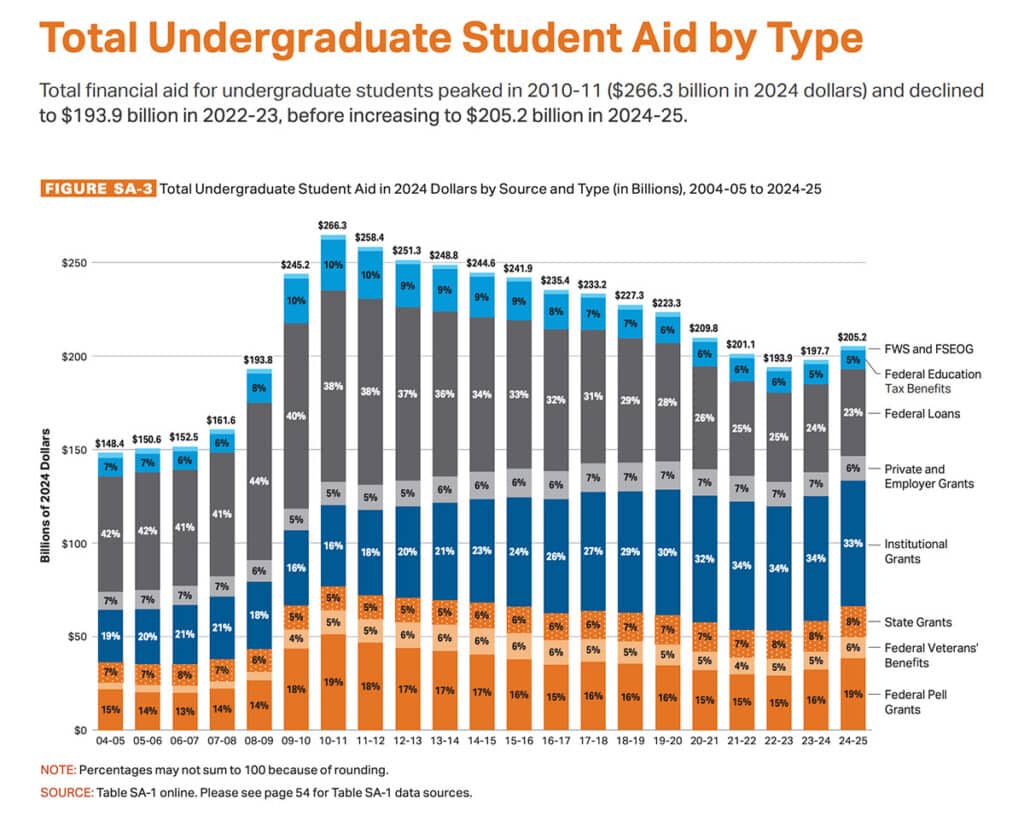
The picture is more positive when you look at costs after grant aid—money students will never have to pay back. Two-year public students have been receiving enough grant aid to completely cover tuition and fees since 2010. What four-year public students pay peaked in 2013, and private students, 2007. (This doesn’t factor in living expenses, however, which add a pretty penny to the total cost of attending.)
This despite the fact that, excepting a recent change to Pell Grant eligibility that expanded access to an additional 610,000 low-income students, federal help has been shrinking for years. What has steadied the price rise is more local: States are contributing a record amount to student aid. And colleges themselves have taken over an increasing amount of the burden.
Make it into some of the nation’s top schools, and you’ll find some extraordinarily generous programs. Princeton, for instance, covers the full cost of attendance for students from families making up to $150,000 per year. Or you could try Berea College, which has been tuition-free since 1892. Of course, class sizes in the Ivies and schools like them are tiny, and these types of institutions are generally more concerned with selectivity than they are with providing genuinely broad access to education. For progress on that front, you have to look to public universities.
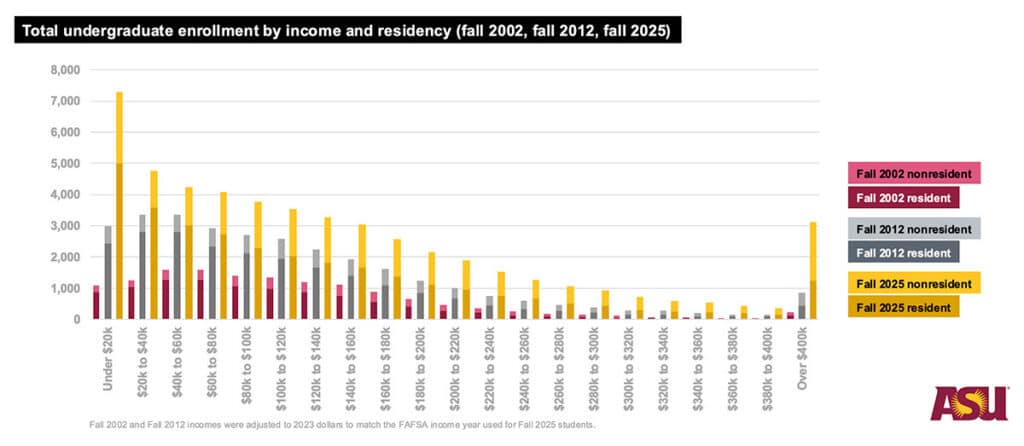
One of those shining cities upon the higher education hill is Arizona State University (ASU)—a longtime partner of The Progress Network—whose commitment to affordable, inclusive education is perhaps unmatched in scale in the United States. ASU enrolls more Pell Grant recipients than any other public university in America. More than one in three undergraduates there are first-generation college students, in part because the university has been making a serious effort to reach the country’s least well-off: In 2002, about 1,000 ASU students came from families earning under $20,000 a year. Today, more than 7,000 do. Institutional aid has more than doubled over the past decade, and the university also runs tuition-free programs for Starbucks employees and Uber drivers.
Meanwhile, public flagship universities have begun experimenting with Princeton-like models. In 2026, the University of Michigan began offering free tuition to students from families earning up to $125,000 per year. This fall, Texas A&M will do the same for families earning up to $100,000. Virginia and a dozen other states are even considering shortening their bachelor’s degrees programs to three years, in response to affordability concerns.
Public universities, in fact, overwhelmingly make up the top tier of think tank Third Way’s Economic Mobility Index, a measure of how well colleges uplift low-income students—including ASU, two University of Michigan campuses, and Texas A&M-Texarkana.
It goes without saying that the country still has a long way to go in addressing issues of affordability and value, one of the focuses of a new Department of Education strategy unveiled last month. Progress Network member and Harvard professor Danielle Allen is absolutely right when she writes that “for the most part, selective higher education remains stuck in the paradigm of the 1990s and early 2000s, when universities competed in ‘top global university’ rankings, rapidly raised tuition to shift subsidies from wealthy to poor kids, and stuck middle-class kids with a chronic affordability problem.” Public universities, however, are showing that there’s a different road forward.
—Emma Varvaloucas
What Could Go Right? S8 E20: Social Media Is Making Politics Feel Worse Than It Really Is | With David Pakman

Podcaster David Pakman joins host Zachary Karabell to discuss his new book, Pay Attention, coming out on September 22. They dive into the missed messaging opportunities for the left, the ongoing culture wars that lend themselves to clickbait headlines, and strategies to expand the progressive political tent within the limitations of the American two-party system. David offers his perspective on building an audience while protecting his values and integrity, and why the future of American political discourse might actually be brighter than the headlines suggest. | Listen now
By the Numbers
0.04%: Malaria prevalence in Zanzibar, down from 40% two decades ago
500K: Number of residential solar batteries now installed in Australia
100: Years since an otter was last spotted in New York City’s Bronx River—one was captured on camera in June, a sign of returning ecological health
Go Figure
Seventeen out of twenty-three. That’s how many shifts an employee at Andon Market in San Francisco was late for without getting fired. The forgiving boss: an AI agent named Luna. Luna, who ignored the disciplinary policy she’d written, only let the employee go after prompting from her human overseers, in what’s believed to be the first AI firing of a human. Worse, when she sought a replacement, all 21 test runs recommended an applicant whose résumé included 15-plus employers and unverifiable references, and who missed an interview. HR 1, AI 0.
Quick Hits
💉 An mRNA vaccine customized to a patient’s tumors has cleared a late-stage trial for the first time. If the data holds up, this vaccine—which prevents melanoma recurrence—could be the first mRNA-based cancer treatment to be approved.
🚘 The Gulf oil shock has electric car sales booming in some unexpected places. They’ve quintupled in South Africa, for instance, and doubled in Colombia. Globally, battery-powered and hybrid vehicles will account for 29% of new cars sold this year, up from 4% in 2020. (NYT $)
🌲 Forest regrowth and falling levels of deforestation are behind a “steep drop” in land-use emissions since 2015. Land-use emissions, which have been falling since the 1990s, refers to the carbon released when forests or peatlands are degraded.
🫁 The lungs of children living in London’s Ultra Low Emission Zone showed remarkable recovery in a large study, the first major evidence that local clean-air zones could mitigate pollution’s harmful effects on children.
👓 An AI-assisted app integrated with smartphones and glasses allows blind users to “see” by describing their surroundings. It was developed by a blind man who learned how to code from YouTube.
🦈 Scientists believe that they are coming closer to discovering where whale sharks mate and give birth, after a baby whale shark was spotted in Indonesia. Only a few dozen babies of this endangered species have ever been documented by science.
🏳️🌈 Canada has ended its restrictions on gay and bisexual sperm donors, a discriminatory practice rendered unnecessary by accurate HIV testing.
🐍 A 15-foot python named Jodie Foster is the first snake in the world to receive electrochemotherapy, a pioneering cancer treatment only recently routinely used in humans.
📱 “Fairphones”—sustainably built, repairable smartphones—are now available in the US, finally giving consumers an option beyond one-year warranties and expensive repair services.
👀 What we’re watching: Harvard neurobiologists grew a mini brain that kept maturing for more than five years. Studying it may yield insights into various brain diseases.
💡 Editor’s pick: Brazil is working on growing sweet potatoes and chickpeas . . . in space.
TPN Member Originals
(Who are our Members? Get to know them.)
- The invisible faction that dominates the Democratic Party | Slow Boring | Matthew Yglesias
- The new physics of power | NYT ($) | Thomas L. Friedman
- Beware the Facebook parents’ group | TFP ($) | Arthur Brooks
- The Renovator’s first birthday | The Renovator | Danielle Allen
- Twilight for Putin | Diane Francis | Diane Francis
- Trump’s accidental gift to the world | The Edgy Optimist | Zachary Karabell
- The least bad way to regulate AI | TFP ($) | Tyler Cowen
This Week in History: The Baltic Way
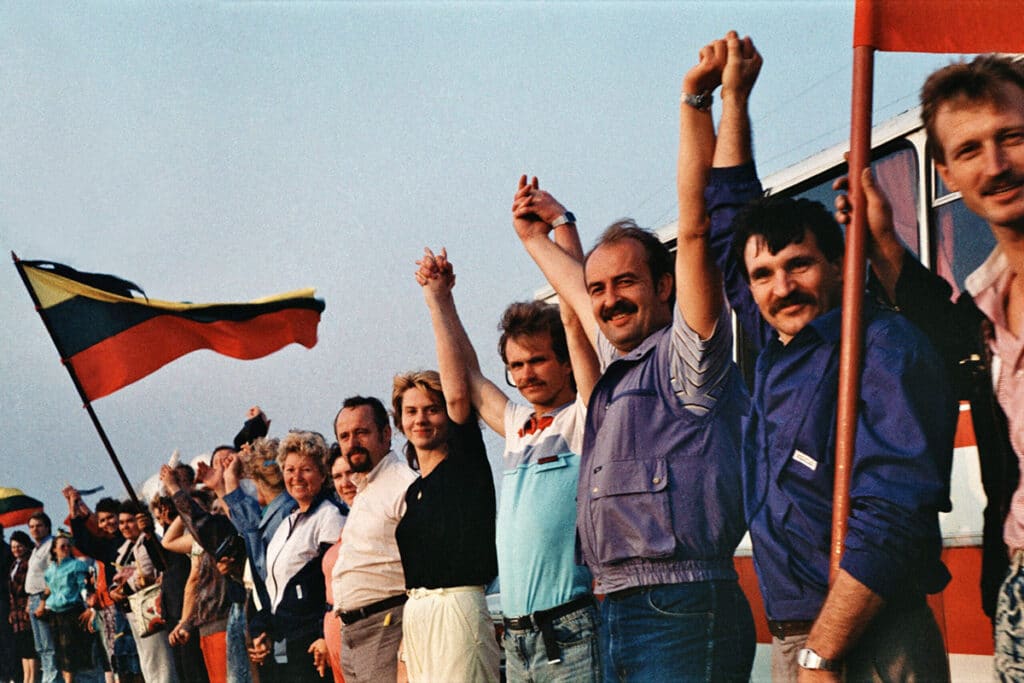
The next time your kid plays Red Rover, spare a thought for the longest human chain ever created, a two million strong demonstration that stretched 370 miles across Estonia, Lithuania, and Latvia.
It was August 23, 1989, and the Baltics had been under Soviet control since World War II, when the Molotov-Ribbentrop Pact handed over Poland, Lithuania, Latvia, Estonia, Finland, and part of Romania in exchange for a non-aggression promise from Nazi Germany. (So much for that; the Nazis attacked, anyway.)
After decades of organizing for freedom, Baltic activists hit upon a way to bring global attention to their cause—the Baltic Way, as the event is now known. Seven months later, Lithuania won its independence, and by 1991, Latvia and Estonia had as well. The giant, peaceful protest may not have accomplished that on its own, but it was a stunning display of collective action, and what it can do.