Volcanoes are erupting in The Philippines, but on-fire Australia received some welcome rain. The Iran war cries have been called off and The Donald’s military powers are about to be hamstrung by the Senate. Meanwhile, his impeachment trial is starting, and we’re all on Twitter for a front-row seat.

What Could Go Right? “Too Big to Rig”
American voters had enough.

Emma Varvaloucas
This is our weekly newsletter, What Could Go Right? Sign up here to receive it in your inbox every Thursday at 5am ET. You can read past issues here.
“Too Big to Rig”
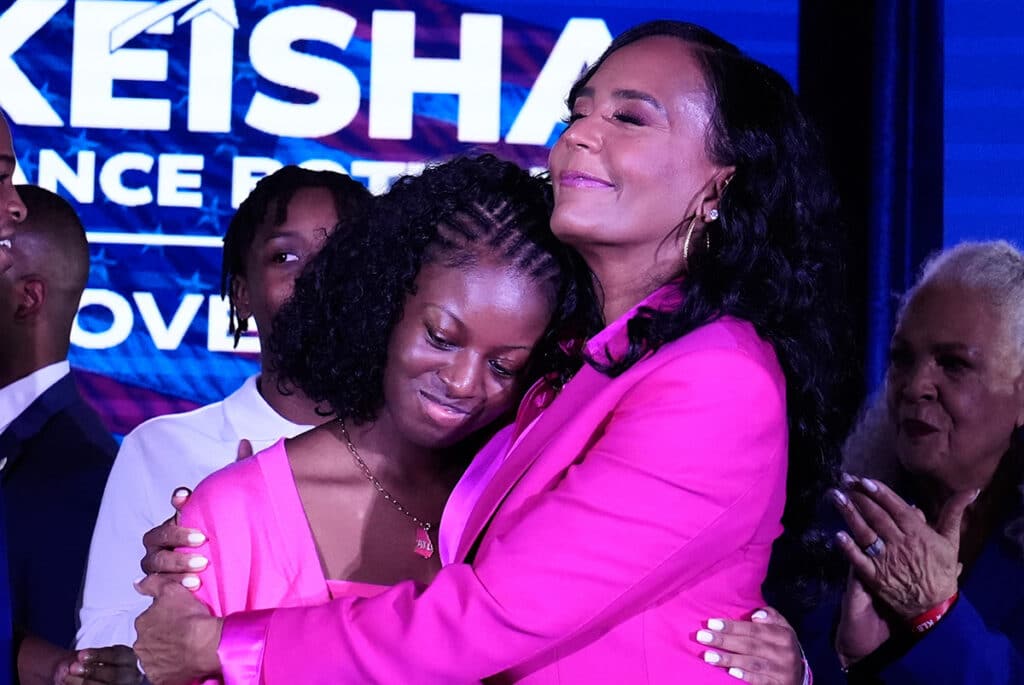
Serbia, Brazil, and now the US. The 10-day period of four massively consequential elections around the world has ended. Barring Israel, where a government has yet to be formed, pro-democratic forces have delivered a rout.
In the States, the “blunami” that overtook the nation on Tuesday was so total that it left little wiggle room for contestation: President Donald Trump has accepted the results, and says he’s looking forward to working with the Democrats. As surprising as it may seem, significant—even bipartisan—legislation may be on the horizon.
Another plus is that as Trump’s luster is fading, so too is the fad of election denialism. The Atlantic reports that fewer election deniers ran for office this year than in the previous midterm election, and those that did are “downplaying their election skepticism.” Losing candidates quickly conceded defeat, and by and large, despite fears of government interference, midterm voting went smoothly. Thank federal court decisions that kept Trump administration petitions at bay, as well as proactivity at the state level to prepare for all contingencies.
It seems too much to wish for after the decade the country has just passed through, but perhaps upending legitimate elections will soon no longer be in vogue.
It’s the turnout, stupid
As I’ve covered in previous newsletters, repeatedly, surging voter turnout has been the key to reversing authoritarian drift in countries around the globe. The US was no exception: these midterms set a record, with total voters currently surpassing 124 million. (For context, the 2018 midterms brought out about 122 million voters, which at the time was the highest turnout since 1978.)
Political pundits and common sense tell us that it was the economy—the high prices that the Iran war and Trump tariffs only elevated—not democratic concerns, that brought Americans in such numbers to the polls. But the two are intertwined. Authoritarian-ish leaders overreach when they believe themselves to be invincible, and choices made divorced from the wellbeing of their constituents eventually come back to haunt them.
Such was the case in Hungary’s election this spring, when Viktor Orbán was voted out after 16 years as prime minister. There, not even a massive propaganda campaign could dull the pain of the economic mismanagement and government corruption that had manifested in Hungarians’ everyday lives. Trump first came to power promising economic prosperity and an end to war. That voters repudiated him for delivering the opposite may be a move colored by self-interest. But it is also a sign of democratic health.
Let’s hear it for the boys historic representation
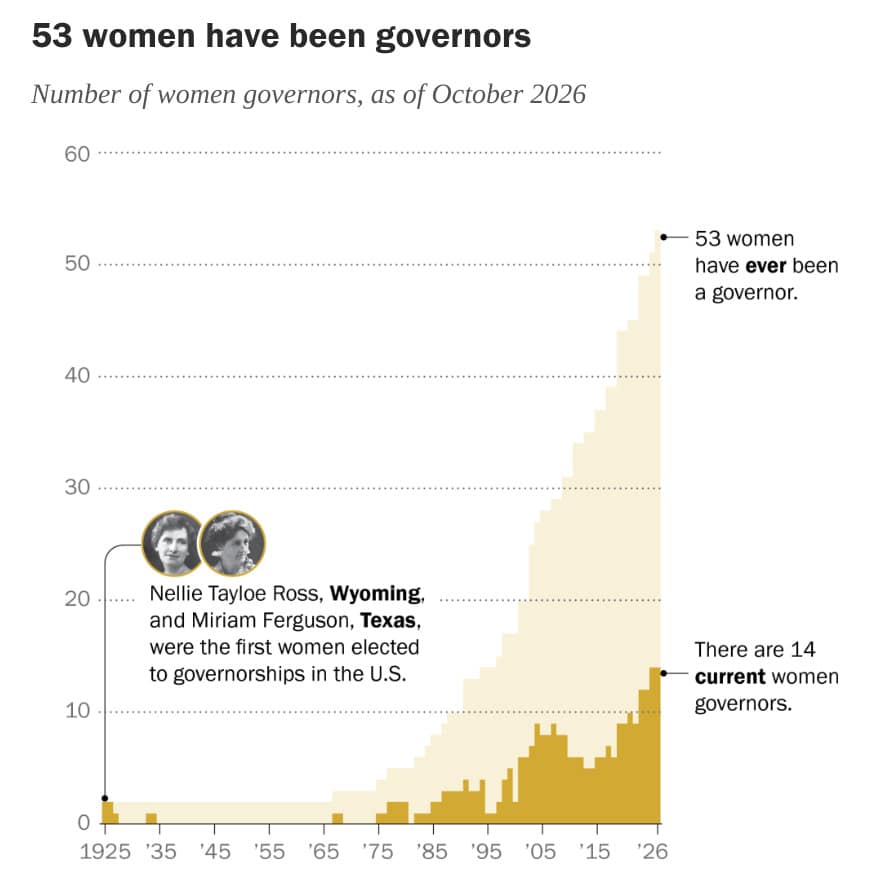
Race and gender is no guide to how well a politician will serve. Still, every time I see historical figures—such as the number of women who have ever been governor in all of US history—I am re-convinced that yes, it is important to note a tableau of elected officials that is becoming increasingly diverse. It’s a portent of a future in which that diversity will eventually be unremarkable, in a nation mere decades away from when it was impossible. (See This Week in History, below.)
That gubernatorial number is 53, by the way, and zero if you’re counting Black or Native American women. But after this week, in which the US voted in a record number of female governors—17 in all, including nine first-timers—we can update the total to 62. That, of course, includes Georgia’s Keisha Lance Bottoms, the first Black female governor, and New Mexico’s Deb Haaland, the first Native American female governor, in US history.
Meanwhile, Michigan’s Abdul El-Sayed will be the first Muslim to serve in the Senate; Minnesota’s Penny Flanagan the first Native American woman; and New Hampshire’s Chris Pappas the first openly gay man. Illinois will be the first state with two women of color in the Senate, now that Juliana Stratton has won her race.
Gina Hinojosa will be Texas’ first Latina governor, Xavier Becerra California’s first Latino governor, and Aaron Ford Nevada’s first Black governor.
New York’s Hakeem Jeffries is set to be the first Black speaker of the House. And last but not least, Melat Kiros will be not only Colorado’s first Black woman in Congress, but also the first Gen Z woman in Congress, period. In fact, journalist Jessica Yellin reports that the newly elected officials “will lower the average age in Congress by about a decade.”
—Emma Varvaloucas
By the Numbers
149M: People now reached by off-grid solar, up 26% from 2023
178: Countries where girls’ health improved between 2000 and 2023
28: US states in which doulas are covered by Medicaid, up from two in 2020
~1.2M: Size, in acres, of a new national park in Australia meant to protect koalas and their habitat
Go Figure
Here’s one way to leave the world a little better than you found it: In Redditch, England, excess heat from a crematorium has been warming a public swimming pool since 2013, saving tens of thousands of pounds per year in energy costs. Now, a crematorium in Scotland will soon supply half the heating needs of a new school, while another in Finland will feed into a heating network serving more than 6,500 homes. The technology captures heat that would otherwise escape into the atmosphere, reducing energy consumption and emissions.
Quick Hits
🪐 Everyone knows that there are nine eight planets in our solar system, plus Pluto, a dwarf planet . . . right? Wrong! There are actually five dwarf planets, plus a just-discovered potential sixth that had been hiding out in the Milky Way.
🏺 More than a million mostly looted antiquities and cultural objects were returned to their countries of origin between 1950 and 2025, a new report shows. The number of repatriation cases has surged since 2020.
🌏 In the largest documented effort of its kind, some 623 million acres across 149 countries are currently under restoration, an area of land and sea roughly the size of Kazakhstan. The restoration has also created more than one million jobs.
🧠 Recent findings confirm that the adult human brain can form new neurons, a topic of decades-long debate that holds massive potential for conditions such as Alzheimer’s or stroke if scientists can harness the process.
🖼️ Artificial intelligence is the newest tool helping the Italian police track down artwork. The custom-built system detects stolen pieces more quickly, spotting details invisible to the human eye.
🦠 Long COVID is not nearly as common or long-lasting as previously reported. A new study of 245 million US patient records found that effects of other conditions were often misattributed to COVID-19.
📱 Greece has passed a social media ban for kids under 15, becoming the latest country to institute such an age restriction.
🌾 Ukraine is projected to produce its largest wheat harvest since the war began, a record national yield that spells good news for some of the world’s poorest countries, which are reliant on it.
🚫 Mink farming will end in Denmark by August 2029, a dramatic turnaround for a country that was once the world’s largest producer of mink fur, and had, until recently, sought an exemption to an EU-wide ban on the practice.
🔬 Those with the ultra-rare condition FOP (fibrodysplasia ossificans progressiva) finally have an effective treatment. In FOP, muscle, tendons, and connective tissue slowly turn into bone. A new drug reduces the abnormal formation by 90%.
💉 The US FDA has approved a generic version of lenacapavir, a one-of-a-kind, twice-yearly injectable drug that is nearly perfect at preventing HIV. The generic will soon allow 120 low- and middle-income countries to receive affordable, rapid access to the medication.
👀 What we’re watching: The technologies that could rid the planet of “forever chemicals.”
💡 Editor’s pick: Who built the fastest internet in America? Not Comcast or Verizon, but the city of Chattanooga, Tennessee.
TPN Member Originals
(Who are our Members? Get to know them.)
- Why the machine always fights back | Danielle Allen
- The real lesson of the Stanford Prison Experiment ($) | Arthur Brooks
- The working-class win-o-meter | Joan C. Williams
- What America is living without ($) | Alissa Quart
- This viral gaffe is just one reason candidates won’t debate ($) | Theodore R. Johnson
- Machado returns to Venezuela—but when will democracy? | Ian Bremmer
- Progress in health care innovation is good news ($) | Zachary Karabell
- Is radicalism the answer? ($) | David Brooks
- US-China relations will never be the same in the age of AI ($) | Thomas L. Friedman
- What men want | Richard Reeves
- Criminal: Reckoning at the ballot box | Scott Galloway
- No matter who wins the midterms, economics will lose ($) | Tyler Cowen
- Europe under pressure, with Polish Foreign Minister Radoslaw Sikorski | Ian Bremmer
This Week in History: The Freedom Vote
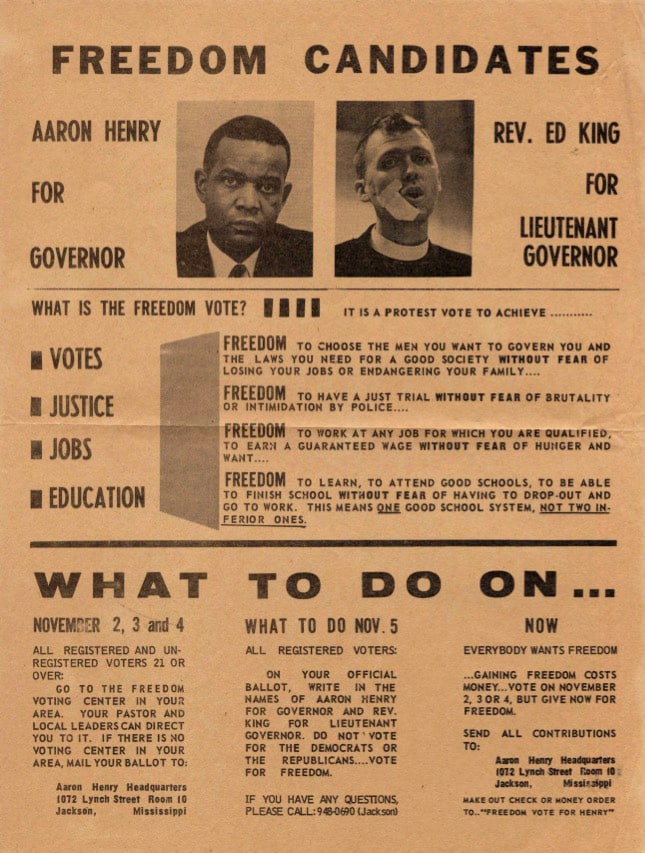
Sixty-three years ago this week, Mississippi was gearing up for its gubernatorial election. Black voters were less than enthused by it: The race was between a white supremacist Republican and a white supremacist Democrat.
For their part, the candidates were unconcerned. Of the 425,000 Black Mississippians eligible to vote, only about 20,000 had been allowed to register in the face of physical violence and other suppression tactics. Meanwhile, the state’s two senators frequently alleged that Black Mississippians “weren’t ready to vote,” reports JSTOR.
Civil activists set out to prove the contrary. They organized the Freedom Vote, a mock election organized for a few days prior to the actual election on November 5. If successful, it would show that black voters would exercise the right to vote if they could do so without intimidation or discrimination.
The organizers got their wish. About 83,000 Black Mississippians turned up at the “polls” in the Freedom Vote, laying the foundation for “Black-led, state-wide, political organization,” as Student Nonviolent Coordinating Committee Chairman John Lewis recalled.
Four years later, Mississippi elected its first Black lawmaker since Reconstruction, Robert G. Clark, to the state legislature. Today, if Scott Colom wins his race, he will be the first Black Senator from Mississippi since Blanche Bruce was elected in 1874.